Entities Explained Like You’re 5: How Google and AI Actually Understand Content
If you’ve ever wondered why some brands keep showing up everywhere—Google search, AI answers, featured snippets, chatbots—while others quietly disappear…
This blog is for you.
We’re going to talk about entities. Slowly. Simply. No jargon Olympics.
Think of this as the version of SEO you’d explain to a 5-year-old—except it also happens to be how AI-powered search actually works.
Let’s start with the basics: what is an entity?
Imagine you’re teaching a child what a dog is.
You don’t say: “D-O-G.”
You say: “A dog is an animal. It barks. It has four legs. It’s friends with humans.”
That idea of a dog—not the letters—is the entity.
In SEO terms:
An entity is a real thing that a machine can understand clearly.
It can be:
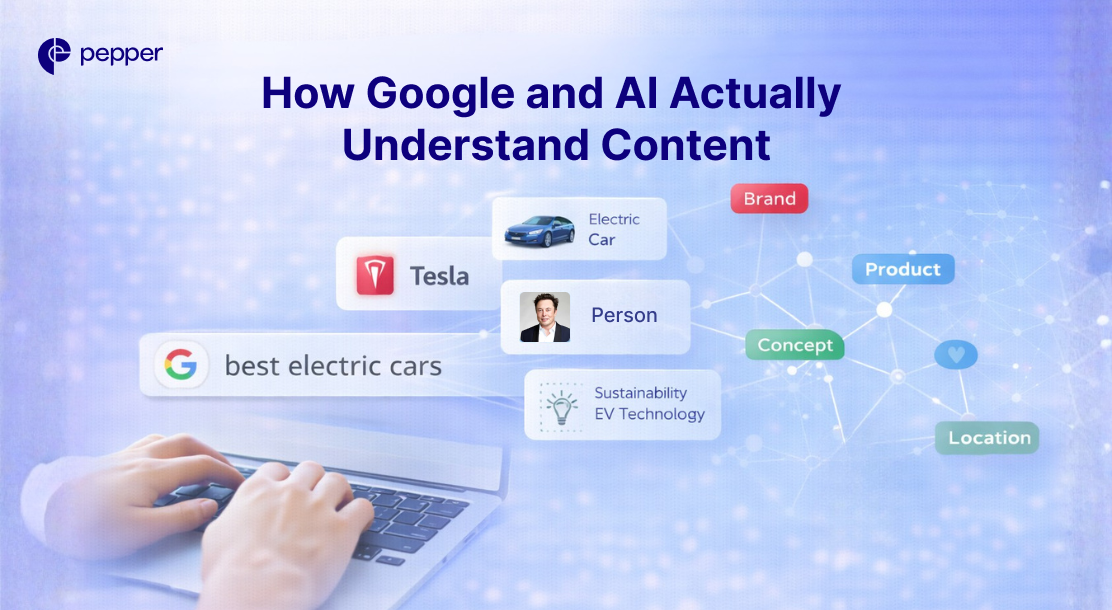
- A person (Elon Musk)
- A company (Pepper)
- A place (San Francisco)
- A concept (SEO, Artificial Intelligence)
- A product (iPhone)
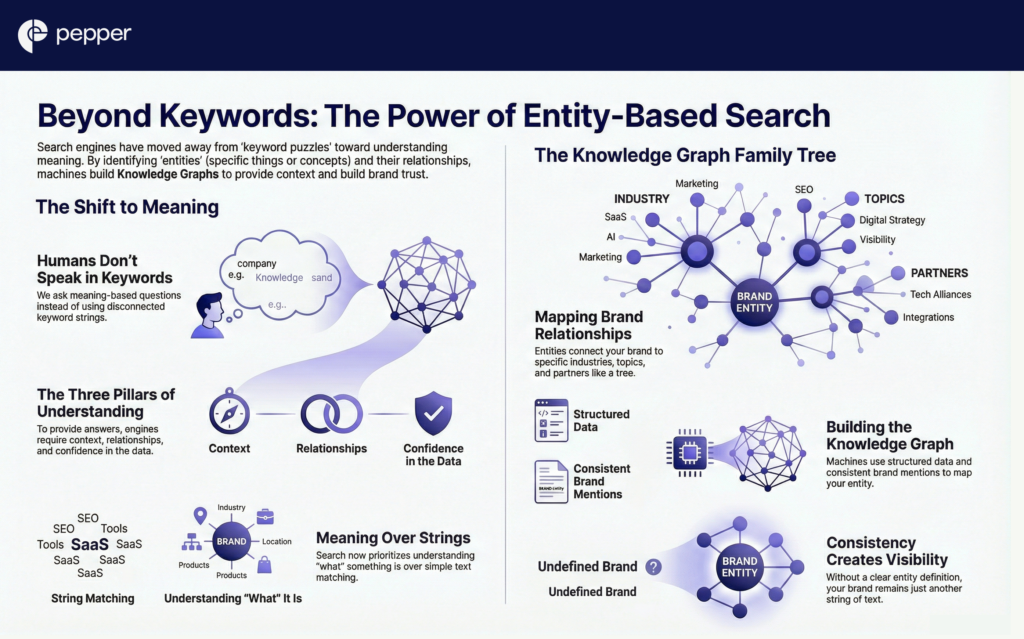
Search engines don’t just read words anymore. They try to understand things.
So… how is an entity different from a keyword?
This is the most important part.
Keywords are strings
👉 “best SEO agency Bay Area”
Entities are meanings
👉 A company that provides SEO services, located in the Bay Area, trusted by businesses
| Remember: A keyword can change. The entity stays the same. |
That’s why:
- You can rephrase a question
- Ask it in a different way
- Or ask an AI assistant instead of Google
…and still get the same answer.
Because machines aren’t matching words anymore. They’re matching entities and relationships.

Why search engines moved from keywords to entities
Because humans don’t talk in keywords.
We say things like:
- “Who should I trust for SEO?”
- “What tool helps with AI visibility?”
- “Which company understands GEO properly?”
These are meaning-based questions, not keyword puzzles. To answer them, search engines (and LLMs) need:
- Context
- Relationships
- Confidence about who or what something is
That’s exactly what entities provide.
A simple way to picture entities
Think of the internet like a giant family tree.
- Pepper → is a → content & SEO company
- Pepper → works with → B2B SaaS brands
- Pepper → talks about → SEO, GEO, AI visibility
- SEO → is related to → search engines
- AI Overviews → are part of → Google search
Each connection strengthens understanding. This web of connections is what machines trust.
Where do entities “live”?
Mostly in knowledge graphs.
A knowledge graph is basically: “Everything the machine knows about a thing—and how it connects to other things.”
Search engines build these graphs using:
- Websites
- Structured data
- Wikipedia-like sources
- Brand mentions
- Consistent explanations across the web
If your brand isn’t clearly defined as an entity, you’re just another string of text floating around.
Why entities matter more in the AI era
This is where it gets interesting.
AI systems don’t “search” the way humans do.
They:
- Retrieve entities
- Compare relationships
- Choose the most confident source to cite
That’s why:
- AI Overviews
- ChatGPT-style answers
- Perplexity citations
…often pull from brands that explain things clearly, not just rank for keywords.
| Entities are how AI decides: Who is credible Who is relevant Who gets quoted |
How entities help you get cited by LLMs
LLMs love content that:
- Defines things cleanly
- Uses simple explanations
- Connects concepts naturally
- Repeats the same meaning in multiple ways
That’s why conversational, navigational content wins. Not because it’s fluffy. But because it’s machine-legible and human-readable at the same time.
Signs your brand isn’t an entity yet
Quick self-check:
- Your brand shows up inconsistently online
- Different pages describe you differently
- You rank for keywords, but don’t get cited by AI
- AI tools mention competitors but skip you
That usually means: The machine doesn’t fully understand who you are.

How to start building entity strength (without overthinking it)
Talk like a human. But be consistent.
Do more of this:
✅ Clear “who we are” explanations
✅ Simple definitions of what you do
✅ Topic clusters that stay on one theme
✅ Internal links that reinforce meaning
Do less of this:
❌ Keyword stuffing
❌ Vague positioning
❌ Copy written only for ranking, not understanding
Think: Would a smart 5-year-old get this? If yes, AI probably will too.
Why Pepper cares so much about entities
Because SEO is no longer about avoiding penalties or chasing rankings.
It’s about:
- Being understood
- Being trusted
- Being referenced
Entities are the bridge between human conversation and machine understanding. That’s where modern SEO, GEO, and AI visibility meet.

The big takeaway
Keywords help you get found. Entities help you get chosen. In a world of AI answers, that difference matters more than ever.
If you’re building content for the next version of search, start thinking less like a keyword tool and more like a human explaining something to a curious child.
That’s where entities quietly do their best work.
Latest Blogs
This blog focuses on 12 of India’s top content writing services.
According to the Content Marketing Institute, one of the most effective ways to promote a business is via good content. At least half of all marketers either are or are planning to use content to reach their customers.
Get your hands on the latest news!

Similar Posts
Digital Marketing
3 mins read
When, Where, And How To Use Primary Keywords And Secondary Keywords
Artificial Intelligence
3 mins read
What Is Anchor Text?
Organic Marketing
2 mins read