AEO vs GEO vs AIO vs LLMO: The Alphabet Soup Explained
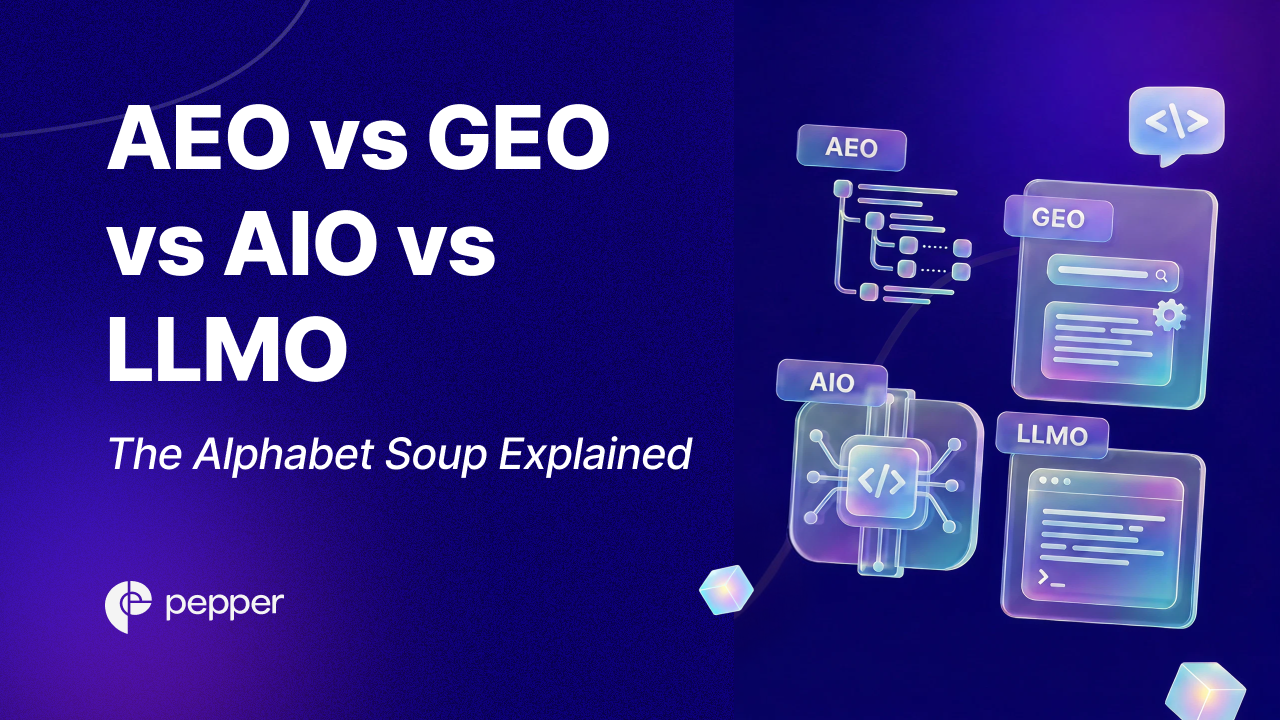
“SEO is not dead. It’s just that now it’s Search Everywhere Optimization: GEO, AEO, LLMO, AI Search, ecommerce search, all of it.” – Pepper
TL;DR
Four terms are dominating every marketing conversation right now: AEO, GEO, AIO, and LLMO. They are not the same thing. They’re not interchangeable. And confusing them is costing brands real visibility. This article defines each one clearly, maps where it came from, and shows you exactly how they relate to each other and to your content strategy.
In This Guide
This article covers everything you need to cut through the AI search terminology chaos, clearly, quickly, and without the jargon:
- Why the Alphabet Soup Exists
- AEO Explained (Answer Engine Optimisation)
- GEO Explained (Generative Engine Optimisation)
- AIO Explained (AI Overview Optimisation)
- LLMO Explained (Large Language Model Optimisation)
- How They Relate (The Hierarchy)
- AEO vs GEO vs AIO vs LLMO: Comparison Table
- What This Means for Your Strategy (4 Key Implications)
Why Everyone’s Confused (And Why It Matters)
Four acronyms walked into a marketing meeting. Nobody could agree on what any of them meant.
If you’ve sat through a content or SEO strategy session recently and heard GEO, AEO, AIO, and LLMO used almost interchangeably, you’re not alone. The industry is moving faster than its own vocabulary. New search surfaces are emerging, old frameworks are breaking, and everyone is coining terminology to describe what’s happening.
The result? A fog of acronyms that means different things to different people, depending on who coined it, which platform they’re optimising for, and when they learned the term.
Here’s the problem with that fog: if you don’t know which surface you’re optimising for, you can’t measure success on it.
At Pepper, we’ve been working to cut through this. We coined the term Search Everywhere Optimisation at Index ’25, the world’s first GEO conference to describe exactly this: the reality that search now happens across Google, ChatGPT, Perplexity, Gemini, Copilot, voice assistants, and more. Each surface has its own logic. Each acronym in this article maps to one layer of that larger framework.
Let’s break them down, one at a time, in plain language.
The Four Terms, Defined
1. AEO – Answer Engine Optimisation
Definition Block: AEO (Answer Engine Optimisation) is the practice of structuring your content so that it directly answers specific questions, making it eligible to appear in featured snippets, voice search results, and “position zero” on search engines. The goal is to be the answer, not just a result.
Where it came from: AEO predates AI chat by several years. It grew out of the featured snippet era, when Google started pulling direct answers from web pages to display above organic results. Marketers realised that the page Google chose to answer a question wasn’t always the highest-ranking one. It was the most answer-shaped one.
What it targets: Google’s featured snippets, voice search (Siri, Alexa, Google Assistant), and structured Q&A formats on traditional search engines.
What it looks like in practice: FAQ sections, concise definition blocks, numbered lists that directly answer a “how” or “what” question, schema markup on Q&A content.
The core question it asks: Is your content structured to be extracted and read aloud as an answer?
AEO is the oldest of the four terms and arguably the most underused. Most brands publish content to rank. AEO says rank isn’t enough. You need to be the answer.
2. GEO – Generative Engine Optimisation
Definition Block: GEO (Generative Engine Optimisation) is the practice of optimising digital content so that it is retrieved and cited by AI language models, such as ChatGPT, Google Gemini, Perplexity, and Microsoft Copilot, when generating answers to user queries. GEO is to AI search what SEO is to Google search.
Where it came from: The term gained academic traction through a Princeton and Georgia Tech research paper in 2023, which studied how content could be structured to improve its chances of being cited in AI-generated responses. Pepper adopted and operationalised it for enterprise brands, building an entire methodology and a platform (Atlas) around it.
What it targets: ChatGPT, Perplexity, Google Gemini, Microsoft Copilot, Claude, and any interface powered by a large language model.
What it looks like in practice: Structured, chunked content with clear H2s and H3s; short, declarative sentences; definition blocks; original data points; FAQ schema; DefinedTerm schema markup; llms.txt files; strong author attribution.
The core question it asks: Would an LLM cite this page when answering a query in your category?
GEO is where the largest opportunity sits right now. According to Pepper’s research, the traditional SEO ranking signals that once dominated, such as backlinks and on-page keyword density, carry far less weight with LLMs, which prioritise different signals entirely.
What actually drives GEO performance: authoritative lists, reviews and ratings, customer examples, and directory presence. The algorithm is completely different.
Myth vs. Reality:
- Myth: If you rank #1 on Google, you’ll also appear in AI search.
- Reality: A brand ranked #4–7 across multiple related queries can score higher in LLM recommendations than the brand that owns position #1 on one query. LLMs use a Reciprocal Rank Fusion (RRF) scoring model. As a result, the breadth of topical presence matters more than a single dominant ranking.
Reciprocal Rank Fusion (RRF) is a method for combining rankings from multiple retrieval systems into a single, unified list. It works by scoring each result based on its position across different ranked lists, giving higher weight to items that rank well consistently rather than those that top just one list. The result is a more reliable ranking that reduces the bias of any single retrieval method.
3. AIO – AI Overview Optimisation
Definition Block: AIO (AI Overview Optimisation) refers specifically to optimising content to appear in Google’s AI Overviews, the AI-generated summary blocks that appear at the top of Google Search results pages. AIO is a subset of GEO, focused exclusively on Google’s search interface.
Where it came from: Google launched AI Overviews (formerly called SGE, Search Generative Experience) as a core feature of Google Search in 2024. Marketers needed a term to describe the specific practice of optimising for this surface, separate from broader GEO work.
What it targets: Google Search only, specifically the AI-generated summary that appears above organic results.
What it looks like in practice: Content that directly answers the query in the first 50 words; FAQ schema; clear heading structure; BreadcrumbList schema; pages that already rank well on Google (AI Overviews tend to pull from top-ranked, trusted domains); E-E-A-T signals.
The core question it asks: Does your content give Google’s AI enough structured, trustworthy content to summarise as an overview?
The key distinction: AIO is a Google-specific tactic. GEO is platform-agnostic.
If someone on your team says “we’re doing AIO,” they’re talking about one search surface. If they say “we’re doing GEO,” they should mean the full landscape: ChatGPT, Perplexity, Gemini, Copilot, and more. Conflating the two means you’re likely leaving most of the AI search opportunity untouched.
4. LLMO – Large Language Model Optimisation
Definition Block: LLMO (Large Language Model Optimisation) is the broadest of the four terms. It refers to all practices (technical, structural, and strategic) that make content more retrievable, trustworthy, and citable by large language models. LLMO encompasses GEO, AEO, and AIO as its component strategies.
Where it came from: LLMO emerged as practitioners tried to name the full-stack discipline of making digital content work across the AI layer of the web, not just for one platform, but for any system that uses an LLM to answer queries. Think of it as the umbrella term.
What it targets: All LLM-powered surfaces, ChatGPT, Perplexity, Gemini, Claude, Copilot, voice interfaces, AI-powered site search, and anything that uses RAG (Retrieval-Augmented Generation) to pull web content.
What it looks like in practice: Everything in GEO and AEO, plus: llms.txt implementation, structured schema across all page types (Article, FAQ, DefinedTerm, Person, Organization, SoftwareApplication), entity recognition (Wikipedia, Wikidata, Crunchbase), technical crawlability for AI bots (GPTBot, ClaudeBot, etc.), and community presence on platforms LLMs trust (Reddit, Quora, G2).
The core question it asks: Is every layer of your digital presence: technical, structural, and reputational optimised to be found, understood, and cited by AI?
LLMO is less a single tactic and more a philosophy. It says: every page you publish, every schema tag you implement, every review you earn, all affect whether an LLM mentions your brand when a buyer asks a relevant question.
How the Four Terms Relate to Each Other
Here’s the simplest way to think about the hierarchy:
There are 3 levels of scope across the four acronyms:
- Broadest: LLMO, the full discipline of optimising for AI-powered systems
- Mid-level: GEO, optimising specifically for generative AI search platforms
- Narrowest: AEO (for Q&A/voice search) and AIO (for Google AI Overviews specifically)
AEO and AIO are parallel practices that sit inside the LLMO umbrella. GEO sits between them, broader than AIO, but more AI-search-specific than LLMO.
And all four of them sit inside what Pepper calls Search Everywhere Optimisation. The recognition that search is no longer a single channel. It’s a surface layer across Google, AI chat, voice, ecommerce platforms, video, and social. You need a strategy for each., video, and social. You need a strategy for each.
The One Table You Need
| Term | Full Name | What It Targets | Core Metric |
| AEO | Answer Engine Optimisation | Featured snippets, voice search, and Q&A on Google | Position zero appearances |
| GEO | Generative Engine Optimisation | ChatGPT, Perplexity, Gemini, Copilot | Share of Answer |
| AIO | AI Overview Optimisation | Google AI Overviews (Google Search only) | AI Overview appearances |
| LLMO | Large Language Model Optimisation | All LLM-powered surfaces + technical infrastructure | LLM citation rate, brand mentions across AI |
What This Means for Your Content Strategy
The terminology shift isn’t semantic -it’s strategic. Each acronym The terminology shift isn’t semantic, it’s strategic. Each acronym points to a different surface, a different success metric, and a different set of tactics.
Here are the 4 practical implications:
- Stop treating all AI search as one channel. ChatGPT and Google AI Overviews have different citation logic. A page that wins in one may not win in the other.
- AEO is still underinvested. Most brands have some SEO. Almost none have deliberately structured content for answer extraction. FAQ schema, definition blocks, and concise Q&A formatting remain low-hanging fruit.
- GEO is where your competitors are moving. Brands that build Share of Answer (the percentage of relevant AI queries in which they appear now) will be very difficult to displace in 12 months. LLM citation patterns tend to compound over time.
- LLMO is infrastructure, not content. Your llms.txt file, your schema markup, your Wikipedia and Wikidata presence: these are the technical foundation. Without them, even great content may not get retrieved.
The brands winning at AI search in 2026 aren’t just writing better content. They’re engineering it for extractability, for trust signals, for machine readability. That’s the mindset shift LLMO demands.
FAQ
What is the difference between AEO and GEO?
AEO (Answer Engine Optimisation) targets traditional search engines, specifically Google’s featured snippets and voice search. GEO (Generative Engine Optimisation) targets AI chat platforms like ChatGPT, Perplexity, and Gemini. Both aim to make your content the direct answer to a query, but on different surfaces with different ranking logic.
Is AIO the same as GEO?
No. AIO (AI Overview Optimisation) refers specifically to appearing in Google’s AI Overview summaries in Google Search. GEO is platform-agnostic and covers all generative AI search surfaces. AIO is one component of a broader GEO strategy.
What does LLMO stand for?
LLMO stands for Large Language Model Optimisation. It’s the broadest term in AI search strategy, encompassing GEO, AEO, AIO, and all technical practices that make content more retrievable and citable by AI-powered systems.
Do I need to do all four: AEO, GEO, AIO, and LLMO?
You don’t have to do them simultaneously, but they are complementary. AEO and AIO improve your visibility on Google search surfaces. GEO improves visibility in AI chat. LLMO is the technical and strategic infrastructure that powers all three. A complete Search Everywhere Optimisation strategy addresses all of them.
How does Pepper approach GEO and LLMO for enterprise brands?
Pepper uses a proprietary Visibility–Citability–Retrievability framework. Visibility asks: Can LLMs see your content? Citability asks: Do LLMs trust it enough to reference it? Retrievability asks: Is your content structured for AI systems to pull and use? Pepper’s Atlas platform tracks brand citations across ChatGPT, Perplexity, and Google AI Overviews, so you can measure Share of Answer in real time.
The Bottom Line
AEO, GEO, AIO, and LLMO are not synonyms. There are four distinct layers of the same underlying shift: search has expanded beyond the blue links, and your content strategy needs to follow it.
If you’re only optimising for Google’s #1 position, you’re already behind. The question isn’t whether AI search matters for your category, it does. The question is whether your content is being found, cited, and recommended when buyers ask AI tools about solutions you provide.
That’s what all four of these acronyms are trying to solve. Now you know exactly which one to reach for, and when.
Ready to find out how visible your brand is in AI search? Pepper’s Atlas platform tracks your Share of Answer across ChatGPT, Perplexity, and Google AI Overviews. Start your GEO audit at atlas.pepper.inc.
Latest Blogs
Most advice on this is inference dressed as fact. OpenAI documents exactly one thing clearly, which is access. Here is what is documented, what is inferred, and how to verify the rest for yourself.
Being named in an AI answer and having your page used as its source are different outcomes with different causes and different fixes. The gap between them is the most useful diagnostic in AI search, and most reporting collapses it into one number.
Every platform reports share of voice and almost none of them define it the same way. Here is the definition worth using, the three choices that change the number, and how to measure it yourself without buying anything.
Get your hands on the latest news!

Similar Posts
GEO / AI Search
10 mins read
How to get cited by ChatGPT
GEO / AI Search
10 mins read
Mentioned vs cited: the difference that decides AI visibility
GEO / AI Search
13 mins read