Amazon, Retail & Agentic Commerce: AI Search for Brands Without a Website
Most AI-search advice in 2026 assumes a brand owns its primary URL. The audit-the-domain, build-the-cluster, schema-the-priority-pages playbook works because the brand controls the surface AI engines crawl. But a meaningful share of consumer brands – house-of-brand CPG companies, private-label manufacturers, third-party Amazon sellers, marketplace-led FBA brands – do not own that surface. Their primary discovery and conversion surface is Amazon, Walmart, Target, Wayfair, or an aggregator marketplace. When a buyer prompts an AI engine for a product in their category, the brand is not represented by a brand-owned domain. It is represented by a product detail page on someone else’s site.
The advice these brands were given for the last decade – “build a D2C website to own the customer relationship” – has been overtaken by a more consequential shift. Agentic commerce has arrived. Walmart and OpenAI announced an in-ChatGPT shopping integration. Amazon shipped Rufus, its native AI shopping assistant, across its main app. OpenAI’s Operator and Anthropic’s computer-use models can navigate marketplace surfaces autonomously on behalf of buyers. The buyer journey now starts inside an AI assistant, runs through a marketplace, and finishes at a checkout the buyer may never directly see – and brand visibility inside that flow is decided by signals that have almost nothing to do with whether the brand owns a website.
This piece is the working framework for marketplace-led brands operating inside that shift. What agentic commerce actually is, what the Walmart-ChatGPT integration changed, how Rufus reshapes Amazon, why LLM visibility now drives marketplace ranking, and the off-marketplace signal programme that earns brand presence even when you don’t own the primary URL.
“Search is undergoing the most profound transformation of our time. Generative AI is redefining how people discover, trust, and engage with information – moving us from keywords and rankings to intelligence and context at scale.” – Anirudh Singla, Co-founder & CEO, Pepper Content (Index’25 keynote)
For marketplace brands, the starting surface moved off your URL entirely. The brands that recognise this earliest will out-compete D2C-first competitors still optimising for an architecture the buyer has already left.
What Agentic Commerce Actually Is
Agentic commerce is the class of shopping experiences in which an AI assistant performs significant parts of the buying journey on behalf of the user. Three operational modes have emerged.
In-assistant discovery and recommendation. The user prompts an AI engine – “best stainless-steel pan under $80,” “sunscreen for sensitive skin,” “budget mechanical keyboard for work” – and receives a curated list of three to seven named products with a one-line case for each. ChatGPT, Perplexity, and Gemini all do this natively. The consideration set is formed inside the AI before any marketplace is opened.
In-assistant transaction. Walmart + ChatGPT shipped instant-checkout flows where the user can complete purchase inside the assistant interface. The buyer never visits the brand’s product page. The product detail page exists, is critical for upstream ranking and selection, but the user does not see it.
Autonomous agent navigation. OpenAI’s Operator, Anthropic’s computer-use Claude models, and emerging Gemini agents can navigate marketplace UIs on behalf of users, comparing products, reading reviews, and adding items to cart. The brand is being evaluated by an AI agent that reads structured product data, ratings, and review content – not by a human scanning the page.
All three modes share one structural truth. The brand’s representation inside the AI engine is downstream of the signals around the product, not on the product page itself. Marketplace product detail pages matter, but they are no longer the only – or even the primary – surface deciding whether the brand shows up.
Walmart + ChatGPT, Amazon Rufus, and the Marketplace Map
The two highest-profile agentic-commerce deployments in 2025–2026 are Walmart’s ChatGPT integration and Amazon’s native Rufus assistant. They sit at different points in the agentic-commerce stack and produce different operational implications for brands.
Walmart + ChatGPT
Walmart partnered with OpenAI to enable shopping inside ChatGPT – buyers prompt the assistant, receive product recommendations curated against Walmart’s catalogue, and can complete purchase within the ChatGPT interface. The integration takes the buyer journey outside Walmart’s own site entirely. The implication is that any brand selling on Walmart inherits – and depends on – ChatGPT’s consensus weighting on product-recommendation queries. A brand that shows up well inside ChatGPT’s answers for its category gets surfaced inside the in-ChatGPT Walmart flow. A brand that does not is invisible inside that flow even if its Walmart listing is technically perfect.
Amazon Rufus
Amazon built its own assistant rather than integrating with a third-party LLM. Rufus is trained on Amazon’s catalogue, customer reviews, Q&A, and licensed open-web content. It answers product-discovery queries inside the Amazon app – “best stainless-steel pan,” “sunscreen for sensitive skin” – with curated lists drawn from the Amazon catalogue, weighted heavily on review signal, A+ content quality, and increasingly on off-Amazon brand mentions that corroborate trust. The Amazon SEO playbook has fundamentally changed: PDP keyword optimisation is now necessary but not sufficient; Rufus weights brand consensus and trust signals that come from outside Amazon.
| Marketplace | Agentic-commerce integration | Where the AI looks | Brand priority |
| Amazon | Rufus AI shopping assistant (native, app-wide). | Product detail page, A+ content, customer reviews, Q&A, off-Amazon brand mentions for trust. | PDP optimisation + review velocity + off-Amazon brand seeding. |
| Walmart | Walmart + OpenAI ChatGPT shopping; instant-checkout inside ChatGPT. | Walmart catalogue + ChatGPT consensus from the open web. | Open-web visibility is the upstream lever; Walmart listing is downstream. |
| Target / Wayfair / others | Emerging integrations; OpenAI Operator can navigate any marketplace UI. | Product data feeds, structured attributes, review signal. | Standardise product data and review velocity across all marketplaces. |
| Aggregators (Google Shopping, Shopify Markets) | Embedded in AI Overviews and AI Mode shopping panels. | Schema-marked product feeds, Knowledge Graph product entities. | Product schema and entity disambiguation across feeds. |
The landscape will keep fragmenting. Target, Wayfair, Best Buy, and regional marketplaces are all building or evaluating agent integrations. Operator can navigate any marketplace UI today without a brand-specific deal. Brands that built marketplace AI-visibility infrastructure early are setting the pattern; the ones waiting are perpetually six months behind.
Why LLM Visibility Now Drives Marketplace Ranking
The most counterintuitive insight in this entire piece: LLM visibility on the open web is now a direct input to marketplace ranking, not a parallel channel. Two mechanisms produce the effect.
Off-platform trust signals feed on-platform ranking. Amazon’s Rufus and the emerging Walmart, Target, and aggregator AI surfaces all incorporate off-marketplace brand mentions as a trust signal. A brand mentioned consistently across DA 50+ trade publications, reviewed favourably on Reddit, and represented well across ChatGPT and Perplexity answers receives stronger surface treatment than a brand strong only on the marketplace itself. Rufus reads what the open web says about the product before recommending it; the marketplace listing is downstream of the open-web consensus.
Agentic agents read the same signals brands have been optimising for. When Operator-class agents navigate marketplaces autonomously, they evaluate products using exactly the signals AI engines weight on the open web – schema, named-expert reviews, original data, trust corroboration. A brand whose off-marketplace footprint has been built for AI citation is being read favourably by the agent even on a marketplace it does not control. A brand whose off-marketplace presence is thin is being read as a single-source claim regardless of how well the PDP is optimised.
This is the structural advantage marketplace-led brands have been slow to internalise. The off-marketplace signal programme – PR, Reddit, named-expert content, original data, entity verification – is no longer adjacent to marketplace performance. It is the upstream input that decides marketplace performance.
“AI search collapses the distance between brand and demand. On marketplace brands specifically, the collapse means the agent picking the product is reading the same signals an enterprise B2B buyer would read – trust, corroboration, authority – before anything on the product page even matters.” – Joyce Hwang, Head of Marketing, Dropbox (Index’25)
The Off-Marketplace Brand Visibility Playbook
The operating playbook for brands without a primary D2C website looks different from the on-page-first playbook covered elsewhere in this hub, but the underlying signal classes are the same. Five moves compound across both marketplace ranking and AI-engine citation.
1. Build a thin brand-owned site as the entity anchor. Even brands that do not sell direct should publish a minimal owned domain – 8 to 15 pages, full schema stack, named-expert content, original data on category questions. The site is not for conversion; it is the entity anchor AI engines, marketplaces, and agents reference when corroborating brand facts. The cost is small; the absence of one is the largest single citation gap in marketplace-led brands.
2. Run the off-page signal programme. PR on DA 50+ niche-trade publications, named-expert presence on LinkedIn, authentic Reddit engagement in category subreddits, Wikipedia/Wikidata accuracy. The five-signal off-page playbook covered elsewhere in this hub applies to marketplace brands at higher leverage than it does to D2C – because off-page is the entire upstream signal.
3. Optimise marketplace listings for AI extraction, not just classical search. Standard PDP optimisation (titles, bullets, A+ content) still matters, but the AI-extractable elements – bullet lists in literal-query format, FAQ-style Q&A blocks, structured attributes, original-image variety – now matter more. Rufus and Operator-class agents read these structurally; sloppy formatting on a PDP fails AI extraction even when it ranks classically.
4. Drive verified review velocity across marketplaces. Reviews are the single highest-weight on-platform signal that AI engines and marketplace algorithms both read. Authentic review-collection programmes – post-purchase email cadence, in-package review prompts, verified-purchase reviews on G2/Trustpilot/Capterra for non-marketplace product categories – produce on-platform and off-platform compounding simultaneously.
5. Cross-marketplace product-data standardisation. The same product on Amazon, Walmart, Target, and Wayfair should carry consistent canonical product names, identical structured-attribute metadata, and aligned brand-entity references. Inconsistency fragments the AI’s understanding of the product entity and weakens ranking on every marketplace the inconsistency touches.
→ Atlas: Atlas runs the marketplace-brand audit across Amazon, Walmart, and major aggregators – correlates open-web LLM citation patterns with marketplace ranking, surfaces PDP elements failing AI extraction, and flags cross-marketplace product-data drift before it propagates into agent-readable feeds.
Insights: What Marketing Leaders Are Saying About Marketplace AI Search
The Index’25 panel on agentic commerce produced unusually direct lines from the field.
“The brands that figured out marketplace AI first stopped thinking of Amazon as a sales channel and started thinking of it as a citation surface. The PDP is the product; what the open web says about the product is the buyer’s decision.” – Sydney Sloan, former CMO, G2 (Index’25)
“Enterprise marketing is being re-architected around retrievability, not production volume. For marketplace brands, retrievability has to happen off the marketplace before it can pay off on it.” – Mandy Dhaliwal, CMO, Nutanix (Index’25)
“In a world where AI summarizes everything, the brands that get summarized favourably are the ones with the clearest positioning. For marketplace brands, positioning has to come from outside the marketplace – because every competitor on the marketplace has the same PDP template.” – Angelique Bellmer Krembs, former CMO, PepsiCo (Index’25)
“Be the source worth citing. On Amazon, the AI is reading reviews and off-Amazon coverage before it reads your bullet points. Optimise upstream.” – Neil Patel (Index’25 keynote)
“Once in a generation, technology doesn’t just improve – it changes the way we see the world. Agentic commerce is the moment when the brand stopped being represented by its website.” – Kishan Panpalia, Pepper Content (Index’25)
The Quiet Truth About AI Search for Marketplace Brands
The conventional wisdom of the last decade – that a D2C website is the customer-relationship asset every consumer brand needs – has been overtaken by agentic commerce. The buyer journey now starts inside an AI assistant, runs through a marketplace, and finishes at a checkout the buyer may never directly see. Brands without a primary D2C site are no longer at the disadvantage they were perceived to be at; they are at a different starting point in the same race, with the same five off-page signal classes deciding the outcome.
The brands compounding fastest are running thin brand-owned entity anchors, full off-page signal programmes, AI-extractable PDP formatting, authentic review velocity, and cross-marketplace data standardisation in parallel. The discipline is unglamorous, cross-functional, and decisive – and it works regardless of whether the brand owns the surface the buyer eventually transacts on.
→ Atlas: Run the marketplace-brand audit on your category inside Atlas – open-web LLM citation correlated with Amazon, Walmart, and aggregator marketplace ranking, plus PDP-extraction diagnostics. Start at atlas.peppercontent.io.
Frequently Asked Questions
Do marketplace-led brands really need a website? Yes – but a thin one. 8–15 pages with full schema, named-expert content, and original data is enough to anchor the brand entity for AI engines and aggregator feeds. Conversion is not the goal; entity verification is.
Is Walmart-ChatGPT the only agentic-commerce integration that matters? No – Amazon’s Rufus is operationally larger, and OpenAI’s Operator already navigates marketplaces autonomously regardless of formal integrations. Target, Wayfair, and Best Buy are following. Treat agentic commerce as a category, not a single deal.
How does Rufus differ from open-web LLMs? Rufus is trained heavily on Amazon’s own catalogue, reviews, and Q&A – but increasingly incorporates licensed off-Amazon content for trust signal. The marketplace-internal weighting is stronger than open-web LLMs; the off-marketplace weighting is still material and rising.
Are reviews still the most important on-platform signal? Yes – verified review velocity is the single highest-weight signal that both marketplace algorithms and embedded AI assistants read. Cross-platform review-collection programmes outperform single-platform efforts.
Can we ignore D2C entirely if Amazon and Walmart are 90% of sales? No – but the D2C site’s role is entity anchor, not revenue driver. Allocate budget accordingly: thin owned site, heavy off-page signal investment, deep marketplace PDP and review programmes.
Latest Blogs
Most advice on this is inference dressed as fact. OpenAI documents exactly one thing clearly, which is access. Here is what is documented, what is inferred, and how to verify the rest for yourself.
Being named in an AI answer and having your page used as its source are different outcomes with different causes and different fixes. The gap between them is the most useful diagnostic in AI search, and most reporting collapses it into one number.
Every platform reports share of voice and almost none of them define it the same way. Here is the definition worth using, the three choices that change the number, and how to measure it yourself without buying anything.
Get your hands on the latest news!

Similar Posts
GEO / AI Search
10 mins read
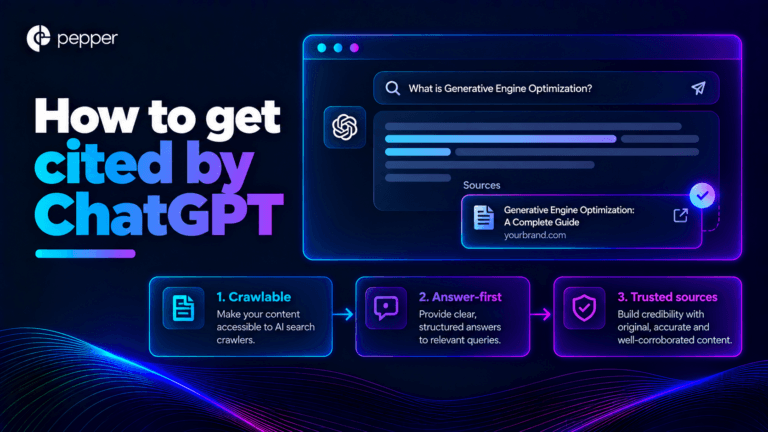
How to get cited by ChatGPT
GEO / AI Search
10 mins read
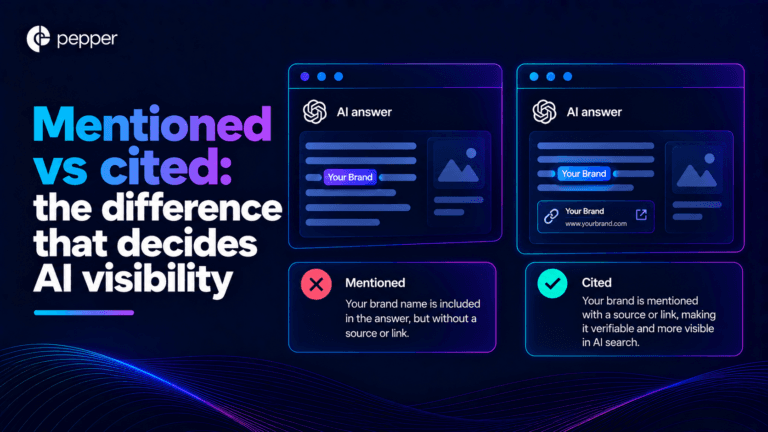
Mentioned vs cited: the difference that decides AI visibility
GEO / AI Search
13 mins read