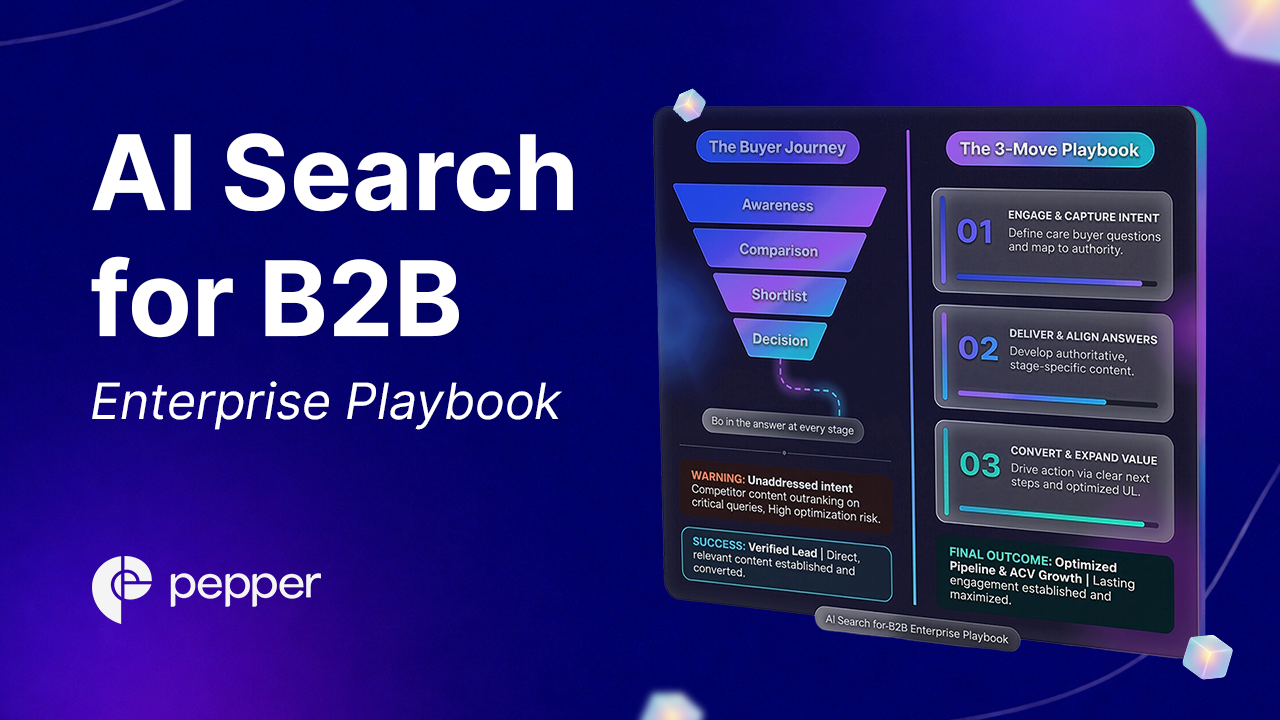
AI Search for B2B: The Enterprise Playbook
By Dhriti Goyal
Pepper Content · Win in AI Search · Enterprise Deep-Dive
AI search in B2B enterprise is not a smaller version of B2C AI search. It is a different problem with a different cost structure, a different buying motion, and a different content economics. The CMOs we work with at Pepper – leading marketing functions across Fortune 500 software companies, mid-cap industrials, and category-defining SaaS challengers – face the same five challenges almost without exception: long sales cycles where citations have to compound across nine to eighteen months, six-to-twelve-person buying committees that each prompt the AI differently, gated-content trade-offs that no one has fully solved, thought leadership as the primary citation signal, and LinkedIn plus analyst relations functioning as load-bearing AI-search infrastructure.
This piece is the working playbook for those five challenges. It is what we ship to every enterprise customer in their first thirty days, refined across hundreds of engagements and the largest cross-industry citation dataset Pepper Atlas has assembled to date. Most of it is operational. None of it is glamorous. All of it compounds – which is what enterprise B2B marketing ultimately rewards.
“Search is undergoing the most profound transformation of our time. Generative AI is redefining how people discover, trust, and engage with information – moving us from keywords and rankings to intelligence and context at scale.” – Anirudh Singla, Co-founder & CEO, Pepper Content (Index’25 keynote)
In B2B enterprise, that transformation is not a slogan. It is the new substrate for every sales cycle that begins with a prompt instead of a Google search.
Why B2B Enterprise AI Search Is a Different Problem
Three structural differences separate enterprise B2B from every other AI-search context.
First, the buying committee. Gartner’s reference figure is six to ten stakeholders per enterprise B2B deal; in our 2026 dataset, software purchases above $500K average 11.4 distinct stakeholders. Each of those stakeholders prompts the AI from a different vantage point. The CFO asks about pricing, payback, and risk. The CISO asks about compliance and architecture. The end-user manager asks about workflow fit. A brand cited only on the “best [category]” round-up has shown up for one of those eleven prompts and missed the other ten.
Second, the time horizon. Enterprise AI-search citations have to survive long sales cycles. The buyer who first prompts an AI in January may not sign until October. The brand that gets cited consistently across that ten-month window – across CFO prompts, CISO prompts, end-user prompts, analyst-comparison prompts – is the brand that controls the narrative when the procurement document arrives.
Third, the content gating problem. The most valuable enterprise content – analyst reports, technical white papers, customer case studies with proprietary data – has historically been gated behind forms. AI engines do not read gated content. Every gated asset is a content investment that earns demand but loses citation. That trade-off needs an explicit policy, not a default behaviour.
“Enterprise marketing is being re-architected around retrievability, not production volume. The teams that figured this out first treated their analyst report as a citation asset, not a lead-gen asset.” – Mandy Dhaliwal, CMO, Nutanix (Index’25)
Challenge 1: Multi-Persona Prompt Mapping
Most B2B AI-search programs are built around a single buyer-persona prompt set. That works for self-serve SaaS. It fails for enterprise. The minimum viable enterprise prompt universe has to cover at least five personas and roughly 200 prompts across them.
| Persona | Surface preference | Representative prompts | Citation lever |
| Economic Buyer (CFO) | ChatGPT, Gemini | “ROI of [category]”, “TCO comparison”, “payback period for [solution]” | ROI calculators, customer case studies |
| Technical Buyer (CISO) | Perplexity, AI Mode | “[category] security architecture”, “SOC-2 vs ISO 27001 for [vendor]” | Compliance pages, security white papers |
| End-User Champion | ChatGPT, Perplexity | “how does [product] work”, “best [category] for [use case]” | Tutorials, demo videos, use-case pages |
| Procurement | AI Overviews, Gemini | “[vendor] vs [vendor] pricing”, “contract terms for [category]” | Pricing pages, vendor-comparison content |
| Industry Analyst | Perplexity, Gemini | “magic quadrant for [category]”, “market share in [vertical]” | Analyst-grade research, original benchmarks |
The discipline is to run the universe at the persona level – measure Share of Answer per persona, not just per category. A brand at 18% Share of Answer overall might be at 35% on end-user prompts and 4% on CISO prompts. That delta is invisible at the rolled-up level and decisive at the procurement level.
→ Atlas: Atlas auto-generates a 200-prompt enterprise universe across the five personas above, then tracks Share of Answer per persona, per platform, per competitor — the cleanest way to see which buyer your AI presence is winning and which it is losing.
Challenge 2: The Gated Content Trade-Off
Every enterprise marketing leader inherits the same problem: the highest-quality content – analyst reports, white papers, deep-dive case studies – has been gated for a decade because gated assets generate MQLs. AI engines cannot read gated content. Every gate is a citation that is forfeited.
There is no universally correct answer. There is a defensible policy. The pattern that works at scale is what we call the 70/30 split.
The top 70% of content – definitive guides, product documentation, original research executive summaries, comparison content, named case studies – is fully ungated. This is the citation surface. It is what AI engines source, what buyers find when they prompt, and what competitors are cited for if you do not publish it ungated yourself.
The bottom 30% – full PDF reports, video deep-dives, ROI calculators, sandbox access, solution-fit assessments – stays gated. The form is shorter (name and work email; nothing else). The gated tier exists to convert AI-referred buyers who arrive on the ungated tier into pipeline.
The trade-off: a small reduction in form-submission MQLs in exchange for citation presence on prompts the AI is now answering directly. Across the Pepper enterprise dataset, this transition costs an average of 14% of form-fills in the first quarter and recovers them in the second through better-quality AI-referred conversions – at 2.1× the baseline conversion rate.
Challenge 3: Thought Leadership as the Primary Citation Signal
In B2B enterprise, thought leadership is not a branding luxury. It is the single highest-leverage citation surface AI engines use. The 96% statistic that gets quoted in every AI-search talk – that 96% of content surfaced in AI Overviews comes from verifiably authoritative sources – has its sharpest expression in B2B. AI engines disproportionately cite content with named expert authors, demonstrated track records, and editorial visibility outside the brand’s own domain.
The operational version of this is the named-expert programme. Every enterprise B2B brand should have three to seven internal experts publishing under their own bylines, with Person schema, verified LinkedIn presence, and a credible cadence of long-form content. The brand’s domain Share of Answer is gated by the visibility of those individuals.
“AI discovery rewards content that proves it has been lived. First-hand experience, original photography, real deployment data and a verified human attached to all of it.” – Linda Caplinger, Head of SEO & AI Search, NVIDIA (Index’25)
Pages with full Creator and Person schema show a 19.72% AI-Overview visibility lift in Atlas’s reference dataset. The lift is not a tooling artefact. It is the AI confirming that named experts beat anonymous content at the citation layer.
Challenge 4: The LinkedIn Layer
LinkedIn is not a social channel for enterprise B2B AI search. It is critical infrastructure. Long-form LinkedIn posts from verified executive accounts are cited by Perplexity at high frequency, indexed aggressively by ChatGPT, and surfaced inside AI Mode answers when prompts touch executive expertise. A Semrush study of 89,000 URLs found that individual long-form posts from verified experts outperform corporate brand pages on AI-citation metrics by a wide margin.
The cadence pattern that works at scale is the 2-Posts-Plus-1-Pulse rule. Every named expert publishes two text-form posts per week (the consistency variable) and one long-form Pulse article per quarter (the density variable). Two posts per week trains the algorithm and the LLM crawler. The quarterly Pulse establishes citation depth on a single, schema-rich, expert-authored URL that becomes the asset AI engines source for that expert’s topic.
Joyce Hwang at Index’25 framed the operational reality:
“AI search collapses the distance between brand and demand. On LinkedIn specifically, that collapse happens at the author level, not the logo level. A buyer discovers your CMO in turn one and evaluates your product in turn three – all without ever seeing your company page.” – Joyce Hwang, Head of Marketing, Dropbox (Index’25)
→ Atlas: Atlas tracks named-author citations across LinkedIn and the open web, surfaces which executive bylines are doing the citation work, and flags when a Pulse-published article begins compounding inside Perplexity and AI Mode.
Challenge 5: Analyst and Media Relations as AI Search Levers
Analyst and PR teams have historically operated parallel to SEO. In enterprise B2B AI search, they are the same function. Tier-one publication mentions, named-analyst inclusions in Forrester or IDC research, and category-defining press citations are leading indicators of AI citations across ChatGPT, Perplexity, Gemini, and AI Overviews – typically four to six weeks ahead of when the citations show up in measurement.
The reason is mechanical. Editorial mentions in publications the AI engines trust function as a strong external signal that the brand’s claims are corroborated. A vendor white paper says the brand is a leader. A Forrester report says the brand is a leader. The AI cites the Forrester report — and increasingly cites the brand’s own pages because the corroboration has been earned.
The operating implication for enterprise B2B brands: PR is no longer adjacent to AI search. PR is a primary input. The Index’25 panel on PR-as-GEO put the conclusion in one line: press mentions in trusted editorial sources are increasingly influencing AI-search outcomes.
The metric that matters is named brand citations in tier-one outlets and analyst reports. Track it monthly. Tie it to Share of Answer movement. Most enterprise PR teams have never been measured this way; the ones that are see budget arguments resolve faster than they have in a decade.
Insights: What Marketing Leaders Are Saying About Enterprise B2B AI Search
The Index’25 panel on enterprise AI search produced unusually direct lines from the field.
“Our buying committee is eleven people on average. If we are cited only on the round-up prompt, we are present for one of eleven conversations. The new content function is built around all eleven.” — Mandy Dhaliwal, CMO, Nutanix (Index’25)
“We treat our analyst reports as citation assets, not lead-gen assets. The lead-gen value compounded once we ungated the executive summaries – because the AI started citing them.” – Sydney Sloan, former CMO, G2 (Index’25)
“The moment we stopped measuring LinkedIn by follower growth and started measuring it by named citations in AI answers, the whole programme got easier. Fewer posts. Denser articles. Happier executives.” — Linda Caplinger, Head of SEO & AI Search, NVIDIA (Index’25)
“In a world where AI summarizes everything, the brands that get summarized favourably are the ones with the clearest positioning and the most distinctive voice. Enterprise content cannot afford to be generic anymore.” — Angelique Bellmer Krembs, former CMO, PepsiCo (Index’25)
“Be the source worth citing. Publish facts, stats, and expert insights that tools like ChatGPT and Perplexity can’t ignore.” — Neil Patel (Index’25 keynote)
“Once in a generation, technology doesn’t just improve — it changes the way we see the world. GEO is not just a buzzword, but a new rule book for brand discovery, trust, and selection in an AI-first marketplace.” — Kishan Panpalia, Pepper Content (Index’25)
The Quiet Truth About Winning Enterprise AI Search
The brands compounding in B2B enterprise AI search in 2026 are not producing more content. They are producing fewer, deeper, expert-authored, ungated, schema-rich, persona-mapped assets — and they are reinforcing those assets through LinkedIn cadence, analyst relations, and PR coverage that earns external corroboration. None of those moves is novel. The novelty is the discipline of doing all of them simultaneously, against a measured baseline, for the entire length of an enterprise sales cycle.
Long sales cycles reward compounding. Enterprise AI search rewards the same. The five challenges above are the five places where compounding gets earned or lost — and the gap between leaders and laggards in our 2026 dataset is, almost without exception, a gap in operational discipline rather than budget.
→ Atlas: Run the enterprise audit on your domain inside Atlas — 24-hour turnaround, 200-prompt persona universe, three competitor benchmarks, named-author tracking, and PR-citation correlation built in. Start at atlas.peppercontent.io.
Frequently Asked Questions
Is gating analyst reports still defensible? Ungate the executive summary; gate the full report behind a short form. The summary becomes the citation surface; the full report converts AI-referred buyers.
How many named experts does an enterprise B2B brand need? Three to seven, each with a distinct topical focus, Person schema, an active LinkedIn presence, and a quarterly Pulse cadence.
Should PR report into marketing for AI search? PR-citation outcomes are now a primary input to Share of Answer; the reporting structure should reflect that. Most enterprise teams converge on a shared scorecard before formal re-orgs.
What is a healthy enterprise B2B Share of Answer? Top-quartile is 12.3% in SaaS and 9.6% in financial services. Leaders sit at 22% and 17.4% respectively. Treat the top-quartile band as the realistic 12-month target.
How long until enterprise AI-search investment shows pipeline impact? Six to nine weeks for citation-to-traffic. Three to five quarters for citation-to-pipeline, given enterprise sales cycles.
Latest Blogs
Most 90-day AI plans are sequenced by how hard the work feels rather than by how long it takes to land. So they spend week one on an llms.txt file that Google states it does not use, and they schedule earned media for phase three, which guarantees no result inside the quarter. This plan inverts that. It orders the work by lead time, starts the slowest thing on day one, and cuts four tactics Google explicitly says are unnecessary.
We priced this category nine days ago. Today we went back to the same four pricing pages to check the numbers before publishing. Three of the four had changed, and two had stopped publishing prices altogether. That is the real answer to what AEO costs in 2026: not a number, but a meter that moves, measured in prompts and responses and engines that are billed separately. Here is how each pricing model works, what unit it charges you for, and which incentive that unit creates.
Ask what AI search traffic is worth and you will be handed a multiplier. The ones in circulation right now run from 13% worse than organic search to 23 times better, a spread of roughly twenty-six fold on the single input your whole business case depends on. They disagree because they are measuring the same behaviour under different attribution models. So this is not a guide to finding the right multiplier. It is a guide to building a model whose assumptions are visible, and to being honest about the half you cannot prove.
Get your hands on the latest news!

Similar Posts
Artificial Intelligence
16 mins read
How to improve your brand’s AI presence: a 90-day operating plan
Artificial Intelligence
16 mins read
What does AEO cost in 2026? Pricing models explained
Artificial Intelligence
17 mins read