Schema Markup: The Secret Decoder Ring for Search Engines
Ever tried explaining your day to someone who doesn’t speak your language? You’d probably point at things and use hand signals, right? That’s what websites do with search engines—except schema markup is their hand signals.
What is Schema Markup? (The Simple Version)
Schema markup is special code you add to your website that tells search engines exactly what your content means. Think of it like this: Your regular website shows a recipe. Search engines see words and pictures. But with schema markup, you’re literally pointing and saying “This is the cooking time, this is the ingredient list, this is the recipe name.”
It’s structured data—information organized in a way that computers can easily read and understand. Instead of guessing what your page is about, search engines get clear labels for everything.
How Does Schema Markup Work?
You add tiny bits of code to your website’s HTML that act like name tags. When a search engine crawler (think of it as a robot librarian) visits your page, it reads these tags.
Here’s a simple example: You write a recipe blog post. Without schema markup, Google sees text. With schema markup, Google sees “Recipe: Chocolate Chip Cookies, Prep Time: 15 minutes, Cook Time: 12 minutes, Rating: 5 stars.” The crawler knows exactly what each piece means because you labeled it using the standardized schema.org vocabulary.
This vocabulary includes different types (like Recipe, Article, FAQPage) and properties (like name, datePublished, author). Each type has its own set of properties that describe it.
Why Does Schema Markup Matter?
When search engines understand your content better, they can show it in more helpful ways. Your recipe might appear with a photo, star rating, and cooking time right in search results. Your how-to guide could show up as a numbered list. Your FAQ section might expand directly in Google.
For AI search engines, schema markup is even more critical. AI systems need structured information to generate accurate answers. When your content has proper schema markup, AI can confidently reference and cite your information.
Schema Markup at a Glance
| Schema Type | What It Labels | Best For |
| FAQPage | Question and answer pairs on your page | Help pages, support docs, Q&A sections |
| HowTo | Step-by-step instructions | Tutorials, guides, DIY content |
| DefinedTerm | Specific terms and their definitions | Glossaries, dictionaries, technical docs |
| Article | News stories, blog posts, editorial content | News sites, blogs, magazines |
| Organization | Business info, contact details, social profiles | Company websites, about pages |
Real-World Examples
A cooking blog adds Recipe schema to their chocolate cake post. Google now shows prep time, calories, and ratings directly in search results—before someone even clicks.
A software company uses FAQPage schema on their support page. When someone searches “how to reset password,” their FAQ answer appears in a featured snippet at the top of Google.
An online store adds Product schema to their sneaker listings. Search results display price, availability, and customer reviews, making their products stand out.
FAQs
Q1: Is schema markup hard to add to my website?
Not really. Many website builders and plugins can add it automatically. If you’re coding by hand, schema.org provides clear examples for each type you can copy and customize.
Q2: Will schema markup guarantee better search rankings?
Schema markup doesn’t directly boost rankings, but it helps search engines understand your content better. Better understanding can lead to richer search results, which often get more clicks.
Q3: What’s the difference between schema markup and regular HTML?
Regular HTML tells browsers how to display content (make this bold, make this a link). Schema markup tells search engines what the content means (this is a price, this is an author name).
Q4: Can I use multiple schema types on one page?
Absolutely. A blog post might use Article schema for the post itself, DefinedTerm schema for a glossary section, and Organization schema in the footer. Just make sure each one accurately describes that section.
Wrapping Up
Schema markup gives search engines and AI systems the context they need to truly understand your content. It’s like speaking their language fluently instead of making them guess what you mean.
Latest Blogs
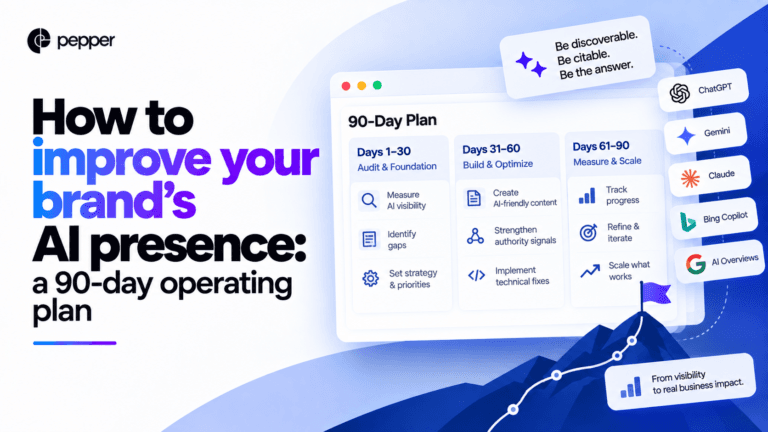
Most 90-day AI plans are sequenced by how hard the work feels rather than by how long it takes to land. So they spend week one on an llms.txt file that Google states it does not use, and they schedule earned media for phase three, which guarantees no result inside the quarter. This plan inverts that. It orders the work by lead time, starts the slowest thing on day one, and cuts four tactics Google explicitly says are unnecessary.
We priced this category nine days ago. Today we went back to the same four pricing pages to check the numbers before publishing. Three of the four had changed, and two had stopped publishing prices altogether. That is the real answer to what AEO costs in 2026: not a number, but a meter that moves, measured in prompts and responses and engines that are billed separately. Here is how each pricing model works, what unit it charges you for, and which incentive that unit creates.
Ask what AI search traffic is worth and you will be handed a multiplier. The ones in circulation right now run from 13% worse than organic search to 23 times better, a spread of roughly twenty-six fold on the single input your whole business case depends on. They disagree because they are measuring the same behaviour under different attribution models. So this is not a guide to finding the right multiplier. It is a guide to building a model whose assumptions are visible, and to being honest about the half you cannot prove.
Get your hands on the latest news!

Similar Posts
Artificial Intelligence
16 mins read
How to improve your brand’s AI presence: a 90-day operating plan

Artificial Intelligence
16 mins read
What does AEO cost in 2026? Pricing models explained

Artificial Intelligence
17 mins read