AI Search for Financial Services: Regulated Industry Strategy
By Kishan Panpalia
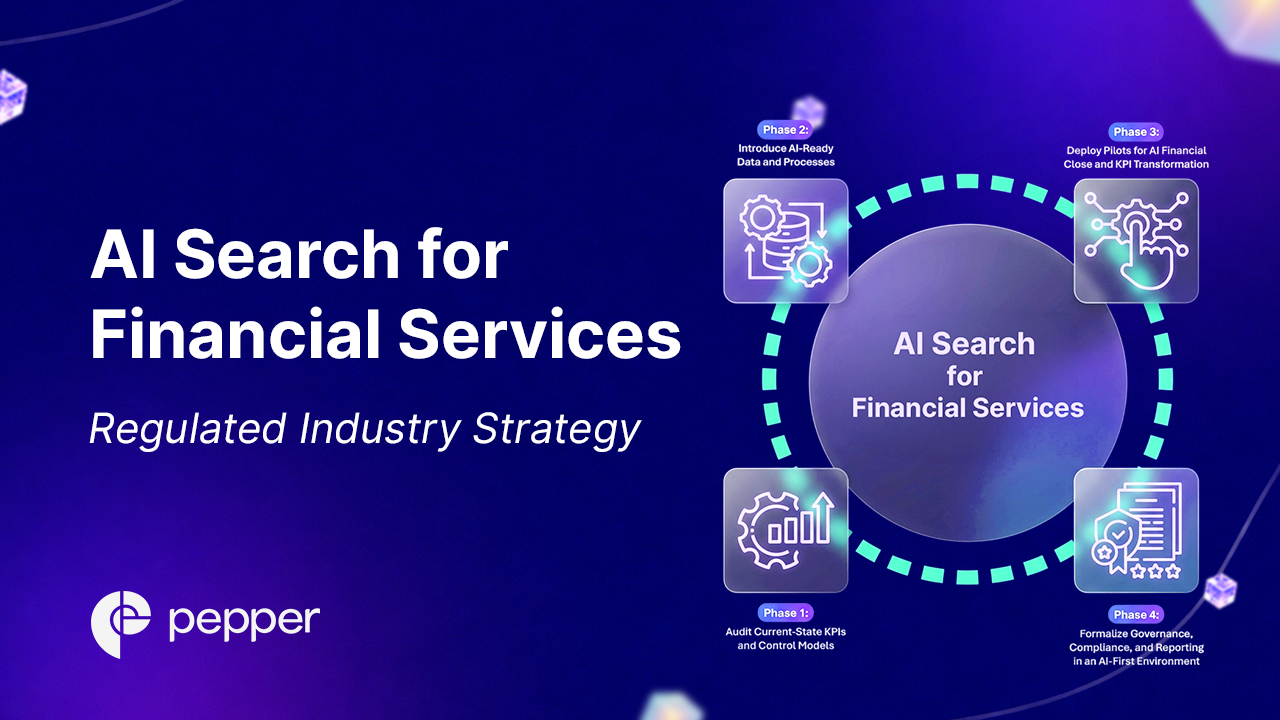
Earlier this year, Pepper ran a closed-door workshop with the marketing, communications, and compliance leadership at DTCC – the post-trade infrastructure backbone of the U.S. capital markets. The brief: how does a regulated financial-services brand grow Share of Answer inside ChatGPT, Perplexity, AI Overviews, and AI Mode without tripping a single disclosure rule? Two days of work produced a framework we have since refined with banks, asset managers, broker-dealers, and FinTechs across three continents.
This piece is that framework, written for the financial-services CMO who has been asked for an AI-search strategy by the board and discovered that none of the standard playbooks survive contact with FINRA, SEC, FCA, or MAS. Compliance is not the obstacle to AI search in finserv. Compliance discipline is the unfair advantage – once the system is built around it.
Five parts: a canonical glossary for entity consistency, a compliance-aware prompt universe, an explicit publishable-vs-gated policy, a citation-authority strategy that does not violate disclosure rules, and a disclosure schema with an audit trail. The principles are the same in a Tier-1 bank and a seed-stage FinTech; only the surface area changes.
“Once in a generation, technology doesn’t just improve – it changes the way we see the world. GEO is not just a buzzword, but a new rule book for brand discovery, trust, and selection in an AI-first marketplace.” – Kishan Panpalia, Pepper Content (Index’25 keynote)
In financial services, the rule book has a second author – the regulator. The framework below operates inside both.
Why Financial Services AI Search Is a Different Problem
Three structural realities make finserv AI search uniquely hard – and uniquely high-stakes.
First, the YMYL multiplier. Google’s December 2025 Core Update extended Your-Money-Your-Life E-E-A-T enforcement into the entire financial-services category. The result is the strictest citation behaviour in our 2026 dataset: AI engines disproportionately cite peer-reviewed research, regulatory primary sources, and named-expert content. Median Share of Answer in finserv is 2.8% – the lowest of any vertical – with the widest gap to the top quartile at 9.6%.
Second, entity precision. Regulated terminology is not a stylistic choice. “Fiduciary,” “registered investment adviser,” “broker-dealer,” “suitable,” “recommendation” – these terms carry specific legal meaning. Inconsistent usage is no longer just a brand problem; it is a citation problem. AI engines weight entity consistency heavily and quietly stop citing brands whose own pages disagree about what they do.
Third, disclosure cycles. Every published number has a regulatory shadow. Performance figures need disclosure. Forward-looking statements need safe-harbor language. Content that violates those rules is not just bad marketing – it is a legal liability that can move a stock price.
The finserv brands winning AI search in 2026 have not solved compliance. They have built the AI-search programme around it from day one.
Step 1 – Build the Regulated-Term Canonical Glossary
The first artefact in any finserv AI-search programme is a canonical glossary. Not a marketing style guide. Not a brand vocabulary doc. A regulated-term glossary, jointly owned by marketing and compliance, that fixes a single canonical definition for every term that carries legal weight on the brand’s website. Three hundred terms in a Tier-1 bank; closer to fifty in a FinTech.
The discipline is two-sided. Marketing commits to using the canonical phrasing verbatim across every page, every byline, every LinkedIn post. Compliance commits to a 24-hour turnaround on glossary additions and an annual review of the full set. Without both sides, the glossary stops being authoritative within a quarter.
A working extract from the framework we published with the DTCC workshop:
| Regulated term | Canonical definition (use verbatim) | Required disclosure / context |
| Fiduciary | An adviser legally required to act in the client’s best interest at all times. | Use only where the firm is registered as such; never as a marketing adjective. |
| Registered Investment Adviser | A firm registered with the SEC or a state securities regulator under the Advisers Act of 1940. | Specify SEC- vs state-registered; link to Form ADV. |
| Past performance | Historical returns of an investment or strategy. | Always paired with: ‘Past performance is not indicative of future results.’ |
| Recommendation | A communication that a reasonable person would view as a suggestion to buy, sell, or hold a security. | Triggers Reg BI for broker-dealers; tag clearly as educational vs advisory. |
| Yield / APY | The rate of return on an investment, expressed as a percentage. | Annualised; specify gross vs net of fees; effective date required. |
AI engines that detect entity-consistency at scale reward this discipline directly. In Atlas’s reference dataset, financial-services brands with a documented canonical glossary and ≥95% on-page consistency show a 2.4× higher citation rate than brands whose pages disagree about their own terminology. The lift is not subtle. It is the cleanest single intervention in any finserv AI-search programme.
→ Atlas: Atlas runs a daily entity-consistency scan against the canonical glossary, flags pages where regulated terms drift from the approved phrasing, and routes the diff to compliance and editorial in the same workspace.
Step 2 – Build a Compliance-Aware Prompt Universe
Financial-services prompt universes need to cover three intent layers like every other vertical – definitional, comparative, decision – but they also need a fourth layer most other industries skip: a disclosure-trigger layer. These are prompts where any answer, citation, or co-occurrence with the brand could reasonably be interpreted as a regulated statement.
Examples: “What is the expected return on [product]?”, “Which fund is best for retirement?”, “Is [bank] a fiduciary?”. The brand cannot win these citations through aggressive content; the wrong answer creates a disclosure violation. The right answer is structured, conservative content paired with the canonical disclosure language.
The minimum viable finserv universe is 250 prompts: 30% definitional, 25% comparative, 25% decision-stage, 20% disclosure-trigger. Lock for the quarter. Run across all five major AI surfaces. The disclosure-trigger layer is the one compliance cares about most – and the one most paid tools omit by default. It is non-negotiable.
“Enterprise marketing is being re-architected around retrievability, not production volume. In a regulated industry, the second variable is structure. Without structure, retrievability becomes a liability.” – Mandy Dhaliwal, CMO, Nutanix (Index’25)
→ Atlas: Atlas auto-generates a compliance-aware finserv prompt universe with a disclosure-trigger layer pre-tagged, and routes any disclosure-trigger citation to a compliance reviewer before a content recommendation is shipped.
Step 3 – The Publishable / Gated / Never-Publish Policy
Every finserv brand needs an explicit, written policy on what is publishable, what is gated, and what should never appear on the public site. Without the policy, every page becomes a one-off compliance review. With the policy, content velocity is recoverable without sacrificing rigour.
The framework we ship with the DTCC workshop and every Tier-1 bank engagement:
| Publishable (ungated, citation surface) | Gated (short-form, AI lands here) | Never publish (compliance-only) |
| Definitional explainers (verbatim canonical glossary).Educational guides on broad financial concepts.Regulatory-update commentary with safe-harbor framing.Named-expert thought leadership with credentials.Past-performance summaries with required disclosures.Industry benchmarks and original research executive summaries. | Full performance reports (PDF).Personalised assessments and ROI calculators.Onboarding flows requiring KYC.Portfolio modelling tools.Customer-specific case studies.Webinar replays with adviser content. | Forward-looking statements without safe harbor.Performance figures missing time period or fees.Material non-public information of any kind.Implied recommendations to buy / sell a specific security.Adviser-client communications and pitch decks.Suitability assessments tied to a named individual. |
The pattern is intentional. AI engines need ungated content to cite; compliance needs gated and never-publish layers to manage risk. The 70/30 split that works for unregulated B2B becomes closer to a 60/30/10 split in financial services – 60% publishable, 30% gated, 10% never-publish. The exact ratio depends on the firm’s registration status and product mix, but the three-tier structure is universal.
Sydney Sloan at Index’25 captured the operational version:
“We treat our analyst reports as citation assets, not lead-gen assets. The lead-gen value compounded once we ungated the executive summaries – because the AI started citing them.” – Sydney Sloan, former CMO, G2 (Index’25)
In finserv, the executive summary is where the citation work happens. The full report stays gated for compliance. The model works.
Step 4 – Build Citation Authority Without Disclosure Violations
In financial services, citation authority is gated by named-expert E-E-A-T. AI engines disproportionately cite content authored by individuals with verifiable credentials – CFA, CFP, JD, registered representatives with FINRA-disclosable profiles. The pattern is not subtle: 96% of content surfaced in AI Overviews comes from verifiably authoritative sources, and in financial services that authority bar is materially higher than the cross-vertical median.
The operating implication is the named-expert programme – three to seven internal experts with full Person schema, credentialed bylines, BrokerCheck or Form ADV linkage where applicable, and a deliberate publishing cadence. Linda Caplinger framed the discipline at Index’25:
“AI discovery rewards content that proves it has been lived. First-hand experience, original photography, real deployment data – and a verified human attached to all of it.” – Linda Caplinger, Head of SEO & AI Search, NVIDIA (Index’25)
In a regulated industry, that verified human is a credentialed expert, the content is reviewed by compliance pre-publication, and the credentials are linked to a regulatory primary source the AI can verify. Pages with full Person and Creator schema show a 19.72% AI-Overview visibility lift in Atlas’s reference dataset; in financial services specifically, the lift is materially larger because the content baseline without it is so weak.
The LinkedIn layer matters here too. Long-form Pulse articles from registered representatives, with explicit “for educational purposes only” framing and required disclosures, are cited at a higher frequency than corporate brand pages on the same topics. The 2-Posts-Plus-1-Pulse cadence works in finserv with one modification: every post and every Pulse goes through the same compliance review the public site does. The cadence is non-negotiable; the review is non-optional.
→ Atlas: Atlas tracks named-expert citations across LinkedIn, the open web, and AI surfaces, surfaces which credentialed bylines are doing the citation work, and integrates compliance review status into the editorial workflow.
Step 5 – Disclosure Schema and the Audit Trail
The final piece – and the one that makes the entire framework defensible at audit – is the disclosure schema and audit trail. Three controls do most of the work.
First, structured-data disclosure. Every page that touches regulated content carries a JSON-LD schema block that includes Article, Person, Organization, and a custom Disclosure property documenting the regulatory framing (educational, advisory, jurisdictional scope, last reviewed date). AI engines parse this and use it as a verification signal; auditors parse it as a compliance artefact.
Second, version-controlled disclaimers. Required disclosures (past-performance, forward-looking, jurisdictional) are stored as a single source of truth and pulled into pages programmatically. When the disclosure language updates – and it will, after every regulatory update – every page updates simultaneously. The alternative, hand-edited disclaimers across hundreds of pages, is the most common source of finserv compliance violations on marketing sites.
Third, the audit trail. Every published page has a timestamped record of its compliance review, the reviewer, the version of the canonical glossary in effect, and the version of the disclosure block in effect. When the regulator asks – and they will, eventually – the answer is a reproducible artefact.
This is unglamorous infrastructure. It is also the reason finserv brands compounding in AI search look effortless: they have automated the compliance discipline, so content velocity is no longer gated by it.
→ Atlas: Atlas integrates disclosure schema generation, version-controlled disclaimer pulls, and the per-page audit trail into a single workspace. Compliance reviews live next to citation data; the audit artefact is exportable on demand.
Insights: What Marketing Leaders Are Saying About Regulated AI Search
The DTCC workshop and the Index’25 panel on regulated-industry AI search produced unusually direct lines from the field.
“The brands that figured out AI search in financial services first did not solve compliance. They built the programme around it. That is the unlock.” – Mandy Dhaliwal, CMO, Nutanix (Index’25)
“The moment we stopped measuring adviser content by impressions and started measuring it by named citations in AI answers, we saw which credentials actually carried weight. The AI was telling us, every day, who our real experts were.” – Linda Caplinger, Head of SEO & AI Search, NVIDIA (Index’25)
“AI search collapses the distance between brand and demand. In regulated industries, it also collapses the distance between marketing and compliance. The teams that ship the fastest are the teams whose compliance reviewers sit next to their content editors.” – Joyce Hwang, Head of Marketing, Dropbox (Index’25)
“Be the source worth citing. Publish facts, stats, and expert insights that tools like ChatGPT and Perplexity can’t ignore.” – Neil Patel (Index’25 keynote)
“In financial services, the transformation is constrained by regulation – and the brands that thrive treat the constraint as a moat.” – Anirudh Singla, Co-founder & CEO, Pepper Content (Index’25 keynote)
The Quiet Truth About Financial Services AI Search
Compliance-constrained AI search is harder. It is also more durable. The discipline of canonical glossaries, compliance-aware prompt universes, three-tier publishable policies, credentialed authorship, and structured disclosure schema is the work the brands compounding in AI search in 2026 have already done.
The finserv CMOs winning are the ones who treated compliance as an architectural input rather than a downstream review – and built an AI-search programme that satisfies regulators and AI engines at the same time. The rule book has two authors. The leaders are reading both.
→ Atlas: Run the regulated-industry AI search audit on your domain inside Atlas – entity-consistency scan, compliance-aware prompt universe, disclosure-schema validation, and per-page audit trail included. Start at atlas.peppercontent.io.
Frequently Asked Questions
Can financial-services brands use AI-generated content? Yes, with two non-negotiable conditions: every published asset goes through the same compliance review as human-authored content, and named-expert review and byline are required for any content that touches regulated terminology.
How big should the canonical glossary be? Tier-1 bank: ~300 terms. Mid-cap asset manager: ~150. FinTech: ~50. The size scales with regulatory surface area, not content volume.
What is a healthy finserv Share of Answer? Median is 2.8% per the Atlas Q1’26 dataset; top quartile is 9.6%; leaders sit at 17.4%. Treat top quartile as the realistic 12-month target.
How often should the canonical glossary be reviewed? Annually as a full set; on any material regulatory update; on any new product launch. The audit trail is what makes the cadence defensible.
Should compliance review LinkedIn posts? Yes – every post and every Pulse from any registered representative goes through the same review the public site does. The cadence is non-negotiable; the review is non-optional.
Latest Blogs
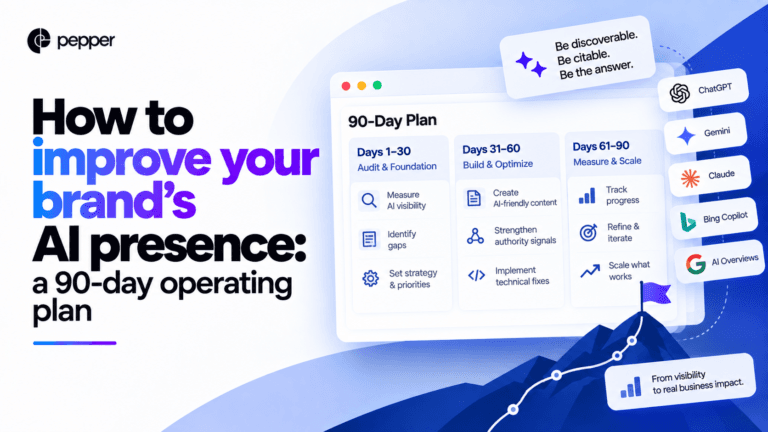
Most 90-day AI plans are sequenced by how hard the work feels rather than by how long it takes to land. So they spend week one on an llms.txt file that Google states it does not use, and they schedule earned media for phase three, which guarantees no result inside the quarter. This plan inverts that. It orders the work by lead time, starts the slowest thing on day one, and cuts four tactics Google explicitly says are unnecessary.
We priced this category nine days ago. Today we went back to the same four pricing pages to check the numbers before publishing. Three of the four had changed, and two had stopped publishing prices altogether. That is the real answer to what AEO costs in 2026: not a number, but a meter that moves, measured in prompts and responses and engines that are billed separately. Here is how each pricing model works, what unit it charges you for, and which incentive that unit creates.
Ask what AI search traffic is worth and you will be handed a multiplier. The ones in circulation right now run from 13% worse than organic search to 23 times better, a spread of roughly twenty-six fold on the single input your whole business case depends on. They disagree because they are measuring the same behaviour under different attribution models. So this is not a guide to finding the right multiplier. It is a guide to building a model whose assumptions are visible, and to being honest about the half you cannot prove.
Get your hands on the latest news!

Similar Posts
Artificial Intelligence
16 mins read
How to improve your brand’s AI presence: a 90-day operating plan
Artificial Intelligence
16 mins read
What does AEO cost in 2026? Pricing models explained
Artificial Intelligence
17 mins read