Share of Voice: From Shouting Loudest to Being AI’s Favorite Answer
Remember when being popular meant everyone talked about you at recess? Share of Voice works the same way for brands, except the playground changed from TV and Google to ChatGPT and AI chatbots.
What is Share of Voice? (The Simple Version)
Think of Share of Voice like a pie chart of who gets talked about most. If you and your friends are picking ice cream flavors, and chocolate gets picked 3 out of 10 times, chocolate has 30% share of voice in your group.
For brands, it used to mean: “How much did we spend on ads compared to competitors?” A toy company spending $300,000 while everyone else spent $700,000 had 30% Share of Voice.
Now it means: “How often does AI mention us when answering questions?” If ChatGPT recommends your sneaker brand 3 out of 10 times when someone asks about running shoes, you have 30% AI Share of Voice.
Same idea, different playground.
How Does Share of Voice Work?
The old way was like counting whose commercials played most during Saturday morning cartoons. Brands tracked ad dollars, website rankings, and who showed up first on Google.
The new way is like checking which friend the teacher asks for answers most often. When someone types “What’s the best laptop for students?” into an AI chatbot, the brand mentioned in that response earns a point. Track 100 similar questions, count the mentions, and boom-you have AI Share of Voice.
Traditional search was a ranking machine (who’s first, second, third). AI search is a thinking machine (who gets mentioned at all).
Why Does Share of Voice Matter?
People don’t scroll through ten blue links anymore. They ask AI and trust whatever answer pops up. If your brand isn’t in that answer, you’re basically invisible.
A small company with 5% actual market share could have 40% AI Share of Voice if chatbots recommend them constantly. That’s free advertising from the world’s new favorite expert-AI assistants that millions of people already trust.
Share of Voice at a Glance
| Feature | Traditional SOV | AI Share of Voice |
| What It Measures | Ad spend and search rankings | Brand mentions in AI responses |
| Key Metric | Percentage of ad dollars or impressions | Percentage of AI-generated mentions |
| Primary Channel | TV, radio, search engines | ChatGPT, Perplexity, Google AI Overviews |
| Success Indicator | Top 3 search ranking, high click rate | Inclusion in AI answers, mention frequency |
| Calculation Method | Your ad spend ÷ total category spend | Your mentions ÷ total brand mentions in responses |
Real-World Examples
A sneaker brand might have run the most YouTube ads last year (high traditional SOV), but when people ask ChatGPT “What running shoes prevent injuries?” and it never mentions them, their AI Share of Voice is zero.
Meanwhile, a smaller brand mentioned in 40% of AI responses about ergonomic office chairs dominates AI Share of Voice in that category-even if their Google ranking is mediocre.
Think of it like this: You used to win by yelling loudest in a crowded room. Now you win by being the answer the smartest person in the room gives when asked a question.
FAQs
Q1: How do I measure AI Share of Voice?
Tools like HubSpot’s AI Share of Voice tracker monitor how often your brand appears in responses from ChatGPT, Perplexity, and similar platforms. They analyze hundreds of relevant queries and count your mentions versus competitors.
Q2: What’s a good Share of Voice percentage?
Traditionally, matching your actual market share was baseline, and exceeding it drove growth. For AI Share of Voice, any meaningful presence matters since many brands currently have zero mentions in AI responses.
Q3: Does traditional SEO still matter?
Yes, but it’s no longer enough. Traditional rankings help people find you when they browse search results. AI Share of Voice determines whether you exist in the answers millions of users now receive directly from chatbots.
Q4: What does 100% Share of Voice mean?
It means your brand owns all the visibility in a category. With traditional advertising, you’d be the only brand spending money on ads. With AI Share of Voice, you’d appear in every single AI-generated answer about your category.
Wrapping Up
Share of Voice grew up and moved platforms. Same concept-measuring who gets noticed-but the scoreboard switched from billboards and search results to AI chatbot mentions. If AI doesn’t know you exist, soon your customers won’t either.
Latest Blogs
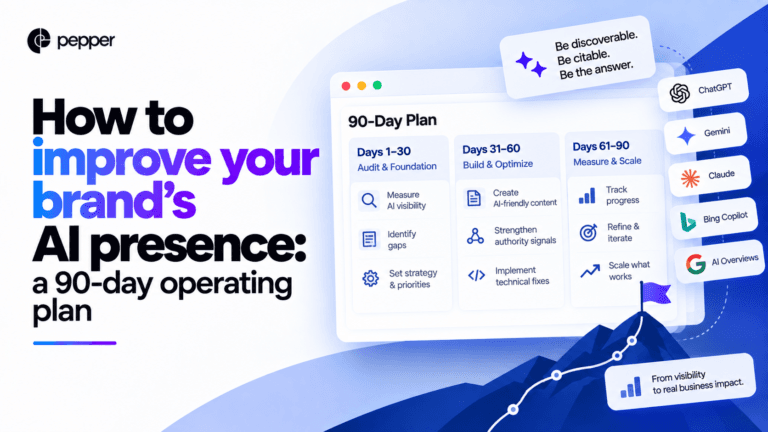
Most 90-day AI plans are sequenced by how hard the work feels rather than by how long it takes to land. So they spend week one on an llms.txt file that Google states it does not use, and they schedule earned media for phase three, which guarantees no result inside the quarter. This plan inverts that. It orders the work by lead time, starts the slowest thing on day one, and cuts four tactics Google explicitly says are unnecessary.
We priced this category nine days ago. Today we went back to the same four pricing pages to check the numbers before publishing. Three of the four had changed, and two had stopped publishing prices altogether. That is the real answer to what AEO costs in 2026: not a number, but a meter that moves, measured in prompts and responses and engines that are billed separately. Here is how each pricing model works, what unit it charges you for, and which incentive that unit creates.
Ask what AI search traffic is worth and you will be handed a multiplier. The ones in circulation right now run from 13% worse than organic search to 23 times better, a spread of roughly twenty-six fold on the single input your whole business case depends on. They disagree because they are measuring the same behaviour under different attribution models. So this is not a guide to finding the right multiplier. It is a guide to building a model whose assumptions are visible, and to being honest about the half you cannot prove.
Get your hands on the latest news!

Similar Posts
Artificial Intelligence
16 mins read
How to improve your brand’s AI presence: a 90-day operating plan
Artificial Intelligence
16 mins read
What does AEO cost in 2026? Pricing models explained
Artificial Intelligence
17 mins read