Citation Analysis: See the Sources Deciding Who AI Believes
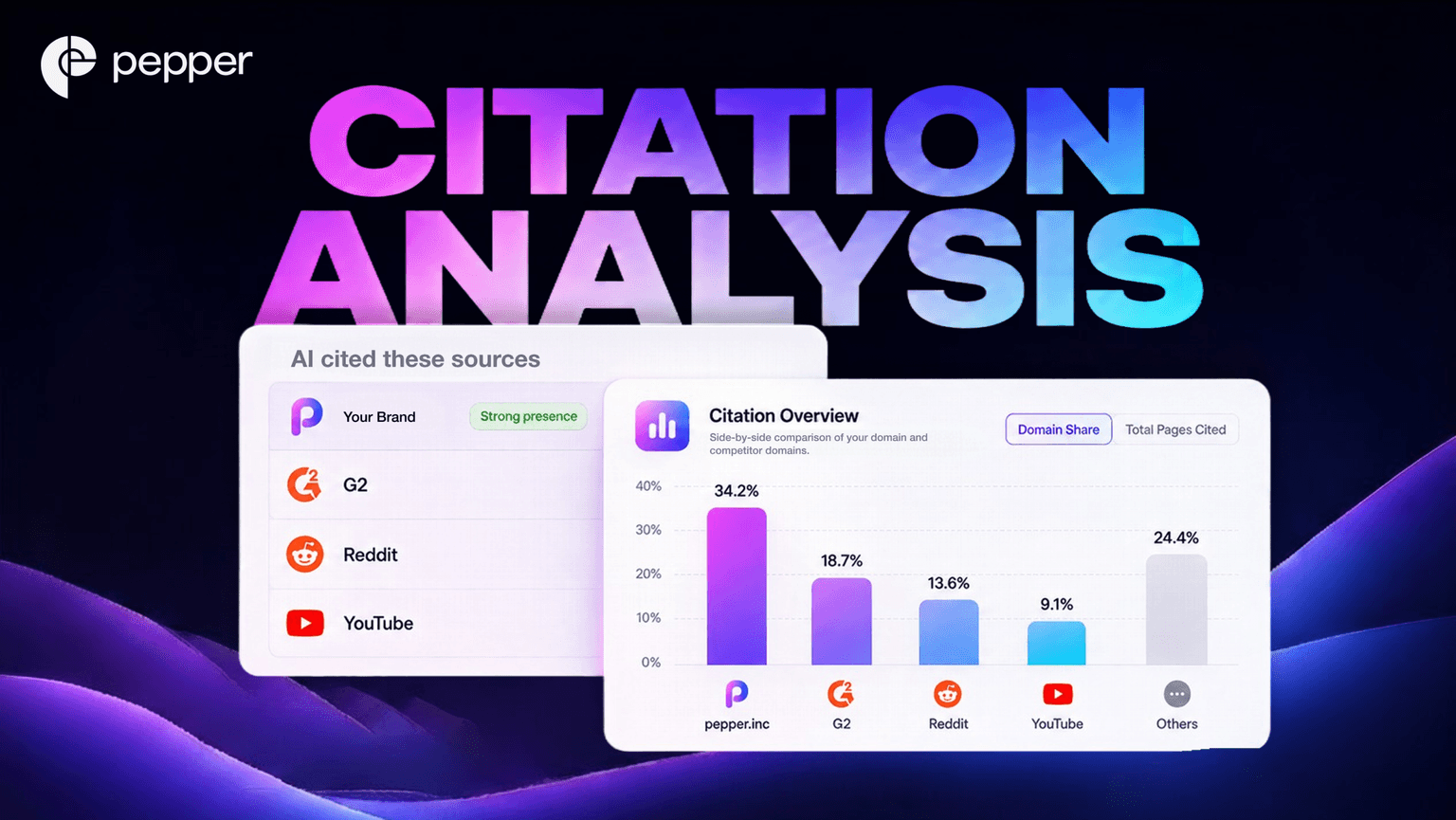
TL;DR: AI engines do not read your website the way a person does. They build an answer from sources they already trust, which means the pages deciding your category are usually not yours at all. Citation Analysis, inside Pepper’s GEO platform, ranks every domain AI cites in your category, splits them into your pages, your competitors’, and third parties, then lets you open any domain to read the exact pages earning those citations. The move it hands you is not more publishing. It is getting your brand onto the channels AI already believes.
Right now, an AI engine is answering a question about your category and citing someone as the source. The only real question is whether that someone is you or a competitor.
Here is the part most teams take longest to accept, and accepting it early will save you a lot of wasted effort. AI engines do not rank pages the way Google does. They retrieve, and they assemble an answer from sources they already trust. So the work that earns you a citation is frequently not on your own site.
Sit with that, because it inverts how most teams spend their GEO time. The default instinct is to publish more, tighten your own pages, and wait. Then the needle barely moves, because you are optimising the one surface the engine is least likely to cite.
What is a citation in AI search?
A citation is the source an AI engine leans on when it writes an answer: the specific page it pulled from and linked to. Being mentioned means the engine said your name. Being cited means the engine trusted your page enough to build the answer on it. Those are two different things, and the gap between them is usually where the real problem hides.
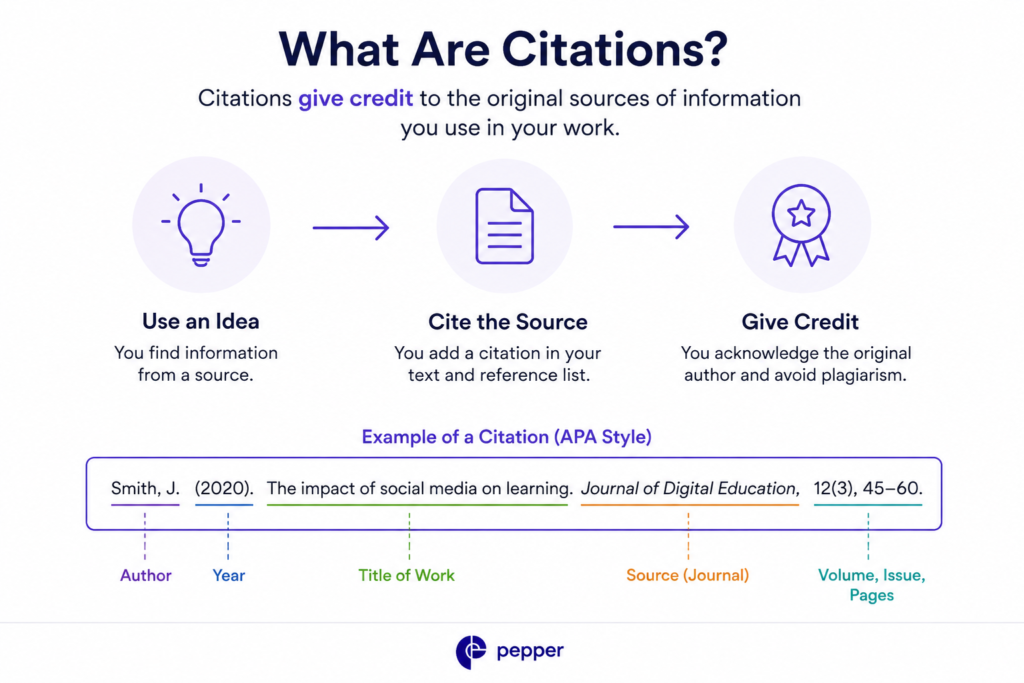
A brand can be mentioned everywhere and cited nowhere. When that happens, AI is talking about you while trusting someone else’s pages to back the claim, and no amount of publishing on your own domain closes that gap.
Start with every domain AI cites in your category
Citation Analysis opens on the Domain Overview table: every domain being cited in your category, ranked. In one view you see whether the sources shaping your answers are yours, your competitors’, or third parties, and how large a share of all citations each one owns.
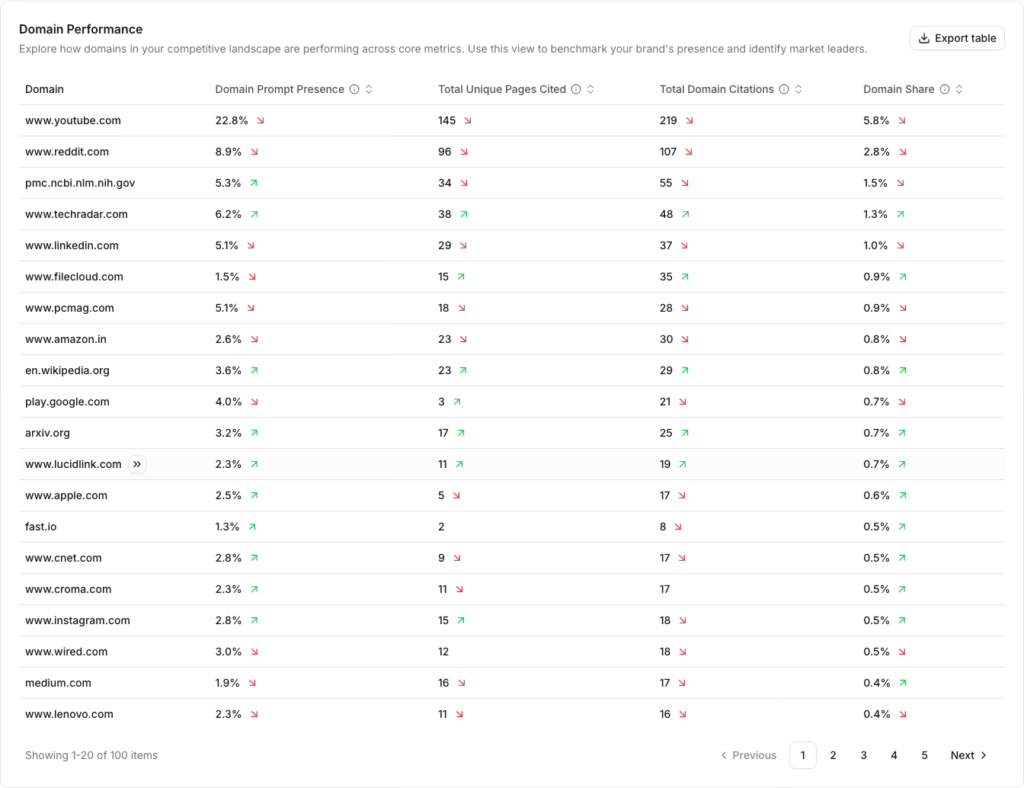
Read the list once and it usually reorders your priorities. Most brands expect to see themselves and their rivals near the top. What they find instead is a review site, a comparison page, or an industry listicle sitting above both.
The domains doing the heaviest lifting in your category are often the ones nobody on your team owns.
Why the third parties matter most
Those third parties are the channels deciding your category. If a review site or a listicle owns a large share of citations and your brand is not on it, that is not a content gap on your own site. It is a distribution gap, and it lives in PR, partnerships, and listings.
How to read what you are looking at:
| What you see high in the ranking | What it means | The move |
| Your own domain | AI trusts your pages to answer for the category | Defend it. Refresh and strengthen your most-cited pages. |
| A competitor’s domain | Those are the pages beating you | Open them, see what earned the citation, build something better. |
| A third-party domain | A channel deciding who gets believed in your category | Get your brand onto it, through PR, partnerships, or a listing. |
That third row is the one most teams have never actioned, and it is usually the highest-leverage work on the list.
Open a domain, and read its strongest pages
Clicking any domain opens the pages being cited from it, ranked by how many prompts pulled each one in. This is where a vague sense of losing turns into something specific.
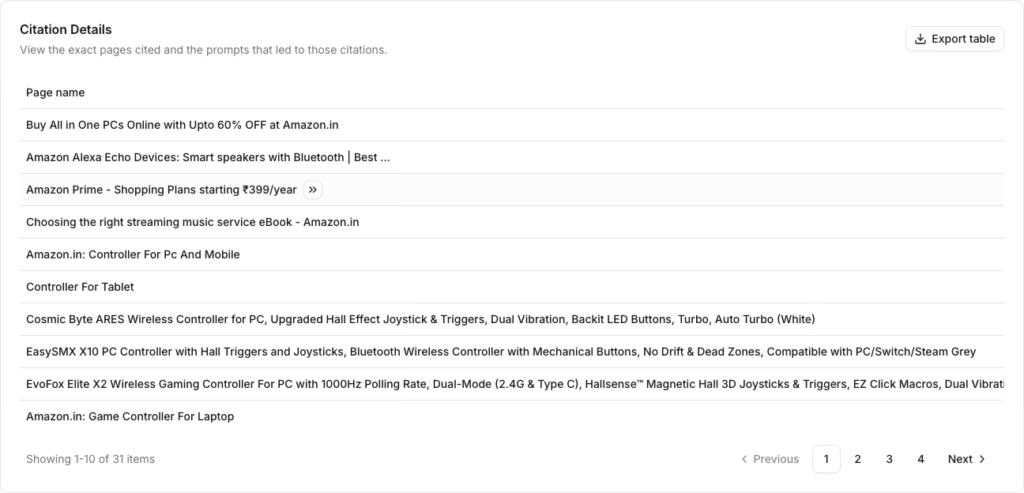
For a competitor’s domain, those top pages are the pages beating you. For a third party, that top page is the one you want your brand on. Same view, two different jobs, depending on whose domain you opened.
Open a page, and see every prompt that pulled it in
Go one level deeper and you can see, for a single page, every prompt that cited it, which engine, and when. One click opens the live page.
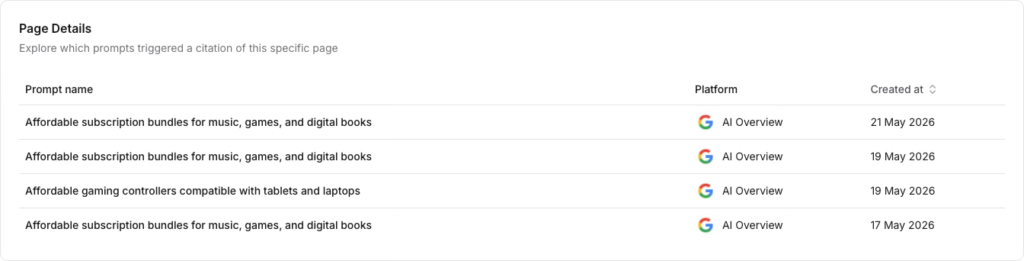
This is the part I would not skip. When you open the actual page a competitor got cited for, the guesswork ends. You can see how deep it goes, how it is structured, how specific it gets.
You read what AI trusts, and then you build something it trusts more
Watch the trend, not just today’s ranking
Citations move. The Domain Performance Trends view plots share of voice across domains over your selected date range, which tells you something a single snapshot cannot.
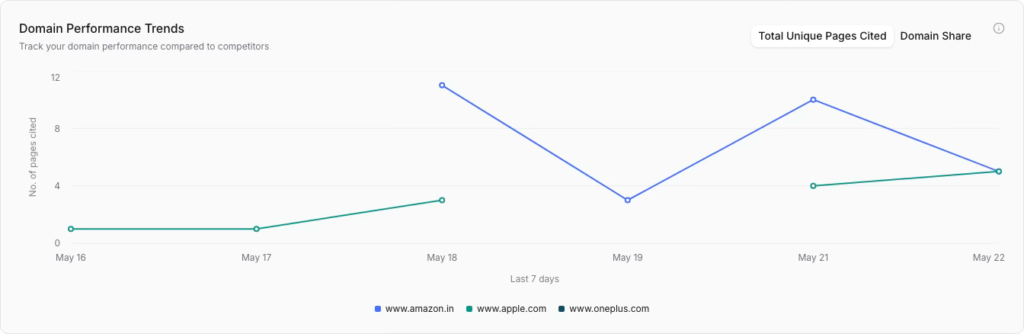
A domain climbing steadily is usually a content campaign in progress. A domain slipping is an opening. Where a source sits today describes last month. Which way it is moving tells you about next quarter.
So what do you actually do on Monday?
Citation Analysis is built to end in a decision, not a chart. Three moves come out of it consistently:
- Defend what you own. If your share of voice is dropping, refresh and strengthen your most-cited pages before you write anything new.
- Beat the pages beating you. Open the competitor pages earning citations and build something more useful against a real example, not a hunch.
- Get onto the channels you do not own. Identify the third-party domains dominating your category and go earn a place on them through PR, partnerships, or listings.
That last one is the shift. For eight years we have run content and SEO for more than 250 enterprises, and the pattern that repeats is this: teams treat citability as a publishing problem when it is usually a trust-and-distribution problem. Everyone else built a mirror that shows you the score. We built an engine that tells you which channel to go win.
FAQ
What is Citation Analysis? Citation Analysis is the view in Pepper’s GEO platform that ranks every domain AI cites in your category, splits them into your pages, competitors’, and third parties, and lets you open any domain to see the exact pages earning those citations.
What is the difference between being mentioned and being cited? Being mentioned means an AI engine said your brand name. Being cited means it trusted a page from your domain enough to build its answer on it. A brand can be mentioned constantly and cited almost never.
Why do third-party sites get cited more than my own? AI engines assemble answers from sources they already trust, and review sites, comparison pages, and industry lists often carry more category authority than any single brand’s site. That is why citability work lives partly in PR and partnerships.
How do I find which pages are beating mine? Open a competitor’s domain in Citation Analysis to see its most-cited pages, ranked by how many prompts pulled each one in. Those are the pages winning the answers you want.
Can I see which prompts caused a citation? Yes. Opening a page shows every prompt that cited it, the engine it ran on, and the date, so you can tie a specific page to the specific buyer questions it is winning.
See who AI believes in your category
An answer about your category is being assembled right now, from sources someone else may own. Citation Analysis shows you which sources those are, and what it takes to get your brand among them.
See where you stand at pepper.inc, or book a demo.
Extended reading:
Latest Blogs
Most 90-day AI plans are sequenced by how hard the work feels rather than by how long it takes to land. So they spend week one on an llms.txt file that Google states it does not use, and they schedule earned media for phase three, which guarantees no result inside the quarter. This plan inverts that. It orders the work by lead time, starts the slowest thing on day one, and cuts four tactics Google explicitly says are unnecessary.
We priced this category nine days ago. Today we went back to the same four pricing pages to check the numbers before publishing. Three of the four had changed, and two had stopped publishing prices altogether. That is the real answer to what AEO costs in 2026: not a number, but a meter that moves, measured in prompts and responses and engines that are billed separately. Here is how each pricing model works, what unit it charges you for, and which incentive that unit creates.
Ask what AI search traffic is worth and you will be handed a multiplier. The ones in circulation right now run from 13% worse than organic search to 23 times better, a spread of roughly twenty-six fold on the single input your whole business case depends on. They disagree because they are measuring the same behaviour under different attribution models. So this is not a guide to finding the right multiplier. It is a guide to building a model whose assumptions are visible, and to being honest about the half you cannot prove.
Get your hands on the latest news!