Competitor Analysis: See Exactly How a Competitor Is Beating You
TL;DR If a competitor is beating you in AI search, staring at the gap accomplishes nothing. The only useful move is to focus on that one competitor and work out exactly how they win. Here is how you do it with Pepper’s GEO platform: start at the leaderboard, find the conversations they control, drill into the exact questions they win, get the ranked moves to take those answers back, then read the pages earning their citations. A dashboard would show you the gap and stop there. Because we have spent eight years running content and SEO for more than 250 enterprises, the platform goes further. It hands you the move, and our team can run it with you.
Most competitive conversations I have with marketing leaders open the same way. “I think a competitor is pulling ahead in AI search, but I couldn’t tell you where, or why.” And that is usually where it ends, at a gut feeling. Because nobody can point to the spot, the team freezes. Watching the gap can feel like progress, but on its own it changes nothing.
The move that works is smaller than people expect. Pick the single competitor actually beating you, and focus on that one brand. Trying to watch every competitor at once just buries you in noise. Follow one, from their lead at the top all the way down to the specific pages winning them answers, and the guessing stops. You come away with something you can run this week.
See this help section for more details.
Start at the leaderboard, and pick your target
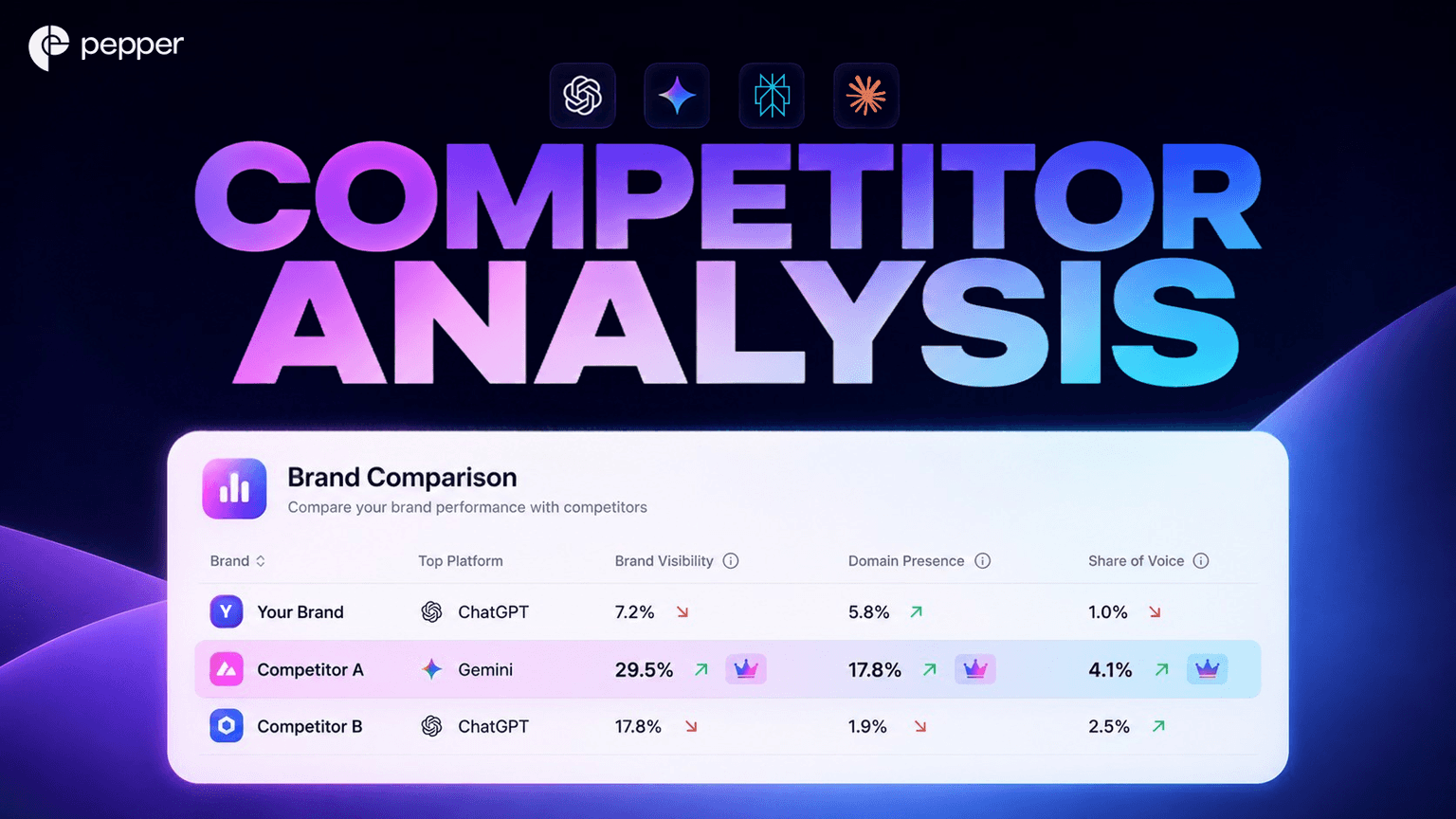
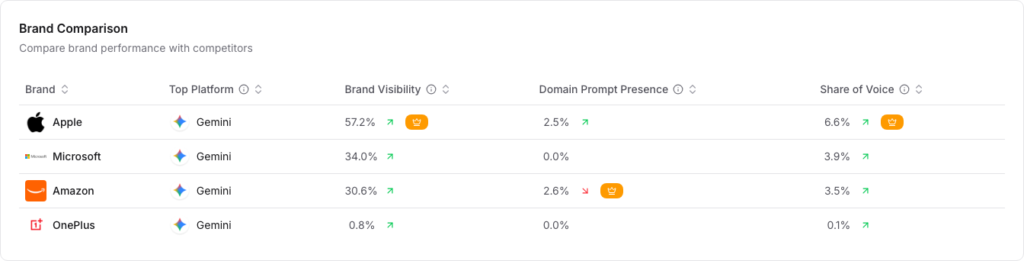
It begins with where you actually stand against the field. The Brand Comparison table ranks you and your competitors on each core metric, and a crown sits on whoever leads it.
Let the crown do the work. Instead of fretting about the whole field, find the brand wearing it next to the metric you care about, and that is your target for the entire analysis. One competitor, followed all the way through. That focus is the whole point.
Find the conversations they own
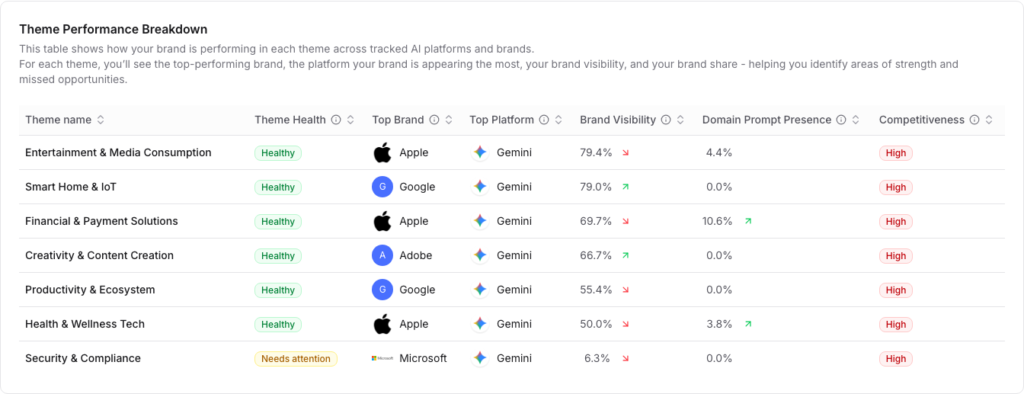
With a target picked, the next question is where they are beating you. Theme Analysis groups every question into themes, the real conversations in your category, so you can see their territory one theme at a time.
Look for the themes where your target is the top brand. Those are the conversations they own. Seeing them laid out this way is the moment a hunch turns into a map: not “I think we are behind here somewhere,” but a list of the exact topics to go contest.
Go inside a theme, and find the exact questions they win
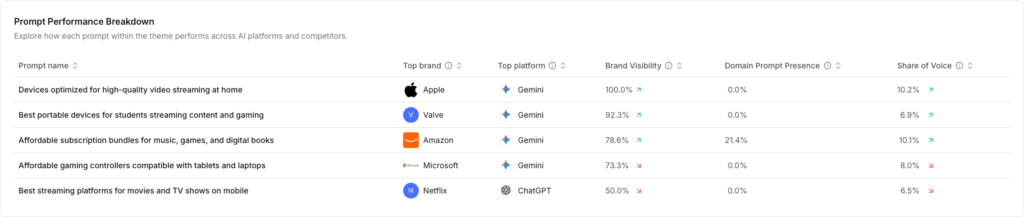
A theme is still a cluster of questions. To get to something you can act on, you open it up. The Theme Section Breakdown shows the individual prompts inside a theme, so you filter to your target and see the specific questions they are winning.
Now the work has a name. Not “we are behind on this topic,” but “these are the exact questions this competitor wins, and here are the ones I am taking back.” That is something a content team can actually pick up and run with.
Get the moves to take them back
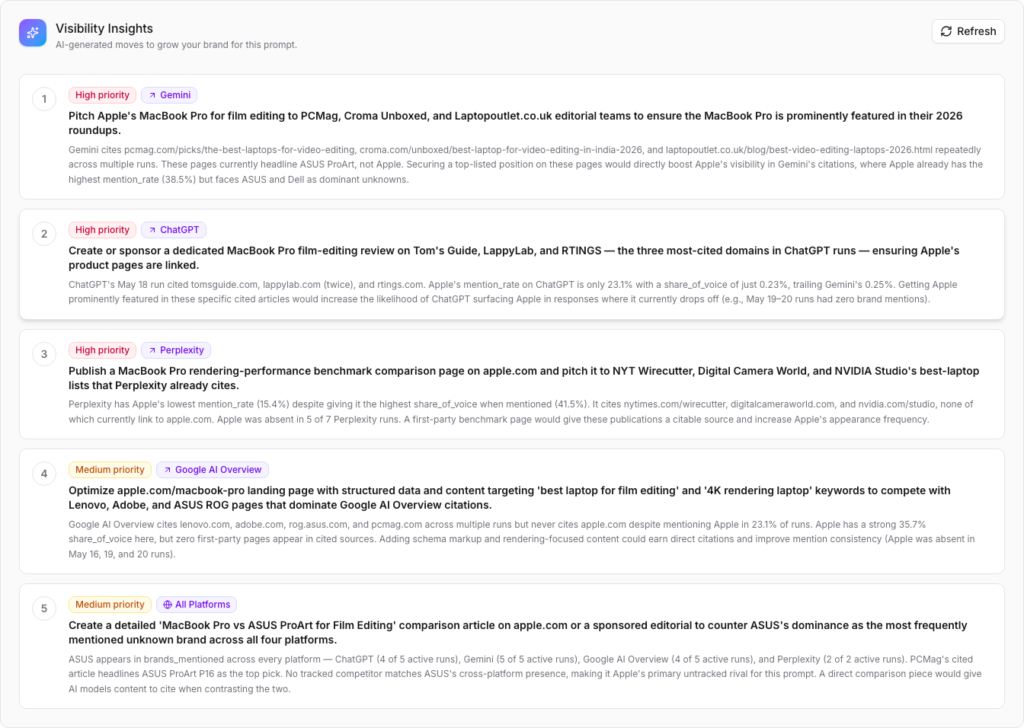
Finding the questions you are losing is only half of it, and it is exactly where a dashboard would leave you. The Prompt Visibility Insights card takes any one of those prompts and hands you the moves to win it, ranked.
Each move carries a priority and a target engine, so you read it top to bottom and go. The engine matters, because winning an answer on Perplexity is not the same work as winning one on AI Overviews. This is where the analysis stops being a diagnosis and becomes a plan. It is also the part a tool cannot fake, because that ranking comes from having actually won these answers before.
Read the pages earning them those answers
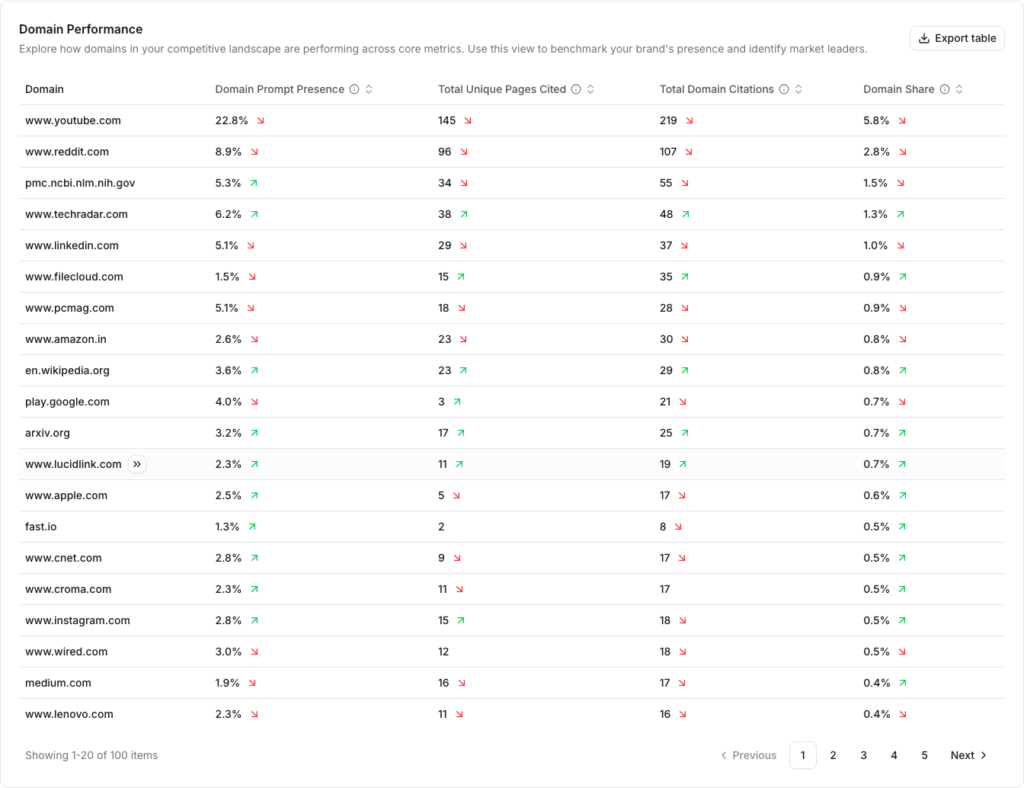
The last step gets at the question sitting under all the others. Why do they win. Citation Analysis lets you open your target’s domain and read the specific pages earning them citations across your category.
Once you can see what their content is actually doing, which pages the engines trust and how often each gets cited, building something better stops being a guess. You are not prising open a black box anymore. You are reading the exact pages doing the work, which is about the clearest brief a content team could ask for.
The point is to out-execute, not observe
Put the five steps together and you have followed one competitor end to end: their lead, the conversations they own, the exact questions they win, the moves to take those back, and the pages earning them their answers. That is a plan built from a competitor’s real performance, not a feeling about a gap.
This is how share in AI search actually changes hands. You pick one competitor, work out exactly how they win, and out-execute them, rather than watching the gap widen.
And out-executing is the part a dashboard was never going to help with. It shows you the gap and goes quiet. It cannot tell you which move closes it, and it certainly will not make the move for you. That is where the eight years come in. We have run content and SEO for more than 250 enterprises, so the platform that hands you the analysis is backed by a team that has run these plays before and can run yours. You get the diagnosis, the ranked move, and the people to act on it.
FAQ
How do I analyse a competitor’s AI search performance? Start at the Brand Comparison table to see who leads each metric, then follow one competitor through themes, prompts, and citations to see exactly where and how they are winning.
Why focus on one competitor instead of all of them? Because a single competitor followed end to end gives you a specific, actionable plan, while trying to track every competitor at once produces noise. The crown on the leaderboard helps you pick the one that matters most.
What is the Theme Section Breakdown? It is the view that opens an individual theme into the prompts inside it, so you can see the specific questions a competitor wins within a conversation, rather than just the theme-level average.
How do I know what to do once I’ve found the gaps? The Prompt Visibility Insights card generates ranked moves for a given prompt, each with a priority and a target engine, so the analysis comes with a plan attached.
How can I tell why a competitor gets cited? Open their domain in Citation Analysis to see the specific pages earning them citations and how often each is cited, which shows you what to build against.
See it on your own category
Pick the competitor beating you in AI search, and work out exactly how they win. Pepper’s GEO platform shows you their lead, their conversations, the questions they win, and the pages behind them. See how it works, and get a read on where your brand actually stands, at Pepper homepage and the case-study hub.
Book a demo to see your brand’s real standing across every major engine.
Extended reading:
Latest Blogs
Discover the 10 best financial SEO agencies to elevate your banking and finance digital presence. Expert strategies tailored to your success.
You can find out today, for free, in about half an hour. Open a logged-out session, ask ten category questions, repeat across three engines, and tally the answers. Here is the method, what the result means, and when it is worth paying for something deeper.
Every SEO platform comparison ranks features you already know you get. So we scored 11 of them on the only question a B2B marketer gets asked in a board meeting: can this thing reach the pipeline data? The answer is that none of them publishes organic-to-revenue attribution. One names a CRM integration, and it puts deal data beside your SEO data rather than through it. Four claim revenue outcomes and none of the four says how the number was calculated.
Get your hands on the latest news!