Pepper Launches Its GEO Platform For Enterprise AI Visibility
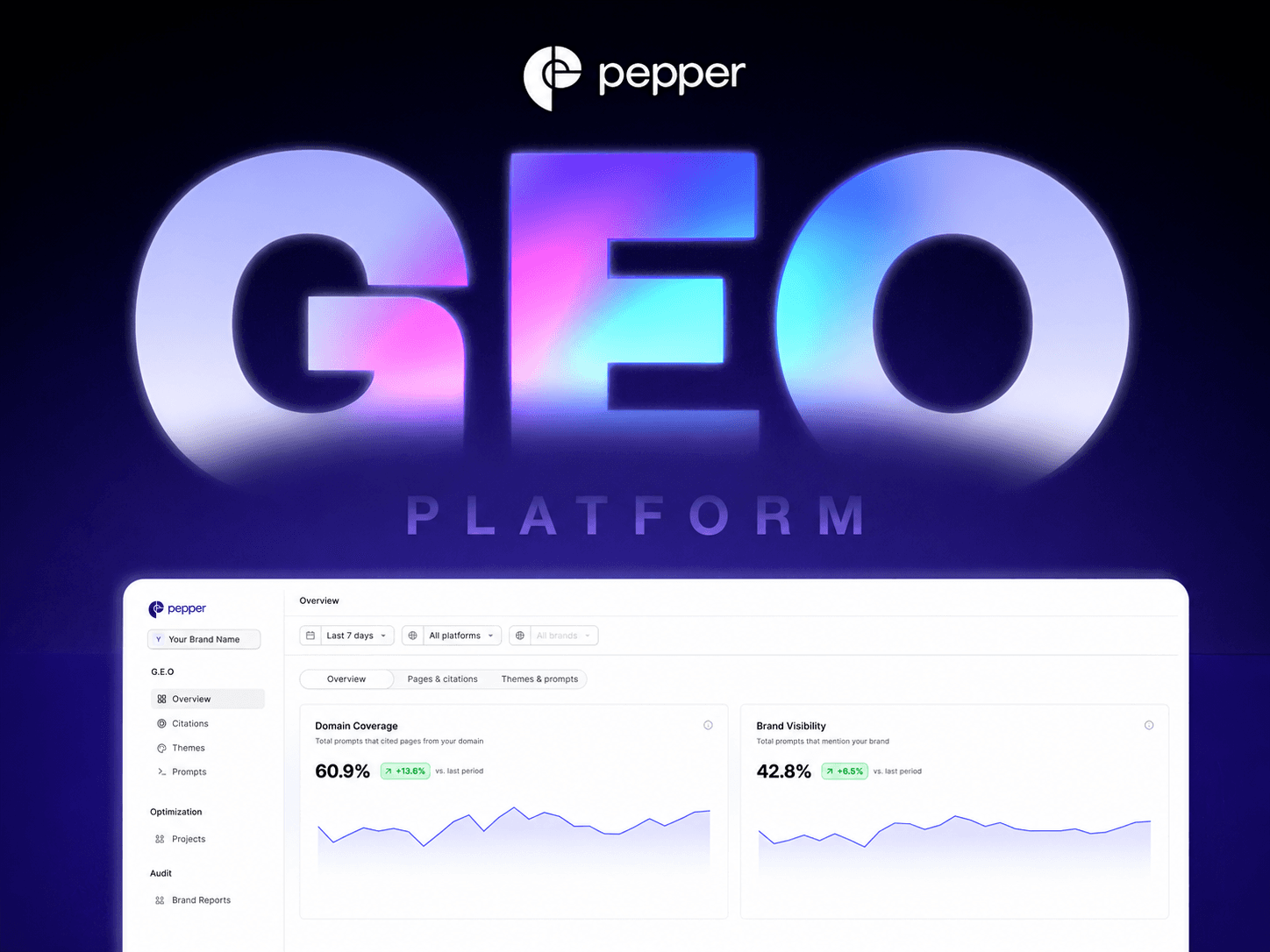
TL;DR: AI search does not work like Google. There is no page of ten links to rank on, only one answer, and your brand is either in it or it is not. Whether you make it in comes down to three things: whether AI knows you (Visibility), whether it trusts you enough to cite you (Citability), and whether it can retrieve you however the question is asked (Retrievability). Pepper’s GEO platform, which we are launching today, measures all three and then hands you the ranked next move. It did not start as a product. It is the instrument my team has used to run GEO for enterprises over the last few years, refined against real client work, and now opened up for you.
For eight years, Pepper has done one job: get brands found. For most of that time, that meant Google. Then, over the last two years, something changed in almost every account we run.
The clicks started drying up.
Not because our clients were ranking worse. Their rankings held. A growing share of their buyers had simply stopped clicking anything at all, because they were getting their answer straight from ChatGPT, Perplexity, or Google’s AI Overviews. One of our customers, Elay Cohen at SalesHood, put the shift plainly.
“The world has seen a drop in clicks. Traffic is shifting from the traditional SEO world to the GEO world.”
— Elay Cohen, SalesHood
This is the new top of the funnel, and it is invisible in every dashboard most teams own. When a buyer asks an AI engine about your category, the answer is assembled before they ever see a link. Your brand is named in it, or a competitor is. If you are not in that answer, the click you spent years earning never happens, and nothing in your analytics tells you why.
The same problem, in account after account
Once we started looking, we saw the same pattern everywhere.
A brand would be all over the AI conversation, mentioned constantly, and yet almost never cited as the source. The engine was talking about them while trusting someone else’s pages, usually review sites and third-party lists they did not own, to back the claim. Mentioned everywhere, cited nowhere. That gap was almost always where the real problem was hiding.
I had a version of this conversation with a CMO at a Fortune 500 company that has stuck with me. Her traffic was steady, her rankings were clean, and she was still losing. She could feel the ground moving under her category, and she had no instrument to prove it to her board. She was not behind on her metrics. Her metrics were measuring the wrong game.
She was not alone. She was one of dozens of marketing leaders describing the exact same thing, and none of them had a way to see it clearly.
Why we built the platform
Here is the part I want to be honest about, because it is the whole reason this launch matters.
Pepper’s GEO platform did not begin as a product. It began as the instrument my own team used, internally, to run GEO for our clients. It was how we saw what AI was actually doing to a brand, and how we decided what to fix. It was never meant to leave the building.
But the more we worked alongside our clients, the clearer it became that they did not just want a report from us once a month. They wanted to see it themselves. So we kept refining the platform against real campaigns, shaped by what those clients told us they needed, until it was no longer an internal tool. It was something worth handing over.
To date, it has tracked more than 10 million prompts across every major engine. That is not a demo dataset. It is years of real client work, and it is what the platform is built on.
Naman Goel at Earnin, another customer, described what it gives a team better than I can.
“It gives you good access into how different LLMs, Perplexity, ChatGPT, Claude, Google AI Overviews, are all looking at how many queries you’re ranking for, what are the prompts you’re ranking for, your citations, domain visibility, all that. It’s a great view to keep track, month over month, of what’s changing.”
— Naman Goel, Earnin
Over hundreds of these engagements, we ended up looking at every brand the same way, in the same order. Each question we asked led naturally to the next. That order is what became the five views of the platform, and it is the honest way to read what follows: not a tour of tabs, but the path we actually walk.
So where did a brand actually stand?
Every engagement started the same way, with a hard look at the truth. Not last quarter’s numbers, and not the ones that felt good. Where a brand stood today, against the competitors actually beating it.
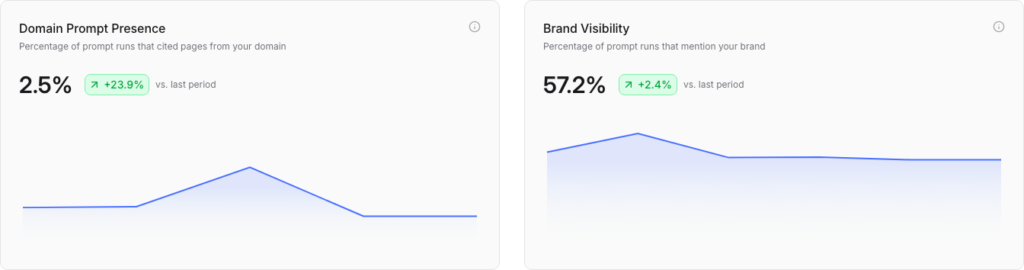
Two numbers told us most of the story. Brand Visibility, how often AI mentioned the brand by name. Domain Prompt Presence, how often it actually cited a page from the brand’s own site.
What we kept finding was a gap between the two. High visibility, low presence. The engine was happy to talk about the brand, but it trusted someone else’s pages to do it. That gap, more than any single score, was usually the first thing worth fixing.
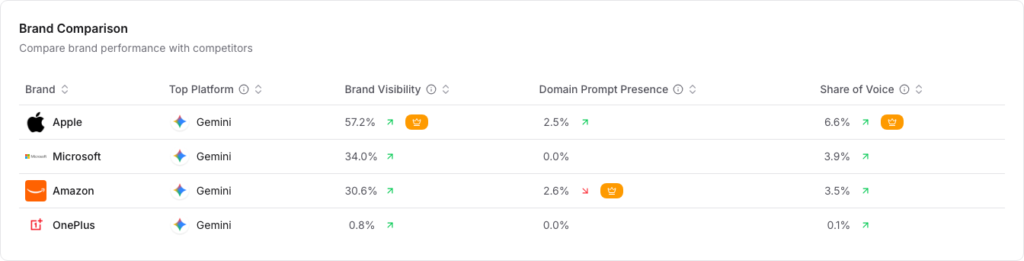
Then we would put the brand next to its competitors. A crown sits on whoever leads each metric, and the first time a client saw a rival wearing the crown on a number they thought they owned, the conversation changed. They stopped telling their board that AI search felt different. They had the number that proved it.
Then, where was it leaking?
A single score never told us enough. What we really wanted to know was which conversations a brand was quietly losing, so we started grouping every buyer question into themes: the real conversations happening in a category.
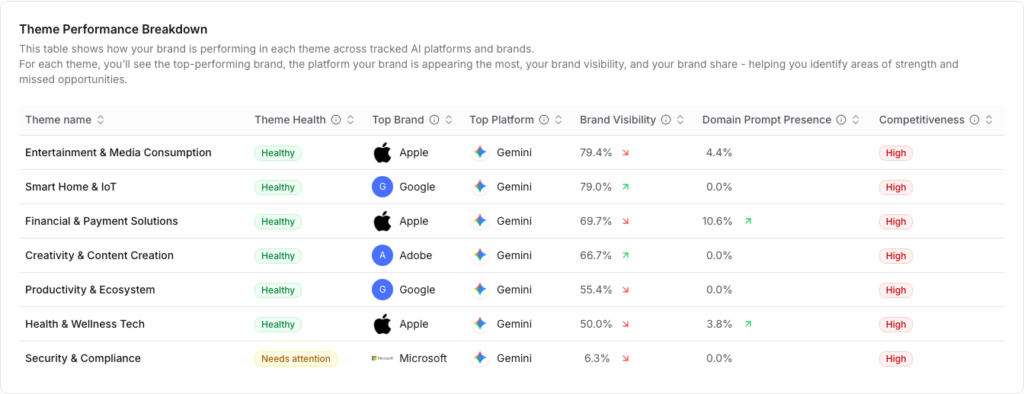
The first time a client saw their own category mapped this way, the pattern was usually uncomfortable. There were whole conversations their competitors owned that they had not realised were even happening.
We learned to read three signals fast. A competitor leading a theme where the brand was barely visible meant ground actively being lost. A theme where the brand did not appear at all was not a ranking problem, it was a permission problem: AI did not yet see them as a credible voice there. Sort by visibility, and the gaps lined up in the order worth fixing them.
But what was AI actually saying?
A theme is still a cluster of questions. To do anything useful, we had to get down to the single question a buyer types, the prompt, because that is where a deal is quietly won or lost.
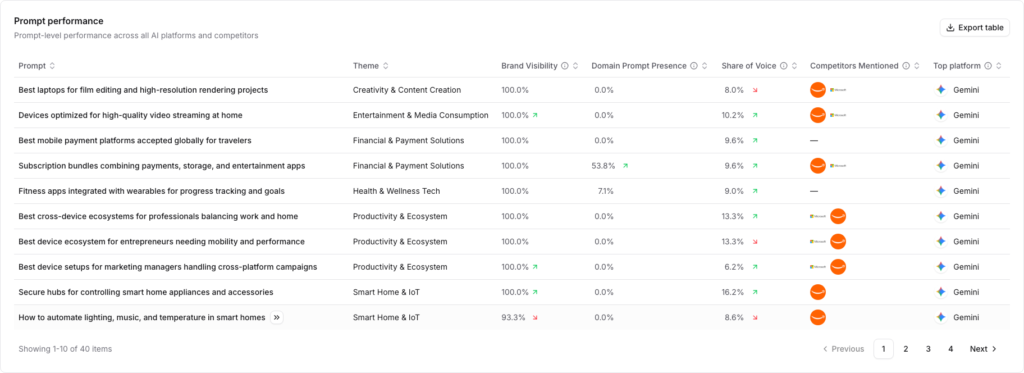
This is the layer everything else is built from. And it is the moment AI search stopped being abstract for our clients, because they could finally read exactly what the machine was saying about them.
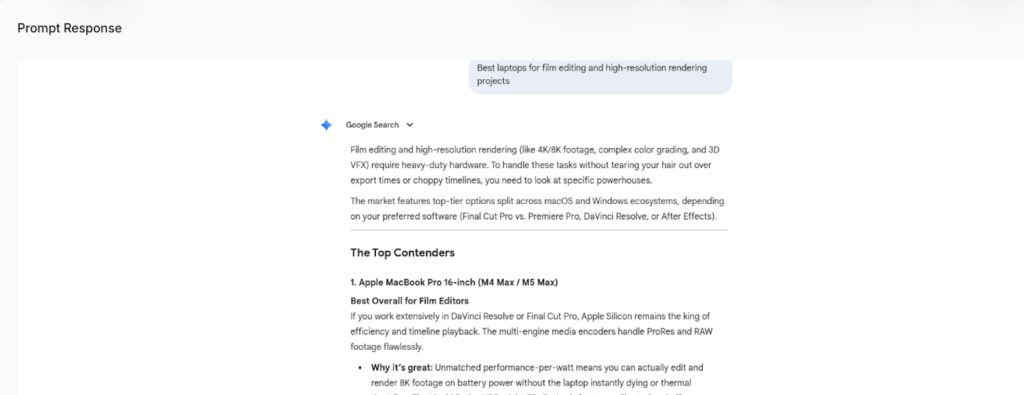
We would open a single run and there it was: the real answer, on that engine, on that day. Not a metric standing in for it. The words a buyer actually saw.
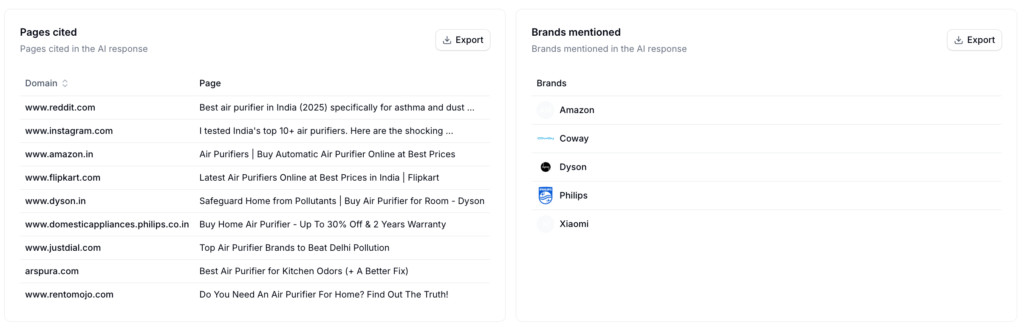
And underneath it, what the engine leaned on to write it: the pages it cited, the brands it named. That was where a loss stopped being a mystery. We could open the page a competitor got cited for and see exactly what earned it. We could catch an engine stating something flatly false about a brand and go correct the record before it cost them a deal.
And what was it trusting to say it?
This was the mechanic that surprised clients most. AI engines do not read your content the way a person does. They retrieve. They build an answer from sources they already trust, and we kept finding that most of that trust sat on pages our clients did not own.
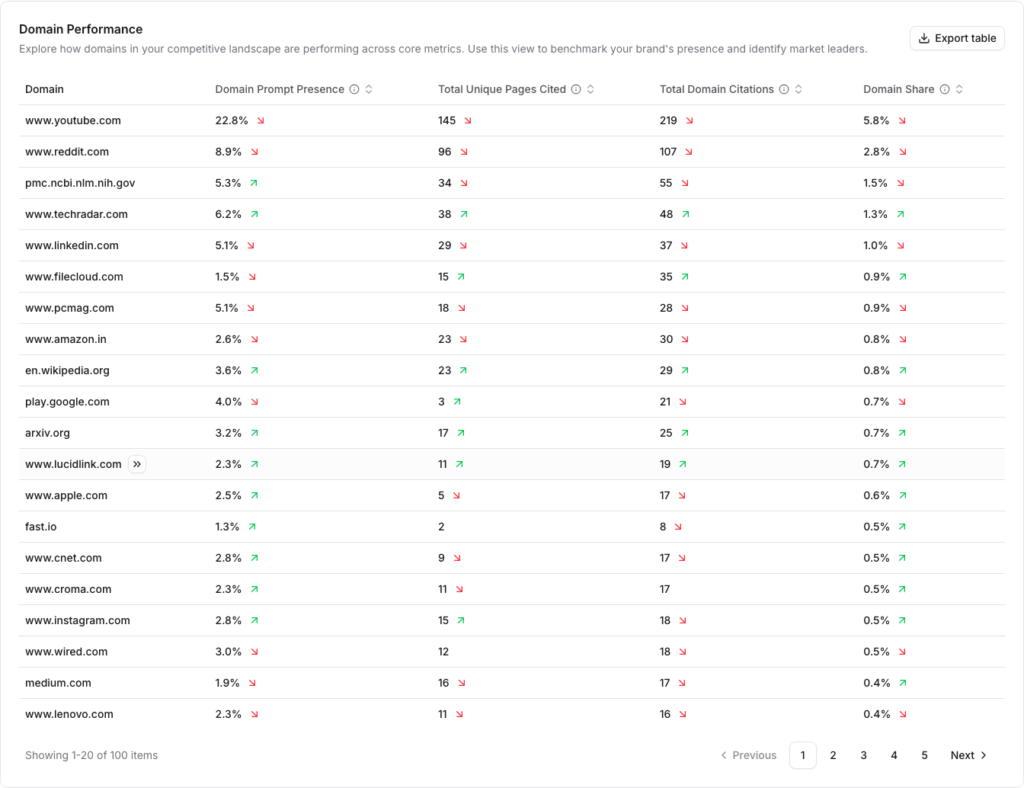
So we started ranking every domain AI cited in a category, and tagging each as the brand’s, a competitor’s, or a third party. More often than not, the domains doing the heavy lifting were review sites, comparison pages, and industry lists.
The lesson landed hard every time. If one of those pages is shaping your category and your brand is not on it, that is the highest-leverage work on your plate, and it lives in PR and partnerships as much as in your own CMS.
So what were we supposed to do about it?
Every view so far told us what was happening. But a diagnosis a client cannot act on is just anxiety with a chart attached. The question that actually mattered was the last one: what do we do on Monday?
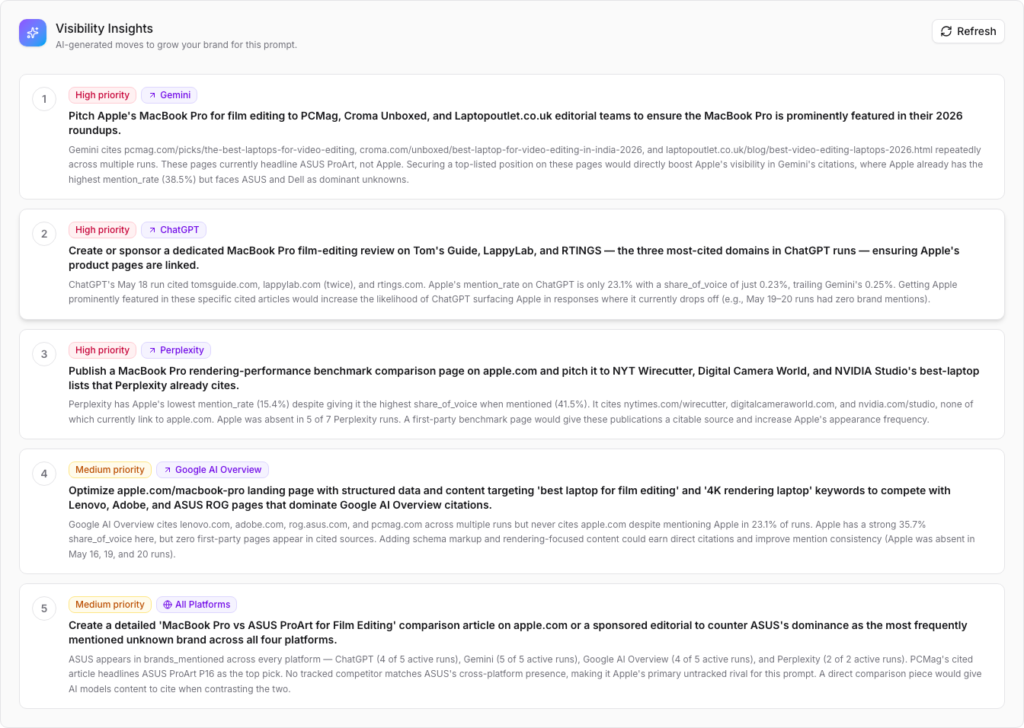
So we built the part that answers it. For any prompt, Visibility Insights reads everything the platform knows, the runs, the trend, the competitors, the cited pages, and hands back a ranked set of concrete moves to win that question. Each one carries a priority and a target engine, because the work that wins an answer on Perplexity is not the work that wins one on AI Overviews.
This is the piece a tool built by people who have never had to move a brand up an answer simply cannot produce. That ranking is not a guess. It is eight years of doing this work, encoded.
Five questions, one loop
Read on their own, those five questions each answer something. Asked in order, they became a single loop we ran on every account: see where a brand stands, find the conversations it is losing, read the real answers, understand what AI trusts to write them, then act on the ranked next move. See, diagnose, act, and around again as the numbers move.
That loop is the whole idea, and it is worth being blunt about what makes it different. Anyone can build you a mirror that reflects your AI visibility back at you. Building the engine that tells you what to do about it is much harder, and it is not something you fake with a clever dashboard. It comes from having done the work.
That is the difference Elay drew when he talked about outcomes, not features.
“I can see a direct connection between the investments we made in Pepper, the utilization of the platform, and the increased lead flow, the specific lead sources being the LLMs, and SalesHood showing up in the answers. That’s resulting in closed business for us.”
— Elay Cohen, SalesHood
That is the whole point. Not a prettier chart. Pipeline.
Still being built, with you
This platform exists because our clients shaped it. It is eight years of getting brands found, turned into something you can now open yourself, and it keeps improving because of the teams using it. If you want, our growth team can run it alongside you. You get the diagnosis, the next move, and the people to act on it, and you do not have to run it alone.
The CMO I mentioned earlier now has the one thing she was missing: a number she can take to her board, a map of the conversations she is losing, and a ranked plan to win them back. She stopped arguing that AI search felt different. She started showing precisely how, and what she was doing about it.
Right now, an AI engine is answering a question about your category and citing someone as the source. The only question that matters is whether that someone is you.
FAQ
What is GEO, and how is it different from SEO? GEO, or Generative Engine Optimisation, is the practice of getting your brand named and cited inside AI answers. SEO optimises to rank a page on a results screen. GEO optimises to be the source an AI trusts and repeats, in a world where the buyer often sees one answer instead of ten links.
Why do my rankings and traffic look fine while my AI visibility does not? Because they measure different things. You can hold your search rankings and still be absent from the AI answers your buyers now start with. Traffic can stay flat while your influence in the consideration set erodes. That is exactly the gap Pepper’s GEO platform is built to surface.
What is the difference between Brand Visibility and Domain Prompt Presence? Brand Visibility is how often AI mentions your brand by name. Domain Prompt Presence is how often it cites a page from your own domain. High visibility with low domain presence means AI is talking about you while trusting someone else’s content to back it up, usually a citability and authority gap.
Can the platform tell me what to do, not just what is happening? Yes. The Visibility Insights card generates ranked, prompt-level next moves, each with a priority and a target engine, so the diagnosis always comes with a decision attached.
Who is this built for? Marketing leaders who need to be discovered and cited in AI answers, and who need to tie that visibility to outcomes they can defend to a board. We have done this work with more than 250 enterprises over eight years, and the platform now puts it in your hands.
See where you stand
Pepper’s GEO platform shows you the answer AI is giving about your category, shows you why, and hands you the move to change it. See how it works, and get a read on where your brand actually stands, at Pepper homepage and the case-study hub.
Book a demo to see your brand’s real standing across every major engine.
Latest Blogs
Most advice on this is inference dressed as fact. OpenAI documents exactly one thing clearly, which is access. Here is what is documented, what is inferred, and how to verify the rest for yourself.
Being named in an AI answer and having your page used as its source are different outcomes with different causes and different fixes. The gap between them is the most useful diagnostic in AI search, and most reporting collapses it into one number.
Every platform reports share of voice and almost none of them define it the same way. Here is the definition worth using, the three choices that change the number, and how to measure it yourself without buying anything.
Get your hands on the latest news!