What is GEO? The Definitive 2026 Guide to Generative Engine Optimization
TL;DR
Generative Engine Optimization (GEO) is the practice of structuring your brand, content, and digital footprint so AI engines like ChatGPT, Perplexity, Google AI Overviews, Gemini, and Claude cite you when answering user queries. GEO replaces the SEO question of “Are we ranking?” with a new one: “Are we being cited?” This guide is the definitive playbook for understanding, executing, and measuring GEO across industries.
Table of contents
- What is GEO?
- GEO vs AEO, AIO, and LLMO: where each term fits
- Why GEO is the single biggest shift in marketing since SEO
- How GEO actually works: inside an AI engine’s decision
- Pepper’s GEO framework: Visibility, Citability, Retrievability
- Search Everywhere Optimization: the bigger picture GEO sits inside
- How measurement and tracking are changing
- GEO for B2B SaaS
- GEO for BFSI (banking, financial services, insurance)
- GEO for e-commerce
- GEO for healthcare and life sciences
- GEO for enterprise (across industries)
- The challenges every brand will face with GEO
- GEO best practices: what actually moves the needle
- How to prepare your brand for GEO: a 90-day plan
- Frequently asked questions about GEO
What is GEO?
Definition block: Generative Engine Optimization (GEO) is the practice of optimizing your brand and content so that generative AI engines, including ChatGPT, Perplexity, Google AI Overviews, Gemini, and Claude, accurately understand, trust, and cite your brand when synthesizing answers for users. GEO replaces the SEO goal of ranking pages with the goal of being the source the AI quotes.
The term was formalized in 2024 in GEO: Generative Engine Optimization, an academic paper from researchers at Princeton, IIT Delhi, and Georgia Tech presented at ACM SIGKDD. The paper introduced the first measurement framework for AI visibility and ran a controlled experiment on 10,000 queries across 10 search engines. (arXiv, 2024)
The Princeton study found that five content modifications lift AI citation rates by 30 to 41 percent on average, and as much as 115 percent for lower-ranked pages. The five winning strategies are: adding statistics, adding quotations, citing sources, improving fluency, and using an authoritative voice.
Takeaway: GEO is the only AI-search discipline grounded in peer-reviewed research. Every tactic in this guide ladders back to those mechanics.
GEO vs AEO, AIO, and LLMO: where each term fits
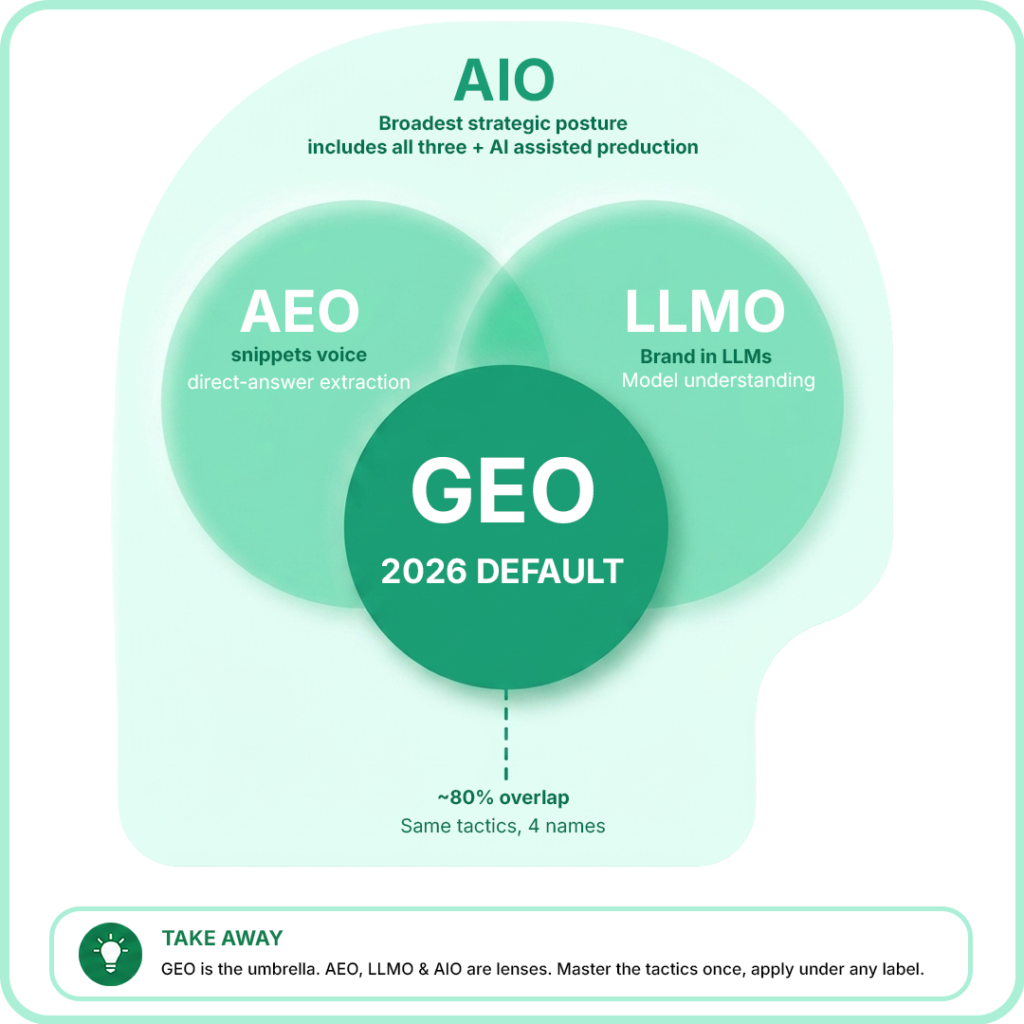
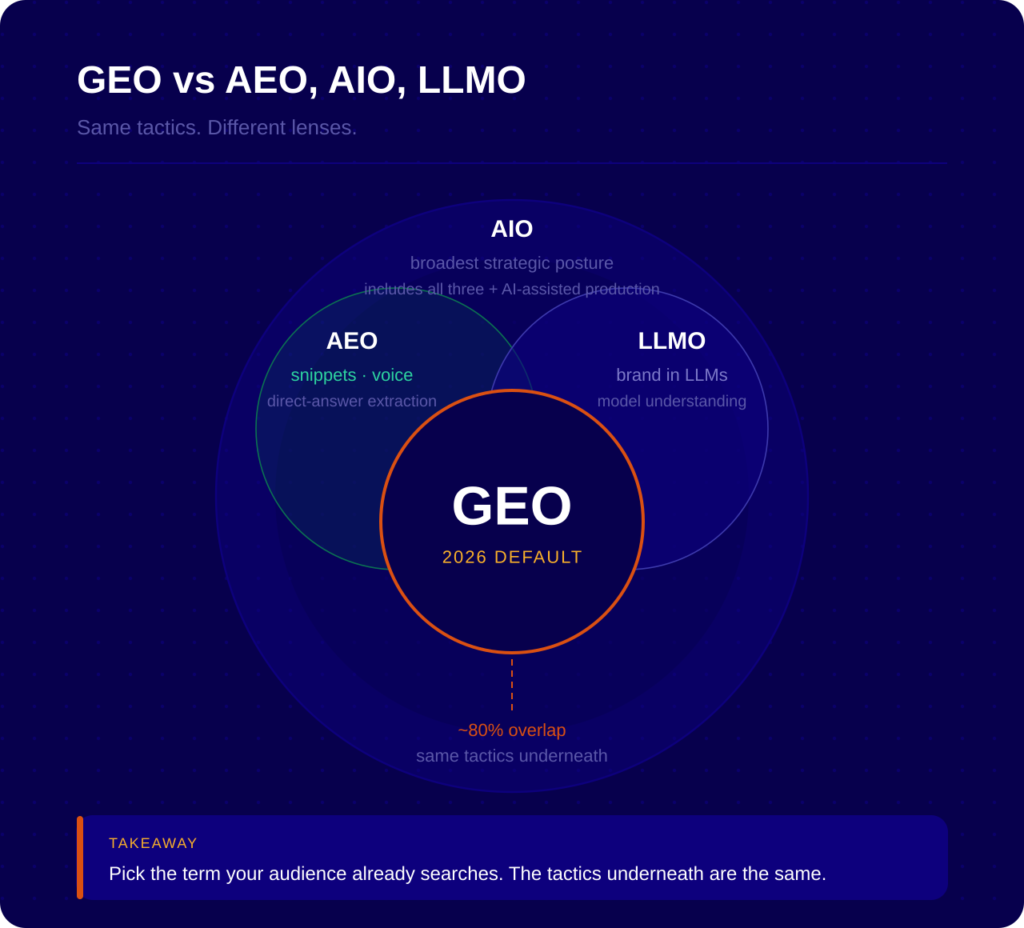
You will see four acronyms used almost interchangeably across the industry: GEO, AEO (Answer Engine Optimization), AIO (AI Optimization), and LLMO (Large Language Model Optimization). The truth is that these terms overlap by roughly 80 percent and describe the same fundamental shift through different lenses. GEO is the most academically grounded and is becoming the default umbrella term in 2026. AEO leans toward direct-answer extraction in featured snippets and voice. LLMO focuses on the underlying language model’s understanding of your brand. AIO is the broader strategic posture covering all three plus AI-assisted content production. For the rest of this guide we use GEO as the primary term, with the understanding that the practices apply equally if your team uses any of the other labels.
Takeaway: Pick the term your audience already searches. The tactics underneath are the same.
Why GEO is the single biggest shift in marketing since SEO
The shift to AI search is not coming. It has already happened.
By February 2026, ChatGPT had reached 900 million weekly active users, up from 400 million the year before. (TechCrunch, 2026) Users now send 2.5 billion prompts every day. A meaningful share of those prompts are exactly the questions a buyer used to type into Google.
Gartner predicted in 2024 that traditional search engine volume would drop 25 percent by the end of 2026 as users migrated to AI answer engines. (Gartner, 2024) The data since then has tracked that prediction closely.
The three things this shift breaks
There are 3 ways this shift breaks the old marketing playbook.
- The click is no longer the conversion event. Buyers research, compare, and form opinions inside the AI’s response. They arrive at your site already decided, or they never arrive at all.
- Rankings stop predicting revenue. A page ranked third on Google can be cited more often by ChatGPT than the page ranked first. Different engines, different signals.
- The brand citation becomes the new impression. Being mentioned in an AI answer is the new top-of-funnel touchpoint, and your competitors are competing for that mention in real time.
The compounding advantage problem
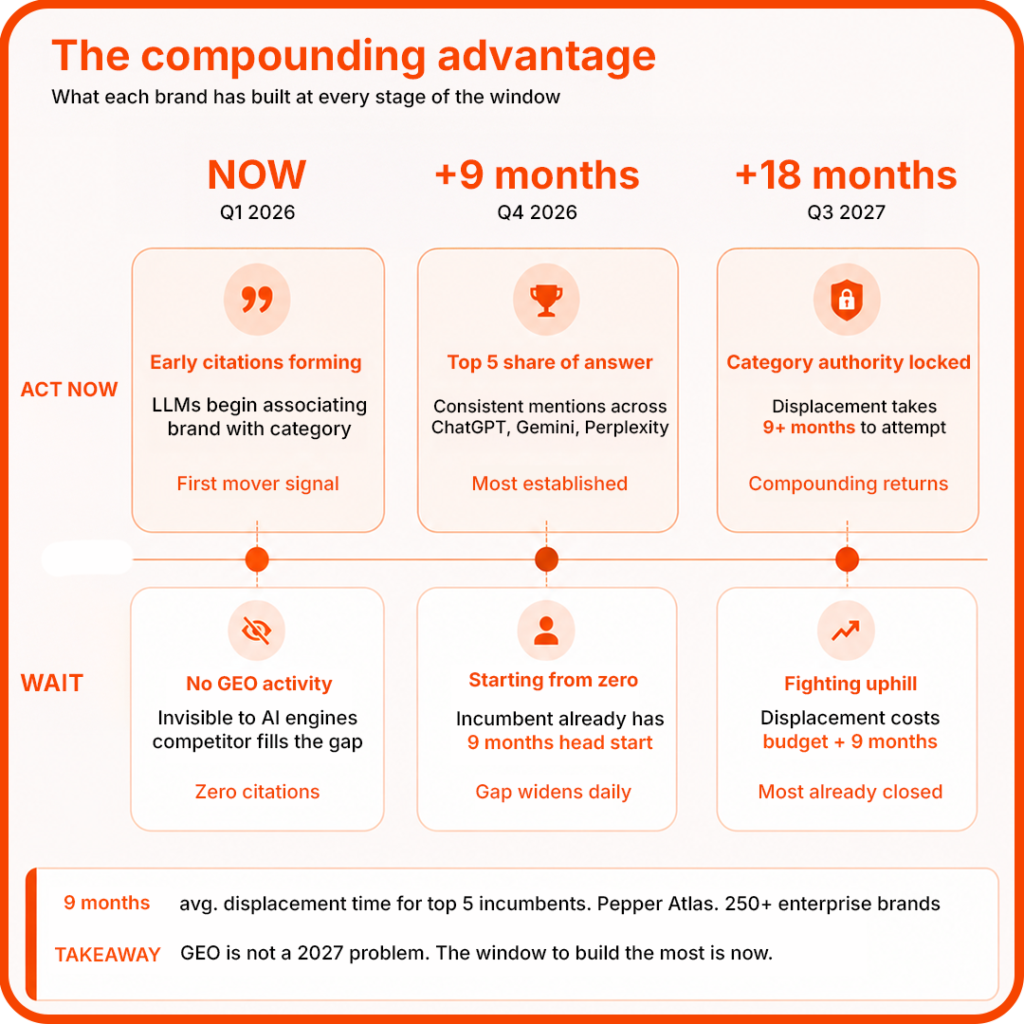
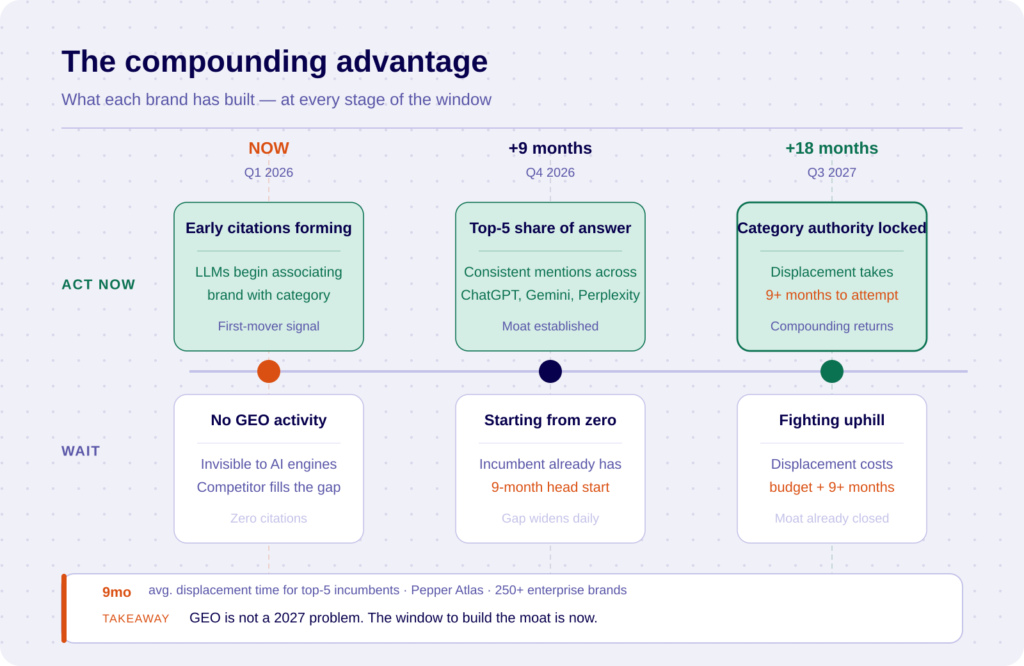
GEO is not like paid ads. Once an LLM learns to trust and cite your brand, it keeps citing you, often without ongoing spend. Brands that get into AI answers in 2026 are building a moat that will be extremely hard to close in 18 months. Pepper’s Atlas Brand Report tracking 250+ enterprise brands across ChatGPT, Gemini, and Perplexity shows that once a brand reaches top-5 share of answer in a theme, displacement by a late-entry competitor takes 9 months or more on average. [INSERT PEPPER PROPRIETARY STAT: Atlas data on time-to-displacement for incumbents]
Takeaway: GEO is not a 2027 problem. The brands acting now are building the citation graph that will define their category for years.
How GEO actually works: inside an AI engine’s decision
To win at GEO, you need to understand the mechanics. There are two distinct pipelines that decide whether your brand appears in an AI answer.
Training-time knowledge
During pre-training, models like GPT, Claude, and Gemini ingest hundreds of billions of web pages from Common Crawl, Wikipedia, Reddit, GitHub, YouTube transcripts, and high-authority publications. They build a statistical model of which brands exist, what they do, and how authoritative they seem.
A brand gets into training data by being mentioned frequently, consistently, and authoritatively across the open web. Brands missing from training data effectively do not exist to the model, no matter how excellent your website is.
Retrieval-time knowledge (RAG)
Perplexity, ChatGPT Search, Bing Copilot, and Gemini all use Retrieval-Augmented Generation (RAG). When a user asks a question, the system does a live web search, fetches the top results, chunks them into 300 to 500 word segments, scores those segments for relevance, synthesizes an answer, and cites the sources it used.
This is the layer most GEO work targets. Every page you publish today can be in the retrieval set tomorrow if it is structured correctly.
The 5 factors that determine LLM retrieval (Pepper’s framework)
Pepper’s GEO research, drawn from analysis of 250+ enterprise brand audits using the Atlas platform, identified the five factors that determine how a piece of content gets retrieved and cited.
| Factor | What it means |
|---|---|
| Chunking | Content structured so 300 to 500 word segments each answer a complete question. Clear H2/H3 headers, short paragraphs, definitions. |
| Structure | Headers, bullet points, numbered lists, tables, and FAQ sections. LLMs extract structured content more reliably than walls of text. |
| Schema markup | Organization, Article, FAQ, SoftwareApplication, Person, and DefinedTerm schemas tell AI crawlers what each page is about. |
| Source weight | LLMs weight citations from YouTube, LinkedIn, Reddit, G2, and high-DA publishers far more than they weight brand websites. |
| Trust signals | E-E-A-T: named authors with credentials, dated sources, Wikipedia entity, press coverage, customer proof. |
Citation weight by source type
Not every channel carries the same weight in an AI’s decision. Pepper’s analysis of LLM citation patterns identifies the following weights.
| Content type | LLM citation weight |
|---|---|
| Authoritative lists (“Best X for Y”) | 40 to 65% |
| Directories and review sites (G2, Capterra) | 20 to 70% |
| Reviews and ratings | 20 to 35% |
| Customer case studies | 10 to 15% |
| Awards and industry recognition | 5 to 20% |
| Social sentiment (Reddit, Quora) | 10% |
Takeaway: The single biggest leverage point in most GEO programs is third-party presence. AI engines trust other people’s content about your brand more than they trust your own.
Pepper’s GEO framework: Visibility, Citability, Retrievability
Pepper’s three-stage GEO framework is the spine of every brand audit and engagement we run. It compresses dozens of tactics into three sequenced questions every team can answer.
1. Visibility: do the LLMs even know you exist?
This is the entity layer. LLMs build their understanding of your brand from Wikipedia, Wikidata, Crunchbase, G2, press mentions, and the broader citation graph. If those signals are missing or stale, the model has nothing to draw on.
Visibility actions include: publishing or claiming a Wikipedia page, creating a Wikidata entity, completing G2 and Capterra listings, securing press coverage in publications LLMs already cite, and ensuring entity consistency across owned channels.
2. Citability: is your content worth quoting?
This is the content layer. Once the model knows you exist, it has to decide whether your content is worth lifting into an answer. Citable content has named authors, dated sources, original data, clear definitions, comparison structures, and FAQ blocks.
Citability actions include: publishing definitional pillar pages, comparison and alternatives pages, original research reports, expert-bylined blog posts, customer case studies with named outcomes, and FAQ sections at the end of every key page.
3. Retrievability: can crawlers actually find and parse you?
This is the technical layer. Even the best content fails if AI crawlers cannot reach it, parse it, or understand its structure. Retrievability covers the plumbing.
Retrievability actions include: deploying llms.txt at your root domain, implementing Organization, Article, FAQ, SoftwareApplication, Person, and DefinedTerm schema, restructuring pages for clean 300 to 500 word chunking, submitting sitemaps to Bing (which powers ChatGPT and Copilot), and using IndexNow for instant indexing.
Takeaway: Visibility, Citability, and Retrievability are sequenced for a reason. Skip Visibility and your perfect content has no entity to attach to. Skip Retrievability and AI crawlers cannot find the citable content you worked so hard to produce.
Search Everywhere Optimization: the bigger picture GEO sits inside
Search Everywhere Optimization is the term Pepper coined at the Index’25 GEO Growth Summit to describe the reality that buyers no longer search in one place. They ask ChatGPT, scroll Reddit, watch YouTube reviews, search LinkedIn for opinions, browse Perplexity for comparisons, and finally Google to confirm. A modern visibility strategy has to cover every one of those surfaces.
GEO is one surface inside this larger framework. The six surfaces are:
| Surface | What it covers | Example query |
|---|---|---|
| GEO (Generative Engine Optimization) | ChatGPT, Perplexity, Gemini, Claude | “What is the best content marketing platform for enterprise?” |
| AEO (Answer Engine Optimization) | Google AI Overviews, featured snippets | “How to do GEO” |
| LLMO (LLM Optimization) | Training data, entity recognition | The model’s underlying knowledge of your brand |
| Traditional SEO | Google organic search | “Content marketing agency” |
| YouTube Search | YouTube’s own search + Google video | “GEO tutorial” |
| Social/Community Search | Reddit, Quora, LinkedIn search | “GEO for SaaS, what’s actually working?” |
Takeaway: Treating GEO as a content silo misses the point. Pepper’s Search Everywhere Optimization framework forces every brand decision to be evaluated against every surface a buyer might use.
[INSERT PEPPER LEADERSHIP QUOTE FROM ANIRUDH SINGLA OR KUNAL: on why one-surface optimization is a losing strategy in 2026]
How measurement and tracking are changing
If GEO breaks the click as the conversion event, it also breaks the metrics most teams report on. Traffic, keyword rank, and click-through rate are no longer enough.
The new GEO KPIs
The metrics that matter in a GEO-first measurement model are these.
| Old KPI (SEO) | New KPI (GEO) | What it measures |
|---|---|---|
| Organic traffic | Share of Answer | The percentage of AI responses for a target theme that mention your brand |
| Keyword rank | Citation count | How often your domain is cited as a source across ChatGPT, Perplexity, Gemini |
| CTR | Sentiment score | Whether AI responses describe your brand positively, neutrally, or negatively |
| Backlinks | Source weight presence | Whether you appear on the third-party sources LLMs trust (YouTube, LinkedIn, Reddit, G2, Wikipedia) |
| Bounce rate | Hallucination rate | How often AI engines invent or misstate facts about your brand |
| Conversions | Assisted AI conversions | Pipeline traceable to AI-influenced research sessions (UTM, self-reported source, post-purchase survey) |
Share of Answer: the new board-level metric
Share of Answer is Pepper’s term for the percentage of AI responses for a tracked theme that cite or mention your brand. If 100 buyers ask ChatGPT “what is the best content marketing platform for enterprise” and your brand appears in 12 of those responses, your Share of Answer is 12 percent. This is the metric replacing keyword rank in 2026 CMO reports. [INSERT PEPPER PROPRIETARY STAT: average Share of Answer across enterprise SaaS, BFSI, and e-commerce categories from Atlas]
How tracking actually works
Tracking GEO requires a different stack than tracking SEO. The standard SEO stack (Ahrefs, SEMrush, Search Console) tells you about Google. It does not tell you whether ChatGPT, Perplexity, Gemini, or Claude cite you.
Atlas is Pepper’s proprietary GEO tracking platform. It runs scheduled prompts across ChatGPT, Gemini, Perplexity, and Claude on behalf of brands, captures whether they are cited, scores citation context (positive, neutral, negative), and surfaces the third-party sources the model used to construct each answer. The same logic can be built in-house with custom prompt suites and manual auditing, though most enterprise teams find the time investment difficult to sustain.
The honest measurement reality
The black box is real. AI engines update retrieval logic frequently, sometimes weekly. Source preferences shift without notice. A theme you dominate in March can lose 30 percent of citations in April without an obvious cause.
The teams winning this are the ones who treat measurement as continuous rather than periodic, who audit Share of Answer weekly for priority themes, and who hold a backlog of citability improvements ready to ship the moment a dip appears.
Takeaway: If you cannot answer “what is our Share of Answer for our top 10 themes” today, that is your starting point. Everything else flows from there.
GEO for B2B SaaS
Why it matters for SaaS: The B2B SaaS buyer journey is now AI-mediated. VP Marketing wants to choose between three vendors. They ask ChatGPT “what is the best [category] tool for [use case]” before they ever land on a vendor site. Vendors that appear in that response have a 40 to 60 percent higher chance of making the shortlist. Vendors that do not appear are effectively invisible at the moment of consideration.
What works for SaaS
- Comparison and alternatives pages. “[Competitor] alternatives” and “[Competitor] vs [you]” are the highest-citation content types for SaaS categories. Pepper’s analysis shows these pages account for over 40 percent of category-level citations in ChatGPT.
- G2 and Capterra reviews. Reviews carry 20 to 35 percent citation weight. G2 alone drives 14 average citation pages per category. Aggressive review acceleration in the first 90 days of a GEO program is the fastest path to first citation.
- Original benchmark data. SaaS buyers want numbers. A category benchmark report (response time, NPS, churn, ROI) is high-citation content because it gives AI engines specific facts to lift.
- Customer case studies with named outcomes. “$330K renewal, two years running” is more citable than “drove growth.”
A Pepper case study
When Pepper applied this playbook to Freshworks, the goal was to compete for share of voice in ChatGPT against Zendesk and ServiceNow inside the customer experience category. Within an annual engagement, Freshworks reached top-3 citation share for priority themes and renewed the program for a second year at $330K. [Source: Pepper client engagement, 2025; full case study at /case-study/freshworks]
For Atlassian, Pepper-written articles generated 2.8x more average clicks per article than non-Pepper content, driven by structural and citability improvements that mapped exactly to the five LLM retrieval factors above.
Takeaway: For B2B SaaS, GEO is now a procurement-stage variable. Show up in the AI answer, or watch the shortlist form without you.
GEO for BFSI (banking, financial services, insurance)
Why it matters for BFSI: Financial decisions are high-stakes, and buyers are deeply skeptical. They cross-check claims across multiple sources. AI engines know this, which is why BFSI is one of the most trust-weighted categories in retrieval. Brands with strong E-E-A-T signals dominate. Brands without them are invisible no matter how much they spend on paid media.
What works for BFSI
- Compliance-safe content with named experts. Every page should be bylined by a credentialed author (CFA, CFP, licensed advisor, named underwriter). LLMs weight expert attribution heavily in YMYL (Your Money or Your Life) categories.
- Dated sources from regulators and industry bodies. Citations from the SEC, IRDAI, RBI, Fed, FCA, or recognized industry analysts carry more weight than internal blog links. Pepper’s audit work in financial services consistently finds regulator-cited content gets retrieved at 2x the rate of self-cited content.
- Plain-language definitions of complex products. AI engines reward content that turns jargon into clear, extractable explanations. A page that defines “indexed universal life insurance” in 60 plain-language words will outperform a 3,000-word product brochure for citation purposes.
- Customer outcomes with verifiable specifics. Specific metrics build trust. Vague claims do not.
A Pepper case study
For Mutual of Omaha, a Fortune 300 insurance brand, Pepper executed a GEO and SEO program that delivered 189 percent month-over-month click growth and 199 percent impression growth in six months. The core moves were applying the Visibility-Citability-Retrievability framework to a previously commodity content footprint, restructuring existing product pages for chunking, adding expert bylines, and earning third-party citations in financial industry publications. [Source: Pepper client engagement, 2025; full case study at /case-study/mutual-of-omaha]
Takeaway: In BFSI, trust signals are not a nice-to-have. They are the primary GEO lever. Compliance-safe expert content outperforms slick brand content every time.
GEO for e-commerce
Why it matters for e-commerce: Product discovery is moving into AI faster than any other category. Shoppers ask Perplexity “what is the best [product] for [use case] under [budget]” and act on the answer. AI shopping agents (ChatGPT Shopping, Perplexity Shopping, Amazon Rufus) increasingly mediate the entire research-to-purchase loop. If your products are not in those answers, you are losing share.
What works for e-commerce
- Programmatic SEO at scale, restructured for GEO. Category and use-case pages need to be both rankable and citable. The same pages that win Google organic can be rebuilt to win AI shopping queries with structured comparison data, review schema, and clean attribute markup.
- Rich product schema. Product, Offer, Review, and AggregateRating schemas help AI engines parse your catalog as structured retail data rather than marketing copy.
- User-generated review depth. Reviews carry 20 to 35 percent citation weight. E-commerce brands with thin review profiles lose to brands with deep, structured review pages even at lower price points.
- Comparison and gift-guide content. “Best [category] for [persona]” gift guides and head-to-head product comparisons are heavily retrieved by AI shopping engines.
A Pepper case study
For Instacart, Pepper built 30,000 programmatic SEO pages targeting product-category and use-case queries. The result was a meaningful shift of demand from paid performance marketing to organic discovery, reducing CAC and creating a discovery asset that compounds as AI shopping grows. [Source: Pepper client engagement, 2024-2025]
For Lakmé, Pepper applied the same approach to beauty category discovery, building citable product and tutorial content that performs across both Google organic and AI shopping surfaces.
Takeaway: E-commerce GEO is programmatic by necessity. The teams that win are the ones treating every product page as a citable entity, not as a brochure.
GEO for healthcare and life sciences
Why it matters for healthcare: Healthcare queries are the deepest YMYL category in AI search. Engines apply the strictest trust filters here. Medical credentials, citation depth, and regulatory alignment are all weighted heavily, and content that gets these wrong is filtered out entirely.
What works for healthcare
- Credentialed medical reviewers on every page. Pages bylined or reviewed by MDs, RNs, RDs, or licensed clinicians are retrieved at significantly higher rates than unattributed content.
- Citations from PubMed, NIH, WHO, CDC, and recognized journals. These are the source weights AI engines trust in medical contexts. Internal cross-links carry minimal weight here.
- Structured medical schema. MedicalCondition, Drug, MedicalProcedure, and similar Schema.org types create explicit semantic relationships that aid retrieval.
- Patient-friendly language layered over clinical accuracy. AI engines reward content that translates clinical accuracy into accessible explanations without losing precision.
A Pepper case study
For Apollo Hospitals, India’s largest healthcare chain, Pepper built a structured healthcare content footprint that delivered 2x organic orders in six months. The work combined clinical accuracy, patient-friendly explanations, and the technical retrievability foundation from Pepper’s GEO framework. [Source: Pepper client engagement, 2025]
Takeaway: Healthcare GEO is unforgiving. The credential and citation bar is higher than any other category, and the brands that meet it earn an outsized share of the answer space.
GEO for enterprise (across industries)
Why enterprise is different: Enterprise GEO is less about which tactics to deploy and more about governance, scale, and managing fragmentation across business units, regions, and product lines. A single Fortune 500 brand may have 50+ sub-brands, 15+ content owners, and dozens of legacy properties with conflicting messaging. AI engines see all of it and average the signals.
What works for enterprise
- Centralized governance with distributed execution. A single GEO standards document (definitions, schema templates, citability requirements, brand voice) executed by individual business units.
- Content consolidation before scaling. Most enterprises have hundreds of legacy pages diluting their authority. Consolidating, redirecting, or retiring weak content often produces more citation lift than publishing new content.
- Cross-property entity consistency. The same brand should appear with the same definition, the same product names, and the same hierarchy across every property the model crawls.
- Managed vs in-house decision. Enterprises typically need either a centralized GEO function with executive sponsorship, or a managed partner who can operate at scale. Hybrid models without clear ownership consistently underperform.
Takeaway: Enterprise GEO is an operations problem disguised as a content problem. Solve governance first, then scale.
The challenges every brand will face with GEO
GEO is a real practice with real returns, and it also comes with challenges that SEO veterans should not underestimate.
1. The black box problem
AI engines do not publish their retrieval logic. Source preferences shift without notice. A tactic that drove 20 percent more citations in March may stop working in May. The only response is continuous monitoring and a culture of experimentation.
2. Velocity is faster than SEO
In traditional SEO, you can ship a quarterly playbook and reasonably expect it to hold. In GEO, the cycle is monthly at most. Models update. Retrieval indexes refresh weekly. Competitors ship comparison pages in 14 days that take you a quarter to match.
3. Hallucination risk
AI engines invent facts about your brand. They cite competitors as you. They attribute products you do not sell to you. Pepper’s Atlas tracking finds hallucination rates of 8 to 14 percent across enterprise brands in any given month, with higher rates in categories where the brand has weak source coverage. Catching and correcting hallucinations is now a marketing operations function.
4. Measurement maturity is low
Most marketing teams do not yet have the data infrastructure to measure Share of Answer, citation count, and sentiment in a consistent way. The teams that do have a 6 to 12 month head start.
5. ROI attribution is harder
AI-influenced sessions often arrive at your site already decided. They do not show up as ChatGPT referrals because most AI engines do not pass referrer data. Attribution requires UTM discipline, self-reported source surveys, and an organizational willingness to credit influence rather than just direct clicks.
Takeaway: GEO is not free, fast, or fully predictable. Brands that go in with that expectation are the ones that build durable programs.
GEO best practices: what actually moves the needle
Below are the best practices Pepper has validated across 250+ enterprise brand audits. They map directly to the Visibility, Citability, and Retrievability framework above.
Content best practices
- Lead every key page with a 40 to 60 word direct answer. AI engines extract front-loaded answers for snippets and citations.
- Use question-format H2s and H3s. Mirror how buyers actually phrase queries.
- Keep paragraphs to two or three sentences. Walls of text do not chunk cleanly.
- Include at least one original statistic per page. The Princeton GEO study found statistics addition lifts citations by 41 percent.
- Cite credible third-party sources with dates. Source-citing lifts visibility by 115 percent for lower-ranked pages.
- Add an FAQ block at the end of every key page. FAQ schema is the most consistently extracted format across all major engines.
- Use named expert bylines. Anonymous content carries less trust weight than expert-attributed content.
Distribution best practices
- Build presence on the sources AI engines trust most. YouTube (95 average citation pages), LinkedIn (45), Reddit (44), G2 (14), Wikipedia.
- Publish LinkedIn Articles in addition to text posts. Articles are indexed and citable. Standard posts disappear from feeds within 24 hours.
- Show up on Reddit and Quora as a credible community member. Direct promotion gets you downvoted. Genuine expertise gets you cited.
- Accelerate G2 reviews aggressively in the first 90 days. Reviews compound. Brands that start in month one are ahead of competitors who delay.
- Earn press placements in publications AI engines already cite. One placement in a high-citation publication can generate more downstream citation lift than three months of blog content.
Technical best practices
- Deploy llms.txt at your root domain. This is the emerging robots.txt equivalent for AI crawlers.
- Implement Organization, Article, FAQ, SoftwareApplication, Person, and DefinedTerm schema. Each tells AI engines something specific about your pages.
- Submit your sitemap to Bing. Bing powers ChatGPT Search and Copilot.
- Use IndexNow for instant indexing. Faster index updates mean faster retrieval inclusion.
- Restructure legacy pages for chunking. A 3,000-word wall of text is invisible to RAG. The same content rebuilt with H2/H3 structure and short paragraphs becomes retrievable.
Takeaway: None of these practices are exotic. The differentiator is execution discipline. Most brands know what to do. Very few actually do it consistently.
How to prepare your brand for GEO: a 90-day plan
If you are starting from zero, the 90-day plan below is the sequence Pepper uses with enterprise clients in the first quarter of an engagement. It moves you from invisible to citable.
Days 0 to 30: Foundation and audit
- Audit your current Share of Answer for top 10 themes. Run priority prompts manually across ChatGPT, Perplexity, Gemini, and Claude. Document who is being cited and why.
- Identify the third-party sources your category cites most. Atlas or manual review surfaces the YouTube channels, Reddit threads, G2 lists, and publications that AI engines pull from.
- Deploy technical foundation. llms.txt, Organization and SoftwareApplication schema, Bing Webmaster, IndexNow, Wikidata entity, complete G2 listing.
- Inventory existing content. Identify pages that are close to citable (rank well but lack structure) versus pages that should be retired or consolidated.
Days 31 to 60: Build the citable layer
- Publish your definitional pillar page. A /geo or category-equivalent page that defines your space and positions your brand as the authority.
- Build 3 to 6 comparison and alternatives pages. Highest-citation content type for any category.
- Publish 4 to 5 case study pages with named outcomes. Specific stats, named clients (where permitted), structured proof.
- Restructure your 10 highest-traffic existing pages. Add direct-answer leads, FAQ blocks, schema, dated sources, expert bylines.
- Launch your YouTube channel with 4 foundation videos. Definitional, comparison, demo, hot take.
Days 61 to 90: Distribute and measure
- Accelerate G2 reviews. Target 25+ reviews in the quarter.
- Begin earning press. Pitch one State of [your category] data story to publications AI engines already cite.
- Start LinkedIn and Reddit cadence. 2 LinkedIn Articles per month from a named executive, 5 to 7 helpful Reddit comments per week.
- Set up your Share of Answer dashboard. Weekly tracking across priority themes.
- Run the first iteration cycle. Identify the lowest-Share-of-Answer themes and ship targeted improvements.
Takeaway: Most brands try to do all of this at once and stall. The brands that win sequence the work: foundation first, citable layer second, distribution third. Measurement runs continuously underneath.
[INSERT PEPPER LEADERSHIP QUOTE FROM ANIRUDH SINGLA: on what 250+ brand audits taught about where teams typically get stuck in the first 90 days]
Frequently asked questions about GEO
What is GEO in simple terms?
GEO (Generative Engine Optimization) is the practice of structuring your brand and content so AI engines like ChatGPT, Perplexity, and Google AI Overviews cite you when answering user questions. It replaces the SEO goal of ranking with the goal of being quoted inside the AI’s answer.
What is the difference between GEO and SEO?
SEO optimizes for being ranked on a search engine results page. GEO optimizes for being cited inside a synthesized AI answer. SEO drives clicks to your site. GEO drives mentions and influence inside the AI’s response. Most brands need both, because Google still drives meaningful traffic while AI engines are becoming the discovery layer for category and comparison queries.
How do I know if my brand is showing up in ChatGPT or Perplexity?
You can audit manually by running your top 10 to 20 buyer prompts across each AI engine and noting whether your brand is cited. For ongoing tracking, you need a GEO platform like Atlas that runs scheduled prompts across ChatGPT, Gemini, Perplexity, and Claude and reports citation share, sentiment, and source weight automatically.
How long does GEO take to show results?
Most enterprise brands see first meaningful citations within 60 to 90 days once the foundational work is in place (llms.txt, schema, comparison pages, G2 reviews, first case studies, initial YouTube and LinkedIn cadence). Reaching top-5 Share of Answer for priority themes typically takes 6 to 9 months of consistent execution.
What is Share of Answer?
Share of Answer is the percentage of AI responses for a target theme that mention or cite your brand. It is the metric replacing keyword rank as the primary GEO KPI. If 100 buyers ask ChatGPT a category question and your brand is cited in 15 responses, your Share of Answer for that theme is 15 percent.
Do backlinks still matter in GEO?
Backlinks still signal authority, but raw link volume matters less than presence on the specific third-party sources AI engines trust (YouTube, LinkedIn, Reddit, G2, Wikipedia, recognized industry publications). One placement in a high-citation publication outweighs dozens of low-trust backlinks.
Should I optimize for ChatGPT, Perplexity, or Gemini first?
Optimize for all of them in parallel. The good news is that the underlying practices overlap by roughly 90 percent. Front-loaded answers, structured content, schema, third-party presence, and trust signals lift citations across all major engines.
Will GEO replace SEO?
No, but the balance is shifting fast. Gartner forecasts a 25 percent drop in traditional search volume by the end of 2026. SEO will continue to drive direct traffic. GEO will drive an increasing share of discovery and consideration that used to happen on the SERP. Most enterprise brands now run GEO and SEO as a single integrated function.
Is GEO different for different industries?
The core principles are the same across industries. The emphasis shifts. B2B SaaS leans on comparison pages and G2 reviews. BFSI leans on expert credentials and regulator citations. E-commerce leans on programmatic scale and review depth. Healthcare leans on clinical credentials and PubMed citations. The frameworks in this guide cover all four with industry-specific tactics.
Can I do GEO in-house, or do I need a partner?
Both paths work. In-house GEO requires a dedicated GEO lead, a content function, technical SEO support, and a measurement stack. Managed partners like Pepper bring proven playbooks, a tracking platform (Atlas), and execution capacity. Most enterprises start with a managed engagement for the first 6 to 12 months to compress the learning curve, then internalize.
What is the single most important GEO action I can take this week?
Audit your current Share of Answer for your top 5 buyer prompts across ChatGPT and Perplexity. Document who is being cited and what they have that you do not. Almost every other GEO decision becomes obvious once you see your starting position.
Where to go next
GEO is the most important shift in marketing since SEO emerged. The brands that act in 2026 will own their category citation graph for years. The brands that wait will be playing catch-up against compounding incumbent advantage.
If you want to move from understanding GEO to executing it, the first step is a Share of Answer audit of your top 10 themes. Pepper’s Atlas platform runs this across ChatGPT, Gemini, Perplexity, and Claude and surfaces exactly where your brand stands today and what your competitors are doing differently.
Get your GEO audit → [INSERT PEPPER CTA LINK: free GEO audit / Atlas demo / Index’26 resource hub]
This guide was written by Anirudh Singla, Founder & CEO at Pepper, and the Pepper Editorial Team. Last updated June 3, 2026. The frameworks referenced here (Visibility-Citability-Retrievability, Search Everywhere Optimization, Share of Answer) are proprietary to Pepper and were developed across 250+ enterprise brand audits and the Index’25 and Index’26 GEO Growth Summits. For original Pepper research, event recordings, and case studies, visit the Pepper Resource Hub.
Sources:
- Aggarwal, P. et al. GEO: Generative Engine Optimization. ACM SIGKDD, 2024. arxiv.org/abs/2311.09735
- Gartner. Gartner Predicts Search Engine Volume Will Drop 25% by 2026. February 2024. gartner.com
- TechCrunch. ChatGPT reaches 900M weekly active users. February 2026. techcrunch.com
- Pepper Atlas Brand Report and 250+ enterprise audit dataset, 2025-2026 (proprietary).
- Pepper Index’25 and Index’26 GEO Growth Summits (proprietary frameworks and panel content).
Latest Blogs
Most advice on this is inference dressed as fact. OpenAI documents exactly one thing clearly, which is access. Here is what is documented, what is inferred, and how to verify the rest for yourself.
Being named in an AI answer and having your page used as its source are different outcomes with different causes and different fixes. The gap between them is the most useful diagnostic in AI search, and most reporting collapses it into one number.
Every platform reports share of voice and almost none of them define it the same way. Here is the definition worth using, the three choices that change the number, and how to measure it yourself without buying anything.
Get your hands on the latest news!

Similar Posts
GEO / AI Search
10 mins read
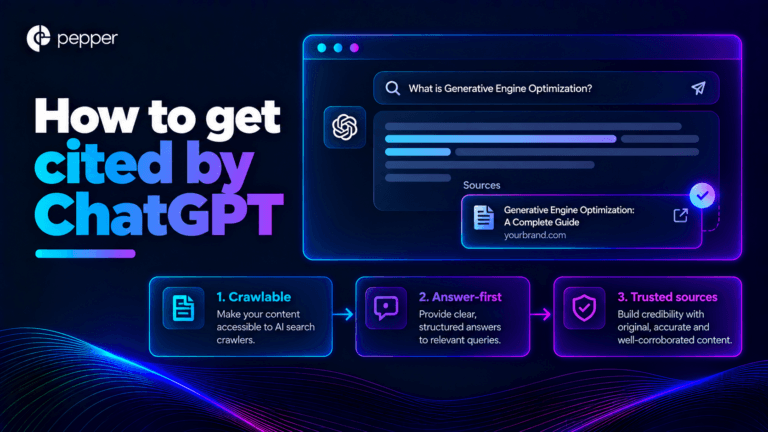
How to get cited by ChatGPT
GEO / AI Search
10 mins read
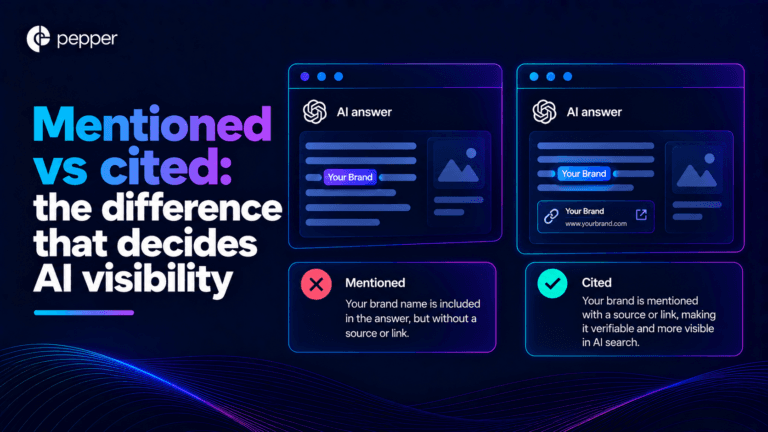
Mentioned vs cited: the difference that decides AI visibility
GEO / AI Search
13 mins read