Share of voice in AI search: how to define it and how to measure it
Two platforms can report your share of voice on the same day and give you different numbers. Neither is wrong. They are answering different questions, and nobody tells you which one you bought.
The short answer
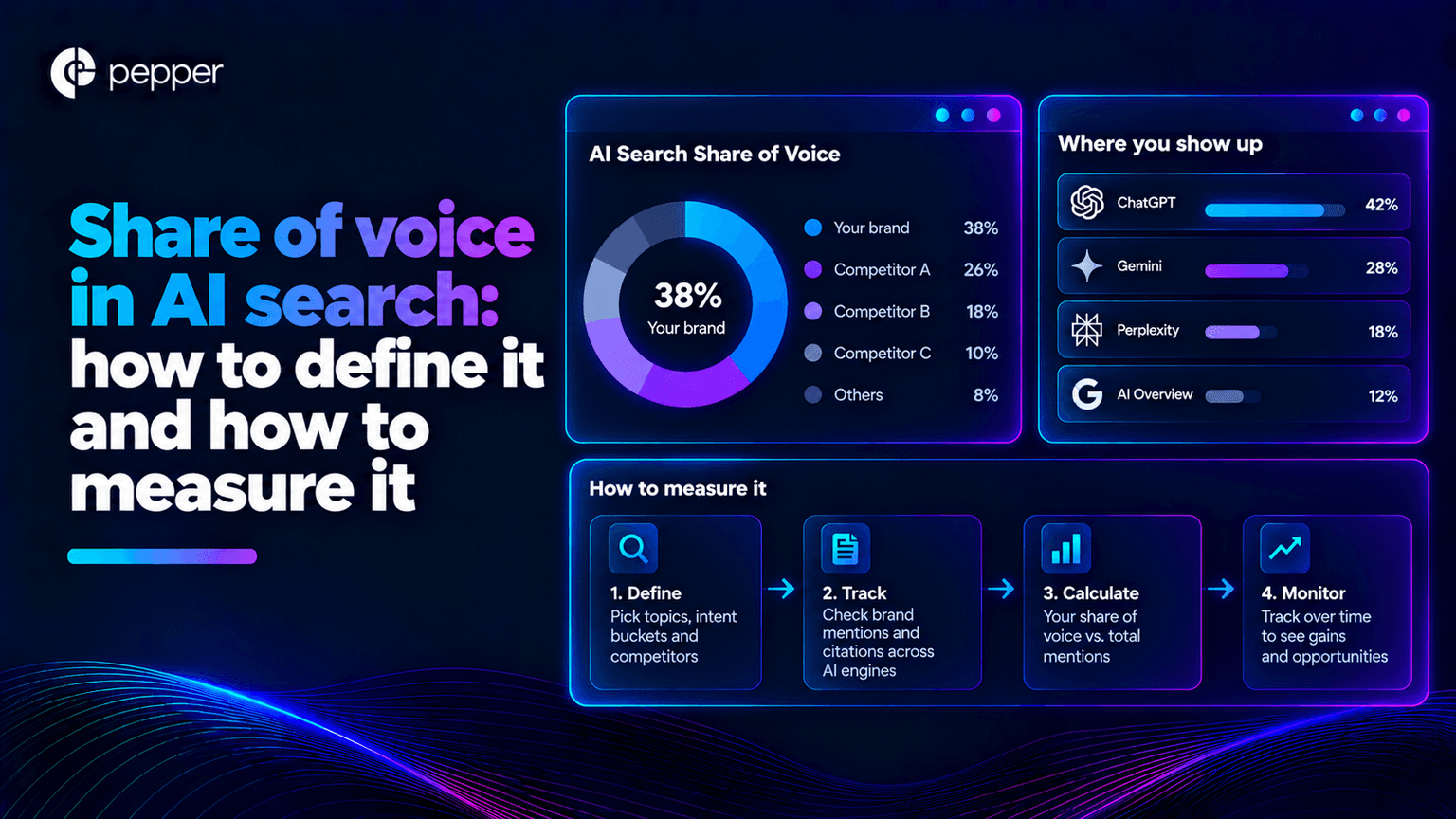
Share of voice in AI search is your brand’s slice of all brand mentions across a set of AI answers. The idea is simple. Three choices buried inside it are what stop one tool’s number matching another’s.
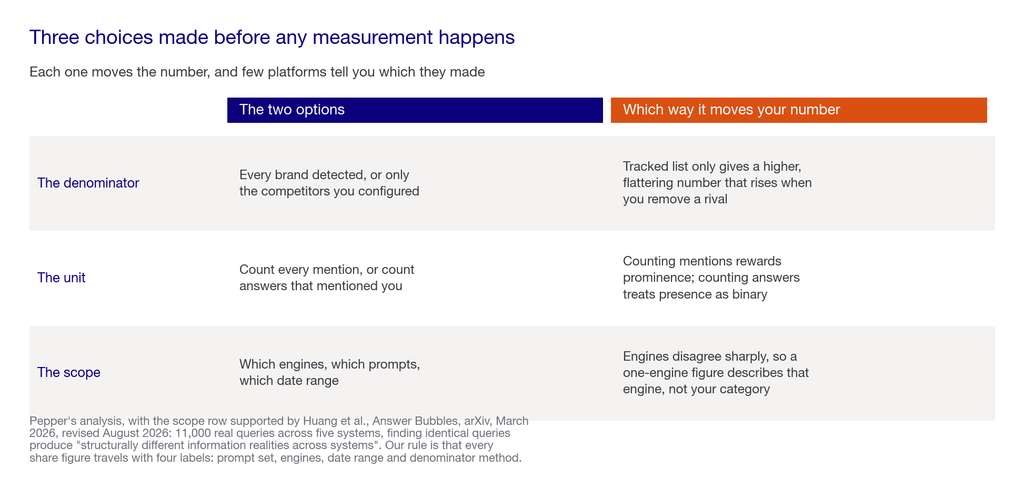
Three decisions change the figure before any measurement happens.
- The denominator. Every brand the engines named, or only the competitors you listed? Counting all brands gives a lower, more honest number. Counting your tracked list flatters you.
- The unit. Mentions, or answers? Counting every mention rewards a brand named three times in one answer. Counting answers treats presence as binary.
- The scope. Which engines, which prompts, which days. A figure from one engine over one week is a real number about a very small world.
The definition we would use. Your brand’s mentions divided by the total mentions of every brand detected, across a fixed prompt set, on named engines, over at least two weeks. State all four of those alongside the number or it cannot be compared with anything, including your own figure from last quarter.
Pepper is an agentic organic growth engine, not an SEO agency. This page comes out of what we run: organic for more than 250 enterprises across eight years, more than 10 million tracked prompts, and the questions buyers put to us in client reviews. Customers log in and run the platform themselves, with a Pepper growth team attached. Book a growth audit and we will measure your category rather than hand you a benchmark.
Key takeaways
Key takeaways before you quote the number to anyone.
- It is relative, so it moves when others move. Your share can fall in a quarter where everything about you improved.
- The denominator is the biggest variable. All brands detected, or only your tracked list, and the gap between those two is often large.
- Mentions and answers are different units. Decide which you are counting and never mix them in one trend line.
- One engine is not the category. Research across 11,000 queries found identical questions produce different source sets on different systems.
- There is no good benchmark. Thirty per cent can be excellent in a fragmented category and poor in a concentrated one.
- You can measure it free. Twenty prompts, two engines, a spreadsheet, an afternoon.
What is share of voice in AI search?
Share of voice in AI search is the share of brand mentions in a set of AI answers that belong to you. So it is the AI version of the old media metric, applied to answers rather than press coverage.
It answers one question. Of everything the engine said about this category, how much was about us?
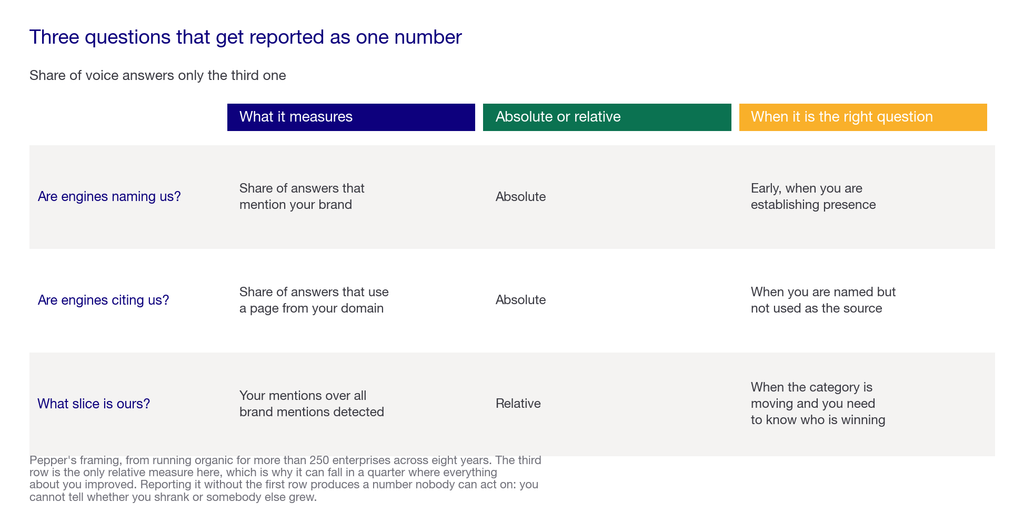
That is different from the two other questions worth asking, and all three get reported together.
- Are engines naming us at all? An absolute question: the percentage of answers that mention your brand.
- Are engines citing our pages? A different absolute question, with a different cause and a different fix. We separate the two in what is brand visibility in AI.
- What slice of the conversation is ours? The relative question, which is share of voice.
Where it falls short. Share of voice treats every mention as equal. A mention as the cheap option and a mention as the leader both count once. No tool in this market tells them apart. So read the answers, not just the rates. Tone and position are where the commercial truth usually sits.
The three choices that change the number
Nobody puts this part in the product docs. It is also why two tools disagree.
Choice one: what goes in the denominator
The denominator is one of two things. Every brand the engines named, or only the rivals you set up.
First, counting every brand is the honest version. If an engine recommends a company you have never heard of, that mention is part of the conversation whether you track that company or not. So it gives you a lower number, and a truer one.
Counting only your own list gives a flattering number. It rises every time you drop a rival. We would not put that in a board pack. And if a tool will not say which method it uses, ask before you quote the figure.
Choice two: mentions or answers
A single AI answer can name your brand three times. Does that count as one or three?
Counting mentions rewards prominence. A brand discussed at length beats one listed once. Counting answers treats the question as binary. Were you in it or not. Both are defensible. But mixing them, or not knowing which you have, is not.
We use mentions for the share, and answers for the absolute rate. That keeps the two metrics measuring different things.
Choice three: scope, and stating it
Date range, engines and prompt set. Change any of the three and the number changes. So a share figure with no scope attached is not a measurement.
And scope matters more here than in classic SEO, because engines genuinely disagree. Independent research across 11,000 real search queries and five systems found identical queries produce “structurally different information realities across systems”, with some sources systematically over-represented and others under-represented. So a share of voice computed on one engine describes that engine.
The rule we apply internally. Every share of voice figure travels with four labels: prompt set, engines, date range and denominator method. Without them it is a number, not a measurement, and half the disagreements we see in client reviews are two people quoting correct figures computed differently.
How to measure it yourself, free
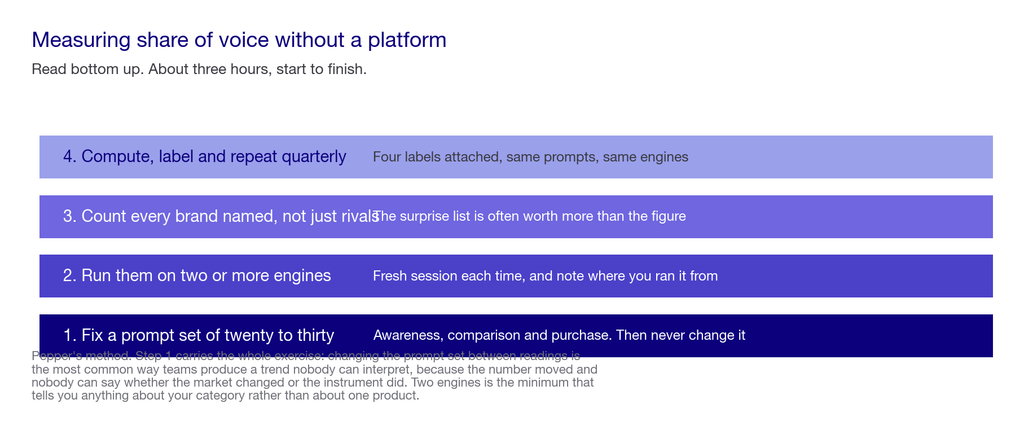
You do not need a platform for the first reading. You need a spreadsheet and about three hours.
Step 1: Build a fixed prompt set
Write twenty to thirty questions your buyers really ask, across awareness, comparison and purchase. “What is X”, “best X for Y”, “X vs competitor”, “how much does X cost”.
Then fix the list and do not change it between readings. Changing the set between quarters is the most common way teams produce a trend nobody can read. The number moved, and nobody can say whether the market changed or the ruler did.
Step 2: Run them on at least two engines
Run each prompt on two or more engines and save the answers. Use a fresh session each time. Results shift by person and by place, so note where you ran them from.
Also, two engines is the minimum that tells you anything about your category rather than one product. The method for the wider routine is in how to track brand mentions in AI search.
Step 3: Count brands, not impressions
For each answer, list every brand named. Count your mentions, then count all brand mentions, including firms you do not treat as rivals.
This is the step that takes the time. But it is also the step that produces the insight. Teams are routinely surprised by which companies appear, and that list is often more useful than the share figure itself. Chasing those sources is a separate exercise, set out in how to find which sources AI cites.
Step 4: Compute, label and repeat
Divide your mentions by total mentions. Write it down with the four labels attached. Then do the same thing a quarter later, same prompts, same engines.
One reading tells you where you stand. Then two readings tell you which way you are moving, which is the only thing this number is genuinely good for.
How to read the number once you have it
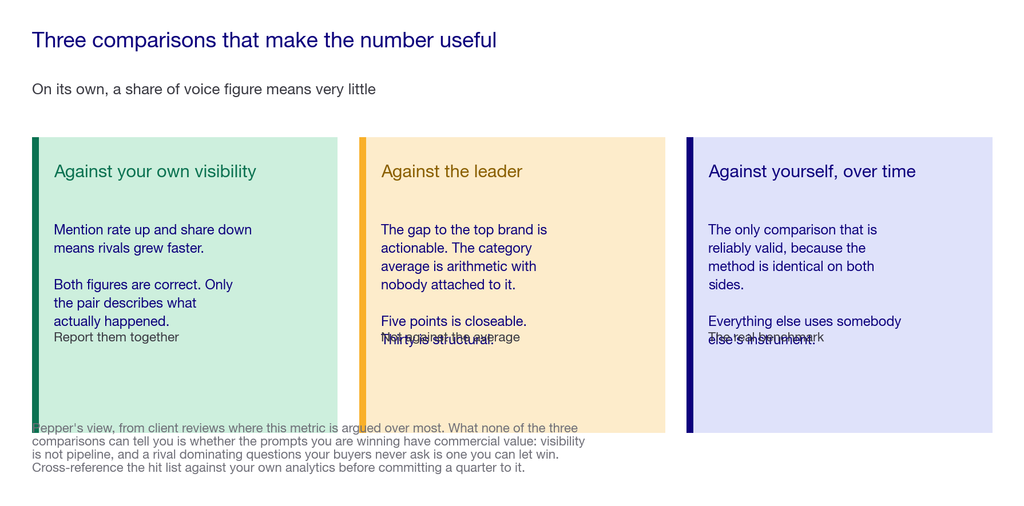
A share of voice figure on its own means very little. It becomes useful in three comparisons.
Against your own absolute visibility. If your mention rate rose and your share fell, competitors grew faster. Both numbers are correct, and only the pair describes what happened. So reporting the absolute number alone during a land-grab produces a deck that is optimistic by exactly the amount everyone else grew.
Against the leader, not the average. The gap to the top brand is actionable. The category average is arithmetic with no owner attached. A five-point gap to the leader is closeable in a quarter. A thirty-point gap is structural, and usually means picking a different theme. The comparison routine is in how to benchmark AI visibility against competitors.
Against yourself, over time. The only safe comparison, because the method is the same on both sides. Everything else uses somebody else’s ruler.
What it cannot tell you. Whether the prompts you are winning have any commercial value. Visibility is not pipeline. And a competitor winning questions your buyers never ask is one you can safely let win. So check your own analytics before you spend a quarter closing a gap, using the setup in how to know if AI search is sending you traffic.
Why there is no benchmark worth buying
Somebody will offer you an industry average. However, it will not help.
Share of voice depends on three things: how many brands exist in your category, how engines spread attention across them, and which prompts you chose. A tight category with four players spreads attention very differently from a crowded one with forty. So no cross-industry average survives that difference.
Thirty per cent can be excellent, or poor, depending entirely on the shape of your market. The useful questions are whether your trend is going the right way and how the gap to the leader is changing, which is also the reason we argue against single composite scores in should you trust a single AI visibility score.
The one benchmark that is real. Your own figure from last quarter, measured the same way. That is the comparison we build client reviews around. And it costs nothing beyond the discipline of not changing the prompt set.
What nobody should promise you
- An industry benchmark for share of voice. Category structure makes cross-industry averages meaningless, and nobody has published a credible one.
- A share of voice guarantee. It is a relative metric. A competitor’s launch moves your number without anything changing on your side.
- That one engine represents your category. Independent research found identical queries produce structurally different source sets across systems.
- A reliable read inside a week. Individual prompts are noisy enough that short windows describe variance rather than position.
Frequently asked questions
What is share of voice in AI search?
It is your brand’s slice of all brand mentions across a set of AI answers. You count mentions of your brand and divide by total mentions of every brand detected in the same answers, across a fixed prompt set on named engines.
How is it different from brand visibility?
Brand visibility is absolute: the percentage of answers that named you. Share of voice is relative: your slice of all brand mentions. Visibility can rise while share falls, because competitors grew faster over the same window.
Measuring it
Can I measure share of voice without a platform?
Yes. Twenty to thirty fixed prompts, two or more engines, and a spreadsheet counting every brand named in each answer. It takes about three hours, and the list of brands that appear is often more useful than the percentage.
Should the denominator include brands I do not track?
Yes, in our view. Counting every brand the engines named produces a lower and more honest figure, where counting only your configured competitors flatters you and rises whenever you remove a rival from the list.
Do I count mentions or answers?
Pick one and be consistent. Mentions reward prominence, answers treat presence as binary. We use mentions for share of voice and answers for the absolute visibility rate, which keeps the two metrics genuinely distinct.
Using it
What is a good share of voice in AI search?
There is no universal figure. It depends on how many brands compete in your category and how engines distribute attention between them. Track the trend and the gap to the leader instead of chasing a benchmark number.
How often should I measure it?
Quarterly for a trend, with the same prompts on the same engines. Shorter windows mostly capture noise, and changing the prompt set between readings makes the comparison meaningless.
Why did my share of voice fall when nothing changed?
Because it is relative. A competitor launch, a new entrant in your themes, or an engine shifting which sources it favours will all move your number while everything on your side stays the same.
Sources
Every claim here traces to a primary source, read directly.
Independent research
- Huang, Goyal, Saha and Chandrasekharan, Answer Bubbles: Information Exposure in AI-Mediated Search, arXiv, 17 March 2026, revised 28 August 2026. 11,000 real search queries across five systems including vanilla GPT, SearchGPT, Perplexity, Google AI Overviews and traditional Google Search. Finds identical queries produce “structurally different information realities across systems”, with some source types systematically over-represented and others under-represented. Academic preprint, not peer-reviewed at the time of writing. Source for the argument against single-engine measurement.
- Zhang Kai, He Xinyue and Yao Jingang, From Citation Selection to Citation Absorption, arXiv, 28 April 2026. 602 controlled prompts and 21,143 search-layer citations across ChatGPT, Google AI Overviews and Perplexity. Finds citation counts alone inadequately measure generative engine performance, because engines differ in how many sources they use and how much influence each carries. Also an academic preprint.
Pepper product documentation
- Pepper help centre, GEO metrics explained, in-product documentation, read 8 October 2026. Source for the definition of Share of Voice as a brand’s slice of total brand mentions across prompt runs, counted against every brand detected rather than only tracked competitors, and for the stated position that no universal good number exists. Requires a workspace login, so we have described the definitions rather than linking you to a wall.
On what this page is not
This is a definition and a manual method, not a benchmark study. We have deliberately published no industry average, because category structure makes cross-industry comparison meaningless and because any figure we invented would be more harmful than useful. The three measurement choices are ours to recommend rather than an industry standard, and a platform that makes them differently is not wrong, only different. That is exactly why the four labels matter more than the number.
Latest Blogs
Most advice on this is inference dressed as fact. OpenAI documents exactly one thing clearly, which is access. Here is what is documented, what is inferred, and how to verify the rest for yourself.
Being named in an AI answer and having your page used as its source are different outcomes with different causes and different fixes. The gap between them is the most useful diagnostic in AI search, and most reporting collapses it into one number.
Every platform reports share of voice and almost none of them define it the same way. Here is the definition worth using, the three choices that change the number, and how to measure it yourself without buying anything.
Get your hands on the latest news!

Similar Posts
How to monitor brand mentions in AI answers, including whether they are true
Content Creation
11 mins read
What is a SERP? A complete guide to search engine results pages in 2026