How to monitor brand mentions in AI answers, including whether they are true
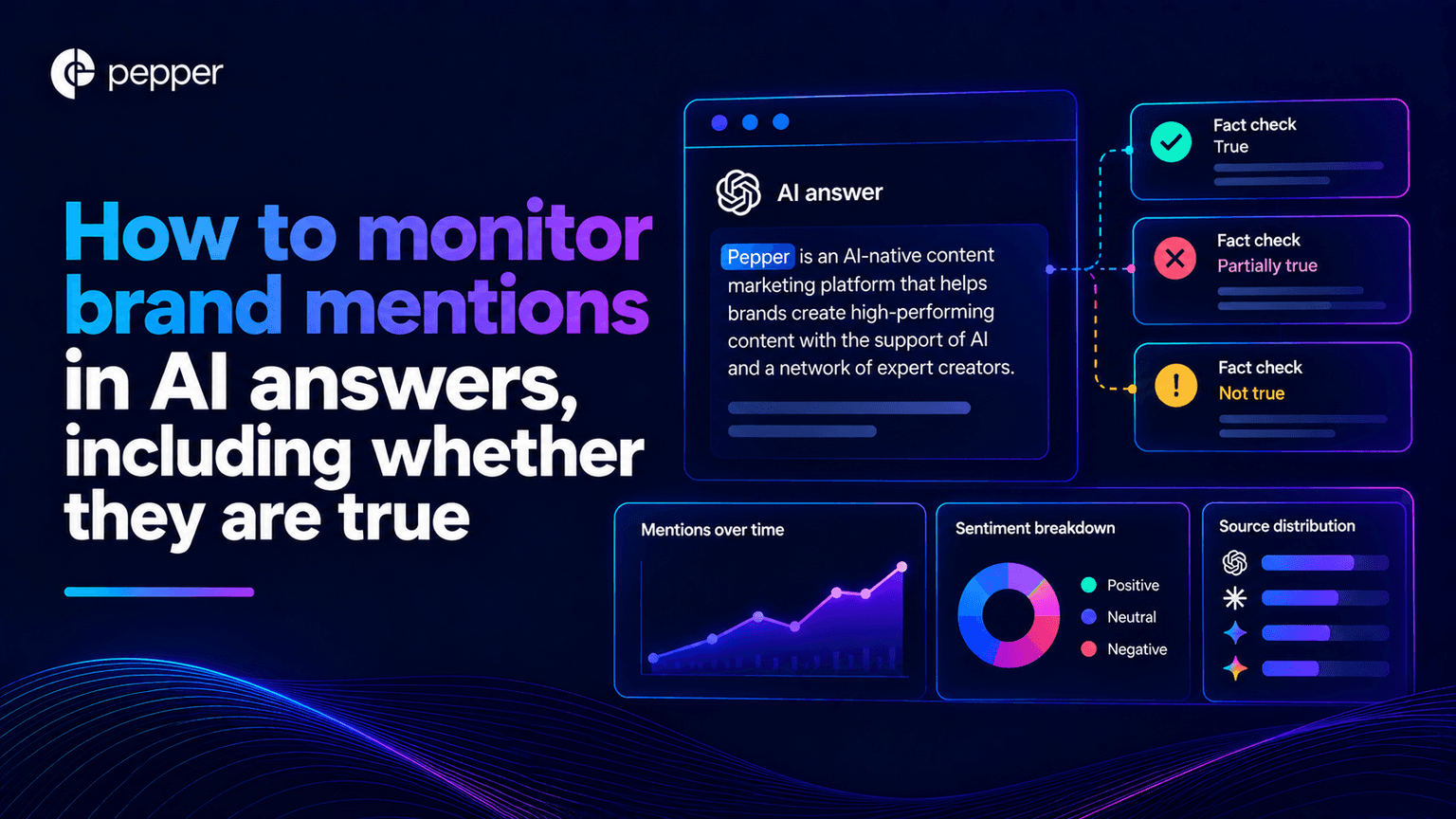
The short answer
Detection is solved and accuracy is not. Five methods will tell you whether your brand appears in AI answers, and our own guide covers all five. None of them tells you whether the engine described your pricing, your features or your positioning correctly. On a 5,000-prompt benchmark across five frontier models, factual recall hallucination ran 4.2% to 12.7% and citation hallucination 6.8% to 19.1%. Monitoring that requires a person reading answers, quarterly.
Key takeaways
- The detection half is already covered. Our five methods for tracking brand mentions sets out manual prompt testing, first-party citation data, log analysis, platforms and citation source analysis.
- That page is explicit about what it does not do. It measures presence and citation patterns and does not examine whether what the engine said was accurate. This article is that missing half.
- The error rates are not small. A benchmark of 5,000 prompts across five frontier models, published April 2026, found factual recall hallucination between 4.2% and 12.7%, and citation hallucination between 6.8% and 19.1%.
- The industry standard already names this. The IAB’s Portrayal group includes hallucination rate and factual inaccuracy rate. No platform we have checked reports either.
- So accuracy monitoring is manual, and that is fine. It is quarterly work for one person, not a subscription, and the method is below.
- Finding an error is not the hard part. Fixing it is. Our reputation management guide covers the recovery sprint once you find something wrong.
- Pepper is an agentic organic growth engine and an organic growth partner. Agent Atlas puts the agents in your team’s hands. Pepper’s GEO platform reports Brand Visibility, Domain Prompt Presence and Share of Voice. A growth team works alongside yours. Eight years, more than 250 enterprises, more than 10 million tracked prompts.
A note on where this comes from. I wrote the five-methods piece on this site, and the sentence I keep coming back to is the one at the end of it about what no method can tell you. Pepper runs organic for more than 250 enterprises over eight years and tracks more than 10 million prompts across every major engine. The thing that worries clients most in a quarterly review is not absence from an answer. It is being present and described wrongly.
Disclosure: Pepper sells a platform that monitors brand mentions, and this article argues that our category measures the easier half of the problem. That includes us. We report presence metrics and we do not report a factual inaccuracy rate either. Competitors are named but never linked.
What is brand mention monitoring, and what does it miss?
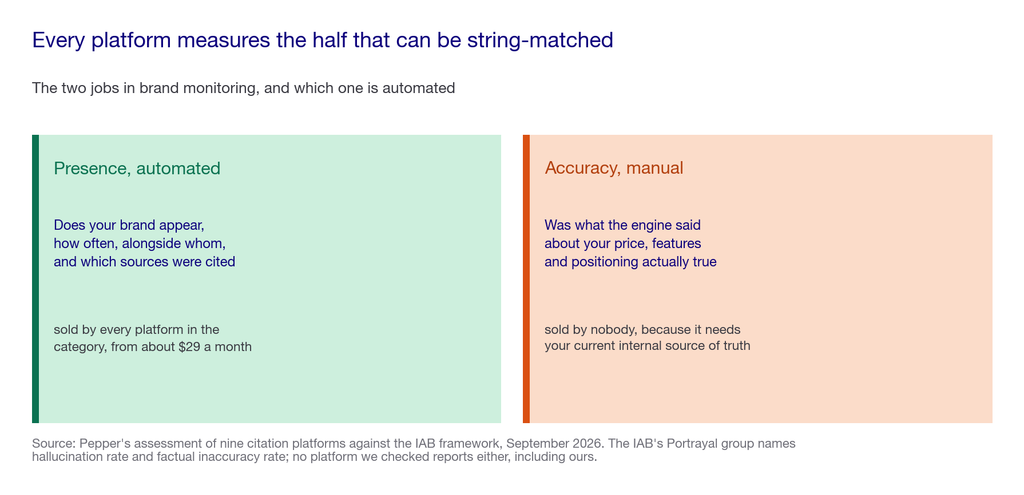
Monitoring brand mentions in AI answers means two separate jobs, and almost everyone does only the first.
Presence monitoring asks whether your brand appears, how often, alongside whom, and which sources the engine cited. That is what every tool in this category sells, and it is genuinely useful.
Accuracy monitoring asks whether what the engine said about you was true. Are your prices right? Are the features real? Is the positioning yours or a competitor’s? Nobody sells this, because it cannot be automated cleanly.
The gap matters because the two failure modes have opposite fixes. Absence is a visibility problem, solved by earning citations. Being present and wrong is a correction problem, and more traffic makes it worse rather than better.
Our guide to detecting mentions across five methods covers the first job thoroughly and says plainly it does not cover the second. This article picks up there.
How often engines get facts wrong
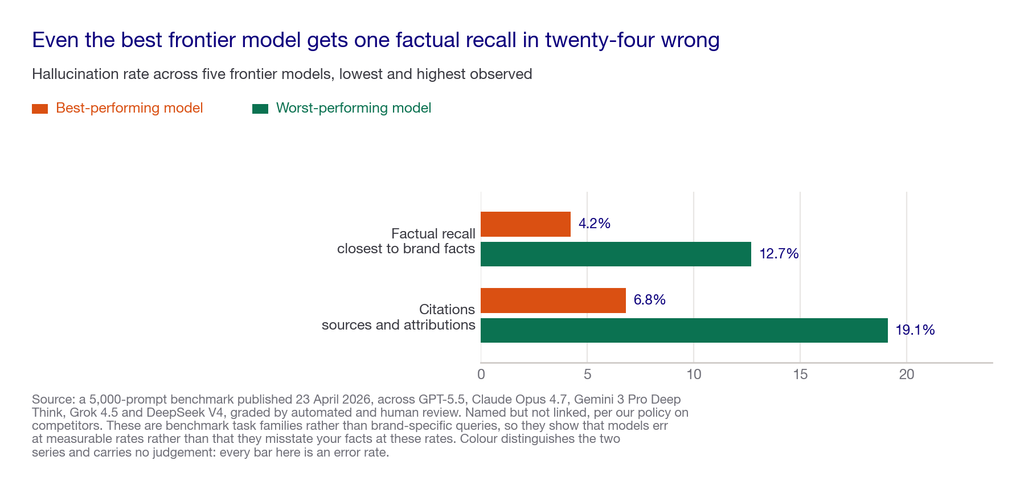
A benchmark published on 23 April 2026 tested 5,000 prompts across GPT-5.5, Claude Opus 4.7, Gemini 3 Pro Deep Think, Grok 4.5 and DeepSeek V4, using three task families and both automated and human review.
- Factual recall hallucination ran 4.2% to 12.7% depending on the model. Factual recall is the task family closest to a buyer asking what your product does or costs.
- Citation hallucination ran 6.8% to 19.1%. The study notes models inventing DOIs, paper titles, author names and journal references.
Apply the lower end to a real prompt set. Track 25 buying questions and even a 5% factual error rate means roughly one answer in twenty contains something untrue about your category. Across a quarter of daily runs, that is not an edge case. It is a weekly occurrence that nobody on your team is reading.
And the citation figure is the one that should worry a marketer more. An invented citation attributes a claim to a source that never made it. If that claim is about your product, you have a fabricated fact with a fabricated authority behind it.
Where it falls short: these are benchmark task families rather than brand-specific queries, so they establish that frontier models get facts wrong at measurable rates rather than that they get your facts wrong at those rates. No 2026 study we could find measures brand-fact accuracy specifically, which is itself worth knowing.
If you would rather read what engines are actually saying about you than assume it is right, book a growth audit and we will pull the answers with you.
Why no tool does this for you
The IAB’s measurement framework, released 3 August 2026, organises AI visibility into four groups, and its Portrayal group names sentiment, framing, hallucination rate and factual inaccuracy rate.
When we checked nine leading citation platforms against that framework, Portrayal was the weakest group. Some report sentiment. None reports a factual inaccuracy rate.
There is a good technical reason. Detecting presence is string matching: did the brand name appear, was the domain cited. Detecting inaccuracy requires knowing the truth, which means a system that holds your current prices, tiers, integrations and claims, and compares them to prose. That is a different product, and it would be wrong the moment your pricing page changed.
So accuracy monitoring stays manual, and the honest response is to schedule it rather than wish for a tool. It is a quarterly job for one person with a checklist, and it does not need a subscription.
Where it falls short: manual review does not scale past a few dozen prompts, and it is subject to the reviewer’s own knowledge. A reviewer who does not know the pricing changed will not catch the error either, which is why the checklist matters more than the reviewer.
How we weight an accuracy audit
Four criteria, fixed before we designed the method. They are our priorities, not measured coefficients.
| Criterion | Weight | What it means |
|---|---|---|
| Commercially decisive facts first | 35 | Price, tiers, integrations and eligibility, because an error here costs a deal rather than a reputation point |
| Checked against a source of truth | 25 | The reviewer compares to a current internal document, not to memory, because memory is where stale facts live |
| Same prompts every quarter | 20 | The set is frozen, so you can tell a new error from one you already knew about |
| Errors are logged with the answer text | 20 | You keep the exact wording, because a correction effort needs evidence of what was said and when |
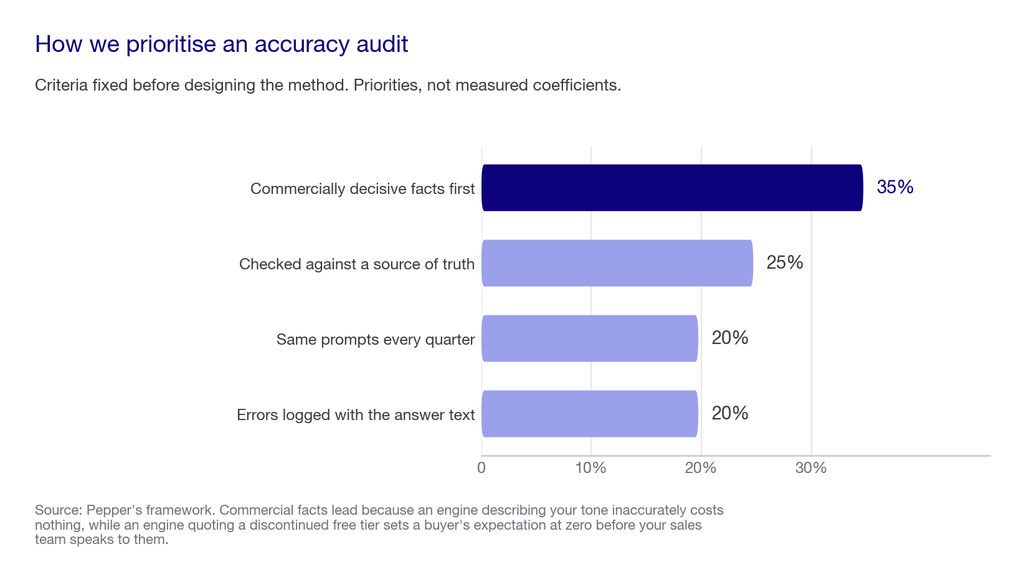
Why commercially decisive facts lead. An engine describing your tone of voice inaccurately costs nothing. An engine quoting a discontinued free tier sets a buyer’s expectation at zero before your sales team speaks to them.
Where it falls short: prioritising commercial facts means you will miss slow reputational drift, which accumulates quietly and is harder to reverse. Read the sentiment reporting your platform already produces as the early warning for that, and treat this audit as the commercial layer on top.
The quarterly accuracy audit
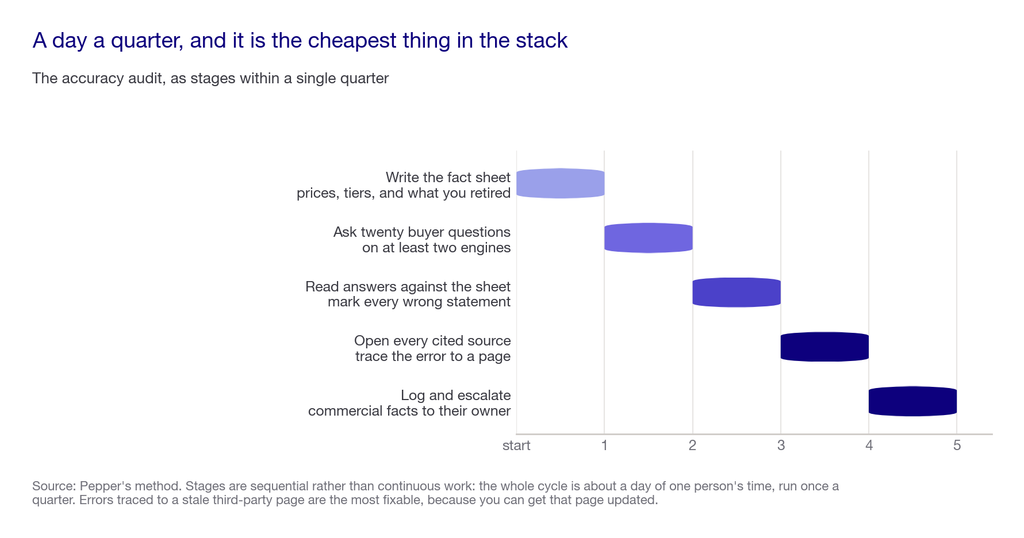
This takes about a day a quarter for one person. It is the cheapest thing in your measurement stack and the only part that catches the errors that cost money.
1. Write the fact sheet first. One page: current prices and tiers, the integrations you actually have, the three claims you make about what the product does, and anything you have recently retired. Retired things matter most, because engines quote them longest.
2. Ask the twenty questions a buyer asks. Not your tracked prompt set, which is built for visibility. Ask directly: what does it cost, what are the tiers, does it integrate with X, what is it best for, who is it not for. Ask on at least two engines.
3. Read the answers against the fact sheet. Mark every statement that is wrong, outdated or attributed to the wrong product. Copy the exact wording.
4. Check the cited sources. Where the engine cited something, open it. You are looking for two things: whether the source says what the engine claimed, and whether the source is yours or a third party’s. Errors traced to a stale third-party page are the most fixable, because you can go and get that page updated.
5. Log and escalate. Record the date, the engine, the prompt, the wrong statement and the source. Anything commercially decisive goes to whoever owns that fact. Anything reputational goes into the recovery process in our guide to repairing a damaged brand picture.
Where it falls short, and it costs us something to say: this is manual work that we cannot sell you a tool for, including our own. Twenty questions on two engines is a sample, not a sweep, and a quarterly cadence will miss errors that appear and resolve inside three months.
Monitoring at a glance
| What you are monitoring | Automated | How | Cadence | Cost |
|---|---|---|---|---|
| Whether you appear | Yes | Prompt tracking platforms | Monthly | From about $29 a month at entry tiers |
| Which sources were cited | Yes | Citation analysis in most platforms | Monthly | Included in the above |
| Share against competitors | Yes | Share of voice on a frozen prompt set | Monthly | Included in the above |
| Sentiment and framing | Partly | Some platforms report it | Quarterly | Included where offered |
| Whether the facts are right | No | A person reading answers against a fact sheet | Quarterly | A day of someone’s time |
| Whether citations are real | No | Opening the cited sources and checking | Quarterly | Included in the day above |
| What to do about an error | No | The correction and recovery process | As found | People time, and sometimes PR |
Note the two rows nobody sells. They are also the two rows where an error costs you a deal rather than a percentage point.
What this costs
- Nothing in software. Every step above uses answers you can generate free, on engines you already have access to.
- About a day a quarter for one person, plus a short review with whoever owns pricing.
- The fact sheet is the only durable artefact, and it is reusable across sales enablement, so it is rarely wasted effort.
- Fixing an error costs more than finding one. A stale third-party page needs outreach, and a claim baked into training data needs the longer recovery process.
- The expensive alternative is not doing it. A discontinued free tier quoted to buyers for a quarter is a pricing problem that arrives as a pipeline problem.
How Pepper fits
Pepper is an agentic organic growth engine and an organic growth partner, and on the subject of this article we are part of the problem we are describing.
- We report presence, not accuracy. Brand Visibility for how often engines mention you, Domain Prompt Presence for how often they cite a page from your domain, and Share of Voice for your slice of the category. Those are three good presence metrics and none of them tells you whether the answer was true. See the platform.
- Where we do help is the source side. Our analysis of which domains engines cite shows which sources they lean on in your category, which is how you find the stale third-party page that is feeding the error. That is the most fixable class of inaccuracy.
- Agent Atlas can carry the repeatable parts. Running the same twenty buyer questions every quarter and diffing the answers against last quarter is workflow rather than heroics. System agents stay fixed, user agents stay editable and versioned, and customers log in and build and run their own inside Atlas.
- A growth team works alongside yours on the outreach that actually fixes a stale source, which is the part no software does.
- Proof rather than adjectives. Acceldata went from 85 to more than 300 top three keywords with 6X organic traffic growth. More in our case studies, and the B2B SaaS practice.
Where Pepper falls short. We do not report a factual inaccuracy rate, the IAB named it as a metric seven weeks ago, and we have not shipped it. Neither has anyone else we have checked, which is an explanation rather than an excuse.
How to choose who will monitor brand mentions for you
I would ask any vendor one question first: what do you do when the answer is wrong rather than absent? Most have not been asked it.
The framing judgement first, anchored outside my own view. The IAB’s measurement framework, released 3 August 2026, puts hallucination rate and factual inaccuracy rate inside its Portrayal group, alongside sentiment and framing. Read that as an instruction that presence alone is an incomplete report. Then hold the other half, which is that the framework is voluntary and new, so no vendor is yet obliged to meet it.
The Pepper view on top is narrower. Presence monitoring is a commodity. The differentiated work is knowing what to do in the week after you find something untrue.
Here is the 100 point scorecard I would run over any monitoring provider, including us.
| Area | Weight | What a strong provider demonstrates |
|---|---|---|
| They surface the answer text, not just the score | 30 | You can read what the engine actually said, in full, and export it, because you cannot audit a number |
| Source-level citation analysis | 25 | They show which third-party domains feed your category, so you can trace an error to a fixable page |
| They will run an accuracy pass with you | 20 | Someone reads answers against your fact sheet during onboarding, rather than handing you a dashboard |
| Sentiment is reported separately | 15 | Framing and tone are their own numbers rather than blended into a visibility score |
| They say what they cannot measure | 10 | Accuracy is named as out of scope in writing, rather than implied to be covered |
Then run the live test, on us as readily as on anyone else.Give any provider 25 buyer questions and your one-page fact sheet, and ask them to come back with every statement in the answers that contradicts it. Hold the result for 90 days before deciding, because engines drift and one pass is a snapshot. Ask them things they cannot answer from a demo script. For example: “which of these answers contains something untrue”, “where did that wrong claim come from”, “can we export the full answer text”, “what would you do about it this week”.
Ask them to come back with five things. The untrue statements. The source of each. The export format for raw answers. What is out of scope. And what they would fix first.
A provider who finds an error in your own answers during evaluation has demonstrated more than any dashboard tour. And one who cannot export raw answer text is selling you a number you can never audit.
The weaker way to run this, and it is the common one. Buy a platform. Watch the visibility score. Celebrate when it rises. Never read a single full answer. Discover at a customer QBR that the engine has been quoting a price you retired in March.
The stronger sequence. Write the fact sheet. Run presence monitoring monthly through a platform. Run an accuracy pass manually every quarter. Trace every error to a source. Fix the sources you can reach, and escalate the rest. The distinction matters because the first sequence optimises a number and the second protects a pipeline.
Red flags, each one something a provider actually does.
- A visibility score with no way to read the underlying answers, which makes auditing impossible by design.
- Accuracy implied rather than stated. Ask whether factual inaccuracy is in scope and get it in writing.
- Sentiment blended into a visibility score, which hides both.
- No citation source analysis, so you can see that you are described wrongly but never why.
- No raw answer export, which means no evidence for a correction effort.
- A claim to detect hallucinations automatically without access to your internal source of truth. That is not possible.
- A guarantee of citations, which Google itself advises against in the equivalent case.
Five questions worth asking, and what a good answer sounds like.
- “Can we read the full answer text?” A good answer is yes, with an export format. A bad answer is a dashboard.
- “Is factual accuracy in scope?” A good answer is an honest no, in writing. A bad answer is vague.
- “Where did this wrong claim come from?” A good answer traces it to a source. A bad answer shrugs at model behaviour.
- “Will you run an accuracy pass during onboarding?” A good answer is yes, with our fact sheet. A bad answer is that the platform handles it.
- “What do you report from the Portrayal group?” A good answer engages with the framework. A bad answer has not read it.
If I reduce this to one principle: read the answers. Every number in this category is a summary of text that somebody should have read, and almost nobody does.
The honest note that costs us something. Very few providers are strong at presence measurement, source analysis, accuracy review and correction work at once, and we would not claim uniform strength across all four either. Accuracy review is the one the whole category skips, ours included, and it is the one a buyer can do themselves for the cost of a day.
What nobody should promise you
Nobody should promise automated hallucination detection about your brand. Detecting an inaccuracy requires knowing your current truth, and no external platform holds that.
Nobody should report presence metrics as if they were a complete picture of how you are described. The IAB named factual inaccuracy rate as a metric seven weeks ago and no platform we have checked reports it.
Nobody should sell you a visibility score you cannot decompose into readable answers. A number you cannot audit is a number you cannot defend.
Nobody should promise a citation for a fee. Google advises against providers who guarantee rankings, because no external party has access to the ranking systems.
Where this stops working, including for us
If engines rarely answer questions in your category, you do not need this audit and should not build a process for it. It will find nothing. Re-check next quarter instead.
If your pricing and features change monthly, a quarterly audit will always lag, and the better fix is upstream: make sure your own pages state the current facts unambiguously so the correct version is available to be retrieved.
If you have no one who can own the fact sheet, this will not happen. It needs a person, and the person needs to be the one who knows when a tier was retired.
Where Pepper falls short. We do not report a factual inaccuracy rate, and the audit above is manual work we cannot sell you. What we can do is the source-tracing half, which is where the fixable errors live.
Where to go next
Write the one-page fact sheet this week. It takes an hour, it is reusable, and without it an accuracy audit is one person’s memory against a language model’s.
Then run twenty buyer questions on two engines and read the answers. For the adjacent decisions, our the five detection methods, compared covers detection, the sampling arithmetic covers how many runs a change needs, reputation management in AI search covers the recovery sprint, and which KPIs to use covers what to report upward. To see which sources feed your category’s answers, see where you show up.
Frequently asked questions
How do you monitor brand mentions in AI answers?
Two jobs. Presence monitoring is automated through prompt tracking platforms and tells you whether you appear. Accuracy monitoring is manual, quarterly, and tells you whether what the engine said about you was true.
Can any tool detect when AI says something wrong about my brand?
Not reliably. Detecting inaccuracy requires knowing your current prices, tiers and claims, which no external platform holds. Any vendor promising automated hallucination detection about your brand is describing something that does not exist.
How often do AI engines get facts wrong?
On a 5,000-prompt benchmark across five frontier models published in April 2026, factual recall hallucination ran between 4.2% and 12.7%, and citation hallucination between 6.8% and 19.1%. Those are benchmark tasks rather than brand queries, so treat them as direction.
What should an accuracy audit check?
Commercially decisive facts first: current prices, tiers, integrations and eligibility, plus anything you have recently retired. Retired offers matter most, because engines keep quoting them long after they are withdrawn.
How often should you run an accuracy audit?
Quarterly, on a frozen set of about twenty buyer questions across at least two engines. That is roughly a day of one person’s time, and it is the only part of the stack that catches errors that cost deals.
What do you do when you find something untrue?
Trace it to a source. Errors coming from a stale third-party page are the most fixable, because you can get that page updated. Claims baked into training data need the longer reputation recovery process.
Is sentiment the same as accuracy?
No. Sentiment tells you how you were described. Accuracy tells you whether the description was true. An engine can be entirely positive about you and still quote a price you retired.
Does presence monitoring cover this?
No, and the better tools say so. Presence monitoring is string matching on brand names and domains. It cannot evaluate whether a sentence about your product is factually correct.
Sources and further reading
- AI hallucination rate benchmarks, published 23 April 2026, named but not linked per our policy on competitors. Method: 5,000 prompts across GPT-5.5, Claude Opus 4.7, Gemini 3 Pro Deep Think, Grok 4.5 and DeepSeek V4, over three task families, graded by automated and human review. Source of the factual recall hallucination range of 4.2% to 12.7% and the citation hallucination range of 6.8% to 19.1%, and of the observation that models invent DOIs, paper titles, author names and journal references. Limitations: these are benchmark task families rather than brand-specific queries, so they establish that frontier models err at measurable rates rather than that they misstate your facts at those rates.
- IAB, Measuring Visibility in the AI Era, released 3 August 2026. Source of the Portrayal group, which names sentiment, framing, hallucination rate and factual inaccuracy rate.
- Pepper, how to track brand mentions in AI search: five methods, published 26 August 2026. The detection half, and the page that states plainly it does not examine accuracy.
- Pepper, online reputation management in AI search. The recovery process for what you find, including the four strategies and the ninety-day sprint.
- Pepper, citation analysis. How to trace an error back to the third-party source feeding it.
- Pepper, AI search tracking and the sampling arithmetic. How many runs a change needs before it means anything.
- Google Search Central, guide to optimizing for generative AI features, page last updated 10 July 2026. Source of the advice against providers guaranteeing rankings.
- The fact sheet method, the five audit steps and the weighting are ours.
Latest Blogs
You can check if your brand appears in AI search in about twenty minutes, on two engines, without paying for anything. The method is simple and the result is noisier than most people admit. In one 2026 pilot, ChatGPT searched the web on only 42% of buying prompts, so on the rest there was no retrieval event at all. In another, rewording a question changed the answer more than 23% of the time. This article gives you the check, then gives you the four reasons it can lie, so you can tell a real absence from a bad sample.
A blog traffic drop has five plausible causes and AI search is the most interesting one, which is exactly why people reach for it first. It is also the only one you cannot measure directly, so it should be diagnosed last, by elimination. The first check takes ten minutes and costs nothing: put clicks and impressions on the same chart. In one 2026 study of 53 brands, clicks held flat at around 400,000 while impressions more than doubled, so clickthrough halved without a single visitor being lost. Work through the other four before you conclude anything about AI.
Google publishes one eligibility rule for AI Mode, and in May 2026 it published what AI Mode users actually do. Both matter more than the fan-out arithmetic the category quotes.
Get your hands on the latest news!

Similar Posts
Content Creation
11 mins read
What is a SERP? A complete guide to search engine results pages in 2026
AI search tracking: how to monitor brand mentions across AI engines in 2026