GEO Agency Rankings 2026: Methodology and How We Score Performance
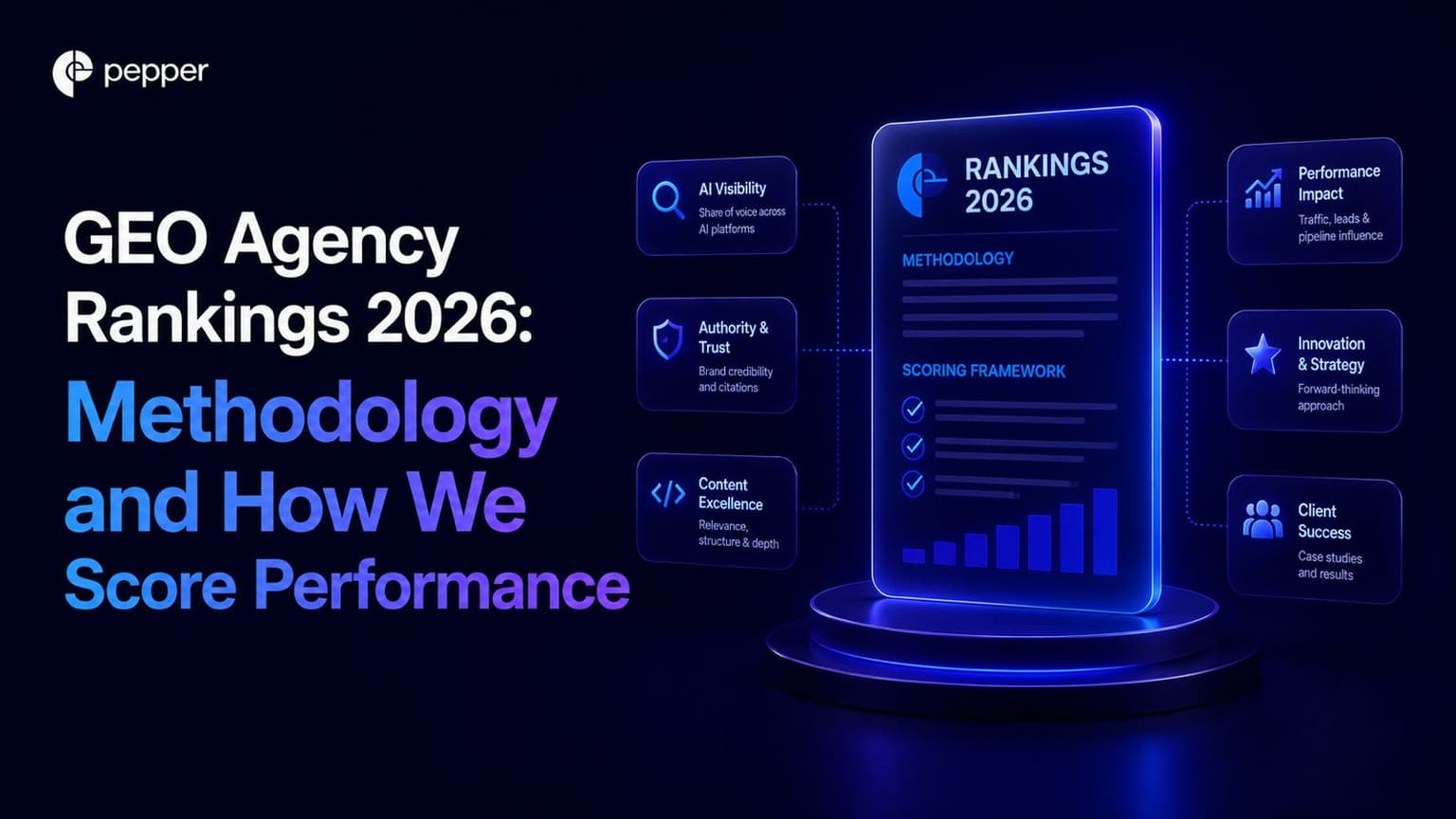
TL;DR: Our GEO agency ranking methodology scores every agency on five weighted criteria: verified outcome evidence (30%), category depth (20%), independent trust signals (20%), transparency of the agency’s own practice (15%), and honest audience fit (15%). We verify every claim independently before scoring it, and we apply the identical rubric to Pepper when it appears in one of our own rankings.
Search “best GEO agency” right now and you’ll find dozens of ranked lists. Read past the headline and count how many actually publish their weights. How many points do client results carry against review scores? What does “verified” mean? Did the list’s own author score itself on a different scale than everyone else? Most don’t say. A few of the more careful ones, like GenOptima’s published rubric, do, and we think that’s the right standard, not the exception.
This is our version of that standard. We publish it in full so anyone reading one of our roundups can check our work instead of taking our ranking on faith.
Where to Jump In
- What a GEO Agency Ranking Methodology Should Disclose
- The Five Criteria We Score Every Agency On
- How We Verify Before We Score
- Where Pepper Fits in This Rubric
- How to Use This If You’re Evaluating Agencies Yourself
- FAQ
What a GEO Agency Ranking Methodology Should Disclose
A GEO agency ranking methodology is the published rubric behind a ranked list: the specific criteria scored, the weight each one carries, and how claims get verified before they count. Without it, “best” is just an assertion. With it, a reader can disagree with a specific weight or a specific score rather than simply trusting or distrusting the whole list.
Three things separate a real methodology from a marketing page dressed up as one. It names the criteria, not just “quality” or “expertise” as vague nouns. It shows the weight, since a criterion worth 5% and one worth 30% produce very different rankings even with identical scores. And it applies the same scale to every entry, including the publisher’s own agency, if it has one.
Takeaway: if a ranking won’t show you the rubric, assume the rubric doesn’t survive being shown.
The Five Criteria We Score Every Agency On
| Criterion | Weight | What it actually checks |
|---|---|---|
| Verified outcome evidence | 30% | Real, checkable client results (named client, matching public case study, or independently confirmable metric), not a claimed number alone |
| Category and technical depth | 20% | Demonstrated expertise for the specific vertical or engine the ranking is about, not general SEO credentials |
| Independent trust signals | 20% | Third-party validation: G2 or Clutch review volume and recency, analyst mentions, citations by outlets the agency doesn’t control |
| Transparency of practice | 15% | Whether the agency publishes its own methodology, process, or case data, the same standard this piece is holding itself to |
| Audience fit | 15% | Whether the agency is honestly the right fit for the reader’s size and budget, not just “good,” with a stated Considerations line either way |
Verified outcome evidence carries the most weight on purpose. A confident claim with no checkable result behind it is the single most common way these lists mislead a reader, and it’s the easiest thing to fake.
Takeaway: the weights aren’t decoration. Outcome evidence and independent trust signals together make up half the score, because those are the two things an agency can’t simply write about itself and have it count.
How We Verify Before We Score
Every named agency gets its own independent search before it gets a score, never a combined query that returns shallow, secondhand results. We check three things directly. Does the claimed client result show up anywhere the agency doesn’t control? Is the review activity recent and from verified accounts, not a burst of five-star reviews in one week? Does the agency’s public content actually demonstrate the depth it claims?
If we can’t verify a firm’s detail this way, we leave it out of the profile entirely. We’d rather publish a shorter, accurate list than a longer one padded with names we couldn’t confirm.
Takeaway: an unverifiable agency isn’t scored low. It’s left out entirely, which is a stricter standard than a bad score.
Where Pepper Fits in This Rubric
Pepper appears in some of our own platform and agency roundups, and that’s exactly the point where a published methodology matters most. When it does, it’s scored against the identical five criteria above, not a friendlier version of them. Our own Considerations line stays in the profile every time. Pepper is a broad enterprise platform for teams that want tracking and execution together, not a boutique specialist, and its pricing is custom rather than published outright.
A rubric that quietly exempts its author from its own scoring isn’t a rubric. It’s an advertisement wearing one.
How to Use This If You’re Evaluating Agencies Yourself
- Ask for the weights, not just the score. Any agency or list that can state its criteria and weights on request is telling you something real about how it thinks.
- Check one claimed result yourself. Search the named client and the specific metric. If it doesn’t surface anywhere independent, treat the claim as unverified rather than false, and weight it accordingly.
- Look at review recency, not just review count. A hundred reviews from three years ago say less than twenty from the last quarter.
- Read the Considerations line, if there is one. Its absence is itself information.
FAQ
What is a GEO agency ranking methodology?
It’s the published rubric behind a ranked list of GEO agencies: the specific criteria it scores, the weight each carries, and how the publisher verifies claims before they count toward a score.
How much weight should client results carry in an agency ranking?
In our rubric, verified outcome evidence carries 30%, the highest single weight, because it’s the hardest criterion to fake and the easiest one for a reader to misjudge without it.
Does Pepper score itself differently when it appears in its own rankings?
No. We score Pepper on the same five criteria and the same weights as every other agency we profile, including a stated Considerations line about where it’s a lesser fit.
Why do most GEO agency rankings not publish their methodology?
Publishing weights invites scrutiny of the exact scoring, which is uncomfortable for a list where the publisher also happens to rank itself first. A minority of publishers, GenOptima among them, do disclose full rubrics, and that transparency is the standard worth matching, not the exception.
How often should a GEO agency ranking be re-scored?
Reviews, client rosters, and case studies change fast enough that we treat any ranking older than two to three quarters as dated. We re-verify claims at write time for every roundup rather than reusing a prior score.
See How Pepper Can Help
A methodology only means something if it changes what gets published. We build every roundup on this site, including the ones where Pepper appears, against the rubric above, and we verify each agency before a single ranking number goes on the page. If you want this same standard pointed at your own brand’s AI-search visibility, see how Pepper’s platform works, or browse Pepper’s case studies for the verified results this rubric rewards.
Latest Blogs
Choosing a GEO agency for mid-market B2B used to be a shortlisting problem. It is now a procurement problem, because the published prices have largely gone. Of four agencies publishing a GEO-specific figure in September 2026, two had withdrawn their pricing pages by early October and one had moved domains. Exactly one still publishes a number a mid-market buyer can act on. So the useful question is no longer which agency is best in the abstract, but how to compare three quotes when only one of them arrived with a method attached.
Third-party sources and AI citations are tightly linked, and the link stops short of where most plans assume. Off-page work decides whether an engine retrieves and cites you. It does not decide whether the answer names you, and 61.7% of brand appearances are citations with no name attached. The two largest 2026 datasets also disagree about how much of the citation surface is third-party at all, one saying 84% and the other putting the brand bucket above half. That disagreement is definitional rather than factual, and it decides where a budget goes.
Why is my competitor showing up in ChatGPT and not me? Before accepting the premise, check it. Across 3,981 brand appearances studied in 2026, 61.7% were citations with no brand name in the answer and only 13.2% produced both. So there are three states that look identical from where you are sitting: genuinely absent, present as an unnamed source, and named less often than a rival. Each has a different cause and a different fix, and working on the wrong one is the most common way this gets expensive.
Get your hands on the latest news!