How to Optimize Your Content for Grok
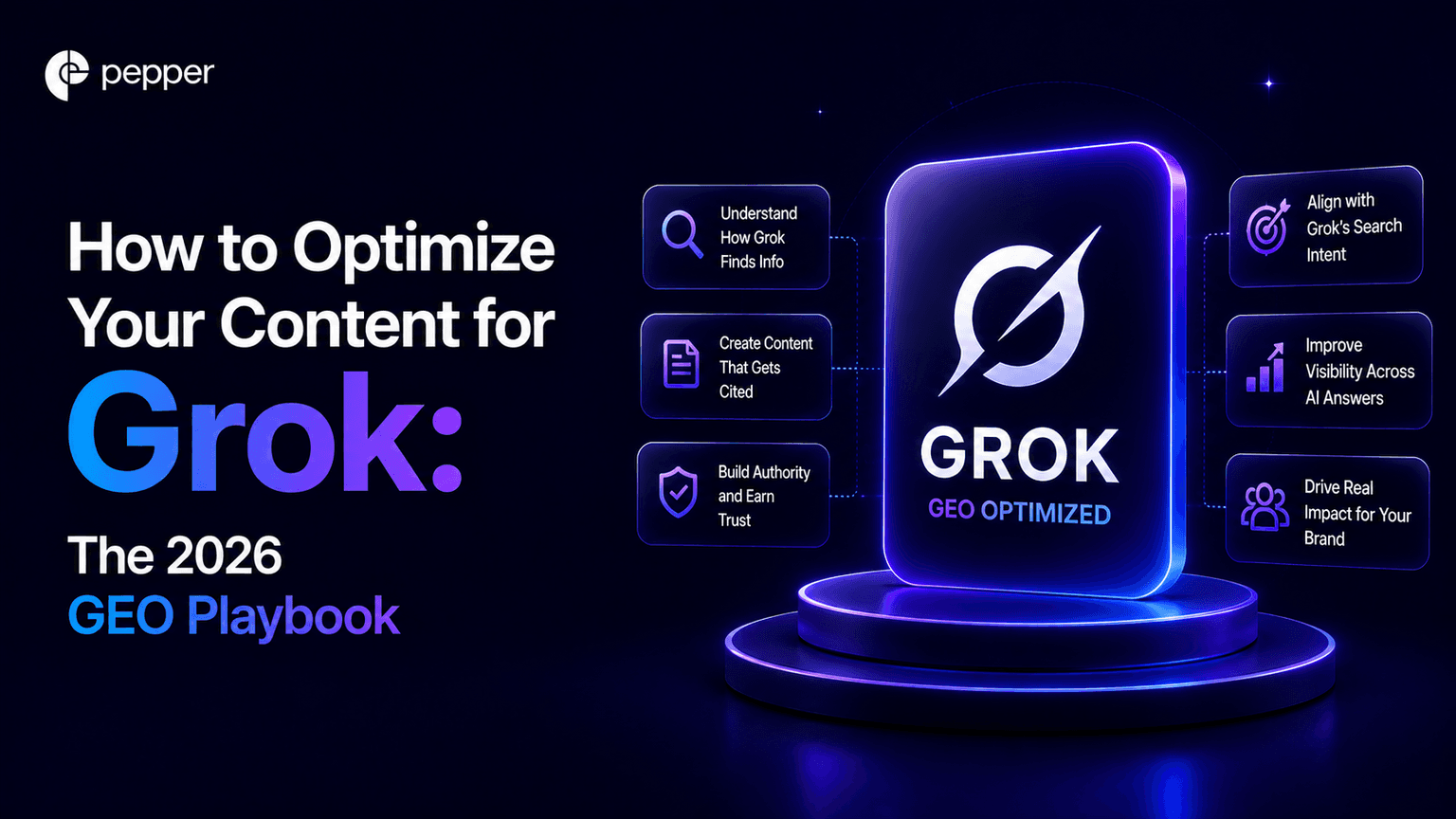
| TL;DR Grok doesn’t rank content the way Google does, and it doesn’t answer the way ChatGPT does. Built by xAI and plugged directly into X, it pulls from two pools at once: the live X post graph and the open web. That dual-source design is unique to Grok, and it weights recency and the social graph more heavily than any other major engine. So optimizing for Grok is two jobs run together: build a real-time presence on X that no other answer engine reads, and structure your web pages so Grok can extract a clean, self-contained passage. This guide covers how Grok selects and cites sources, why traditional SEO only gets you partway, and the exact steps to become visible where Grok is looking. |
What This Guide Covers
- Why Grok Is a Different Optimization Problem
- How Grok Selects and Cites Its Sources
- Grok vs. ChatGPT, Perplexity, and Gemini
- Why Traditional SEO Only Gets You Partway
- The Playbook: How to Optimize for Grok
- A Word on Grok’s Reliability
- Industry Updates
- YouTube Script
- FAQ
Why Grok Is a Different Optimization Problem
Most GEO advice treats all AI engines as roughly the same problem: publish well-structured, authoritative content and wait to be cited. That works, up to a point. But Grok breaks the pattern, because it is the only major answer engine wired directly into a live social network.
Grok is built by xAI and plugged into X (formerly Twitter). When you ask it a question, it does something no other big assistant does: alongside a normal web search, it reads live public posts on X in the same pass. xAI and X are the same house, so Grok has a direct path into a fast-moving public conversation layer that updates far faster than ordinary web pages or news articles.
That single fact changes what optimization means. On Google, you compete for a rank. With Grok, you compete to be one of the few sources it names inside a generated answer, and part of that answer may be drawn from what people are posting about your category right now. There is no second page. You are cited, or you are not.
And Grok is too big to ignore. By early 2026 it had reached roughly 64 million monthly active users and about 17.8% of the US chatbot market, making it the third most-used AI assistant in the country after growing nearly ninefold in a year.
| DEFINITION: Grok Optimization |
| Grok optimization is the practice of structuring your brand’s content and social presence so that Grok, xAI’s AI assistant, cites you in its generated answers. Because Grok grounds answers in two pools at once, the live X post graph and the open web, it requires a dual-surface strategy: a real-time presence on X that no other engine reads, plus web pages structured so Grok can extract a clean, self-contained passage. Grok weights recency and the social graph more heavily than any other major answer engine. |
How Grok Selects and Cites Its Sources
Grok retrieves its cited sources from two pools simultaneously, the live X post graph and the open web, scores them for relevance and recency, then composes an answer that attributes each claim to a specific web page or X post. It runs through two modes:
Grok WebSearch: fast, indexed retrieval
WebSearch is Grok’s quick-answer path. It searches the web in real time, indexes millions of pages, and returns fast, relevant results for straightforward factual queries. Think of it as Grok’s take on traditional search, but with semantic understanding and the answer synthesized inline rather than returned as a list of links.
Grok DeepSearch: agentic, multi-step research
DeepSearch is the agentic mode. It fires an iterative retrieval loop: the agent splits your question into sub-queries, runs parallel searches against both the web and X, follows fresh links, summarizes each batch in an internal scratchpad, and repeats until it hits a 10-step limit or a time threshold. It is built for complex, multi-step evaluation, exactly the comparison and decision-stage queries that precede a purchase. In the xAI API, this maps to two server-side tools: web_search and x_search. (The older standalone ‘Live Search’ API was retired in early 2026 and replaced by these agent tools.)
Two traits shape everything downstream. First, Grok distinguishes its sources: its interface shows a sources panel that separates web citations from X posts. Second, and most important for strategy, Grok weights recency and the social graph more heavily than any other major engine. A brand that publishes and posts on a live cadence wins citations that static competitors never see.
| The core mechanic: Grok folds X and the web into a single cited answer. A strong X footprint and frequently updated web pages feed the same citation engine. Optimizing for one surface and ignoring the other means competing on one leg. |
Grok vs. ChatGPT, Perplexity, and Gemini
GEO is not one-size-fits-all. Each engine sources differently, so the moves that win Grok are not the moves that win elsewhere. Here is the contrast:
| Engine | Primary Retrieval Sources | What Makes It Distinct |
| Grok | Live X post graph + open web | Only major engine reading live X; weights recency and social graph heaviest |
| ChatGPT Search | Bing index (primary) | Leans on cross-source consensus and earned editorial citations |
| Perplexity | Live multi-source web search | Answer-first extractability; strong Reddit and community weighting |
| Google Gemini / AI Overviews | Google index | Traditional Google ranking signals plus E-E-A-T |
The takeaway: for ChatGPT, Perplexity, and Gemini, your web content is the whole game. For Grok, your web content is half the game, and your live presence on X is the other half. No other major engine gives your social activity that kind of citation weight.
Why Traditional SEO Only Gets You Partway
Classic SEO signals still matter to Grok’s web-retrieval half. Crawlable, well-structured, authoritative pages get pulled into the candidate pool, and the peer-reviewed AEO research holds here: content that opens with a clear definition earns a large citation premium, and lists and tables get lifted more readily than walls of prose.
But three things traditional SEO was never built for decide whether Grok cites you:
- Grok favors fresh content and live posts. A page last updated two years ago loses to one updated this week, and to an X thread from this morning. Static SEO treats content as publish-once; Grok rewards a live cadence.Recency.
- Grok reads what credible, topically-relevant X accounts say about you. That is a citation input no amount of on-page SEO can produce. Your backlink profile does not help you here; your X presence does.The social graph.
- Grok resolves a brand as a coherent entity by triangulating your website, your X profile, and third-party mentions, then cites the entity it can resolve cleanly over one with conflicting signals. SEO optimizes the website in isolation; Grok checks whether your website and your X identity agree.Entity resolution across surfaces.
So traditional SEO gets your web pages into contention. It does nothing for the X half of Grok’s engine, which is precisely the half that makes Grok different.
The Playbook: How to Optimize for Grok
Getting cited by Grok is two jobs run together: build a real-time presence on X that no other answer engine reads, and structure your web pages so Grok can extract a self-contained passage. Six moves cover both surfaces.
1. Build a Real, Active Presence on X
This is the move that separates Grok optimization from every other platform strategy. Publish original, on-topic X content that reinforces your brand’s positioning on the categories you want to be known for. Post consistently rather than in bursts, because Grok weights recency and cadence. The goal is not follower count; it is a steady stream of substantive, on-topic posts that Grok’s x_search can retrieve when someone asks about your space.
2. Earn Mentions From Credible X Accounts
Follower count matters less than who is talking about you. A brand mentioned positively by authoritative, topically-relevant X accounts carries more citation weight in Grok than a brand with a large but low-quality footprint. Build genuine relationships with the analysts, journalists, and practitioners your category listens to, and give them reasons to mention you. This is digital PR aimed at the social graph, not just the open web.
3. Publish on a Live Cadence
Because Grok favors recency, freshness is a ranking input, not an afterthought. Update your key web pages on a schedule, and keep your X presence current. The businesses that publish on a live cadence win citations that static competitors never see, on both surfaces. Treat your highest-value pages as living documents, refreshed with new data and examples, and resubmitted for crawling.
4. Structure Pages as Definition-First, Extractable Passages
On the web surface, Grok DeepSearch reads several sources before composing an answer, so pages built as bounded, definition-first passages clear its extraction step where long, unstructured pages get skipped. Open every H2 and H3 section with a plain-language definition that uses the query language directly, then expand. Research in 2026 measured a significant citation premium for content that opens with a clear definition over content that buries it mid-passage, and a meaningful attention drop-off on passages that run long without structure. Keep sections tight and self-contained.
5. Lead With Statistics and Quotations
Grok, like other answer engines, prefers evidence-rich content it can lift and attribute. Contently’s 2026 analysis found that adding statistics increased Grok visibility by 22%, and adding quotations by 37%. Put concrete figures, named sources, and quotable lines near the top of each section. Original data, a number no other page has, is the single most citable content unit you can publish.
6. Lock Your Entity Across Website and X
Grok resolves your brand by triangulating your website, your X profile, and third-party mentions. Make them agree: the same brand description, category language, and key facts across your site, your X bio and posts, and the third-party sources that mention you. A brand Grok can resolve cleanly gets cited over one sending conflicting signals. Consistency across surfaces is not housekeeping; it is a direct citation input for Grok specifically.
| PR is now a growth marketing function, 100%. Digital PR directly drives LLM citations. One-time annual link campaigns don’t work anymore. Consistent monthly distribution does. (Kishan Panpalia, Pepper founding team, Index ’26) |
A Word on Grok’s Reliability
One caveat worth stating plainly, because it shapes strategy. Grok’s live-X advantage is also a risk: live posts are noisy and unverified, and Grok will sometimes repeat that noise. On the Columbia Journalism Review’s citation test, Grok-3 scored poorly on citation accuracy, meaning its citations were generated but did not always match the source content, while Perplexity performed best on the same test.
For brands, the implication is twofold. First, the noise means your accurate, well-sourced, entity-consistent content has a real chance to become the signal Grok anchors to, if you make it the clearest, most citable material in your category. Second, monitor how Grok represents you, because it can misattribute or garble claims. Optimizing for Grok includes watching what it actually says about you and correcting the record on X and on your pages when it drifts.
Industry Updates: Grok in 2026
Grok 4 Is the Current Flagship, and It Uses Tools by Default
Grok 4 (launched July 2025 and refined through 2026) is xAI’s current production model, a reasoning-first system with a higher-compute ‘Grok 4 Heavy’ multi-agent tier. Grok 4 was trained to use tools, so it picks its own search queries, reads what comes back, and keeps digging on hard questions rather than answering from a frozen knowledge cutoff. For brands, this means Grok is actively retrieving, not just recalling, so fresh, retrievable content matters more than ever.
The Standalone ‘Live Search’ API Was Retired
In early 2026, xAI retired the older standalone Live Search API and replaced it with server-side agent tools, web_search and x_search, callable through the xAI Agent Tools API. Citations are generated only when these tools are invoked. The signal for marketers: X search is now a first-class, permanent part of Grok’s retrieval stack, not an experimental add-on.
Grok Is the Third Most-Used US Assistant
Grok reached roughly 64 million monthly active users and about 17.8% of the US chatbot market by early 2026, growing nearly ninefold in a year to become the third most-used AI assistant in the country. It is now large enough that leaving it out of a GEO program means ceding a material share of AI-driven discovery to competitors.
Access Has Broadened Beyond X
Grok is now available well beyond its original X-only home: on the web at grok.com, through dedicated iOS and Android apps, bundled into X Premium+ and xAI’s SuperGrok subscriptions, and via the xAI API. Broader access means more of your buyers can reach Grok without an X account, which raises the stakes on being the source it cites.
Marketing Leaders Are Treating Social as a Citation Surface
A recurring theme among GEO practitioners in 2026 is that Grok collapses the old wall between social media and search. As Kishan Panpalia of Pepper’s founding team argued at Index ’26, PR and distribution have become growth functions because they directly drive AI citations, and Grok is the clearest case: your X activity is no longer just engagement, it is retrievable citation fuel.
YouTube Script: How to Optimize Your Content for Grok (Under 4 Minutes)
Format: Talking head (Anirudh Singla) | Target: 3 to 4 min | Target Query: ‘how to optimize content for Grok’ / ‘Grok GEO’ | Channel: Pepper YouTube (pepper.inc)
| SCRIPT (Spoken on camera) | DESIGN GUIDELINES |
| [HOOK, 0:00 to 0:20]Every AI search engine reads the web. Only one reads what people are posting on X right now. That’s Grok, and it’s why optimizing for it is unlike optimizing for anything else.Built by xAI and wired straight into X, Grok pulls from two pools at once: live social posts and the open web. If you optimize for Grok like it’s Google, you’re competing on one leg. | On camera: Anirudh, clean modern setText overlay: ‘Grok reads live X + the web’Graphic: two streams (X logo + globe) merging into one Grok answerPepper logo lower-third, pepper.inc watermark |
| [WHY IT’S DIFFERENT, 0:20 to 0:55]Here’s the mechanic. When you ask Grok a question, it searches the web and reads live X posts in the same pass, then writes one answer that cites specific pages and specific posts. xAI and X are the same company, so Grok has a direct line into a conversation layer that moves faster than any news cycle.And it’s big. By early 2026 Grok hit around 64 million monthly users and roughly 18% of the US chatbot market, the third most-used assistant in the country. This isn’t a niche tool anymore. | Animation: Grok composing an answer with two citation types (web link + X post chip)Text overlay: ’64M MAU / ~18% US share’Source chips: SQ Magazine, FatJoe 2026Split-screen: web result vs live X post |
| [HOW IT PICKS SOURCES, 0:55 to 1:40]Grok runs two modes. WebSearch is the fast lane, quick indexed answers for simple questions. DeepSearch is the agent: it splits your question into sub-queries, searches the web and X in parallel, follows links, and iterates up to ten steps before answering. That’s the mode behind comparison and buying-decision queries.Two things matter most. Grok separates web citations from X posts in its sources panel. And it weights recency and the social graph harder than any other engine. Publish on a live cadence and you win citations static competitors never see. | Two-lane graphic: WebSearch (fast) vs DeepSearch (multi-step loop)Animated 10-step DeepSearch loopSources panel mockup: ‘Web’ vs ‘X posts’ columnsText overlay: ‘Recency + social graph = Grok’s bias’ |
| [THE PLAYBOOK, 1:40 to 2:50]So here’s the playbook, and it’s two jobs at once.On X: one, build a real, active presence, post on-topic content consistently. Two, earn mentions from credible, relevant X accounts, because who talks about you matters more than follower count. Three, keep a live cadence.On the web: four, structure pages definition-first, open each section with a plain-language answer Grok can lift cleanly. Five, lead with statistics and quotes. Contently found adding stats lifted Grok visibility 22%, quotes 37%. Six, lock your entity, make your website, your X profile, and third-party mentions all tell the same story, because Grok cites the brand it can resolve cleanly.As Kishan from our founding team said at Index, PR is now a growth function, because it directly drives these citations. | Two-column checklist building in:X SURFACE: 1 Active presence / 2 Credible mentions / 3 Live cadenceWEB SURFACE: 4 Definition-first / 5 Stats + quotes / 6 Entity lockStat chips: +22% stats, +37% quotes (Contently 2026)Quote chip: Kishan Panpalia, Index ’26 |
| [RELIABILITY + CLOSE, 2:50 to 3:40]One honest caveat. Grok’s live-X feed is powerful but noisy, and on the Columbia Journalism Review citation test, Grok was the least accurate at matching citations to sources. That’s a risk, but also your opening: be the clearest, best-sourced, most consistent voice in your category, and you become the signal Grok anchors to instead of the noise.And monitor what Grok actually says about you.Want to track your Share of Answer across Grok, ChatGPT, Gemini, and Perplexity in one place? That’s exactly what Pepper’s Atlas does. Link in the description. Subscribe for more on GEO. See you next week. | Return to talking head: AnirudhText overlay: ‘Be the signal, not the noise’Atlas dashboard b-roll showing Grok trackingChyron: atlas.pepper.incSubscribe animation, Pepper outro with pepper.inc |
FAQ: Optimizing for Grok
How do I get my brand cited by Grok?
Run two efforts together. On X, build an active, on-topic presence, earn mentions from credible and relevant accounts, and post on a consistent cadence, because Grok reads live X posts and no other major engine does. On the web, structure your pages definition-first so Grok can extract a clean passage, lead with statistics and quotations, and keep content fresh. Finally, make your website, X profile, and third-party mentions describe your brand consistently, so Grok can resolve you as a single coherent entity and cite you over competitors with conflicting signals.
How is optimizing for Grok different from ChatGPT or Perplexity?
The big difference is X. Grok is the only major answer engine that reads the live X post graph alongside the open web, and it weights recency and the social graph more heavily than any other engine. For ChatGPT, Perplexity, and Gemini, your web content is essentially the whole game. For Grok, your web content is half the game and your live X presence is the other half, which means social activity becomes a direct citation input in a way it never is elsewhere.
Does my follower count on X affect Grok citations?
Not directly. Follower count matters far less than the credibility and topical relevance of what is being said about you. A brand mentioned positively by authoritative, on-topic X accounts carries more citation weight in Grok than a brand with a large but low-quality or off-topic following. Focus on substantive, relevant posts and mentions from credible voices in your category rather than chasing raw follower numbers.
What is the difference between Grok WebSearch and DeepSearch?
WebSearch is the fast path: it retrieves indexed web results in real time and is best for straightforward, factual queries. DeepSearch is the agentic mode: it splits a question into sub-queries, searches the web and X in parallel, follows links, and iterates up to a 10-step limit before synthesizing a cited answer, which suits complex, multi-step evaluation and comparison queries. Both matter for visibility: WebSearch handles high-frequency informational queries, while DeepSearch handles the deeper comparison queries that often precede a purchase.
Is Grok reliable enough to optimize for?
Grok is worth optimizing for given its scale (roughly 64 million monthly users and the third-largest US chatbot share by early 2026), but its citation accuracy is a known weak point: on the Columbia Journalism Review test, Grok was the least accurate major model at matching citations to source content. The practical response is to be the clearest, best-sourced, most entity-consistent voice in your category so Grok anchors to your accurate content, and to monitor how Grok represents your brand so you can correct the record when it drifts.
| Want to see how often Grok cites your brand, right alongside ChatGPT, Gemini, and Perplexity? Pepper’s Atlas platform tracks your Share of Answer across every major AI engine, including Grok’s dual web-and-X citations, and shows which content is driving your visibility. Start your audit at atlas.pepper.inc |
Latest Blogs
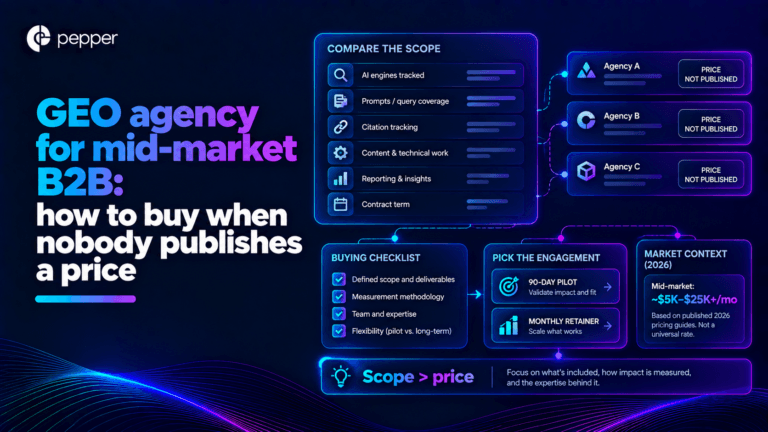
Choosing a GEO agency for mid-market B2B used to be a shortlisting problem. It is now a procurement problem, because the published prices have largely gone. Of four agencies publishing a GEO-specific figure in September 2026, two had withdrawn their pricing pages by early October and one had moved domains. Exactly one still publishes a number a mid-market buyer can act on. So the useful question is no longer which agency is best in the abstract, but how to compare three quotes when only one of them arrived with a method attached.
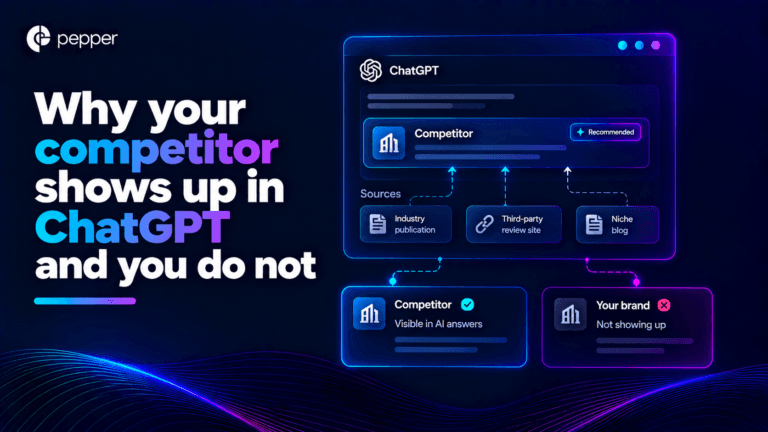
Third-party sources and AI citations are tightly linked, and the link stops short of where most plans assume. Off-page work decides whether an engine retrieves and cites you. It does not decide whether the answer names you, and 61.7% of brand appearances are citations with no name attached. The two largest 2026 datasets also disagree about how much of the citation surface is third-party at all, one saying 84% and the other putting the brand bucket above half. That disagreement is definitional rather than factual, and it decides where a budget goes.
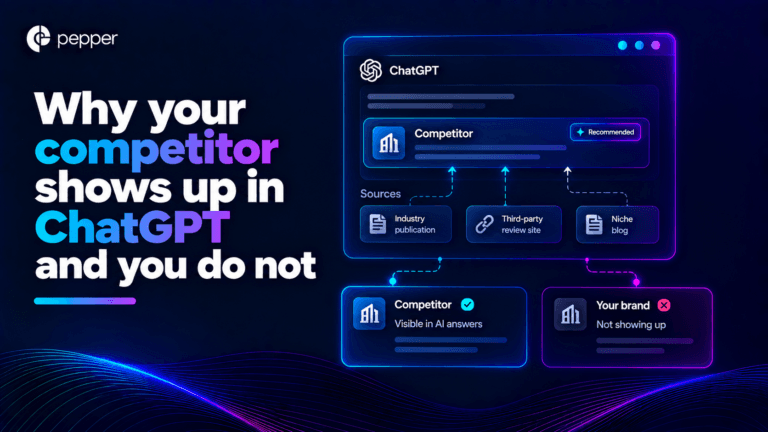
Why is my competitor showing up in ChatGPT and not me? Before accepting the premise, check it. Across 3,981 brand appearances studied in 2026, 61.7% were citations with no brand name in the answer and only 13.2% produced both. So there are three states that look identical from where you are sitting: genuinely absent, present as an unnamed source, and named less often than a rival. Each has a different cause and a different fix, and working on the wrong one is the most common way this gets expensive.
Get your hands on the latest news!

Similar Posts
GEO / AI Search
13 mins read
GEO agency for mid-market B2B: how to buy when nobody publishes a price
GEO / AI Search
14 mins read
Third-party sources and AI citations: what off-page decides, and what it does not
GEO / AI Search
14 mins read