Embedding Drift: When Your Content Gets Lost in Translation
Remember playing telephone as a kid? The message changes a little bit each time it gets passed along. Embedding drift is kind of like that, but for how AI systems understand your marketing content over time.
What is Embedding Drift? (The Simple Version)
Think of embeddings like a secret code that turns your words into numbers so computers can understand them. When you write “best running shoes,” the AI turns that into a special number pattern. Now here comes the tricky part: over time, the way people search for running shoes changes. They might start saying “marathon sneakers” or “jogging footwear.” Your content is still using the old code, but the AI is listening for new codes. That gap? That’s embedding drift.
It’s like if you labeled all your toy boxes “action figures” but everyone now calls them “superhero toys.” Your boxes didn’t change. The toys inside didn’t change. But nobody can find them anymore because they’re searching with different words.
How Does Embedding Drift Work?
When your content first gets added to an AI system, it gets turned into a mathematical representation (those number patterns we talked about). This happens when the content goes into a vector database, which is basically a fancy filing system for AI.
At first, everything matches up nicely. Your article about “social media marketing” matches perfectly when someone asks an AI chatbot about social media marketing.
But then time passes. People start talking about “creator economy strategies” instead. Maybe “influencer partnerships” becomes the hot phrase. The AI’s understanding shifts because that’s what people are feeding it through their searches and questions. Your content sits there with its original number pattern, getting further and further from what people are actually asking about.
The math behind your words hasn’t changed. But the math behind everyone else’s words has. That mismatch is embedding drift in action.
Why Does Embedding Drift Matter?
For marketers, this is huge. You might have amazing content that perfectly answers customer questions, but if it’s drifting away from how customers ask those questions today, it becomes invisible in AI-powered search systems.
Think about RAG pipelines (that’s Retrieval-Augmented Generation, or how AI chatbots pull information). When customers ask questions, these systems search through your content using those embedding codes. If your codes are old and drifted, you don’t show up. Your competitor with fresher content does.
Embedding Drift at a Glance
| Feature | Details |
| What Changes | The statistical distribution of how text is represented as numbers |
| Main Cause | Language evolution and shifts in how users phrase queries |
| Two Types | Data drift (input patterns change) and concept drift (meaning relationships change) |
| Most Affected Systems | Vector databases, RAG pipelines, AI-powered search tools |
| Marketing Impact | Content becomes less discoverable despite remaining topically relevant |
| Detection Method | Comparing embedding distributions between time periods |
Real-World Examples
Your 2020 knowledge base article uses the term “remote work tools.” By 2025, everyone searches for “hybrid collaboration platforms.” Same concept, different language. Your content drifts away from the queries.
A product description embedded in your search system says “affordable smartphones with good cameras.” Today’s buyers search for “budget phones with 108MP sensors and night mode.” Your old embedding doesn’t match their new search patterns, even though you’re selling exactly what they want.
Your marketing guide about “email campaigns” was perfectly embedded three years ago. Now people ask AI assistants about “inbox engagement strategies.” The underlying topic hasn’t changed, but the semantic representation has drifted far from current search language.
FAQs
Q1: How is embedding drift different from regular SEO decay?
Traditional SEO decay happens when your content becomes outdated or loses backlinks. Embedding drift happens when the mathematical representation of your content becomes statistically different from current query patterns, even if the content itself is still good.
Q2: Can I fix embedding drift without rewriting my content?
Sometimes. You might just need to re-embed your existing content using a newer model that understands current language patterns. Other times, you’ll need to refresh the language to match how people actually talk now.
Q3: How often does embedding drift happen?
It’s gradual and constant. Language shifts every day, but you’ll usually notice meaningful drift over months or years. Fast-moving industries with rapidly changing terminology see it faster.
Q4: Does embedding drift affect all AI marketing tools?
It primarily affects tools that use vector embeddings for matching and retrieval, like AI chatbots, semantic search systems, and recommendation engines. Traditional keyword-based tools face different challenges.
Wrapping Up
Embedding drift is just a fancy way of saying your content’s code is getting old. The good news? Now that you know about it, you can plan to refresh your content’s embeddings periodically. Keep your content speaking the same language as your customers, and you’ll stay visible in the AI-powered world.
Latest Blogs
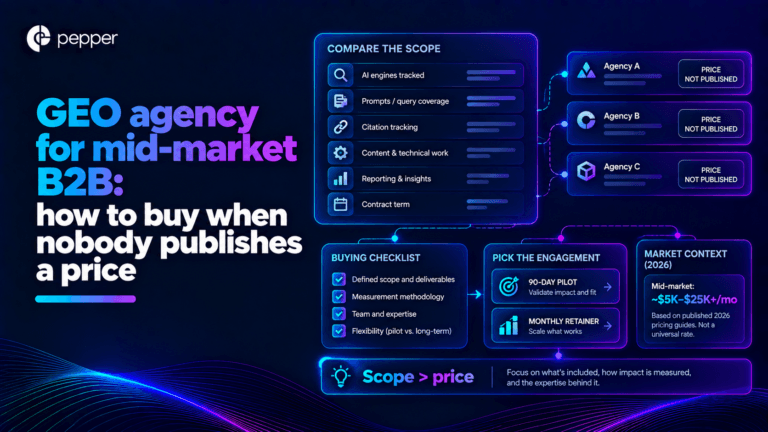
Choosing a GEO agency for mid-market B2B used to be a shortlisting problem. It is now a procurement problem, because the published prices have largely gone. Of four agencies publishing a GEO-specific figure in September 2026, two had withdrawn their pricing pages by early October and one had moved domains. Exactly one still publishes a number a mid-market buyer can act on. So the useful question is no longer which agency is best in the abstract, but how to compare three quotes when only one of them arrived with a method attached.
Third-party sources and AI citations are tightly linked, and the link stops short of where most plans assume. Off-page work decides whether an engine retrieves and cites you. It does not decide whether the answer names you, and 61.7% of brand appearances are citations with no name attached. The two largest 2026 datasets also disagree about how much of the citation surface is third-party at all, one saying 84% and the other putting the brand bucket above half. That disagreement is definitional rather than factual, and it decides where a budget goes.
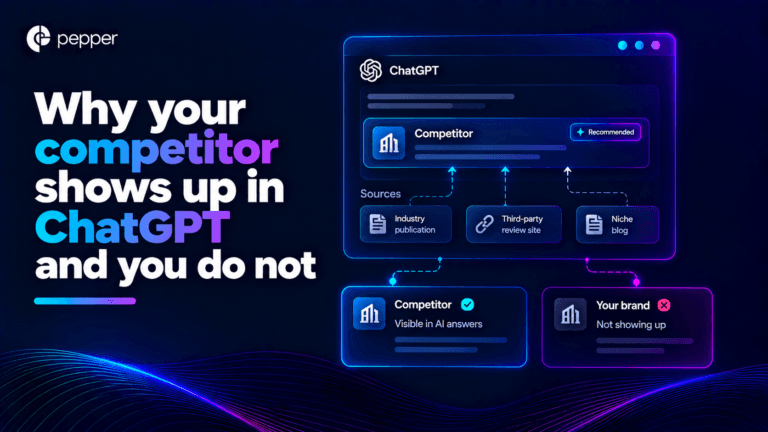
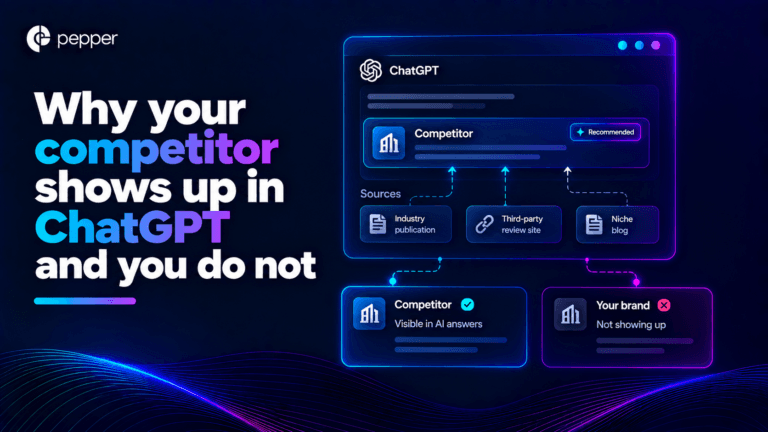
Why is my competitor showing up in ChatGPT and not me? Before accepting the premise, check it. Across 3,981 brand appearances studied in 2026, 61.7% were citations with no brand name in the answer and only 13.2% produced both. So there are three states that look identical from where you are sitting: genuinely absent, present as an unnamed source, and named less often than a rival. Each has a different cause and a different fix, and working on the wrong one is the most common way this gets expensive.
Get your hands on the latest news!

Similar Posts
GEO / AI Search
13 mins read
GEO agency for mid-market B2B: how to buy when nobody publishes a price
GEO / AI Search
14 mins read
Third-party sources and AI citations: what off-page decides, and what it does not
GEO / AI Search
14 mins read