Mentioned vs cited: the difference that decides AI visibility
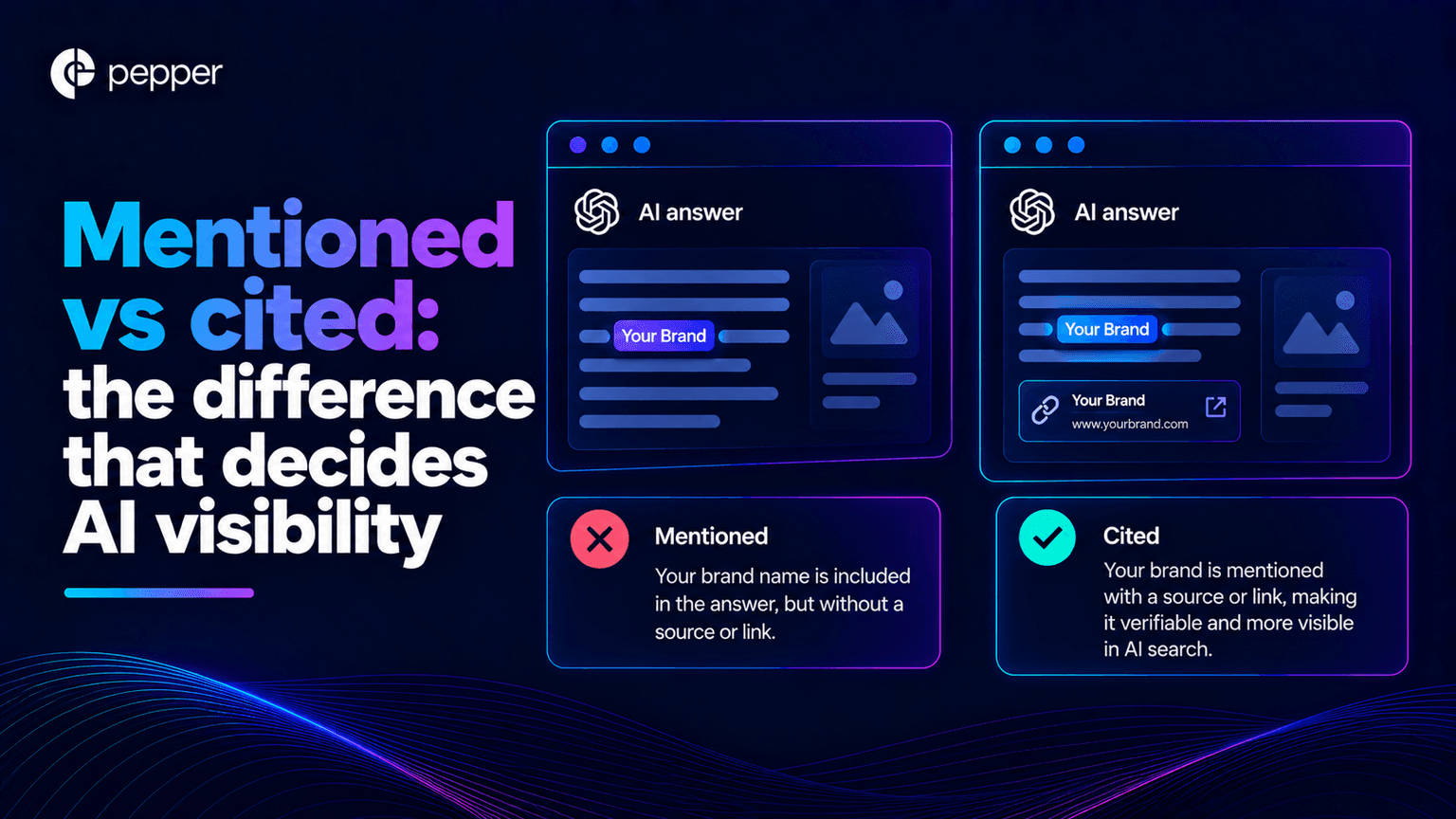
An AI answer can name your brand while drawing entirely on somebody else’s pages. That is not a small distinction. It separates talking about you from using you as the source, and it changes what you should do next.
The short answer
A mention is your brand name in the text of an AI answer. A citation means an engine used a page from your domain as a source, usually with a link. The two come from different places, and different work fixes each.
Four things follow from the distinction.
- Mentions come from the wider web. Your name shows up because enough trusted sources tie it to the category. It is not because the engine read your site today.
- Citations come from your own pages. An engine cites you when it can reach the page, read it, match it to the question, and find a line worth lifting.
- The gap between them is the diagnostic. High mentions with low citations means engines are describing you using other people’s material.
- Reporting them as one number hides which one moved. A composite visibility score cannot tell you whether to brief a PR team or a content team, and those are the two different answers.
What to do with the gap. Mentioned but not cited means the problem sits in your pages. Cited but rarely mentioned means the problem sits in category association. And if neither happens, engines probably cannot reach you at all, which matters more than everything else on this page.
Pepper is an agentic organic growth engine, not an SEO agency. This page comes out of what we run: organic for more than 250 enterprises across eight years, more than 10 million tracked prompts, and the questions buyers put to us in client reviews. Customers log in and run the platform themselves, with a Pepper growth team attached. Book a growth audit and we will show you your own gap between the two.
Key takeaways
Key takeaways on the two outcomes and what separates them.
- They are separate measurements. Brand Visibility counts mentions. Domain Prompt Presence counts whether the answer cited a page from your domain.
- Each has a different cause. Mentions follow category association across the web. Citations follow retrievable, quotable pages.
- A citation is worth more and is harder to get. It carries a link, it survives the answer, and it requires the engine to choose your page over everyone else’s.
- Citation counts are not influence. Research across 21,143 citations found engines differ sharply in how many sources they use and how much weight each carries.
- Engines disagree with each other. The same question produces different sources on different engines, so a single-engine read is not a category position.
- The gap tells you who to brief. Content team or communications team, and the answer is in the gap rather than in the total.
What is the difference between mentioned and cited?
Mentioned means an AI answer used your brand name. Cited means it used one of your pages as a source, with a link. Two words, two different things.
The clearest way to see it is to run a category question and read the answer properly.
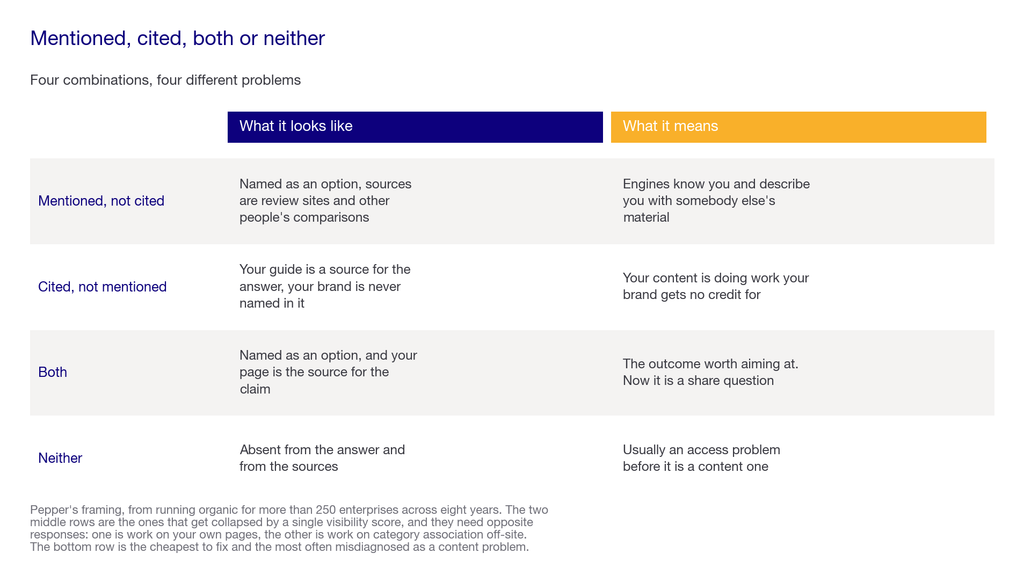
- Mentioned, not cited. “For enterprise teams, options include Acme, Brand B and Brand C”, with the sources beneath being three review sites and a comparison blog. Your name is in the answer. None of your pages are.
- Cited, not mentioned. The answer explains how to choose a vendor, links your guide as a source for the criteria, and never names you as an option. Your content taught the answer. Your brand did not benefit from it.
- Both. The answer names you as an option and uses your page as the source. This is the one to aim for.
- Neither. It sounds like a visibility problem. It is more often an access problem.
Where it falls short as a binary. An answer can mention you in passing, as the cheap option or the one to avoid. Counting mentions tells you presence, not position, and we would not let a client report a rising mention count without reading the actual answers. The metric definitions sit in what is brand visibility in AI.
Mentioned vs cited: why each one happens
The causes are genuinely different, which is why the fixes are.
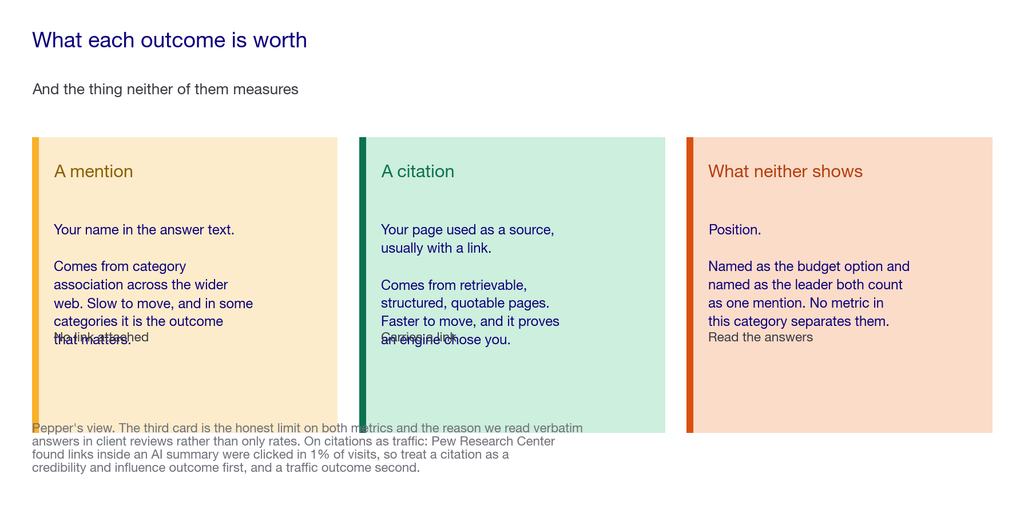
Mentions come from association. An engine names your brand because the material it has seen connects you to the category. That material is mostly not yours: review sites, comparison articles, forums, press coverage, documentation written by other people. You shift it slowly. PR, community presence and word of mouth are the levers, and none of them is quick.
Citations come from retrieval. An engine cites your page because it fetched it, could parse it, judged it relevant, and found something in it worth using. You control every step of that. Crawler access, rendering, page structure, how clearly you answer, and whether the page holds a hard fact rather than a paragraph of positioning.
The research supports treating these as separate problems. One controlled study ran 602 prompts and 21,143 search-layer citations across ChatGPT, Google AI Overviews and Perplexity. It found that high-influence pages are longer, more structured, more semantically aligned, and richer in extractable evidence: definitions, numerical facts, comparisons and procedural steps. The same study concluded that citation counts alone inadequately measure performance, because breadth and influence are different things.
The practical consequence. PR work shifts mentions, but it takes quarters. Content and technical work shifts citations, and that can take weeks. Most teams attempt them in the opposite order. What makes a page quotable in the first place is the subject of how to structure content for answer engines.
How to measure the gap
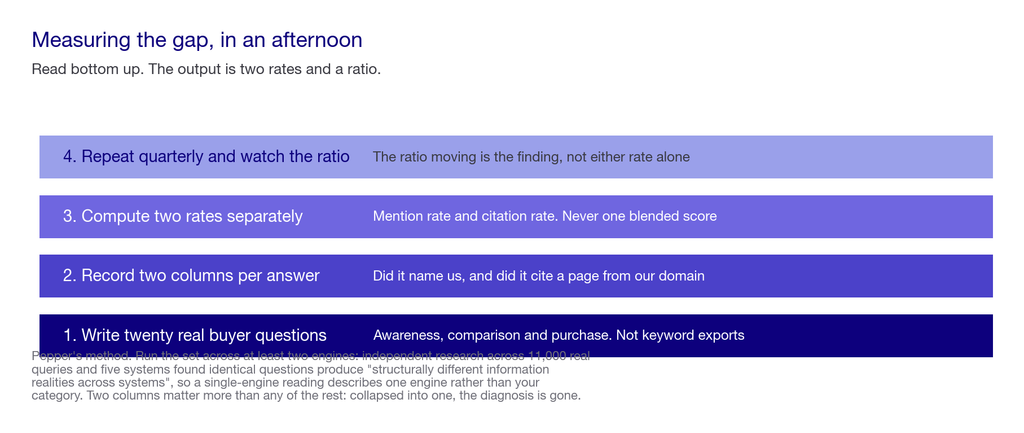
You do not need a platform to see this. Twenty prompts and an afternoon will do.
Build the question set first
Write twenty questions your buyers actually ask, spread across awareness, comparison and purchase. “What is X” at the top, “best X for Y” in the middle, “how much does X cost” at the bottom.
Do not just use your head keyword twenty times. Engines answer questions, not keywords. A set built from a keyword export measures something nobody asks.
Run them and record two things, separately
For each answer, record whether your brand name appears anywhere in the text, and separately whether any page from your domain appears in the sources. Those are two columns, not one.
Do it across at least two engines. Independent research across 11,000 real queries and five systems found identical queries produce “structurally different information realities across systems”, so one engine tells you about one engine. The full routine is in how to track brand mentions in AI search.
Compute two rates, not one score
Mention rate is the share of runs that named you. Citation rate is the share that used one of your pages. Keep them apart. The ratio between them is the finding.
In the platform these are Brand Visibility and Domain Prompt Presence, and the gap between them is the citability diagnostic we use in every client review. We set out what gets recorded on every run in what Pepper tracks.
Repeat it, and watch the ratio
One reading is a snapshot. Track the ratio over a quarter instead. It tells you whether the content work is landing, or whether you are simply getting better known.
What to do in each quadrant
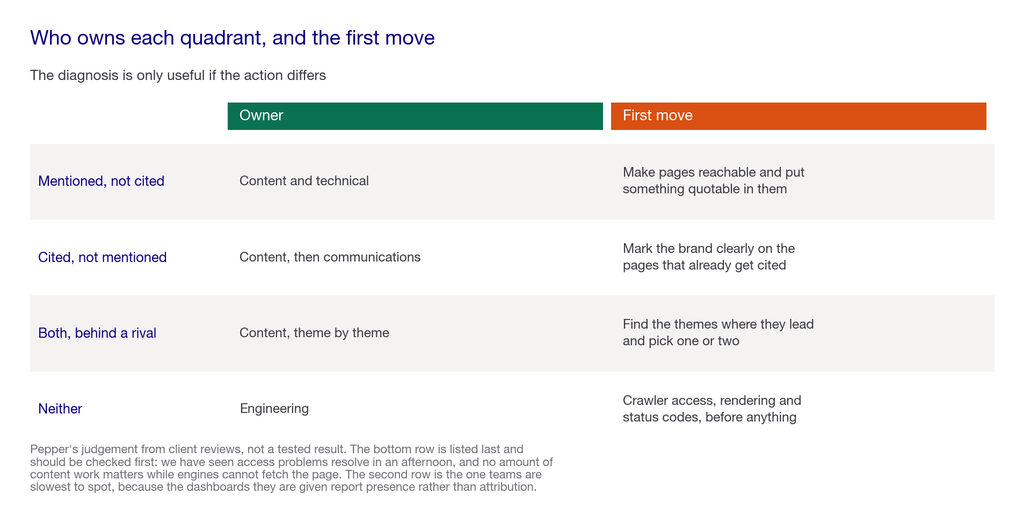
The diagnosis is only useful if the action differs, and it does.
Mentioned, not cited. Engines know you and use somebody else’s pages to describe you. The work is on your own site: make the pages reachable, structure them so an answer can lift from them, and put something quotable in them. A page calling your product powerful and intuitive gives an engine nothing to use. A page that defines the category, gives a number and weighs three options does.
Cited, not mentioned. Your content is doing work your brand is not getting credit for. Mark the brand clearly on the page: in the title, the opening, the author block and the structured data. Then check that the pages getting cited are ones where naming you reads naturally rather than awkwardly. Then work on category association off-site, because that is where the naming comes from.
Both, but behind a competitor. This is the healthiest problem to have. Now it is a share question, not a presence one. The work goes theme by theme, not site-wide. We set out the comparison method in how to benchmark AI visibility against competitors.
Neither. Check access before anything else. Crawler tokens, rendering, status codes, robots rules. We have seen this resolve in an afternoon more than once, and the checklist is in how to audit your site for AI search.
Which one is worth more
A citation is worth more than a mention, and the difference is larger than most reporting suggests.
- A citation carries a link. It can send a visit, and the visit arrives with the question already half answered.
- A citation survives the answer. It is a verifiable source the reader can open, which matters for considered purchases.
- A citation is evidence your content works. Mentions can be an accident of category association, while a citation means an engine chose your page over every alternative it had.
The honest counterweight. Mentions still matter, and in some categories they matter more. Say buyers ask “who are the main vendors in X” and never click anything. Then the mention is the outcome, and the citation is a bonus. The useful question is which of the two actually precedes a conversation in your business. You can usually answer that by asking sales where recent deals first heard of you.
And the thing neither measures. Position. A mention as the budget option and a mention as the leader both count as one. No metric in this category separates them. Read the answers.
Why one number hides all of this
Blended scores are popular because they are easy to report upward. They are also why teams brief the wrong department.
A single score blends mention rate, citation rate and some weighting nobody publishes. So when it falls, you cannot tell which of three things happened. Engines stopped naming you, stopped citing you, or started naming more rivals. Those three require three different responses from three different teams.
The three questions worth keeping separate are: are engines saying our name, are they linking to us, and what share of the conversation is ours. Each one has an owner and a fix. A blended score has neither. The longer argument is in should you trust a single AI visibility score.
What nobody should promise you
- A guaranteed citation. Nobody controls model output, and a vendor promising a specific placement is selling something they cannot deliver.
- That mentions convert like citations. A mention has no link. Treating the two as equivalent in a model will overstate the return.
- A benchmark citation rate for your industry. It varies by category more than any average can survive, and your own measurement takes an afternoon.
- That one engine represents the category. Independent research found identical queries produce structurally different source sets across systems.
Frequently asked questions
What is the difference between being mentioned and being cited in AI search?
A mention is your brand name appearing in the answer text. A citation means an engine used a page from your domain as a source, usually with a link. The two have different causes, and an answer can name a brand while drawing entirely on other people’s pages.
Which is better, a mention or a citation?
A citation, in most cases. It carries a link, it is verifiable by the reader, and it proves an engine chose your page over the alternatives. In categories where buyers never click, being named can matter more, so check which one precedes conversations in your business.
Measuring them
How do I measure mentions and citations separately?
Run twenty category questions across at least two engines and record two columns for each answer: did it name your brand, and did it cite a page from your domain. Compute a rate for each and watch the ratio between them over a quarter.
What does a high mention rate with a low citation rate mean?
Engines know your brand and are describing you using somebody else’s pages. It is a content and retrievability problem rather than an awareness problem, and the work sits on your own site rather than in communications.
What does a high citation rate with a low mention rate mean?
Engines use your content without your brand getting any credit. Mark your pages clearly with the brand and work on category association off-site, because being named comes from the wider web rather than from your own pages.
Acting on them
How long does it take to move a citation rate?
Weeks rather than quarters, when the cause is access or structure, because those fixes take effect as soon as pages are re-crawled. Category association moves far more slowly, which is why mention rates are the slower of the two.
Do citations send traffic?
Some, and less than the exposure suggests. Pew Research Center found links inside an AI summary were clicked in 1% of visits, so treat the citation as a credibility and influence outcome first and a traffic outcome second.
Should I report one AI visibility number to my board?
We would not. Report the mention rate, the citation rate and your share against named competitors. A single blended score cannot tell you which of the three moved, and each one has a different owner and a different fix.
Sources
Every claim here traces to a primary source, read directly.
Independent research
- Zhang Kai, He Xinyue and Yao Jingang, From Citation Selection to Citation Absorption, arXiv, 28 April 2026. 602 controlled prompts, 21,143 search-layer citations, 18,151 fetched pages and 72 features, across ChatGPT, Google AI Overviews and Perplexity. Finds citation counts alone inadequately measure generative engine performance, and that high-influence pages are longer, more structured, more semantically aligned and richer in extractable evidence including definitions, numerical facts, comparisons and procedural steps. Academic preprint, not peer-reviewed at the time of writing.
- Huang, Goyal, Saha and Chandrasekharan, Answer Bubbles: Information Exposure in AI-Mediated Search, arXiv, 17 March 2026, revised 28 August 2026. 11,000 real search queries across five systems. Finds identical queries produce “structurally different information realities across systems”. Also an academic preprint.
- Pew Research Center, Google users are less likely to click on links when an AI summary appears, 22 July 2025. 900 US adults, 68,879 unique searches collected March 2025. Source for the 1% click rate on links inside an AI summary. Non-commercial research organisation, and Pew states the data reflects how results appeared when collected.
Pepper product documentation
- Pepper help centre, GEO metrics explained, in-product documentation, read 8 October 2026. Source for the definitions of Brand Visibility as the percentage of runs mentioning the brand by name and Domain Prompt Presence as the percentage of runs citing a page from the domain. Requires a workspace login, so we have quoted the definitions rather than linking you to a wall.
On what this page is not
This is a distinction and a measurement method, not a benchmark. We have deliberately given no target citation rate, because the variation between categories is wide enough to make an average misleading, and because the measurement costs you an afternoon. The quadrant actions are our judgement from running this work rather than a tested result. The research cited supports separating mentions from citations in general, not any specific action we recommend.
Latest Blogs
Most advice on this is inference dressed as fact. OpenAI documents exactly one thing clearly, which is access. Here is what is documented, what is inferred, and how to verify the rest for yourself.
Being named in an AI answer and having your page used as its source are different outcomes with different causes and different fixes. The gap between them is the most useful diagnostic in AI search, and most reporting collapses it into one number.
Every platform reports share of voice and almost none of them define it the same way. Here is the definition worth using, the three choices that change the number, and how to measure it yourself without buying anything.
Get your hands on the latest news!