Two pieces of evidence point in opposite directions about how long a page should be. Resolving that tension is the whole of content architecture for answer engines, and most advice picks a side without noticing there is one.
The short answer
The passage competes, not the page. Once you accept that, the page-length argument mostly dissolves.
Here is the tension that creates the confusion.
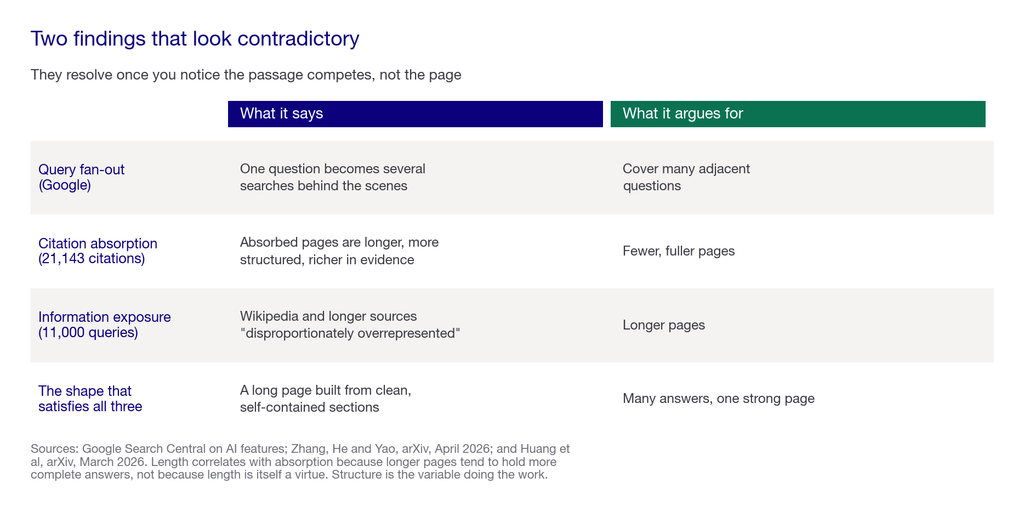
- Fan-out rewards breadth. Google states that its AI features issue multiple related searches behind the single query you typed, which surfaces “a wider and more diverse set of helpful links.” That argues for covering many adjacent questions.
- Absorption rewards depth. Independent research across 21,143 citations found that pages absorbed into answers are “longer, more structured and richer in extractable evidence” than pages merely retrieved. That argues for fewer, fuller pages.
- A second study agrees on length. Across 11,000 queries, Wikipedia and longer sources were found “disproportionately overrepresented” in AI answers.
So both are true, and they are not actually in conflict. A long page made of clean, self-contained passages satisfies both: it is long enough to be absorbed, and it contains many separately retrievable answers for fan-out to find.
The architectural question is therefore not “how long” but “how many questions does this page answer cleanly, and can each one stand alone.” This page is about that decision. For the sentence-level craft, our answer engine optimization techniques covers the on-page work in detail, and this page deliberately does not repeat it.
We run this work daily. Pepper is an agentic organic growth engine, not an SEO agency. This page comes out of what we run: organic for more than 250 enterprises across eight years, more than 10 million tracked prompts, and the questions buyers put to us in client reviews. Customers log in and run the platform themselves, with a Pepper growth team attached. Book a growth audit and we will show you which of your pages engines can currently lift from.
Key takeaways
Key takeaways from Google’s documentation and two independent studies.
- The passage is the unit of competition, not the page. Engines lift passages and cite the page they came from.
- Longer pages are absorbed more often, per research on 21,143 citations and a separate study of 11,000 queries.
- Fan-out rewards covering adjacent questions, because one query becomes several searches.
- Both are satisfied by the same shape: a long page built from self-contained sections.
- Split on the question, not the word count. A page should split when two questions need different answers, not when it gets long.
- Most sites over-split. Thin pages per keyword is a ranking-era habit that works against absorption.
What is content structure for answer engines?
It means organising a topic so that an engine can find a clean, complete answer to a specific question inside your content, and attribute that answer to you.
Three decisions sit inside that, and they are usually made by accident.
- How many pages a topic becomes. One comprehensive page, or eight narrow ones.
- Where the splits fall. By question, by audience, by funnel stage, or by keyword.
- How self-contained each section is. Whether a passage survives being lifted away from everything around it.
Where it falls short as a framing. Structure is necessary and not sufficient. A perfectly structured page about a subject nobody asks about will not be retrieved, which is why the prompt set comes before the page plan in our SEO content plan. And a well-structured page with nothing original in it will be retrieved, then ignored in favour of a source with something to say. Structure makes your content usable; it does not make it worth using.
The evidence on page length
Worth going through properly, because this is where most content strategy advice is guessing.
What absorption research found. Zhang, He and Yao analysed 602 set prompts producing 21,143 search-layer citations and 18,151 fetched pages across ChatGPT, Google AI Overview and Perplexity. Their finding is that pages which get absorbed into an answer are longer, more structured and richer in extractable evidence than pages that are merely retrieved.
That distinction matters. Retrieved means the engine fetched it. Absorbed means the engine used it. Many pages clear the first bar and fail the second, and page shape is a large part of why. The wider mechanics are in what is AI search.
What the exposure research found. Huang and colleagues, across 11,000 real queries on five systems, found “Wikipedia and longer sources are disproportionately overrepresented” in AI answers.
What Google documents. Its AI features use query fan-out, issuing several related searches behind one question, which Google says lets it show “a wider and more diverse set of helpful links.”
The resolution. Length is correlated with absorption because longer pages tend to contain more complete, self-contained answers, not because length itself is a virtue. A 4,000-word page of unstructured prose is not better than a 1,200-word page of clean sections. The variable doing the work is extractable structure, and length is a side effect of having enough of it.
When to split a topic, and when not to
This is the actual architectural decision, and the rule is simpler than the keyword-era version.
Split when two questions need genuinely different answers. “What does it cost” and “how do I implement it” are different answers for different readers at different moments. Two pages.
Do not split when two questions share an answer. “Best X for small teams” and “affordable X” are usually the same answer phrased twice. One page, two sections, two headings.
Do not split on keyword variants. This is the habit worth breaking. Creating a page per phrasing was a ranking strategy, and under fan-out it actively hurts: you end up with several thin pages each answering a fragment, when one fuller page would have been absorbed.
Do split when the reader changes. A page serving a practitioner and a budget holder serves neither well, because the answer each needs is different even when the question sounds the same.
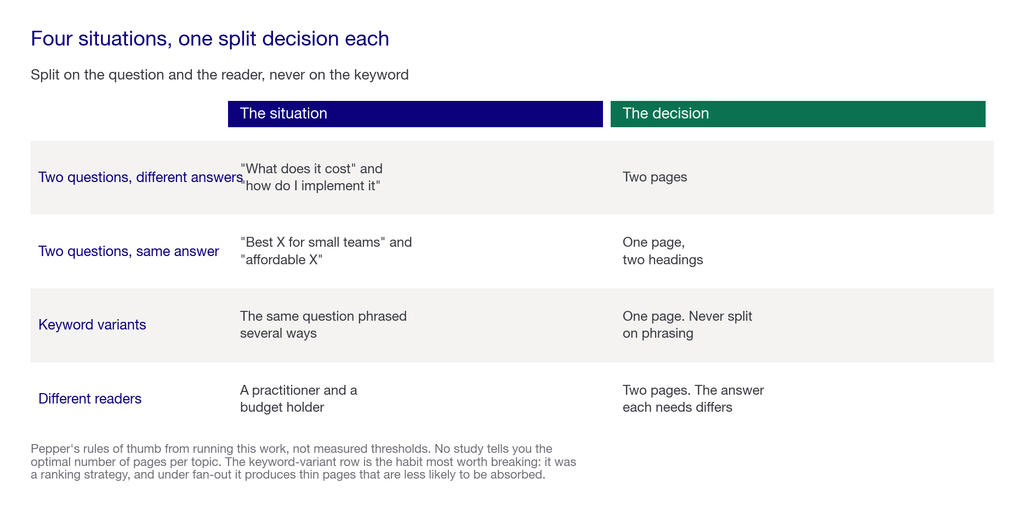
Where it falls short. These are rules of thumb from running this work, not measured thresholds. We have no study telling you the optimal number of pages per topic, and anyone who offers you one is estimating.
How to shape a page once you have decided
Three structural properties, at the section level rather than the sentence level.
Step 1. Every section answers one question completely
A section should be readable as a standalone answer. If a reader arrived at that section cold, with no context from the page around it, would it make sense?
The test. Copy one section into a blank document. Does it still answer its own heading? If it needs the previous section to make sense, an engine lifting it will produce something confusing, and the engine is more likely to reach for a competitor who did this properly.
Step 2. Order sections by dependency, not by narrative
A page built as an argument reads well start to finish and extracts badly. A page built as a reference extracts well and still reads acceptably.
The practical version. Put the answer first, context second, nuance third, within every section and across the page as a whole. The reader who wants the full argument will keep reading. The engine lifting the first passage gets a complete answer rather than a preamble.
Step 3. Give adjacent questions headings, not pages
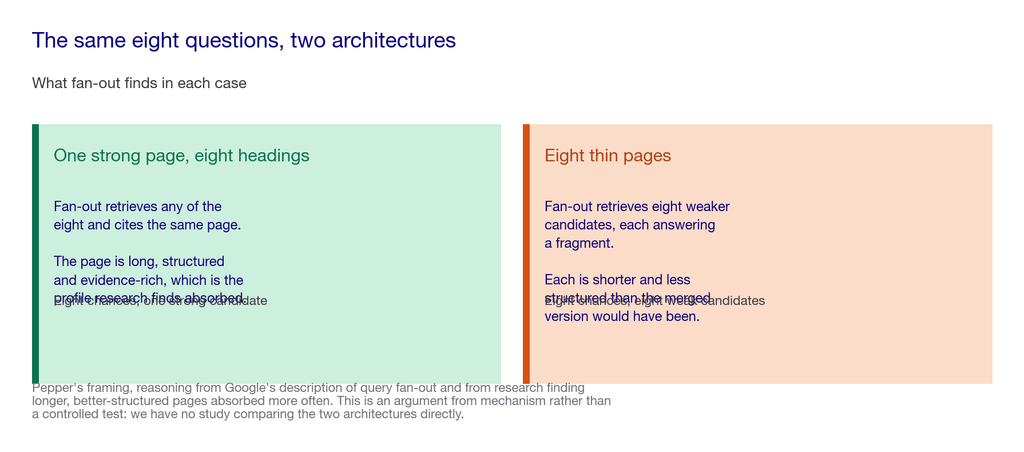
This is where fan-out cashes out. If your topic has eight adjacent questions, giving each one a heading on a single strong page means fan-out can retrieve any of the eight and cite the same page.
The alternative, and why it is worse. Eight thin pages means fan-out retrieves eight different weak pages, each of which is less likely to be absorbed than one strong one.
How to retrofit an existing library
Most teams are not starting fresh. Four steps, in the order that returns the most soonest.
- Find your thin clusters. Groups of pages that each answer a fragment of the same question. These are the keyword-era artefacts, and they are the biggest available win.
- Consolidate rather than delete. Merge the fragments into one page with a heading per question, and redirect. You keep the coverage and gain the absorption.
- Re-order your best pages. On the twenty pages that already earn traffic, move the answer to the top of each section. Fast, cheap and the most visible change.
- Leave the rest alone. Restructuring a library nobody reads is effort spent on pages that were never going to be retrieved.
The honest limitation. Consolidation is a real risk if done carelessly. Merging pages that genuinely serve different readers loses both. And redirects handled badly cost you more than the structure gains. If you are not confident, start with the re-ordering step, which has no downside, and come back to consolidation later. The technical side of that is in how to audit your site for AI search.

Figure 4: Four retrofit steps. The cheapest one has no downside.
What this does not fix
Setting expectations, because structure gets oversold.
- It does not create authority. Research consistently finds third-party sources carry most citations, which is the gap the Visibility, Citability and Retrievability framework is built to diagnose. A well-structured page on an unknown domain still competes against a review site.
- It does not make you worth citing. If your page says what every other page says, better structure makes it easier to lift something unremarkable.
- It does not override access problems. A page an engine cannot fetch or render scores zero whatever its shape.
- It does not guarantee anything. Google states there are “no additional requirements to appear in AI Overviews or AI Mode, nor other special optimizations necessary,” which cuts both ways: no special structure is required, and none is sufficient.
The answer that loses us the sale. If your pages are already answer-first and your problem is that nobody cites you, structure is not your bottleneck and restructuring will not move your numbers. Go and find which sources your category actually cites, and work on becoming one of them. The practices for that are in our GEO best practices playbook.
What nobody should promise you
- An optimal page length. No study gives one. Length correlates with absorption because longer pages tend to contain more complete answers, not because length is itself a ranking factor.
- A guaranteed citation from restructuring. Nobody controls what a model outputs.
- A word count target. If a proposal contains one, ask what evidence produced it.
- That structure beats authority. The research points the other way: third-party and reference sources carry most citations.
- A consolidation with no risk. Merging pages that serve different readers loses both audiences.
Frequently asked questions
How do I structure content for answer engines?
Build pages from self-contained sections, each answering one question completely, ordered answer-first. Give adjacent questions their own headings on a strong page rather than their own thin pages.
Should pages be longer or shorter for AI search?
Longer pages are absorbed more often, per research on 21,143 citations and a separate study of 11,000 queries. But length is a side effect of containing more complete answers, not a target in itself.
Deciding page structure
When should I split a topic into several pages?
When two questions need genuinely different answers, or when they serve genuinely different readers. Do not split on keyword variants, which is a ranking-era habit that produces thin pages fan-out cannot use well.
Is one long page better than eight short ones?
Usually, for this purpose. Eight headings on one strong page means fan-out can retrieve any of the eight and cite a page likely to be absorbed. Eight thin pages means eight weaker candidates.
What is the test for a well-structured section?
Copy it into a blank document. If it still answers its own heading without the surrounding page, it will survive being lifted. If it needs context from above, it will not.
Fixing what you have
Where do I start with an existing library?
Re-order the twenty pages that already earn traffic so the answer comes first in every section. It is fast, cheap and has no downside, unlike consolidation.
Is consolidating thin pages safe?
Only if the pages genuinely answer fragments of one question. Merging pages that serve different readers loses both, and poorly handled redirects cost more than the structure gains.
Will restructuring fix my AI visibility?
Only if structure is your bottleneck. If your pages already answer cleanly and you are still not cited, the problem is authority or coverage, and restructuring will not move it.
Sources
Google documentation was read at source. Research is independent and named.
Independent research
- Zhang Kai, He Xinyue and Yao Jingang, From Citation Selection to Citation Absorption, arXiv, 28 April 2026. 602 set prompts, 21,143 search-layer citations, 18,151 fetched pages, across ChatGPT, Google AI Overview and Perplexity. Finds absorbed pages are longer, more structured and richer in extractable evidence than pages merely retrieved. Academic and independent.
- Huang, Goyal, Saha and Chandrasekharan, Answer Bubbles: Information Exposure in AI-Mediated Search, arXiv, 17 March 2026. 11,000 real search queries across five systems. Finds “Wikipedia and longer sources are disproportionately overrepresented” in AI answers. Academic and independent.
Google documentation
- Google Search Central, AI features and your website, checked 29 September 2026. Source of the query fan-out description, and of the statement that there are “no additional requirements to appear in AI Overviews or AI Mode, nor other special optimizations necessary.”
On what this page is
The split rules, the section tests and the retrofit order are our judgement from running this work, not measured thresholds. No study tells you the right number of pages for a topic or the right length for a page, and we have not invented one. What the research does support is the direction: longer, better-structured pages with more extractable evidence get used more often than short thin ones. Everything else here is how we would act on that, and you should feel free to disagree with it.
Latest Blogs
The research pulls in two directions. Fan-out rewards covering many adjacent questions; absorption research finds longer pages get used. The resolution is that the passage competes, not the page.
Seven documented changes, not seven predictions. Google switched two rich results off, shipped two new AI reports, and added a channel to Analytics. Here is what actually moved and what it means.
Content chunking is the process of splitting a page into smaller pieces so a machine can retrieve one of them. Here is the part most articles get wrong: chunking is something engines do to your page, not something you do to it. You do not choose the chunk size.
Get your hands on the latest news!