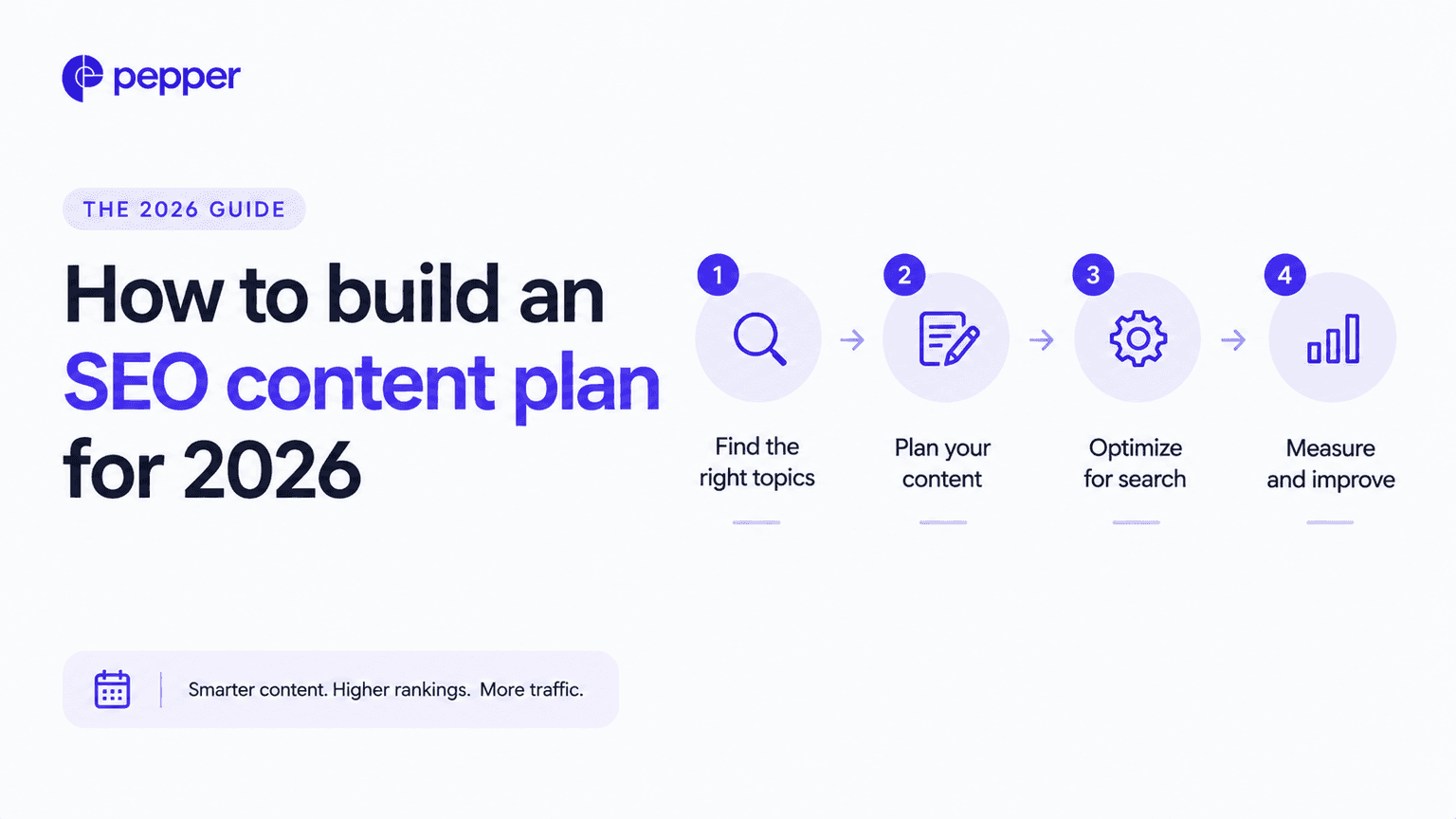
Most content plans fail at stage one, and not for the reason people expect.
They fail because nobody wrote down what the plan is allowed to say no to. A plan that cannot reject a topic becomes a wish list, and wish lists die around week six when someone senior asks for a page about something else.
Pepper runs organic for more than 250 enterprises. The six stages below are what our growth teams work through, in this order, with the template at the end. The AI part is smaller than the category implies: two extra columns and one capability most teams do not have.
The short answer
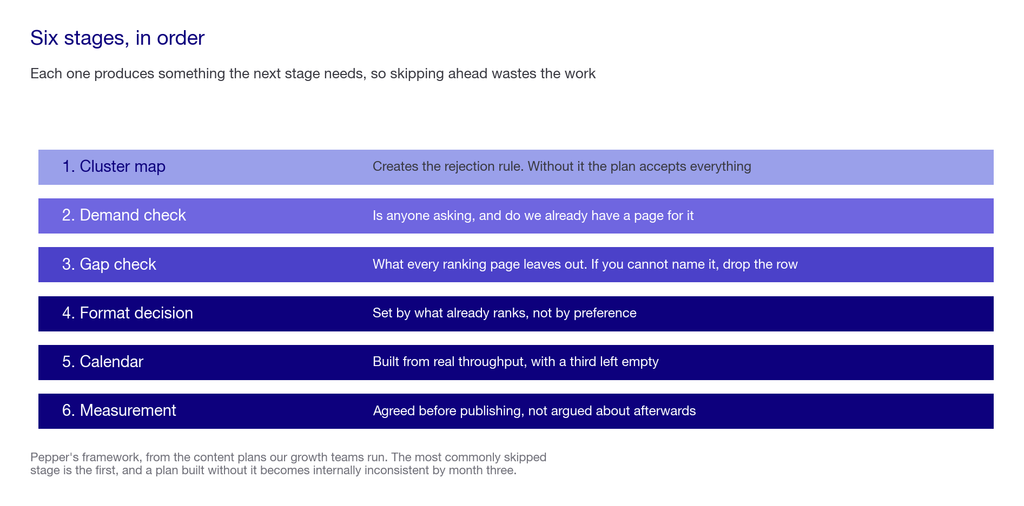
Build it in six stages, in order. Cluster map, demand check, gap check, format decision, calendar, then measurement. Each stage produces something the next one needs, so skipping ahead wastes the work.
Then add the AI layer, which is not a separate plan. It is two columns in the same spreadsheet: whether a question triggers an AI answer at all, and which outside sources feed it.
Key takeaways
- The plan needs a rejection rule. Without one it becomes a list of everything anyone suggested.
- Two of your own pages targeting one phrase is the expensive mistake. Check before you add a row, not after.
- What already ranks decides the format, not your preference. A good article in the wrong shape loses to a mediocre one in the right shape.
- The AI layer adds two columns, not a workstream. Does this question produce an AI answer, and who gets cited in it.
- The capability most plans lack is earned media, and no amount of publishing replaces it.
A note on where this comes from. We run organic for more than 250 enterprises and track over 10 million prompts across every major engine. What follows is shaped by that, by the client reviews we sit in weekly, and by the abandoned content calendars we inherit.
What is an SEO content plan?
An SEO content plan is a decided list of what you will publish, in what order, why each item is on it, and what would make you remove it.
The last part is what separates a plan from a calendar. A calendar says what goes live on Tuesday. A plan says why that thing and not the forty others somebody suggested, and it can defend that answer to a sceptical executive.
Three things belong in one, and most plans only contain the first:
- What to publish, with the target phrase and the format
- Why, meaning the demand evidence and the gap it fills
- What would remove it, the rejection rule that keeps the plan honest
Our guide to adding GEO to an existing SEO scope covers where the AI work sits organisationally, and enterprise SEO covers what changes above 10,000 pages.
Stage 1: Build the cluster map before anything else
A cluster is one pillar page covering a broad topic, plus eight to fifteen supporting articles that each cover one narrower question and link back up.
This stage exists to create the rejection rule. Once you have the map, any topic fitting no cluster either joins one or earns a written exception. That single rule kills most of what goes wrong later.
- Name your pillars first, usually three to six for a mid-sized company. These map to what you sell, not to what is interesting
- List the questions under each pillar in your buyers’ words, not your category’s words
- Mark which already have a page, so you are planning additions rather than duplicates
- Write the exception rule down and agree who can invoke it
If you want the cluster map built against your own category rather than from a template, book a growth audit and we will work through it with your team.
Where this stage falls short: it moves slowly, it looks unglamorous, and people skip it. A plan built without it turns internally inconsistent by month three.
Stage 2: Check demand before you commit a row
Now find out whether anyone is asking, because a well-written article about a question nobody asks is still a waste.
- Get search volume and difficulty for every candidate phrase
- Check whether you already rank for it, using the methods in our guide to tracking brand mentions in AI search. If an existing page picks up impressions, improve that page instead of writing a new one
- Look for phrases you rank for accidentally, where you have no dedicated page. Google has already decided you are relevant and you have not tried
- Reject anything with no evidence of demand, and record the rejection so nobody re-proposes it in six weeks
Where this stage falls short: volume tools disagree with each other and all of them are estimates. Use them to separate “some demand” from “none”, not to rank topics to two decimal places.
Stage 3: Check the gap before you decide the angle
Open the top ten results for each surviving phrase and read them properly.
- Count the formats. How many are numbered lists, how many are how-to guides, how many are comparisons
- Write down what every one of them leaves out. That gap is the reason your article exists, and if you cannot name it, drop the row
- Note who publishes them. In most markets, companies selling one of the answers publish the ranking pages, which is often the gap itself
- Check for an AI answer, which feeds stage 4
Where this stage falls short: it takes roughly twenty minutes per topic done properly, and most teams reduce it to a glance at the titles.
Stage 4: Let the results decide the format
The shape of the article is not a preference. What already ranks sets it, because engines and readers both expect a particular answer shape for a particular question.
| What the results mostly show | Write this |
|---|---|
| Numbered lists and “best X” pages | A ranked list with a comparison table |
| Step-by-step guides | A how-to with sequenced stages |
| “X vs Y” pages | A comparison, dimension by dimension |
| Definitions and explainers | An explainer with a standalone definition up top |
| A mix, on a broad head term | A pillar: playbook first, then the list |
Record the count that justified the choice. “Eight of the top ten are numbered lists, so this is a list” gives somebody a decision they can check later.
Where this stage falls short: it tells you the shape, not the substance. Matching the format and saying nothing new still loses.
Stage 5: Build the calendar around capacity, not ambition
This is where plans quietly become fiction.
- Start from throughput, not targets. How many pieces did you actually publish last quarter, not how many you planned
- Sequence by dependency. Pillar pages before the clusters that link to them
- Leave a third of the calendar empty. Something urgent always arrives, and a full calendar means the urgent thing displaces the planned thing permanently
- Assign a named owner per piece, not a team
- Book the review time, especially legal or subject-matter review, which is the real bottleneck in regulated categories
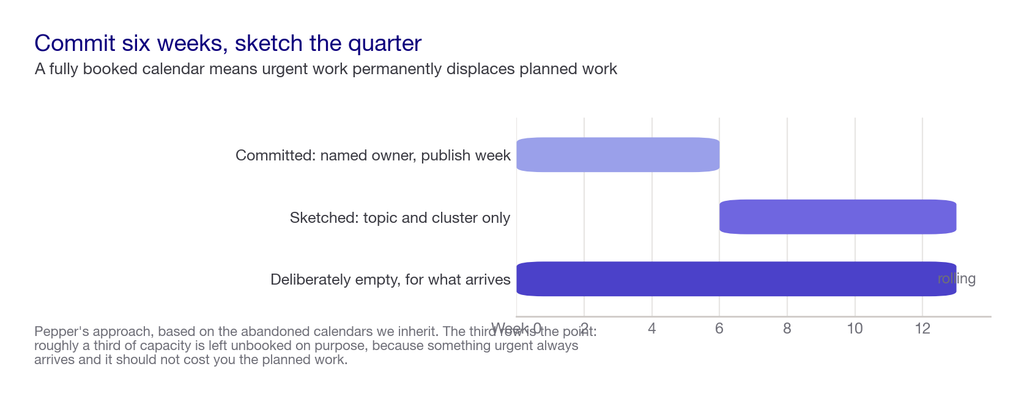
Where this stage falls short: it will be wrong. Treat the calendar as a rolling six weeks of committed work and a looser quarter behind it.
Stage 6: Decide what you will measure before you publish
Agreeing this after the fact is how reporting arguments start.
- Name the outcome metric. Conversions from organic, by landing page
- Name the leading indicators. Clicks and impressions by page, read together
- Set the checkpoints. Day 7, 30 and 90, with what would count as working at each
- Agree what would make you kill a piece and rewrite it
Our guide to reading an SEO report covers which numbers matter and which fill space.
Where this stage falls short: organic attribution stays directional and always will. Agree that up front rather than discovering it in a quarterly review.
The AI search layer: two columns, not a second plan
Here is the part the category oversells. Google states that AEO and GEO are part of SEO, and that AI Overviews and AI Mode run on core Search ranking systems with no separate AI index. You are not building a second plan.
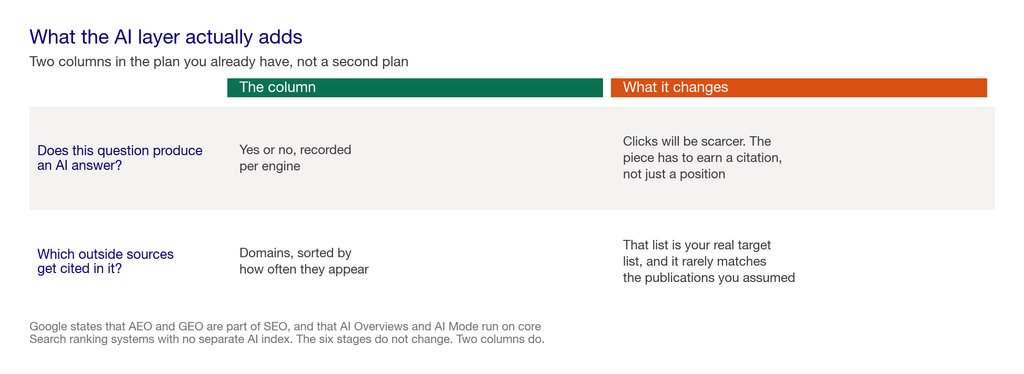
Column one: does this question produce an AI answer? Run the phrase and record whether an AI Overview or assistant answer appears. If it does, clicks will be scarcer and the piece needs to earn a citation rather than a position.
Column two: which outside sources get cited? Record the domains appearing in those answers, sorted by frequency. That list is your real target list, and it will not match the publications you assumed mattered.
What changes in the writing. Independent researchers measured 21,143 citations across ChatGPT, Google AI Overview and Perplexity in April 2026. Engines absorb pages that run longer, carry more structure, and hold more extractable evidence: definitions, numerical facts, comparisons and procedural steps. Build those four into the brief rather than hoping they appear.
What does not change. The six stages above. Clusters, demand, gaps, format, capacity, measurement all work the same way.
The capability most plans lack. Muck Rack’s analysis of more than 25 million cited links found earned media accounted for 84% of AI citations against 0.3% for paid. Muck Rack sells PR software, so treat it as an interested party with a large dataset, but independent academic work points the same way. No amount of publishing on your own site reaches that pool.
If you want your cluster map and prompt set built against your own category rather than from a template, book a growth audit and we will work through stages 1 to 3 with your team.
The template
Twelve columns. Every stage above fills one of them, which is the point: an empty column means somebody skipped a stage.
| Column | What goes in it | Which stage fills it |
|---|---|---|
| Target phrase | The exact phrase, one per row | 2 |
| Cluster and pillar | Which group it belongs to | 1 |
| Volume and difficulty | The demand evidence | 2 |
| Existing page? | URL if one already targets this | 2 |
| The gap | What every ranking page leaves out | 3 |
| Format | List, how-to, comparison, explainer | 4 |
| Format evidence | The count that justified it | 4 |
| AI answer present? | Yes or no, per engine | AI layer |
| Sources cited in that answer | Top domains, by frequency | AI layer |
| Owner | A named person | 5 |
| Publish week | Committed only for six weeks out | 5 |
| Success at day 90 | What would count as working | 6 |
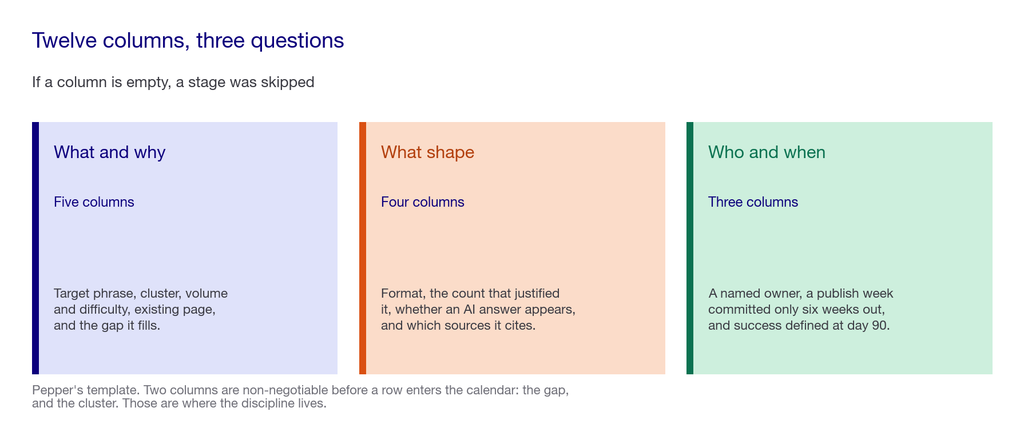
Figure 4: The twelve columns, grouped by the question each answers.
A rejection rule worth copying. A row cannot enter the calendar with an empty gap column or an empty cluster column. Those two are where the discipline lives.
What nobody should promise you
A number of articles per month as a strategy. Volume is an activity commitment. Nothing in the measured research rewards it.
That AI search needs a separate content plan. Google places AEO and GEO inside SEO. Two columns is the honest version of the change.
Guaranteed rankings or citations from a plan. Google advises against providers guaranteeing rankings, because third parties cannot access internal ranking systems.
That publishing more will fix visibility. Most of the citation pool sits on sources you do not own, and no calendar reaches it.
Where Pepper fits
Pepper is an agentic organic growth engine, which matters here because a plan is only as good as the capacity behind it.
- What you log into: workspace setup, brand profile, competitors and personas. GA4 and Search Console connected. Themes and prompts managed, GEO analytics read directly, and your own agents built and run in the Agent Atlas
- Engines tracked: 6, including ChatGPT, Perplexity, Gemini and Google AI Overviews, reported separately so the AI columns are real data rather than a guess
- And a growth team is attached to the account, working through the plan alongside your people, including the earned media that no calendar reaches
- Best for: teams whose plan keeps slipping because throughput, not ideas, is the constraint
- Where it falls short: we do not publish pricing, so you cannot size it before a call. A one-off plan is not what we are for, and our depth sits in content, authority and AI search rather than large technical migrations
Frequently asked questions
The basics
What is an SEO content plan?
A decided list of what you will publish, in what order, why each item is on it, and what would remove it. That last part separates a plan from a calendar, because it lets you reject topics with a reason.
How far ahead should a content plan run?
Commit six weeks of specific work and keep a looser quarter behind it. Anything further out is a guess, and a fully booked calendar means urgent requests permanently displace planned work.
How many articles should I plan per month?
Start from what you actually published last quarter rather than a target. Plans built on ambition rather than throughput die around week six, which is the most common failure we inherit.
Do I need a cluster map first?
Yes, because it creates the rejection rule. Without it, anyone can justify any topic, and the plan turns into a list of everything rather than a set of decisions.
The AI layer
Does AI search need its own content plan?
No. Google states AEO and GEO are part of SEO, and AI Overviews run on core Search ranking systems with no separate index. The honest change is two extra columns in the plan you already have.
What are the two AI columns?
Whether the phrase produces an AI answer at all, and which outside domains get cited in it. The second is more useful, because that domain list is your real target list for earned media.
How do I write content that gets cited by AI?
Independent research found absorbed pages carry definitions, numerical facts, comparisons and procedural steps, and are longer and more structured. Build those four into the brief rather than hoping they turn up.
Will publishing more content improve AI visibility?
Not on its own. Most citations come from sources you do not own, so a plan confined to your own site addresses the smaller share regardless of how much it produces.
Where to go next
Write the cluster map this week, before anything else. Three to six pillars, the questions under each, and a written rule for what happens when a topic fits none of them. That single page makes every later decision faster.
Then run stage 2 on your top ten candidates and see how many survive. In our experience about half do, which is the plan working rather than failing.
Our guide to reading an SEO report covers the measurement stage, 18 GEO best practices covers what the research says gets cited, and how to run a GEO audit covers the diagnostic behind the AI columns.
For the wider picture, adding GEO to an existing SEO scope covers where this sits organisationally and enterprise SEO covers what changes at scale. Our SalesHood case study documents AI Overview keywords moving from 14 to 97 across five months.
The honest exit. If you publish fewer than about two pieces a month, you do not need a twelve-column plan. A cluster map and a rejection rule will do, and the rest is overhead you will abandon.
Sources
We quote Google’s guidance from Google’s own documentation, checked on 16 September 2026. Every study here appeared in 2026, and we checked each at the original source.
- Google Search Central, AI features and your website, 15 May 2026. States that AEO and GEO are part of SEO, that AI Overviews and AI Mode use core Search ranking systems with no separate AI index, and advises against providers guaranteeing rankings.
- Zhang Kai, He Xinyue and Yao Jingang, From Citation Selection to Citation Absorption, arXiv, 28 April 2026. 602 controlled prompts, 21,143 search-layer citations, 18,151 fetched pages across ChatGPT, Google AI Overview and Perplexity. Finds absorbed pages are longer, more structured and richer in extractable evidence. Academic and independent.
- Huang, Goyal, Saha and Chandrasekharan, Answer Bubbles: Information Exposure in AI-Mediated Search, arXiv, 17 March 2026. 11,000 real search queries across five systems, finding identical queries produce structurally different results between systems. Academic and independent.
- Muck Rack, Earned media still drives 84% of AI citations, 7 May 2026. More than 25 million cited links, 17 industries. Muck Rack sells PR software, so read it as an interested party with a large dataset.
The six stages, the twelve columns and the rejection rule are Pepper’s own framework, based on the plans our growth teams run and the abandoned calendars we inherit. They are a working method rather than an industry standard.
Latest Blogs
Six stages, in order, with the template at the end. The new part is not a separate AI workstream bolted on the side. It is two extra columns in the plan you were already building, and one capability most teams do not have.
No regulator requires you to monitor what ChatGPT says about your products. Vendors imply otherwise. Here is what the rules actually cover, what the real risk is, and which tools stand up to a buying review.
Every ranked list of financial SEO agencies puts its own author first. We checked three of them. Here are ten agencies compared on what they publish, what financial SEO costs, and the questions that sort a real partner from a good deck.
Get your hands on the latest news!

Similar Posts

SEO
15 mins read
What are the best SEO agencies in 2026?

Artificial Intelligence
12 mins read
How to check whether your brand appears in AI search

Digital Marketing
15 mins read