Should you add GEO to your SEO scope, or run it separately?
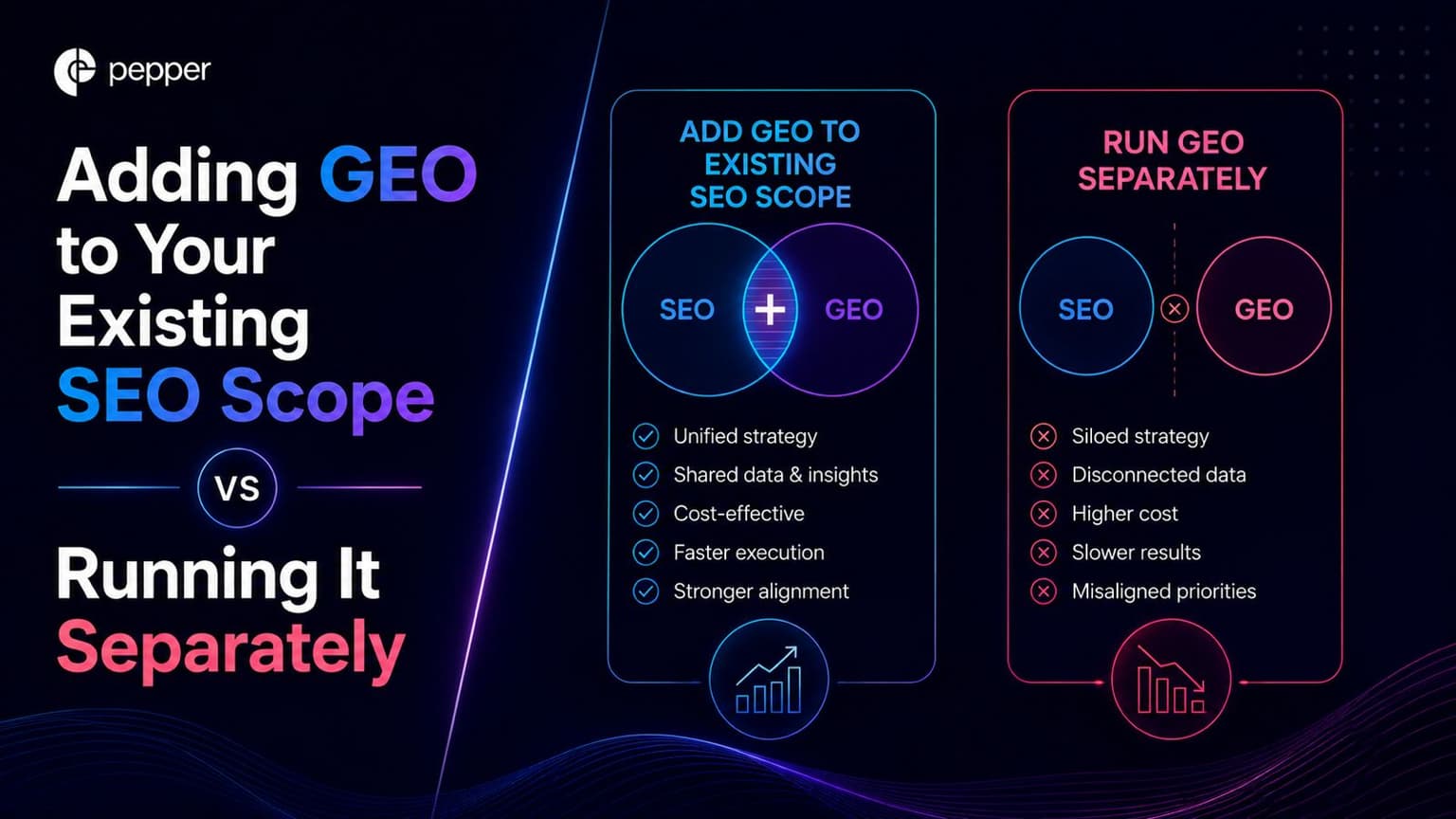
Google has already answered half of this question, and most teams are still arguing about the other half without noticing.
In its May 2026 guidance, Google states plainly that AEO and GEO are part of SEO, and that AI Overviews and AI Mode run on core Search ranking systems with no separate AI index. There is no second algorithm to optimise for at Google. That settles the technical question.
It does not settle the organisational one, and that is the question you are actually asking. Pepper runs organic for more than 250 enterprises, and we watch teams get the technical answer right and the org design wrong roughly as often as the reverse.
The short answer
Add GEO to your existing SEO scope. Do not build a separate team.
Then fund two things that your current SEO scope almost certainly does not cover: earned media, and a measurement layer that reads AI answers rather than rankings. Those are the real gaps, and neither of them is a reason to split the function.
Key takeaways
- Google says GEO and AEO are part of SEO. AI Overviews and AI Mode run on core Search ranking systems with no separate index, so there is no second algorithm to staff against.
- Splitting the team duplicates the 80% that is shared. Technical retrievability, entity clarity and content quality serve both. A separate team rebuilds all of it.
- The genuine gap is earned media. Muck Rack found 84% of AI citations come from earned media, which sits outside most SEO scopes entirely.
- The second gap is measurement. Rank tracking cannot see an AI answer. That is a new instrument, not a new department.
- Separate reporting lines, shared execution. Report the AI numbers separately so they get attention. Keep the people together so the work does not get done twice.
A note on where this comes from. We run organic for more than 250 enterprises and track over 10 million prompts across every major engine. What follows is shaped by that, by the client reviews we sit in weekly, and by conversations with in-house leads at the events we run. It is our read on the org design question rather than a neutral survey.
What is GEO, and how much of it is actually new?
GEO, generative engine optimization, is the work of getting a brand mentioned and cited inside AI-generated answers rather than ranked in a list of links. AEO, answer engine optimization, is the same idea described with different vocabulary. The terms are used interchangeably in the market, and our breakdown of GEO, SEO and AEO covers where the distinctions genuinely matter.
The useful question is not what GEO is called. It is how much of it your SEO team already does.
Most of it. Crawlability, rendering, site speed, structured data, entity clarity, content depth and internal linking all feed AI retrieval directly, and they are all in a normal SEO scope already. An engine cannot cite a page it cannot fetch or parse.
What is genuinely new is narrower than the category’s marketing suggests, and it comes down to three things: measuring answers instead of positions, earning citations from sources you do not own, and treating brand entity clarity as a ranking input rather than a branding exercise.
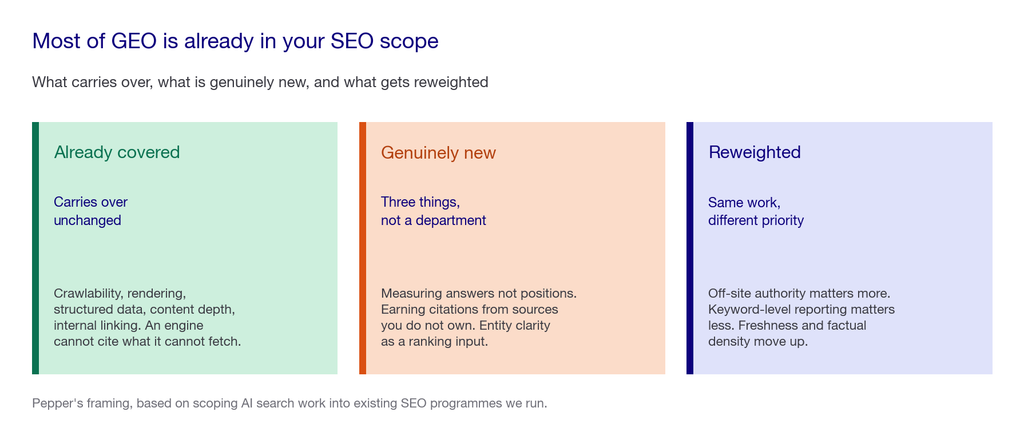
Add GEO to your SEO scope: the three operating models at a glance
| Absorb into SEO | Separate GEO team | Shared team, split reporting | |
|---|---|---|---|
| Who owns it | Existing SEO lead | New hire or new function | Existing SEO lead, new metrics |
| Duplicated work | None | Technical, content, entity work rebuilt twice | None |
| Time to running | Weeks | A quarter or more | Weeks |
| Risk | AI metrics get deprioritised behind rankings | Two teams competing for the same pages | Reporting overhead |
| Added cost | Measurement tooling and earned media | Headcount, tooling, earned media | Measurement tooling and earned media |
| Where it falls short | Nothing forces attention on the new numbers | Expensive and slow, and the work overlaps anyway | Needs discipline to keep the reporting honest |
We recommend the third column for most enterprises, and the first for teams under about fifteen people. The middle column is the one we would argue against, and we say why below.
How we weighted this decision
These weights come from what actually predicts whether an AI search programme produces movement in the accounts we take over. They are about org design rather than vendors.
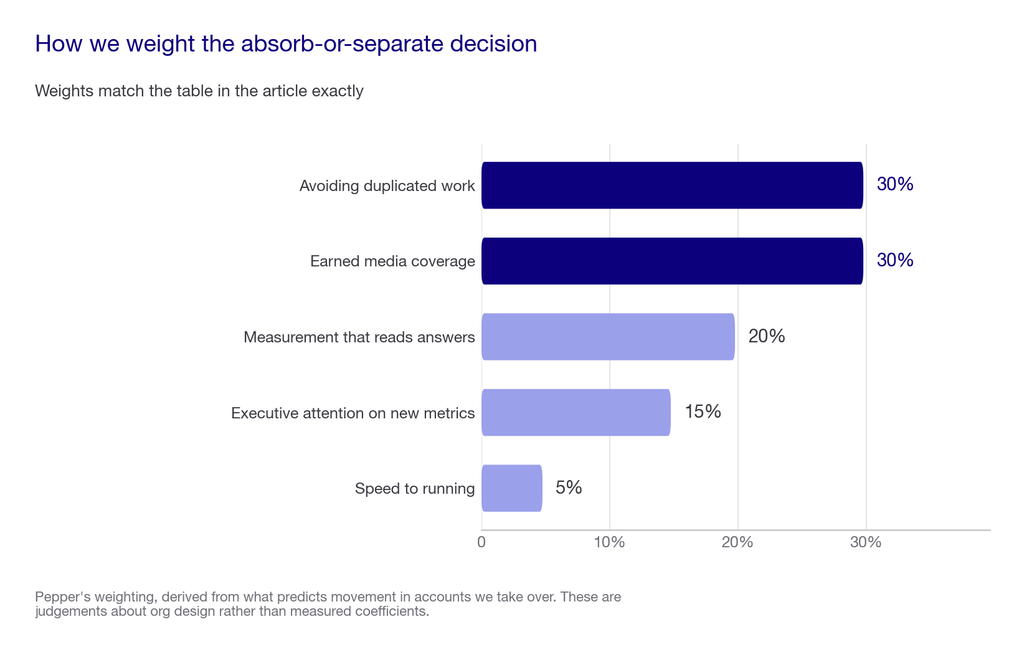
| Area | Weight | What decides the score |
|---|---|---|
| Avoiding duplicated work | 30 | Whether technical, content and entity work is done once or rebuilt by a second team chasing the same pages |
| Earned media coverage | 30 | Whether anyone owns getting you into third-party sources, which is where the large majority of citations originate |
| Measurement that reads answers | 20 | Whether you can see AI answers and cited URLs, rather than inferring from rankings that no longer move together |
| Executive attention on new metrics | 15 | Whether AI numbers get reported and acted on, or buried under a rankings dashboard that still looks healthy |
| Speed to running | 5 | Whether the programme starts in weeks or waits on a hiring cycle |
The top two carry equal weight because they are the two ways this decision usually goes wrong, and they fail in opposite directions. Splitting the team duplicates work. Absorbing it without protecting attention buries the new numbers.
Our GEO agency ranking methodology explains how we build weightings like this.
Why a separate GEO team usually backfires
Two teams end up briefing changes to the same pages.
That is the whole argument, and it is more damaging than it sounds. The SEO team wants a page restructured for topical depth. The GEO team wants the same page restructured for extractability. Both are reasonable. Both queue behind the same developer, and the page gets rewritten twice or, more often, neither change ships.
There is a second failure. A separate team needs its own technical remediation capacity, because retrieval problems are technical. Retrieval failures caused more than 70% of chatbot errors in a Stanford-led evaluation of six commercial chatbots covering 2,100 questions in May 2026. If your GEO team cannot get engineering time, it will produce reports about problems the SEO team already knows about.
The case for separating is usually attention rather than capability. Somebody senior wants AI visibility to have an owner who is not distracted by quarterly ranking targets. That instinct is correct, and the fix is a reporting line rather than an org chart.
This is also the shape Pepper is built around. Customers log into the platform themselves: workspace setup, brand profile, competitors and personas, GA4 and Search Console connected, themes and prompts managed, GEO analytics read directly, and their own agents built and run in the Agent Atlas.
And a growth team is attached to the account doing the work alongside them, which covers the earned media and execution gaps without adding a second internal team briefing the same pages.
Where that falls short: we do not publish pricing, so budget discovery is a conversation rather than a page, and we are built for teams running organic as a long-term function rather than one-off audits.
If you want the decision scored against your actual structure, book a growth audit and we will map the overlap with your current scope.
The two gaps your SEO scope does not cover
Earned media. Muck Rack analysed more than 25 million cited links across ChatGPT, Claude and Gemini in May 2026, spanning 17 industries, and found earned media accounted for 84% of AI citations against 0.3% for paid and advertorial.
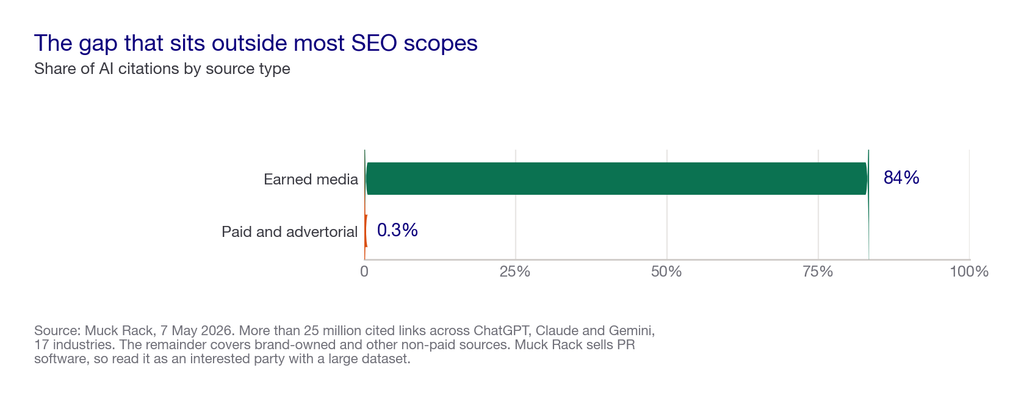
Read that against a typical SEO scope of work. Technical audits, content production, internal linking, some link building. Digital PR is often a separate budget owned by communications, and in many enterprises the two functions do not share a plan.
That is the single most consequential gap in this decision, and notice that it is not an argument for a separate GEO team. It is an argument for adding an earned media line to the scope you already have.
Measurement that reads answers. Rank tracking cannot tell you whether ChatGPT mentioned you, which competitor it named instead, or which URL it cited. That is a different instrument.
The diagnostic worth adopting is the gap between two numbers. Brand Visibility is how often engines mention your brand by name. Domain Prompt Presence is how often they cite a page from your domain. When the first is healthy and the second is weak, engines know who you are and trust somebody else to describe you, which is a citability problem rather than an awareness problem. Our Visibility, Citability and Retrievability framework sets out how we diagnose which of the three is stuck.
What it costs to add GEO to an existing scope
Less than most teams budget, because you are adding two lines rather than a department.
Measurement tooling is the smaller line, and it has moved sharply. AirOps now positions as “AI Search for Enterprise” and offers a free Solo tier covering 100 tracked prompts and pages on ChatGPT only. Profound publishes $99 for Starter with 50 prompts tracked and 1,500 monthly responses on ChatGPT only, and $399 for Growth with 100 prompts, 9,000 responses and three answer engines. Peec AI lists four tiers, publishes no figures, and covers five engines at every tier.
Earned media is the larger line and the one that actually moves the number. Budget it as its own item rather than hoping it comes out of the content allocation, because it will not.
Our cost breakdown of platforms against hiring models the internal execution hours that neither of those lines includes.
How to choose between absorbing GEO and separating it
I would start by testing a claim rather than drawing an org chart, because the org chart follows from what you find.
Google’s May 2026 position is the anchor. AEO and GEO are part of SEO, and AI Overviews and AI Mode run on core Search ranking systems with no separate AI index. That is correct for Google, and Google is one engine. ChatGPT and Perplexity retrieve differently, weight sources differently, and cite differently. Hold both ideas: the technical fundamentals are shared, so a separate team rebuilds them for nothing, and the distribution is genuinely different, so the measurement and the earned media work are genuinely new.
Score the decision before you restructure anything.
| Area | Weight | What a strong answer demonstrates |
|---|---|---|
| Single owner for page changes | 30 | One person decides what happens to a given URL, so two briefs never queue against the same developer for the same page |
| Earned media owner and budget | 30 | A named owner and a separate budget line, with a target list of publications drafted from actual citation data |
| Answer-level measurement | 20 | You can read raw AI answers and cited URLs, not infer AI performance from ranking movement |
| Protected reporting for AI metrics | 15 | Brand Visibility and Domain Prompt Presence are reported to leadership on their own line, not folded into an organic summary |
| Engineering access | 5 | Retrieval fixes have a route to a developer, with time already agreed rather than requested each quarter |
Those weights sum to 100. Score your current structure first, then score the structure you are proposing. If the proposed one does not beat the current one by a clear margin, you are reorganising for the feeling of progress.
The live test, and run it before you restructure. Take 30 real commercial questions from your category, written the way a buyer would type them. Four worked examples: “which vendor should we use for AI search visibility”, “how do we get cited by ChatGPT in our category”, “best enterprise SEO platform for a large site”, “is generative engine optimization worth it for B2B”. Run each across the engines your buyers use, more than once, because engines are probabilistic and one run establishes nothing.
Then answer five questions with the results in front of you. Where do we appear and where do we not. Which competitors appear instead, consistently. Which sources influence those answers, sorted by frequency. How many of those sources sit inside our current SEO scope. What would change in the next 90 days, and who does it.
The fourth question decides the org design. If most of the winning sources are third-party publications and communities, your gap is earned media and no reorganisation of the SEO team touches it.
The weak approach against the strong one. The weaker sequence is to hire a GEO specialist, give them a tool, and ask for a monthly AI visibility report. It creates a second opinion about the same pages and a dashboard nobody acts on, because the new hire has no route to engineering and no earned media budget.
The stronger sequence keeps one execution team, adds an answer-level measurement layer, funds earned media as its own line, and reports the AI numbers separately so they cannot be buried. It is less satisfying to announce and it is the one that moves the number.
Red flags, each one something you will genuinely hear. “We need a dedicated GEO team”, said before anyone has run the diagnostic. “GEO is a completely different discipline”, which contradicts Google’s own published position on its own surfaces. “Our AI visibility score is up”, offered as a single composite number with no competitor share of voice beside it. “We guarantee citations”, which Google explicitly advises against because third parties cannot access ranking systems. “We track your branded prompts”, which always looks healthy because those answers were already yours. “GEO is 80% strategy”, a claim we have seen quoted with no study behind it. And the quiet one: “digital PR sits with communications”, said as though that settles the earned media question rather than raising it.
Five questions for the restructure conversation.
- Who decides what happens to a given URL? A good answer is one name. A weak one describes a collaboration between two teams.
- Which budget line pays for earned media? A good answer names the line and its owner. A weak one says it comes out of content.
- How do we currently see what ChatGPT says about us? A good answer describes an instrument. A weak one describes inference from rankings.
- What breaks if we do nothing structural for two quarters? A good answer is specific and might be “nothing”. A weak one is about falling behind.
- Who gets engineering time for retrieval fixes, and how much? A good answer is hours already committed. A weak one is a ticket queue.
It all comes down to one principle: separate the reporting, not the people. The numbers need their own visibility. The work does not need its own department.
One closing note that costs us something. Very few providers are equally strong across measurement, execution, earned authority and attribution, ours included, and the good ones will tell you which of the four is their weakest. If a partner tells you that you need a separate GEO function before they have looked at your citation data, they are selling scope rather than answering your question.
The first 90 days, if you absorb it

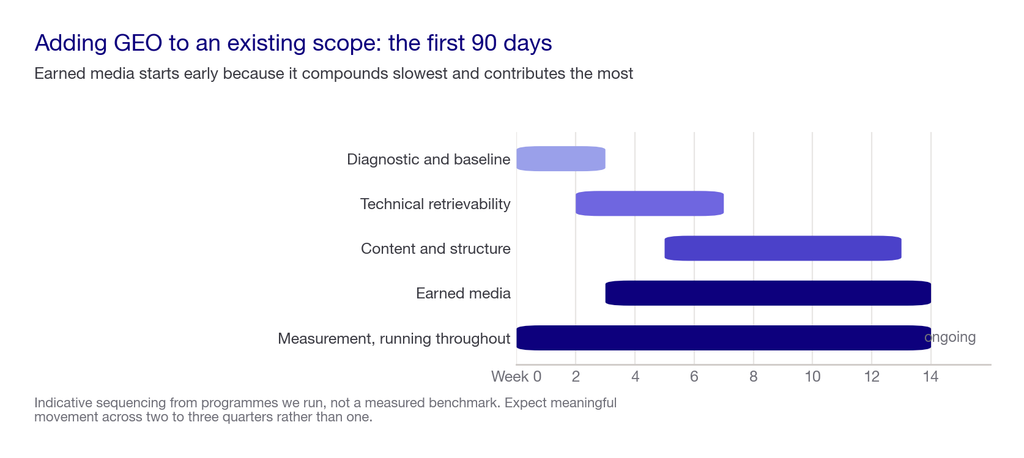
The order matters more than the speed. Diagnostic first, because it tells you which of the three levers is actually stuck. Technical remediation next, since a page that cannot be fetched cannot be cited regardless of how good it is. Content and structure follow. Earned media starts early and runs continuously, because it is the slowest to compound and the largest share of citations.
Measurement runs alongside all of it rather than at the end. If you cannot see the baseline before you change things, you will not be able to attribute the change.
What nobody should promise you
That GEO needs its own team to work. Google’s own guidance places AEO and GEO inside SEO. A vendor arguing otherwise is usually scoping a bigger engagement.
Guaranteed citations. Google advises against providers guaranteeing rankings because third parties cannot access internal ranking systems. The same holds for AI answers.
A single AI visibility score worth reporting. Composite numbers hide the gap between Brand Visibility and Domain Prompt Presence, which is the finding you could act on.
That your existing scope already covers this. It covers most of it. It almost certainly does not cover earned media or answer-level measurement, and those are the two that matter.
Frequently asked questions
Should I add GEO to my current SEO scope?
Yes for most teams. Google states that GEO and AEO are part of SEO, and the technical work overlaps almost entirely. Add two things your scope likely lacks: earned media, and measurement that reads AI answers rather than rankings.
Does GEO replace SEO?
No. AI Overviews and AI Mode run on core Search ranking systems with no separate index, so the fundamentals still apply. What changes is that appearing in the answer matters alongside ranking in the list of links beneath it.
Do I need a separate GEO team?
Usually not. A separate team rebuilds technical, content and entity work that already exists, and two teams end up briefing changes to the same pages. Separate the reporting line instead, and keep execution together.
What does my SEO team already cover?
Crawlability, rendering, structured data, entity clarity, content depth and internal linking all feed AI retrieval directly. An engine cannot cite a page it cannot fetch or parse, so most retrievability work is already in scope.
What is genuinely new about GEO?
Three things: measuring answers rather than positions, earning citations from sources you do not own, and treating brand entity clarity as a ranking input. Everything else is work your SEO scope already contains.
How much does adding GEO cost?
Measurement tooling starts at zero, since AirOps offers a free tier covering 100 tracked prompts on ChatGPT. Profound publishes $99 and $399 tiers. Earned media is the larger line and needs its own budget rather than coming out of content.
Who should own GEO reporting?
The existing SEO lead usually, with AI metrics reported to leadership on a separate line so they are not folded into an organic summary that still looks healthy on rankings alone.
How long before adding GEO shows results?
Expect two to three quarters for meaningful movement rather than one. Technical fixes surface first because they unblock retrieval, content follows, and earned media compounds slowest while contributing the largest share of citations by a wide margin.
Where to go next
Run the diagnostic before you restructure anything. Take 30 commercial prompts, run them across the engines your buyers use, and sort the cited domains by frequency. If most of them sit outside your current scope, you have your answer and it is not an org chart.
Our guide to tracking brand mentions in AI search covers the five methods and what each one misses. GEO agency vs GEO tool covers what to buy once you know the gap, and is a GEO platform worth it without an agency covers whether your team can act on what a platform tells you.
For enterprise-scale considerations, enterprise SEO covers what changes above 10,000 pages. Our Acceldata case study shows the absorbed model running on a technical B2B account.
The honest exit. If your SEO programme is currently underfunded and underperforming, do not add GEO to it. Fix the base first. Adding an AI measurement layer to a site with unresolved crawl and rendering problems produces a more precise description of the same problem, and you do not need to buy anything to know that.
Sources
Vendor details came from each company’s own site on 31 August 2026. Every study cited was published in 2026.
- Google Search Central, AI features and your website, 15 May 2026. States that AEO and GEO are part of SEO, that AI Overviews and AI Mode use core Search ranking systems with no separate index, and advises against providers guaranteeing rankings.
- Muck Rack, Earned media still drives 84% of AI citations, 7 May 2026. More than 25 million cited links across ChatGPT, Claude and Gemini, 17 industries. Muck Rack sells PR software, so read it as an interested party with a large dataset.
- Suzgun et al., Evaluating Commercial AI Chatbots as News Intermediaries, arXiv, 21 May 2026. 2,100 questions across six commercial chatbots. Tested on news rather than commercial queries, so read the mechanism rather than the exact rate.
Latest Blogs
Most advice on this is inference dressed as fact. OpenAI documents exactly one thing clearly, which is access. Here is what is documented, what is inferred, and how to verify the rest for yourself.
Being named in an AI answer and having your page used as its source are different outcomes with different causes and different fixes. The gap between them is the most useful diagnostic in AI search, and most reporting collapses it into one number.
Every platform reports share of voice and almost none of them define it the same way. Here is the definition worth using, the three choices that change the number, and how to measure it yourself without buying anything.
Get your hands on the latest news!