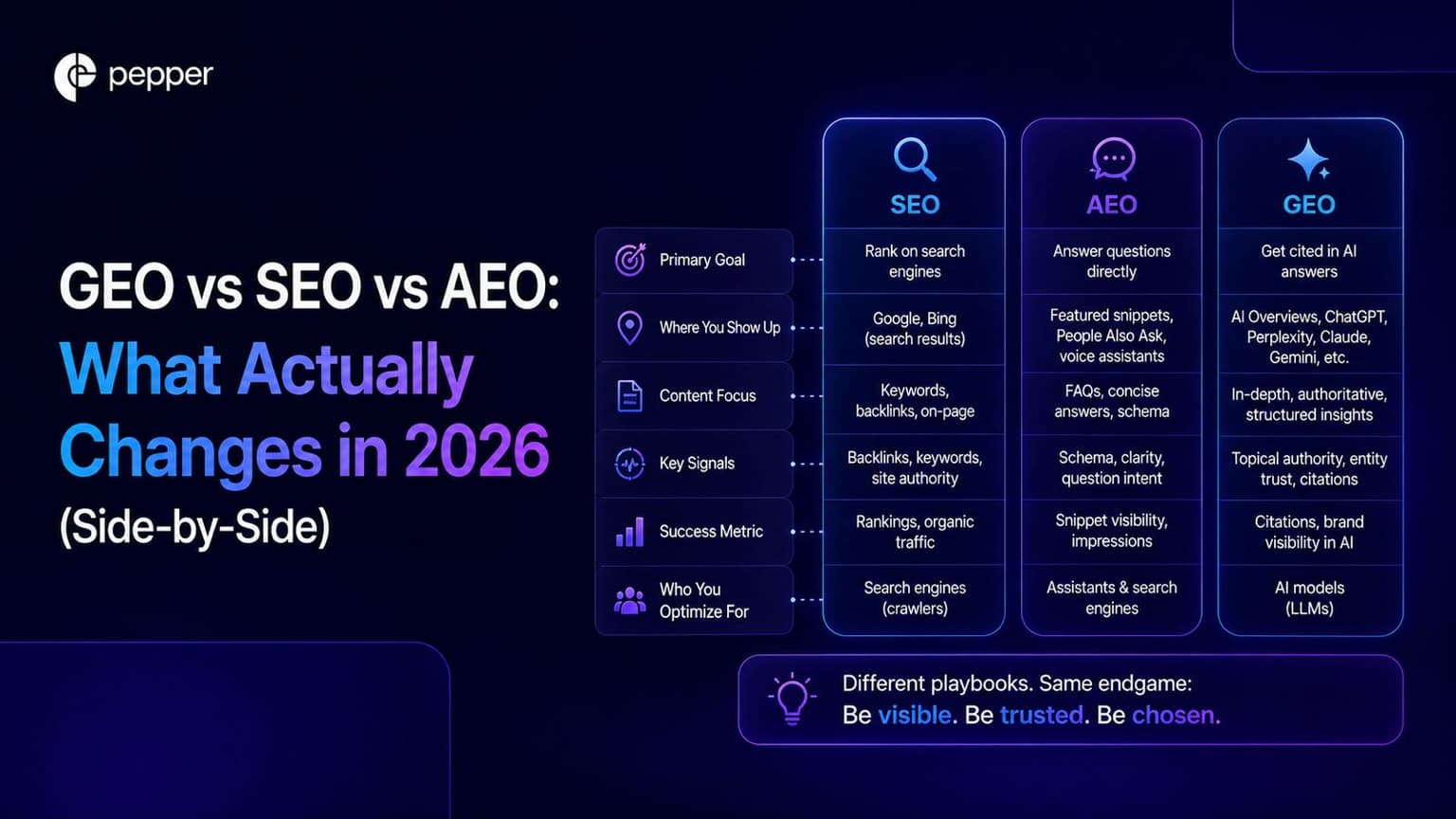
Start with the part nobody selling you these services will lead with. Google’s own position is that this is all still SEO.
Its first official AI search guidance, published 15 May 2026 and filed under SEO fundamentals, states that optimising for generative AI search is optimising for the search experience. It confirms AI Overviews and AI Mode run on core Search ranking systems, with no separate AI index. Meanwhile Wikipedia’s entry on the subject records that no consensus definition distinguishing these terms existed in academic literature as of early 2026, and that they are used interchangeably.
So the honest answer to “what is the difference” has two parts. Technically, less than the market implies. Practically, enough that treating them as identical will cost you.
We have run organic for more than 250 enterprises across eight years, and we track over 10 million prompts across every major engine. What follows is where we think the line actually falls.
The three, side by side

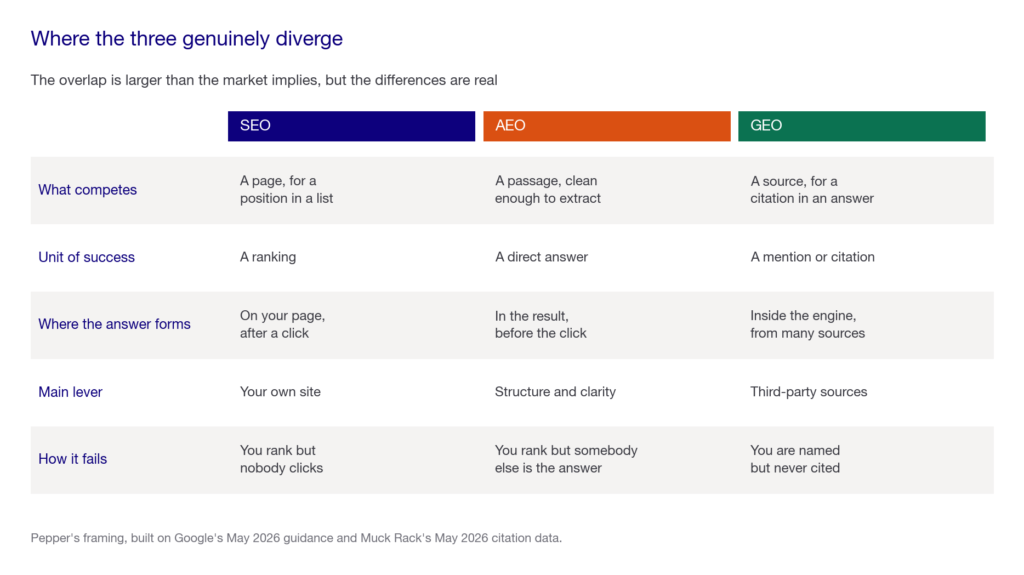
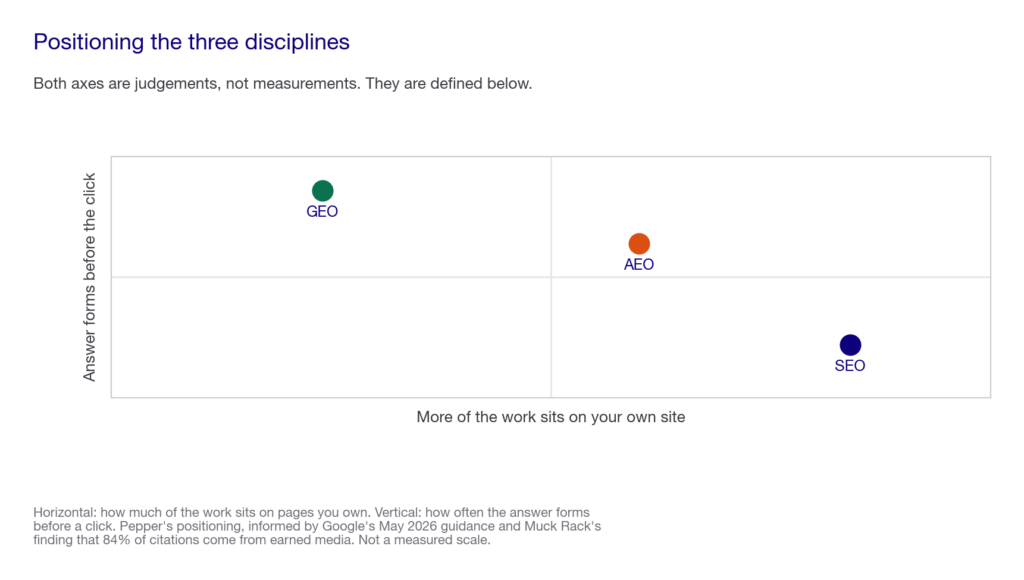
SEO optimises for a ranked list of documents. You win a position, the user clicks, and the answer forms on your page. The lever you pull hardest is your own site.
AEO optimises to be lifted as the answer itself. Featured snippets, voice results, the direct answer at the top. You are not competing for a position so much as for a passage clean enough to extract. Structure and clarity do most of the work.
GEO optimises to be named and cited inside a generated answer assembled from many sources at once. Here the lever moves off your site entirely, because the engine is choosing which sources to trust, and most of them are not yours.
A shorter way to hold it. SEO makes you findable. AEO makes you extractable. GEO makes you trustworthy enough to cite.
What is genuinely identical
This section does not appear in most comparison articles, because it is bad for business. It is also the most useful part.
Crawlability and rendering pose the same problem in all three. If an engine cannot fetch and parse your page, nothing downstream matters, whichever acronym you are working under. That has become more true rather than less. A Stanford-led evaluation of six commercial chatbots, covering 2,100 factual questions in May 2026, found that retrieval failures rather than reasoning errors caused more than 70% of all mistakes. When the models retrieved the right source, they usually produced the right answer.
Content quality behaves the same way too. Specific, evidenced, well-structured writing performs better across every surface. Nobody has found a technique that makes thin content work in AI answers while failing in classic search.
Entity clarity matters equally across all three. Engines need to resolve what your company is before they can rank or recommend you, and describing yourself three different ways across your site, your profiles and your listings hurts you identically in all three disciplines.
Authority carries across too, though it surfaces differently. Traditional link-based authority and AI citation authority draw on overlapping signals, because both ask the same underlying question: who do other people treat as credible?
If a vendor tells you your existing SEO work is irrelevant now, they are either misinformed or selling you a rebuild you do not need.
What genuinely changed
Three things, and they are real.
The answer often forms before the click. Forrester’s 2026 Buyers’ Journey Survey of 18,000 global business buyers found generative AI use in the purchase process rose from 89% in 2025 to 94% in 2026. More pointedly, it reports companies seeing 10% to 40% traffic declines as research migrates into engines. So a programme measured on sessions will read a working quarter as a failing one.
Most of what decides the answer is not on your site. This is the single biggest practical difference, and it changes who in your organisation owns the work.
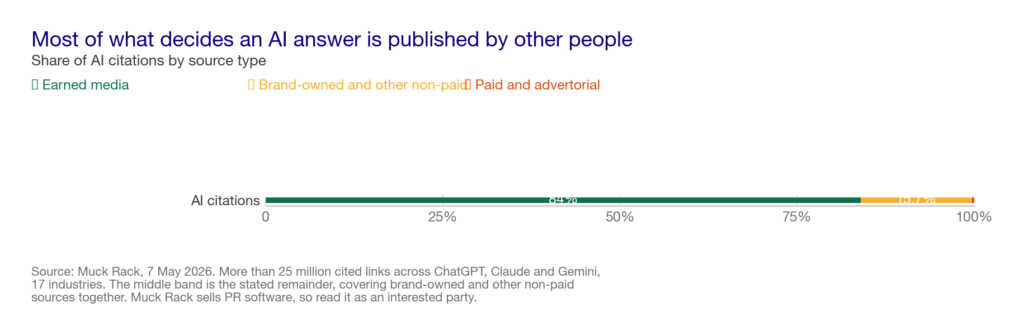
Muck Rack analysed more than 25 million cited links across ChatGPT, Claude and Gemini in May 2026, spanning 17 industries. Earned media accounted for 84% of AI citations. Paid and advertorial content accounted for 0.3%. The remainder covers brand-owned and other non-paid sources.
Under SEO, your site was the main lever. Under GEO it is necessary but no longer sufficient, and the work moves toward digital PR, review platforms, comparison sites and communities. That is a different budget line and often a different team.
The engines disagree with each other. Classic SEO had one dominant engine to optimise for. That is no longer the situation.
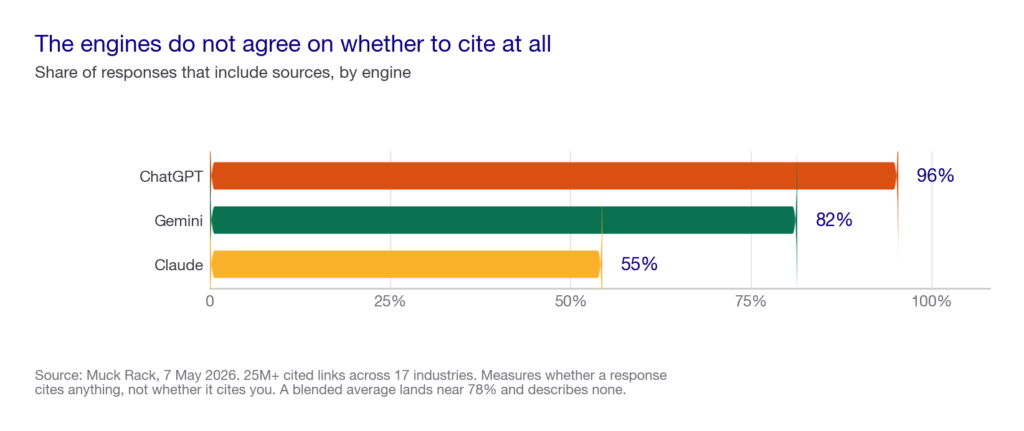
Muck Rack’s data shows ChatGPT includes sources in 96% of responses, Gemini in 82%, and Claude in just 55%. A blended average across those three would land near 78% and describe none of them. So per-engine reporting is not a nice-to-have, and any vendor handing you one composite visibility score is hiding the variance that matters.
Which one should you actually resource?
Here is where the comparison becomes a decision rather than a definition.
Resource SEO fundamentals first, always. They are the foundation for all three, Google says so explicitly, and they are the cheapest thing on this list to fix. If your rendering fails or your architecture is a mess, no amount of AI-specific work compensates.
Add AEO work when your content is good but never gets lifted. The symptom is ranking respectably while somebody else’s page supplies the actual answer. The fix is structural: answer the heading in the first two sentences, keep a claim next to its evidence, write headings that stand alone as questions. Our guide to structuring content for AI citation covers the mechanics.
Add GEO work when engines name you but never cite you. That gap is the clearest diagnostic in this whole field. It means the engine knows who you are, then describes you using somebody else’s page. So the work shifts to earned media rather than publishing. We break the full model down in the Visibility, Citability and Retrievability framework.
Notice that all three diagnoses come from the same measurement exercise. Run a real prompt set, record where you appear, which competitors appear instead, and which sources are winning those answers. The answer tells you which discipline you are actually short on, and it usually is not the one you were about to buy.
If you want that run on your own category before committing to anything, book a growth audit and we will show you which sources are deciding your answers today.
How to tell when the distinction is being oversold
A few tells, learned mostly from cleaning up after them.
If a vendor spends the first ten minutes explaining why their acronym is the correct one, that is a signal about them rather than about the field. Wikipedia notes that people use these terms interchangeably, and that no academic consensus separates them. So the taxonomy argument functions as a sales device.
If you are told SEO is dead, check whether the same vendor is selling technical audits under a new name. Google’s guidance is unambiguous that AI Overviews run on core Search ranking systems.
If llms.txt appears in a proposal as a core deliverable, ask what evidence supports it. Google’s May 2026 guidance explicitly mythbusts llms.txt, alongside content chunking, AI-specific rewrites and structured-data over-optimisation. It may still be worth trying, but it is not a foundation.
And if a proposal covers only ChatGPT, that is a fraction of the picture. The engines disagree, and single-engine coverage tells you about one system’s behaviour.
What nobody should promise you
Guaranteed citations or rankings, in any of the three disciplines. Nobody has access to the ranking systems, and Google advises against providers who promise otherwise.
A single score covering all three. Composite numbers hide the gap between being mentioned and being cited, which is the one finding you could act on.
That one discipline replaces another. They layer. Google’s own framing is that AEO and GEO are part of SEO rather than successors to it.
Fast results in GEO specifically. Earned authority compounds slowly, because it depends on other people publishing about you. Anyone promising a spike is describing paid media.
Frequently asked questions
What is the difference between GEO, SEO and AEO?
SEO optimises for ranked positions in a results list. AEO optimises to be lifted as the direct answer, such as a featured snippet. GEO optimises to be named and cited inside AI-generated answers. The technical overlap is substantial, and Google treats all three as SEO.
Is GEO just a rebrand of SEO?
Partly. Google states that optimising for AI search is still SEO, and AI Overviews run on core Search ranking systems. However, the source mix genuinely differs: 84% of AI citations come from earned media rather than your own pages, which changes what work is needed.
Should I do SEO or GEO first?
SEO fundamentals first, always. They are the foundation for all three disciplines and the cheapest to fix. Add GEO work specifically when engines mention your brand but do not cite your pages, which signals a citability rather than awareness problem.
Is AEO different from GEO?
Slightly, though most people use the terms interchangeably. AEO usually describes extraction as a direct answer, including featured snippets and voice. GEO usually describes citation inside a generated answer. Wikipedia records no consensus definition separating them.
Do I need separate agencies for each?
No, and separate vendors usually creates coordination cost without capability gain. The underlying work overlaps heavily. What matters is whether one partner can do technical, content and earned media rather than only one of the three.
Which engines should I be measuring?
At minimum ChatGPT, Perplexity, Google AI Overviews and Gemini. Report per engine rather than blended, because Muck Rack found citation rates ranging from 96% for ChatGPT to 55% for Claude. An average describes none of them.
Does traditional SEO still work in 2026?
Yes. Crawlability, content quality, entity clarity and authority carry across all three disciplines. What changed is measurement and source mix, not the fundamentals. Any vendor claiming your existing SEO work is now irrelevant is overselling.
Is llms.txt worth implementing?
Google’s May 2026 guidance explicitly mythbusts llms.txt, along with content chunking and AI-specific rewrites. Treat it as unproven rather than essential, and be cautious of proposals listing it as a core deliverable.
Where to go next
Skip the taxonomy debate and run the diagnostic. Take 20 to 30 real commercial questions from your category, run them across the engines your buyers use, and record three things: where you appear, which competitors appear instead, and which sources are influencing those answers.
That exercise resolves the GEO versus SEO versus AEO question for your specific situation in an afternoon, which is faster than any framework will.
For the underlying disciplines, our guides to what generative engine optimization is and AEO vs SEO go deeper on each. If you want to settle an internal terminology argument properly, AEO vs GEO vs AIO vs LLMO covers the full set. And for measurement, what actually matters in AI search measurement covers which numbers to report.
To see where you stand across engines, see where you show up in ChatGPT, Perplexity, Gemini, Claude and AI Overviews. Customers run this themselves in the platform, with a growth team attached to do the work alongside them.
One honest exit. If your technical foundation fails, none of these disciplines work for you yet, and buying GEO services will not fix a rendering problem. Fix the foundation first. We would rather say that than sell you the acronym you came in asking about.
Sources
Every study cited here was published in 2026.
- Google Search Central, AI features and your website, 15 May 2026. AI Overviews and AI Mode on core Search ranking systems, no separate AI index, plus the llms.txt mythbusting and the advice against guaranteed rankings.
- Wikipedia, Generative engine optimization, on the absence of a consensus academic definition separating GEO, AEO, LLMO and AIO as of early 2026.
- Muck Rack, Earned media still drives 84% of AI citations, 7 May 2026. More than 25 million cited links across ChatGPT, Claude and Gemini, 17 industries. Muck Rack sells PR software, so read it as an interested party with a large dataset.
- Suzgun et al., Evaluating Commercial AI Chatbots as News Intermediaries, arXiv, 21 May 2026. 2,100 factual questions across six chatbots, February 2026. Tested on news rather than commercial queries, so read the mechanism rather than the exact rates.
- Forrester, 2026 Buyers’ Journey Survey, January 2026. 18,000 global business buyers. Forrester sells research subscriptions.
Latest Blogs
The research pulls in two directions. Fan-out rewards covering many adjacent questions; absorption research finds longer pages get used. The resolution is that the passage competes, not the page.
Seven documented changes, not seven predictions. Google switched two rich results off, shipped two new AI reports, and added a channel to Analytics. Here is what actually moved and what it means.
Content chunking is the process of splitting a page into smaller pieces so a machine can retrieve one of them. Here is the part most articles get wrong: chunking is something engines do to your page, not something you do to it. You do not choose the chunk size.
Get your hands on the latest news!