How to structure content for AI citation: what the evidence supports, and what it does not
Key takeaways
- Structure genuinely changes citation rates. A March 2026 study lifted citations 17.3% by altering structure alone, with meaning held constant and verified.
- But the gain is not where the category says it is. Document architecture contributed 44.9% of it, information chunking 39.7%, and visual emphasis only 15.4%.
- Google states there are “no additional requirements to appear in AI Overviews or AI Mode, nor other special optimizations necessary”, and that it has no preferred word count.
- Those two facts fit together. Structure improves how reliably an engine can extract your answer. It is not an eligibility gate, and nobody can sell it as one.
- The one formatting rule Google does give is about availability, not shape: important content must be present in textual form.
A note on where this comes from. We run organic programmes for 250+ enterprises and track more than 10 million prompts across AI engines, and the question of how aggressively to chunk a page comes up in client reviews almost weekly. The judgements here come from that work. The evidence comes from Google’s documentation and from named, dated research, and we have kept them apart.
The short answer
Structure works, and the part the category sells hardest is the part that matters least.
In March 2026, four researchers published a controlled study of exactly this question. They rewrote the structure of 200 articles, holding the meaning constant and verifying that with sentence embeddings, then ran 377 real queries against six generative engines. Restructuring alone raised citation rates by 17.3%.
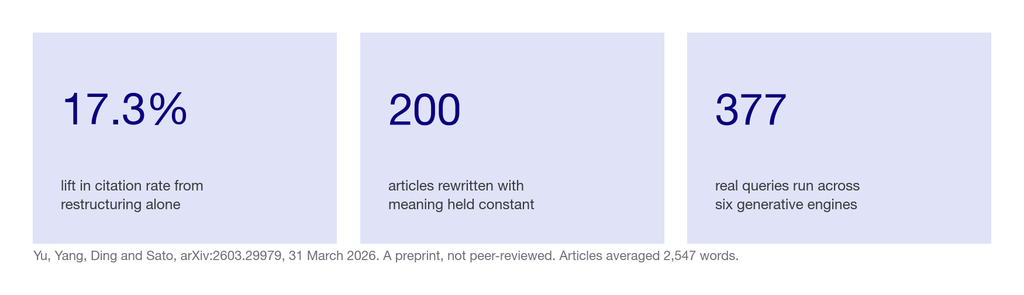
That is a real finding, and therefore worth acting on. However, the same study also broke the gain down by level, and the breakdown is the opposite of the advice most pages give.
If you would rather have someone audit your templates with you than work through this alone, you can book a growth audit and we will look at your page architecture directly.
What is content structure for AI citation, and which part of it matters?
Content structure here means three separable things. Yet conflating them is precisely how the category gets this wrong.
Macro-structure is document architecture: how the page is organised, what order the sections run in, whether the headings map the question. Meso-structure is information chunking: paragraph and block length, lists, tables. Micro-structure is visual emphasis: bold, italics, callouts.
The March 2026 study ran an ablation to see how much each level contributed to the total gain. Macro-structure accounted for 44.9%. Meso-structure, the chunking everyone writes about, accounted for 39.7%. Micro-structure accounted for 15.4%.
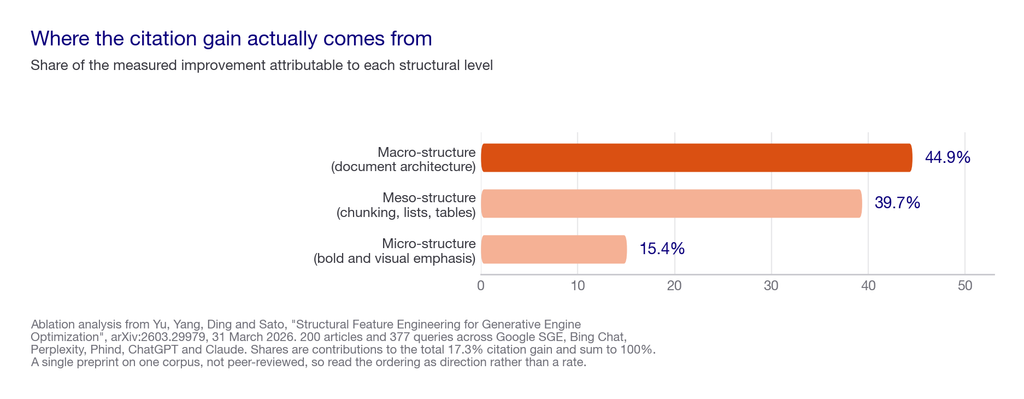
So the single biggest lever is the one nobody sells: deciding what the page is about and putting the sections in the right order. Chunking matters too, although slightly less than architecture. Bolding things matters least of all, which should therefore give pause to anyone whose structure audit is mostly a list of phrases to embolden.
For the prose-level craft, which is a different job, we have written separately on structuring content for answer engines. This page is about the shape of the document.
What Google actually says, and why both things are true
Here is where most structure advice quietly oversteps.
Google’s documentation on AI features is unambiguous: “There are no additional requirements to appear in AI Overviews or AI Mode, nor other special optimizations necessary.” It adds that “You can apply the same foundational SEO best practices for AI features as you do for Google Search overall.”
Its helpful-content guidance then goes further on length, in a parenthesis that deserves to be quoted often: “Are you writing to a particular word count because you’ve heard or read that Google has a preferred word count? (No, we don’t.)”
Google specifies no chunk size, no block length, and no paragraph rule anywhere.
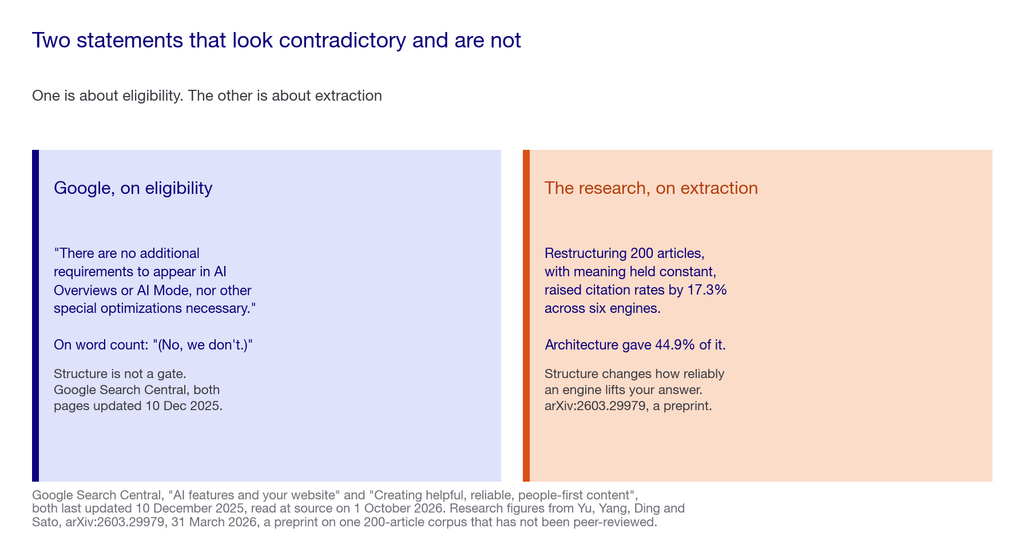
Hold both. Google is describing eligibility, and structure is not an eligibility requirement. The study is describing extraction, and structure measurably improves how reliably an engine lifts your answer out of the page. Neither contradicts the other, and the category collapses them constantly.
In practice, the consequence is a sales test. If someone tells you a chunking project will make you eligible for AI Overviews, then they are wrong, and Google says so in writing. If someone tells you clearer architecture will improve how often engines can extract a usable answer from your page, there is now evidence for that.
The one formatting rule Google does give
It is about availability rather than shape. Specifically, among its recommended practices for AI features, Google lists ensuring “important content is available in textual form”.
That is the defensible version of the accordion argument. An accordion whose content sits in the page as text is fine. By contrast, an accordion that fetches its answer only when a user clicks may not be, because the text is not there to read. The problem is never the accordion. It is whether the words exist in the document.
We covered the full version of this question, including what Google permits and where the real risk sits, in our article on hidden content and its impact on SEO.
How to structure content for AI citation: the playbook, ordered by the evidence
This runs in the order the ablation implies, not the order structure audits usually follow.
1. Confirm the text is in the document. (Documented by Google.) Not loaded on click, not rendered only after interaction. If an engine cannot read it, nothing below matters.
2. Fix the architecture before the paragraphs. (Evidence: 44.9% of the measured gain.) Does the heading order follow how someone actually investigates the question? Does the page answer the title in its first screen? This is editing with a scalpel, not a formatting pass.
3. Make each section answerable on its own. (Evidence, macro and meso together.) A reader arriving at one H2 should get a complete answer without the section above it. This is the single most useful change for a multi-turn surface like AI Mode.
4. Use a table where you are comparing things. (Evidence: part of the meso gain.) Comparisons in prose are hard to extract, whereas comparisons in a table are not. Even so, do not convert prose that is not a comparison.
5. Chunk sensibly, and stop there. (Evidence: 39.7%, and no Google support for any specific size.) Shorter blocks do help. Nevertheless, there is no documented threshold, and fragmenting a coherent argument into six sub-headings to manufacture chunks makes the page worse for the people Google tells you to write for.
6. Treat bold as emphasis, not as a lever. (Evidence: 15.4%, the smallest contribution.) Emphasise what matters. Beyond that, do not build an audit around it.
7. Measure citation, not formatting compliance. (Judgement.) A structure score tells you whether you followed a checklist. Prompt-level tracking tells you whether anything changed.
Our methodology: how we ordered the steps
We ordered the seven steps by evidence weight rather than by effort, and scored each on three inputs.
| Input | Weight | What it means |
|---|---|---|
| Documented by Google | 40% | Google states it in published guidance, in its own words |
| Measured contribution in controlled research | 40% | The March 2026 ablation attributes a share of the citation gain to it |
| Pepper judgement | 20% | Our reading, from the programmes we run. Marked as judgement in the text |
Step one scores entirely on documentation, which is why it comes first despite being the least interesting. Steps two and three carry the largest measured contribution. Step seven rests on judgement alone, and we have labelled it that way rather than dressing it as evidence.
Content structure approaches at a glance
| Architecture rework | Section independence | Chunking pass | Emphasis audit | |
|---|---|---|---|---|
| What it changes | Section order and scope | Whether a section stands alone | Block and paragraph length | Bold and callouts |
| Measured contribution | Largest, 44.9% level | Macro and meso combined | 39.7% level | Smallest, 15.4% level |
| Google documents it | No specific rule | No specific rule | No, and no word count | No |
| Who does it | Editor or strategist | Writer | Writer | Anyone |
| Typical cost | Highest, slowest | Moderate, per page | Low, often templated | Lowest, near zero |
Where it falls short as a comparison: the cost row is a shape, not a quote. Nobody publishes defensible benchmarks for editorial rework, and the contribution percentages come from one study on 200 articles, so they indicate direction rather than a rate you should expect.
What this costs
An emphasis audit is free, and consequently worth almost nothing. Treat it as tidying.
A chunking pass, similarly, is cheap and templatable, so most teams can apply it across a library in a sprint.
Architecture rework, meanwhile, is the expensive one, because it is genuine editing. Someone has to decide what each page is for, cut what does not belong, and reorder the rest. That is the work with the largest measured return, and it is the work nobody wants to quote for.
Finally, measurement costs whatever prompt tracking costs you, and it is a tooling decision rather than a content one.
Where Pepper fits
We are not a neutral recommender in this section, and you should read it knowing that.
Pepper works as an organic growth partner rather than a tool vendor. Agent Atlas is our agentic engine for research, briefing and production, and briefing is where architecture gets decided, which is why we put it there rather than in a formatting step. Pepper’s GEO platform tracks prompts and mentions rather than formatting compliance. Customers log in and run it themselves, and a growth team sits alongside for the editorial judgement that no checklist covers.
The framework we run this on is visibility, citability and retrievability. Structure sits squarely in citability: whether a passage survives being lifted out of your page and used somewhere else.
For a worked example in B2B SaaS, our Acceldata case study shows architecture decided at brief stage rather than retrofitted.
Where it falls short. We cannot give you a structure score that predicts citations, and we would not trust one. The research shows a 17.3% average lift across 200 articles in six domains, which is a direction, not a forecast for your page. What we can do is show you whether citations moved after you changed something.
How to choose what to fix first
I will write this in the first person, because an ordering nobody will defend is not worth printing.
Start by finding out whether your words are even in the document. I have reviewed a library where a quarter of the FAQ answers loaded only after a click, and the team had spent a quarter rewriting those answers. In short, no amount of good structure survives text that is not there.
After that, resist the chunking pass. Although it is the cheapest thing to do, it is not the biggest lever, which is precisely why it gets done first in most programmes. Here is the scorecard I would apply to any proposed structure project, on a 100 point scale.
| Area | Weight | What a project worth funding demonstrates |
|---|---|---|
| Text is present in the rendered document | 30 | Someone has checked the rendered HTML, not the CMS preview, on real templates this quarter. |
| Architecture is in scope, beyond formatting | 25 | The plan allows section order and scope to change, which is where the largest measured gain sits. |
| Sections are made to stand alone | 20 | Each H2 answers its own question without depending on the one above it to make sense. |
| Measurement is running before the work starts | 15 | A fixed prompt set exists, so the team can tell whether anything actually changed. |
| No claim rests on an unpublished benchmark | 10 | Every number traces to published documentation or a dated study with a stated sample. |
Five questions I would ask before funding any of this, in this order.
- “Have you looked at the rendered HTML of our main template?” A stronger answer is a view-source walkthrough. A weaker one is a screenshot of the page, which tells you nothing about what a crawler receives.
- “Does this project let us change section order, or only formatting?” If architecture is out of scope, you are funding the smaller half of the gain and calling it the whole thing.
- “Can you read me one H2 section with the rest of the page covered up?” If it needs the paragraph above to make sense, it will not survive extraction.
- “What is our chunking rule based on?” If the answer is a number somebody read somewhere, there is no documented basis for it. Google publishes none.
- “What are we measuring, formatting compliance or citations?” A structure score going up is not evidence. A stronger answer names a prompt set.
Red flags, each one something a supplier actually says. A required block length, when Google documents none and explicitly denies a preferred word count. Structure sold as a route to eligibility, which Google contradicts in writing. A citation multiplier attached to a specific format, offered without a study. A benchmark drawn from a dataset you are not allowed to see. And our own previous version of this page, which did all four.
Before commissioning anything, measure what you own. Write 25 real commercial questions your buyers would type, then run each of those 25 prompts three times across every engine you care about, because engines are probabilistic and one run is an anecdote. Then give any change 90 days before judging it. Four worked examples for a mid-market B2B software company:
- “what is the difference between data observability and data quality tooling”
- “compare data observability platforms for a mid-size engineering team”
- “how should I evaluate a data observability vendor”
- “what does a data observability rollout actually involve”
Record which page the engine used, and which section of it. If the same page is cited repeatedly but always for one section, your architecture is doing the work and the rest of the page is dead weight.
And the answer that loses Pepper the sale: if your text renders as text, your sections already stand alone and your headings follow the question, you do not need a structure project, and you do not need us to run one. Spend the budget on topics you do not cover yet.
It comes down to one principle: fix the architecture, make every section survive on its own, chunk sensibly, and refuse every number nobody will source, ours included. We published eight such numbers on this very page, which is the strongest argument we can make for the principle.
The claims we removed
Every statistic on the previous version of this page, and what happened to it.
| Claim on the old page | Source named | What we found | Action |
|---|---|---|---|
| “70% of enterprise brands publish unstructured content” | Our own benchmark of 110 companies, unpublished | Not publishable under our own rules without the data | Removed |
| Benchmark of “110 enterprise companies with 500+ employees” | Our own, unpublished | Cited as authority for several claims above | Removed |
| “ChatGPT weights authoritative list mentions at 41%” | Our own research, unpublished | No published source located, and no engine publishes weights | Removed |
| “Claude weights traditional directory citations at 68%” | Our own research, unpublished | No published source located, and no engine publishes weights | Removed |
| “RAG breaks pages into 300 to 500 word chunks” | None | Describes some implementations generally. Google publishes nothing about its own chunking | Removed |
| “Atomic chunking, 2 to 4 sentence blocks” | None | Google documents no block length and denies a preferred word count | Removed and corrected |
| “Long-form blob content actively hurts AI search performance” | None | Contradicts Google’s “no additional requirements” statement | Removed and corrected |
| “13.2 percent were both cited and named” | None | Removed from a second Pepper page in the same batch. Real research reports 38.3% | Removed, sourced figure used instead |
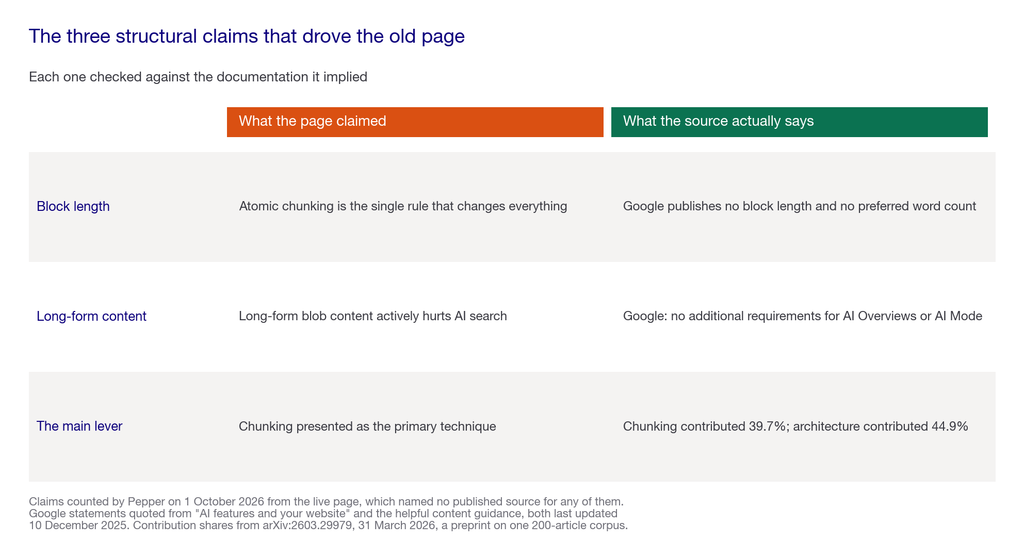
One number is now travelling between our own pages. The “13.2 percent” figure appeared here and on our entity optimization article, with no source on either. We removed it from both in the same week. When an unsourced number starts replicating across a library, the problem has stopped being editorial and become procedural.
What nobody should promise you
Be sceptical of any of these.
- A required block or chunk length. Google documents none and explicitly denies having a preferred word count.
- Structure as a route to eligibility. Google states there are no additional requirements for AI Overviews or AI Mode.
- A citation multiplier for a named format. Ask for the study, the sample size and the date.
- A single composite structure score. It measures checklist compliance, not citations.
- A benchmark from a dataset you cannot see. Including ours, which is why we removed four of them from this page.
Frequently asked questions
Does content structure actually affect AI citations?
Yes, and it has been measured. A March 2026 study restructured 200 articles while holding meaning constant, then tested 377 queries across six engines. Citation rates rose 17.3%, with statistical significance reported.
What chunk or block length should I use?
There is no documented answer. Google publishes no block length, no paragraph rule and no preferred word count, and says so directly. Use whatever length makes each section readable and self-contained for a person.
Is long-form content bad for AI search?
No evidence supports that claim. Google states there are no additional requirements for its AI features and no preferred word count. The articles in the March 2026 study averaged 2,547 words.
Which matters more, page architecture or chunking?
Architecture, by a clear margin. In the 2026 ablation, document architecture contributed 44.9% of the citation gain, information chunking 39.7%, and visual emphasis such as bold text only 15.4%.
Do accordion FAQs stop my content being cited?
Not by themselves. Google’s documented recommendation is that important content is available in textual form. An accordion that renders its text in the page is fine; one that fetches content only on click is the real risk.
Should I add tables to my content for AI citation?
Add them where you are genuinely comparing things, because comparisons are hard to extract from prose. Converting non-comparative prose into a table adds formatting without adding clarity, and helps nobody.
Does bolding key phrases improve citations?
Barely. Visual emphasis was the smallest contributor in the 2026 ablation, at 15.4% of the measured gain. Use bold for genuine emphasis and do not build a structure audit around it.
How long before structural changes show up?
Nobody publishes a defensible timeline, so treat any specific figure with suspicion. We recommend giving changes 90 days and measuring against a fixed prompt set run before and after the work.
Where to go next
- How to structure content for answer engines, for the prose-level craft
- Hidden content and its impact on SEO, for the rendering question in full
- How to get cited in LLMs, for the broader citability sequence
- Entity optimization and LLM brand recognition
- Ranking in Google AI Overviews
- How we rank and score GEO providers
Sources and further reading
- Junwei Yu, Mufeng Yang, Yepeng Ding and Hiroyuki Sato, “Structural Feature Engineering for Generative Engine Optimization: How Content Structure Shapes Citation Behavior”, arXiv:2603.29979, submitted 31 March 2026. 200 articles averaging 2,547 words, 377 real queries, six engines, meaning preservation verified by sentence embeddings. A preprint, not peer-reviewed. Source of the 17.3% figure and the macro, meso and micro ablation.
- Google Search Central, “AI features and your website”, last updated 10 December 2025. Source of the no-additional-requirements statement and the textual-form recommendation.
- Google Search Central, “Creating helpful, reliable, people-first content”, last updated 10 December 2025. Source of the word count statement.
- Semrush with Kevin Indig, Growth Memo, “The ghost citations study”, 9 June 2026. Source of the 38.3% mention rate that replaces the unsourced “13.2 percent”.
- HubSpot, “On-page content formats answer engines actually favor”, 3 June 2026, reporting HubSpot’s State of AEO 2026 alongside a Wix Studio dataset of over a million citations. Read at one remove, which is why no figure from it is used as a headline number here.
Latest Blogs
Most advice on this is inference dressed as fact. OpenAI documents exactly one thing clearly, which is access. Here is what is documented, what is inferred, and how to verify the rest for yourself.
Being named in an AI answer and having your page used as its source are different outcomes with different causes and different fixes. The gap between them is the most useful diagnostic in AI search, and most reporting collapses it into one number.
Every platform reports share of voice and almost none of them define it the same way. Here is the definition worth using, the three choices that change the number, and how to measure it yourself without buying anything.
Get your hands on the latest news!

Similar Posts
GEO / AI Search
10 mins read
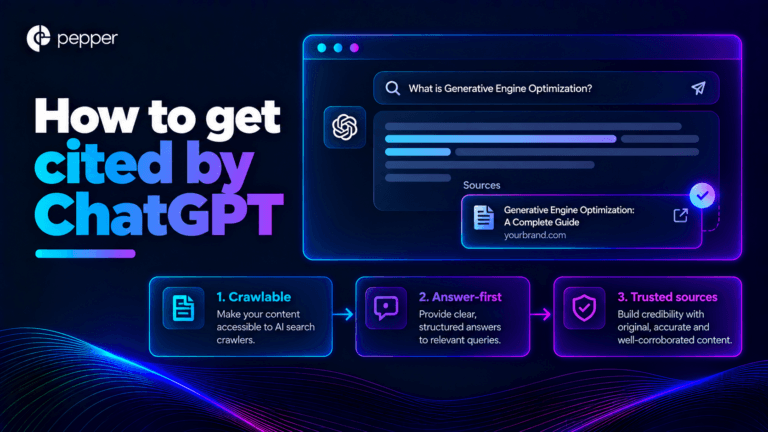
How to get cited by ChatGPT
GEO / AI Search
10 mins read
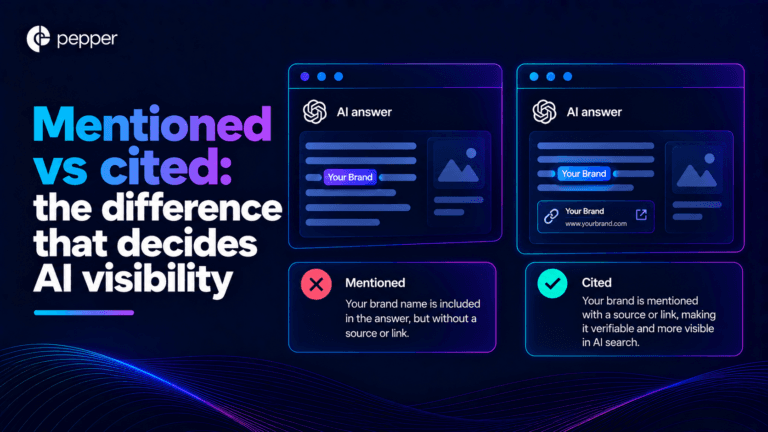
Mentioned vs cited: the difference that decides AI visibility
GEO / AI Search
13 mins read