AEO vs SEO: what Google settled, and what still differs
The short answer
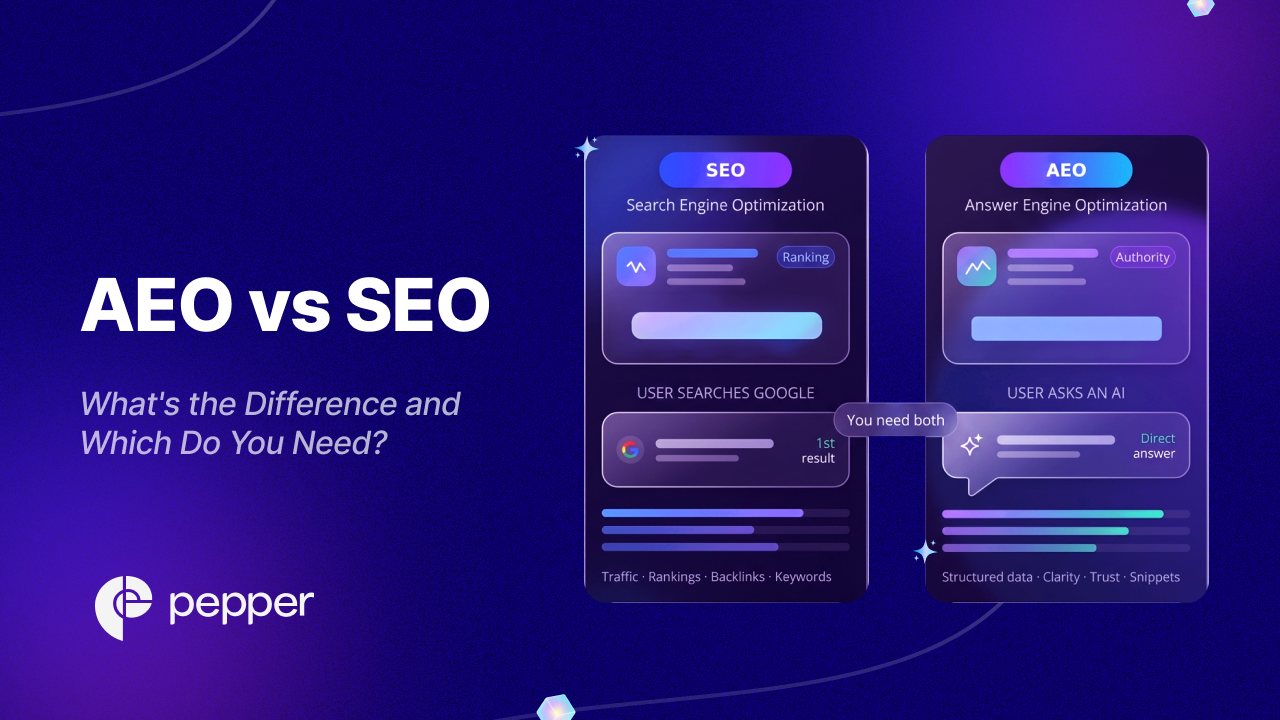
Google settled this in May 2026, and most of the internet has not caught up. Its official position is that AEO and GEO are part of SEO, not separate disciplines. That does not mean nothing changed. It means the argument about naming is over and the argument about practice is the one worth having.
Key takeaways
- Google’s position, published May 2026: AEO and GEO are part of SEO. AI Overviews and AI Mode run on core Search ranking systems. There is no separate AI index or AI ranking algorithm.
- Google also named what does not work: llms.txt, content chunking and AI-specific rewrites are listed as things you can stop doing for its AI features.
- That ruling covers Google. It does not cover ChatGPT, Perplexity or Claude, which cite at very different rates and draw on different sources.
- What genuinely changed is where the answer gets assembled from. 84 percent of AI citations come from third-party sources, so the work shifted off your domain.
- If you are choosing between doing SEO and doing AEO, you are asking the wrong question. The real one is which of your fundamentals is weakest.
A note on where this comes from. We run organic for more than 250 enterprises at Pepper and track over 10 million prompts across every major engine. So we watched this argument play out in client rooms for two years before Google ended it. What follows is our read on what actually changed, which is less than the vendors claimed and more than the sceptics did.
What Google actually said
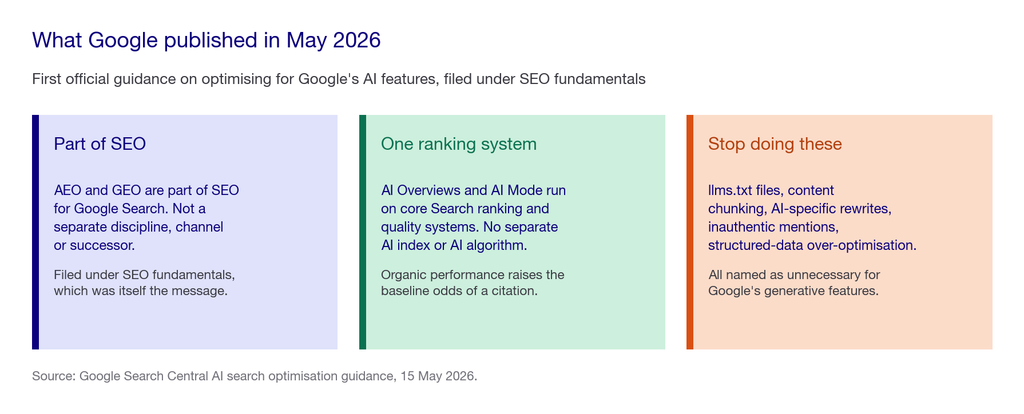
On 15 May 2026, Google published its first official guidance on optimising for its AI features and filed it under SEO fundamentals, which was itself the message.
Three statements matter.
AEO and GEO are part of SEO for Google Search. Not adjacent disciplines, not successors, not a new channel.
AI Overviews and AI Mode run on the core Search ranking and quality systems. There is no separate AI index and no separate AI ranking algorithm. Content that performs in organic search has a higher baseline probability of being cited in AI features.
Several widely sold tactics are unnecessary. The guidance names llms.txt files, content chunking, AI-specific rewrites, inauthentic mentions and structured-data over-optimisation as things site owners can stop doing for its generative features.
We think that is correct, and we also think it is being over-read in both directions. It does not mean AI search changes nothing. It means the mechanism is the one you already know, and the advantage moved rather than disappeared.
What is AEO, and what is SEO?
Search engine optimization (SEO) is the practice of improving a site so search engines can crawl it, understand it and show it to people looking for what it offers. It covers what is on your pages, how the site is built, and what the rest of the web says about you.
Answer engine optimization (AEO) is the practice of structuring content so an engine can lift a direct answer from it. That answer might land in a featured snippet, a People Also Ask box or an AI Overview.
Generative engine optimization (GEO) is the practice of earning citations inside generated answers across ChatGPT, Perplexity, Gemini, Claude and Google AI Overviews.
The honest relationship: AEO and GEO are specialisations within SEO rather than replacements for it. They emphasise different parts of the same discipline. Our fuller breakdown of the acronyms lives in AEO vs GEO vs AIO vs LLMO, and the underlying definition sits in what GEO is.
See where you show up. Pepper’s GEO platform tracks Brand Visibility, Domain Prompt Presence and Share of Voice across ChatGPT, Perplexity, Gemini, Claude and Google AI Overviews. Your team can log in, connect Search Console and GA4, manage the prompt set and run your own agents in the Agent Atlas. A growth team works the same account alongside you. Book a growth audit or see where you show up.
AEO vs SEO: a comparison of where they genuinely differ
| Classic SEO | AEO | |
|---|---|---|
| Goal | Rank a page | Be lifted into the answer |
| Unit of work | The keyword | The question, phrased as a buyer would ask it |
| Winning outcome | A click | A citation, and often no click at all |
| Page structure | Optimised for a reader scanning | Optimised for a machine extracting a clean passage |
| Content shape | Comprehensive coverage | Answer-led openings, extractable tables, concise definitions |
| What decides it | Relevance and authority | The same, plus whether the passage can be lifted cleanly |
| Measurement | Rankings, impressions, clicks | Whether you are named, whether you are cited, share of category mentions |
| Typical incremental cost | Already in your budget | Roughly $99 to $400 a month for per-engine tracking, or nothing if you run the prompts manually |
| Where it falls short | Ranking well no longer guarantees a click | Being cited does not guarantee a visit either, so it needs pairing with demand capture |
Read the last row carefully, because it is the one most comparisons omit. AEO does not solve the traffic problem, it solves the presence problem. Those are different, and a team that swaps one for the other has moved sideways.
Where they are the same, which is most of it
This is the part vendors under-sell, because there is no product in it.
Crawlability, indexing, site structure, page speed, internal linking, entity clarity, schema markup, genuine subject expertise and credible authorship all matter identically for both. If you want the technical floor written out, we covered it in can AI bots crawl your site. Google’s own framing is that content performing in organic search has a higher baseline probability of appearing in AI features. Read that again: it means the fundamentals are shared infrastructure.
So if your pages are not indexed, your AEO strategy is a rounding error. We see this constantly: teams commissioning answer-first rewrites while their most important pages are blocked or orphaned.
What actually changed, and it is not the naming
Two things shifted, and both are about where the advantage now sits.
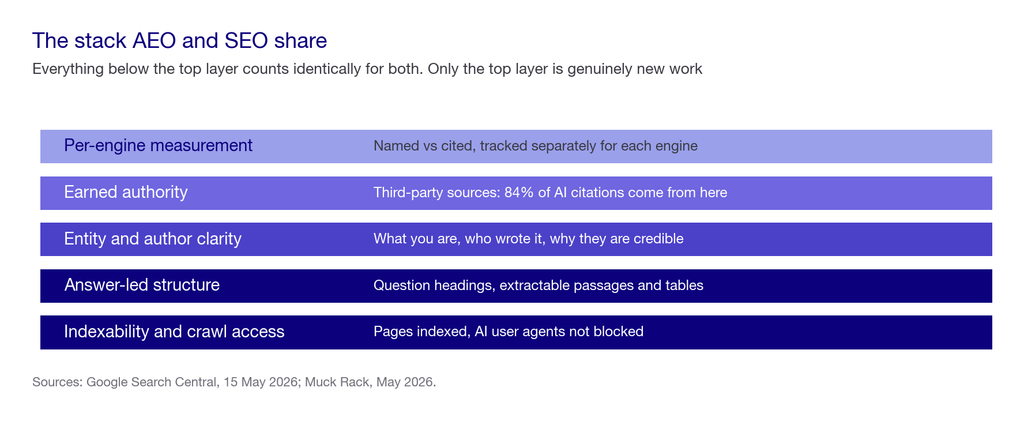
The answer is assembled off your domain. Muck Rack studied more than 25 million cited links across ChatGPT, Claude and Gemini in May 2026. Earned media accounted for 84 percent of AI citations. Journalism alone made up 27 percent, and paid or advertorial content just 0.3 percent (Muck Rack, May 2026). Across three editions since July 2025 the earned share has held between 82 and 89 percent.
That is the real change. Classic SEO could be won substantially on your own site. The generated answer cannot, because the model assembles it from several sources and most of them are not yours.
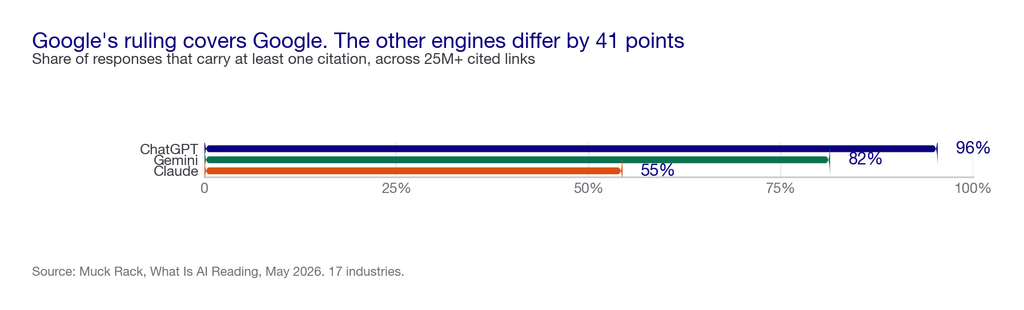
And the engines do not behave alike. The same study found ChatGPT carries a citation in 96 percent of responses, Gemini in 82 percent, and Claude in just 55 percent. So Google’s ruling settles Google, and tells you nothing about the other three. A single blended visibility number averages away a 41-point spread.
Put those together and the practical answer emerges. Fundamentals are the floor, they are shared, and the ground you gain now comes from earned authority and per-engine measurement. We break the mechanics of the second half down in how to structure content for AI citation and LLM seeding.
What this looked like for one company
SalesHood is a useful example because the work was not a choice between SEO and AEO. It was both, sequenced.
They were losing organic traffic and disappearing from AI answers while competing against better-funded rivals. We ran seven workstreams. A strategic audit mapped competitor performance and gaps. An SEO blog engine produced 20 new pieces and refreshed 8. GEO and AEO work was tracked in Atlas across ChatGPT, Gemini and Claude. Technical SEO resolved 10 issues, including sitemap and schema fixes. The rest was competitive intelligence, EEAT work and monthly reporting.
The technical and content work is what most people call SEO. The tracking and answer-shaping is what most people call AEO. Neither would have worked alone.
Blog impressions went from 200,000 to 417,000. AI Overview visibility went from 14 keywords to 97. Rich results grew 291 percent in five months, and clicks rose 20 percent against an industry-wide decline. Their CMO, Elay Cohen, put it in business terms: he could see a direct connection between the investment and lead flow from LLMs that closed.
Our methodology: how we scored the difference
| Criterion | Weight | What that means here |
|---|---|---|
| Alignment with official guidance | 40% | Where Google has published a position, we lead with it rather than a vendor interpretation |
| Practical difference, not semantic | 30% | The comparison has to change what someone does on Monday |
| Multi-engine honesty | 20% | Google’s ruling covers Google, and we say where it stops |
| Sourced to 2026 primaries | 10% | Every statistic traced to a study published this year |
**What we could not verify.** Claims that AEO produces a specific traffic or conversion multiple. The figures circulating come from vendor studies with narrow samples, so we have left them out rather than repeat them.
How to choose what to prioritise
Most teams asking “AEO or SEO” are really asking “what should I do first”, which is a better question with an answerable form.
Start from Google’s position: the fundamentals are shared, so anything broken there is broken for both. Then work outward to the parts that genuinely differ.
The scorecard I would use
Score your own site out of 100. The lowest-scoring area is your priority, regardless of what it is called.
| Area | Weight | You score well when |
|---|---|---|
| Indexability and crawl access | 25% | Your important pages are indexed and AI user agents are not blocked. Nothing downstream counts until this is true |
| Answer-led structure | 20% | Headings read as real questions, the first two sentences under each answer it, and tables are extractable rather than images |
| Entity and author clarity | 20% | An engine can tell what you are, who wrote it, and why they are credible without inferring |
| Earned authority | 20% | Credible third parties describe you accurately, since 84 percent of citations come from them |
| Per-engine measurement | 15% | You track named and cited separately, per engine, rather than one blended score |
### Run this before you decide
Write down 30 prompts your buyers actually ask, phrased the way they would type them, not as keywords. Run all 30 through Google, ChatGPT and Perplexity. Record three things per prompt: whether your brand appears, whether a page from your domain is cited, and which sources were cited instead. That first pass takes an afternoon.
Then read the result. If you are absent everywhere, that is usually a fundamentals problem and the label does not matter. If you are named but not cited, that is an authority problem and no amount of answer-first rewriting fixes it. If you appear on Google but not on Perplexity, that is a per-engine problem, and it is exactly the one Google’s guidance does not address.
Now hold the same 30 prompts steady and rerun them monthly for 90 days. Three readings on a fixed prompt set is the shortest honest window. One gives you a number with nothing to compare it against. Two could be noise. Three shows a direction. Change the prompts and you have restarted the clock, so resist the urge to tidy the list. If a partner cannot show you movement on a fixed set over that window, they are showing you a snapshot rather than progress.
The weak playbook against the strong one
The weaker sequence, still widely sold: declare SEO dead, buy an AEO tool, rewrite pages into FAQ format, add llms.txt, wait for citations. Google has now explicitly named two items on that list as unnecessary for its features.
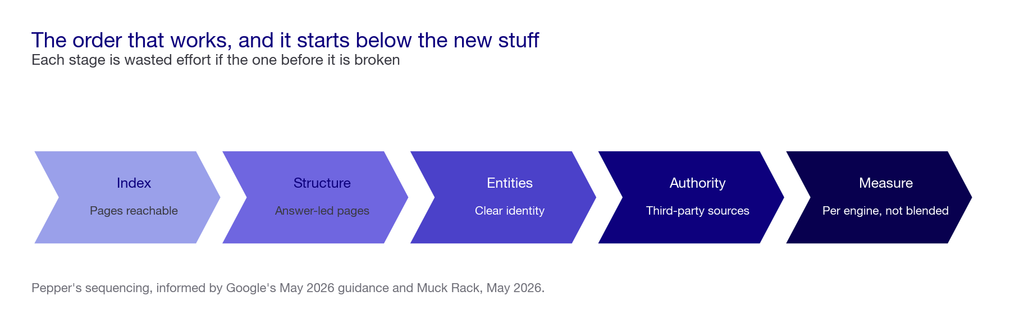
The stronger sequence: fix indexability, then structure and entity clarity, then earned authority, then measure per engine and act on the gap.
The difference matters because generative engines assemble an answer from several sources rather than ranking one page. Being retrieved, being cited and actually influencing the answer are three different things, and the tactics that move each are not the same.
Red flags
- “SEO is dead.” Google’s own guidance says the opposite, and anyone leading with this is selling the replacement.
- “You need llms.txt.” Named in Google’s 2026 guidance as unnecessary for its AI features. Our own write-up on llms.txt reaches the same conclusion.
- “AEO is a separate channel with its own budget.” For Google it is part of SEO. Structuring it as a separate function usually creates two teams optimising the same pages.
- A single AI visibility score. It hides the named-versus-cited gap, which is the useful part. More on that in what to track and what to ignore.
- One engine. Citation rates differ by 41 points between ChatGPT and Claude.
- Answer-first rewrites as the whole plan. That addresses structure while ignoring the 84 percent of the signal that sits off your domain.
The five questions I would ask a partner
- “What in Google’s May 2026 guidance changes your recommendations?” Anyone unfamiliar with it is not current.
- “Show me a query where a competitor is cited and explain why.” This separates retrieval understanding from software reselling.
- “How much of your scope is off-domain?” If none, it addresses the minority of the signal.
- “How do you report per engine?” Listen for separate numbers, not an average.
- “Which of our fundamentals would you fix before doing any AEO work?” A good partner has an answer. A weak one goes straight to content.
Reduced to one principle: stop choosing between them and fix whichever fundamental is weakest. The label follows the work, not the other way round.
One honest closing note. Very few teams are equally strong across technical, content, authority and measurement, ours included, and the good ones will tell you which is their weakest without being asked.
What nobody should promise you
That AEO replaces SEO, or that SEO alone is now sufficient. Google’s position is that one contains the other.
A guaranteed citation or position in an AI answer. Nobody controls the output, and Google warns against providers guaranteeing rankings for the same reason.
A single composite AI visibility score sold as a ranking. Ask a model the same question repeatedly and the answers move.
A specific traffic or conversion multiple from switching to AEO. Every figure we found traces to a vendor study with a narrow sample.
What does the AEO half actually cost?
This is the question hiding underneath most AEO versus SEO conversations, and the honest answer is that the marginal cost is smaller than the category implies.
| What you are buying | Typical 2026 price | What it gets you | When it is worth it |
|---|---|---|---|
| Manual prompt tracking | Free, about 2 hours a month | 30 prompts across 3 engines in a spreadsheet | Always. Do this before buying anything |
| Google Search Console and Bing Webmaster Tools | Free | Google’s generative AI performance reports and Bing’s cited-URL data | Always, once your site is verified |
| Entry-level tracking platform | Roughly $99 a month | One engine, a capped prompt set, automated refresh | When manual tracking stops fitting in an afternoon |
| Mid-tier tracking platform | Roughly $300 to $400 a month | Three or more engines, competitor share of voice, sentiment | When more than one engine matters to your pipeline |
| Platform plus a team doing the work | Custom | Tracking, plus the content, technical and earned-authority work the tracking points at | When the gap is diagnosed and nobody internally has the hours to close it |
Prices in the middle two rows reflect published 2026 rate cards from AI visibility platforms, checked in August 2026. They move, so verify before budgeting.
The pattern we see is that teams overbuy tracking and underbuy the work. A dashboard tells you that you are absent from a query. It does not fix the reason.
You may not need to think about this yet
The answer that costs us the sale. If your important pages are not indexed, or your site has fewer than about twenty pages worth optimising, you do not need an AEO strategy yet. You need indexing, clear page titles and an accurate description of what you sell. Those are fundamentals, they serve both disciplines, and they are free. Buying an AEO programme on top of a site engines cannot read is paying to amplify a problem you already have.
Frequently asked questions
What is the difference between AEO and SEO?
SEO optimises a site so search engines rank it. AEO structures content so engines can lift a direct answer from it. Google’s May 2026 guidance states that AEO and GEO are part of SEO rather than separate disciplines.
Did Google say AEO and SEO are the same thing?
Close to it. Google published that AEO and GEO are part of SEO, that AI Overviews and AI Mode run on core Search ranking systems, and that there is no separate AI index or AI ranking algorithm.
Does AEO replace SEO?
No, and Google’s own guidance says so directly. The fundamentals are shared infrastructure: crawlability, indexing, site structure, entity clarity and earned authority all matter identically to both. AEO adapts that infrastructure for answer-first surfaces rather than replacing any part of it.
Do I need llms.txt for AEO?
Not for Google’s AI features. Its 2026 guidance names llms.txt, content chunking and AI-specific rewrites as things site owners can stop doing. Treat a vendor leading with llms.txt as a prompt to ask what else is on their list.
What actually changed with AI search?
Where the answer gets assembled. Muck Rack found 84 percent of AI citations come from third-party sources, so the work moved off your own domain toward earning authority in the places engines already trust.
Should AEO have its own budget and team?
Usually not. For Google it is part of SEO, and splitting it typically produces two teams optimising the same pages with different targets. One function with per-engine measurement works better.
How do I measure AEO separately from SEO?
Track whether engines name your brand and whether they cite a page from your domain, per engine rather than blended. The gap between those two numbers tells you whether you have a content problem or an authority problem.
Is AEO different for each AI engine?
Yes, substantially. Muck Rack found ChatGPT carries a citation in 96 percent of responses, Gemini 82 percent and Claude 55 percent. The same content therefore performs very differently depending on where the question gets asked.
Where to go next
Stop litigating the acronyms and run the fifteen-question test above. It takes an afternoon and it tells you which of the three problems you actually have.
Most teams discover the answer is fundamentals, which is unglamorous and cheap to fix, and considerably more valuable than another vocabulary debate.
Book a growth audit · See the work in our case studies · Explore Pepper’s platform
Sources and further reading
- Google Search Central. First official AI search optimisation guidance, published 15 May 2026, filed under SEO fundamentals. States that AEO and GEO are part of SEO, and that AI Overviews and AI Mode run on core Search ranking systems with no separate AI index. Also names llms.txt, content chunking and AI-specific rewrites as unnecessary for its AI features.
- Muck Rack. “What Is AI Reading?” May 2026 edition. More than 25 million cited links across ChatGPT, Claude and Gemini, 17 industries. Link
- Pepper. SalesHood case study. Metrics as published on the page.
- Pepper. AEO vs GEO vs AIO vs LLMO explained, for the full acronym breakdown.
- Pepper. llms.txt explained, which reaches the same conclusion Google published.
- Pepper. How to structure content for AI citation.
- Deliberately excluded: traffic and conversion multiples attributed to AEO adoption. Every version we found traces to a vendor study with a narrow industry sample and no 2026 general-purpose equivalent.
Latest Blogs
Discover the 10 best financial SEO agencies to elevate your banking and finance digital presence. Expert strategies tailored to your success.
You can find out today, for free, in about half an hour. Open a logged-out session, ask ten category questions, repeat across three engines, and tally the answers. Here is the method, what the result means, and when it is worth paying for something deeper.
Every SEO platform comparison ranks features you already know you get. So we scored 11 of them on the only question a B2B marketer gets asked in a board meeting: can this thing reach the pipeline data? The answer is that none of them publishes organic-to-revenue attribution. One names a CRM integration, and it puts deal data beside your SEO data rather than through it. Four claim revenue outcomes and none of the four says how the number was calculated.
Get your hands on the latest news!

Similar Posts

Artificial Intelligence
12 mins read
How to check whether your brand appears in AI search

Artificial Intelligence
19 mins read
Best SEO platforms for B2B in 2026: 11 tools compared for pipeline, not traffic

Artificial Intelligence
16 mins read