AI Search Measurement Tools & What Actually Matters

| Everyone’s asking which AI search measurement tool is best. It’s the wrong question. The measurement tools have largely converged, they all track citations, Share of Voice, and competitor mentions across the major LLMs. The differentiator was never the tool. It’s the speed at which you act on what the tool tells you. A team with a ‘good enough’ tool and a 48-hour response loop will out-compete a team with a perfect tool and a quarterly review every time. This piece is about what to measure, what to ignore, and why agility beats accuracy. |
What Actually Moves the Needle, A Field Guide
- The Uncomfortable Truth: The Tool Is Not the Differentiator
- Vanity Metrics vs. Metrics That Move Business Outcomes
- The Three Questions Every Measurement System Must Answer
- The Three-Tier Metric Framework: Primary, Secondary, Leading
- Why Agility Beats Accuracy
- Building a Measurement Cadence That Compounds
- Industry Updates: What CMOs Are Saying About Measurement
- FAQ
You’re asking the wrong question about measurement tools
The most common question I get about AI search is some version of: ‘Which measurement tool should we use?’ Pepper, or one of the alternatives? Which one is most accurate?
It’s the wrong question. The measurement tools have largely converged. They all track the same core signals, citations, Share of Voice, brand position, competitor mentions, across ChatGPT, Gemini, Perplexity, and Claude. The accuracy differences between them are real but marginal, and they shrink every quarter.
The differentiator was never the tool. It’s the speed at which you act on what the tool tells you. A team with a ‘good enough’ tool and a 48-hour response loop will systematically out-compete a team with a theoretically perfect tool and a quarterly review cadence. Measurement that doesn’t change behavior fast is just expensive reporting.
This is a philosophy piece, not a tool comparison. It’s about what to measure, what to ignore, and why your measurement cadence matters more than your measurement precision.
| “Visibility without intent is noise. If you can’t measure this, it won’t scale. Traffic went down, pipeline didn’t.”, the measurement philosophy Pepper applies to every GEO program |
| DEFINITION: AI Search Measurement |
| AI search measurement is the practice of tracking how a brand appears and performs across generative AI search surfaces, measured through citation counts, Share of Voice, brand position, and downstream conversion. Mature AI search measurement distinguishes between primary metrics (citation outcomes), secondary metrics (content and channel performance), and leading indicators (early signals that predict future citation growth). The discipline is defined less by tool accuracy than by the speed and consistency with which insights are converted into action. |
The Uncomfortable Truth: The Tool Is Not the Differentiator
Marketing teams spend weeks evaluating measurement tools. They compare accuracy benchmarks, feature matrices, prompt-coverage claims. Then they pick one, run a baseline, generate a beautiful report, and act on almost none of it for two months.
That’s the failure mode. Not the tool choice. The action gap.
There are 3 reasons the tool stopped being the differentiator:
- Pepper, and the credible alternatives, all measure the same core signals across the same major LLMs. The methodological differences are real but narrowing. You will not win or lose on tool selection.The tools have converged,
- AI answers change in days. A monthly report describes a landscape that has already moved. The value of measurement decays with every day between insight and action.LLM answers shift faster than reports,
- Knowing your Share of Voice is 23.4% versus 23.1% changes nothing about what you do next. Knowing a competitor just took three citations you held last week, and responding within 48 hours, changes everything. Precision past the decision threshold is wasted.Accuracy has diminishing returns,
| The reframe: stop evaluating measurement tools on accuracy and start evaluating your organization on response speed. The question isn’t ‘how precisely can we measure?’ It’s ‘how fast can we act on what we measure?’ That’s the metric that actually predicts citation growth. |
Vanity Metrics vs. Metrics That Move Business Outcomes
The fastest way to waste a measurement program is to optimize a metric that doesn’t connect to revenue. AI search produces a lot of trackable numbers. Most of them are vanity. A few of them move the business.
Here’s the honest split:
| Vanity Metrics (Track Lightly) | Business-Outcome Metrics (Track Closely) |
| Total brand mentions in isolation | Citation share vs. competitors on buyer-intent queries |
| Raw AI answer appearances | Conversions and pipeline influenced by LLM-referred traffic |
| Impressions inside AI interfaces | Query coverage on the prompts your buyers actually use |
| Sentiment score with no action attached | Whether you’re shown the way you want your brand shown |
| Number of LLMs that mention you, as a trophy | Top-3 citation rate on revenue-relevant queries |
The distinction isn’t that the left column is useless, it’s that the left column doesn’t tell you what to do. A business-outcome metric implies an action; a vanity metric implies a feeling. As one enterprise CMO put it at Pepper’s Index ’26: the board doesn’t care about effort, it cares about efficiency and growth, revenue growth, shorter deal cycles, higher ACV. Measure toward those, not toward applause.
The Three Questions Every Measurement System Must Answer
At Pepper’s Index ’26, a GEO practitioner named Arnit cut through the metric noise with the cleanest measurement framing I’ve heard. Forget the dashboard for a second, he said, there are only three questions that matter, and you measure backward from them:
- How does your brand appear in the user queries across ChatGPT, Gemini, Perplexity, and Google AI Overviews? This is the visibility question, citation count, query coverage, Share of Voice. Necessary, but not sufficient.Are we showing up?,
- When you do appear, is your brand represented the way you want it represented? This is the sentiment-and-positioning question. Showing up described wrongly can be worse than not showing up at all.Are we showing up the way we want?,
- It’s fine to show up. It’s fine to show up well. But if that visibility never converts to your user base, it’s no use. This is the business-outcome question, and it’s the one that justifies the entire program to the board.Is it converting?,
Most teams measure only the first question. The mature ones measure all three, and the third question is the one that turns a GEO program from a marketing experiment into a revenue function.
The Three-Tier Metric Framework: Primary, Secondary, Leading
A measurement system that drives action organizes metrics into three tiers. Each tier has a different job, a different audience, and a different review cadence.
Tier 1, Primary Metrics (Citation Outcomes)
These are the headline numbers, tracked weekly, reported monthly to leadership. They answer ‘are we winning?’
- Total LLM citations across all tracked LLMs and queries
- Citation share vs. competitors (your citations ÷ you + top 5 competitors)
- Number of LLMs citing you (breadth across platforms)
- Top-3 citation rate (% of queries where you’re in the top 3 cited)
- Query coverage (unique queries from your target set where you’re cited)
Tier 2, Secondary Metrics (Content & Channel Performance)
These confirm the underlying engine is working, organic traffic, AI Overview appearances, G2 review velocity, YouTube and LinkedIn performance. They answer ‘is the machine running?’
Tier 3, Leading Indicators (Early Warning Signals)
This is the tier most teams ignore, and it’s the one that makes agility possible. Leading indicators show up 4-8 weeks before citation growth. They let you diagnose blockers before they cost you citations.
| Leading Indicator | What It Predicts | Action If Below Target |
| GPTBot crawl rate | LLM discoverability of new pages | Check robots.txt, llms.txt, page speed |
| FAQ schema impressions | LLM question-answer citability | Add/expand FAQ schema on weak pages |
| Internal links to glossary pages | Authority clustering signal | Add contextual links from new posts |
| G2 reviews added (weekly pace) | LLM-perceived social proof | Expand review outreach to promoters |
| Newsletter open rate | Content quality / audience fit | A/B test subject lines and openings |
The leading-indicator tier is the early-warning system. A team watching GPTBot crawl rate sees a discoverability problem in week 1; a team watching only citations sees the same problem in week 8, after it’s already cost them. That 7-week head start is agility, operationalized.
Why Agility Beats Accuracy
Here’s the core thesis of this entire piece: in AI search, the speed of your response loop matters more than the precision of your measurement. This is counterintuitive to teams trained in the SEO era, where rankings moved slowly and a monthly report was timely. AI search doesn’t work that way.
Sydney Sloane, an investor at Index ’26, captured why: a change a brand makes in AI search ‘will literally show up as a result that same week.’ When cause and effect compress to days, the team that measures weekly and acts in 48 hours runs circles around the team that measures perfectly but acts quarterly.
The Agility Math
Consider two teams, both tracking the same 100 queries:
- Detects a competitor citation gain 11 weeks after it happens. By then the competitor has built a content moat around the win. Recovery takes a full quarter.Team A, perfect tool, quarterly review.
- Detects the same gain in week 1, ships a refreshed page within 48 hours, and recovers the citation before the competitor consolidates. Net citation loss: near zero.Team B, good-enough tool, weekly scan, 48-hour response.
Team B’s tool is less accurate. Team B wins anyway, by an enormous margin, because measurement value is a function of response speed, not measurement precision. The most accurate measurement in the world, acted on slowly, loses to a rough measurement acted on fast.
| The principle, stated plainly: a measurement insight has a half-life. In AI search, that half-life is measured in days. An insight acted on within 48 hours is worth multiples of the same insight acted on in 11 weeks. Optimize your organization for the response loop, not the measurement decimal places. |
The Cost of Slow: One Bad Mention Becomes a Defining Trait
Agility isn’t only about citation gains, it’s about damage control. A single negative or outdated mention gets amplified across multiple LLMs, and AI repeats old data until it’s actively replaced by fresher, positive signals. Without an agile response loop, a brand’s worst review can become its defining trait in AI answers. The team that catches and counters a polluting mention within days protects its brand; the team that finds it a quarter later inherits a corrupted narrative that’s already replicated across every model.
Building a Measurement Cadence That Compounds
Agility isn’t a personality trait, it’s an operating cadence. Here’s the rhythm that converts measurement into compounding action. There are 3 nested loops:
- Run a scan of your tracked queries. Flag any citation change or competitor spike. Write a response brief within 24 hours, ship within 48. This is the loop that wins or loses the week. It is non-negotiable and it is the single most important meeting in the entire system.The weekly loop (agility),
- Report primary metrics to leadership against targets. Review which content earned citations, which themes moved, and reallocate the next month’s effort accordingly. This is where the board-facing story gets told, in pipeline and revenue terms, not vanity counts.The monthly loop (steering),
- Audit the top and bottom performers. Turn the best-performing content into a template for the next quarter. Expand the query set with newly discovered prompts. This is where the gains compound, where this quarter’s wins become next quarter’s baseline.The quarterly loop (compounding),
The weekly loop is where agility lives. The monthly loop is where it gets justified. The quarterly loop is where it compounds. Skip the weekly loop, and the whole system degrades into the quarterly reporting that loses to faster competitors.
| The measurement maturity test: if your team can answer ‘what changed in our AI search position this week, and what did we do about it within 48 hours?’, you have a measurement program. If you can only answer ‘here’s last quarter’s report,’ you have expensive reporting. The difference is the weekly loop. |
Industry Updates: What CMOs Are Saying About Measurement
‘Measure It Down to the Pipeline and the Revenue’
At Pepper’s Index ’26 enterprise CMO panel, Christine described how she’s educating her board on GEO measurement: ‘We measure it down to the pipeline and the revenue.’ Crucially, she noted that LLM-influenced pipeline is often indirect, ‘people who come through the LLM, they go do a couple of other things, then they come in direct later.’ The measurement implication is significant: last-click attribution systematically undercounts AI search impact, so mature measurement tracks influenced pipeline, not just directly-sourced traffic.
Measure Efficiency and Growth, Not Effort
A sharp challenge surfaced on the same Index ’26 panel: most teams measure top-of-funnel and pipeline, but the board cares about efficiency and growth, revenue, shorter deal cycles, higher ACV. The panelist’s point reframes AI search measurement entirely: if you’re measuring effort (how much content you published, how many mentions you got), that’s an activity metric. If you’re measuring efficiency (revenue per unit of effort, deal cycle compression), that’s a business metric. AI search measurement should ladder up to the second category, or it won’t survive board scrutiny.
The Three-Question Measurement Model From the GEO Practitioner Panel
Arnit, on the Index ’26 GEO-in-practice panel, offered the cleanest measurement framework of the summit: three questions, are we showing up, are we showing up the way we want, and is it converting? He described using Pepper to answer the first (‘how different LLMs are looking at how many queries you’re ranking for, your citations, domain visibility’), internal prompt sets for the second, and conversion tracking for the third. The model’s value is its discipline: it forces every measurement back to a business question rather than a vanity count.
Output and Impact, Not Time Saved
Dane Vahey of OpenAI made a measurement point at Index ’26 that applies directly to GEO: the wrong metric for AI is time savings; the right metric is increased output and impact. ‘It’s not savings of time. It’s how are you increasing your output and how are you generating more impact.’ Applied to AI search measurement, this means the question isn’t ‘how much time did our tool save us?’, it’s ‘how much more citation share, pipeline, and revenue did our faster response loop generate?’
Tools Give the ‘What,’ Not the ‘How’
A recurring theme across Index ’26: monitoring tools tell you what’s happening but not what to do about it. As one practitioner put it, GEO monitors give you the ‘what,’ but not the ‘how’ to fix it. This is the structural reason the tool isn’t the differentiator, every credible tool surfaces roughly the same ‘what.’ The competitive advantage lives entirely in the speed and quality of the ‘how’: the response loop that turns a flagged citation drop into a shipped fix within days.
FAQ: AI Search Measurement
What metrics actually matter for AI search?
The metrics that move business outcomes are: citation share versus competitors on buyer-intent queries, conversions and pipeline influenced by LLM-referred traffic, query coverage on the prompts your buyers actually use, top-3 citation rate on revenue-relevant queries, and whether your brand is represented the way you want. Vanity metrics to track lightly include total mentions in isolation, raw AI answer appearances, and impressions with no action attached. The test: a business-outcome metric implies a specific action; a vanity metric implies a feeling. Measure toward revenue, shorter deal cycles, and higher ACV, what the board actually cares about.
Which AI search measurement tool is best?
It’s the wrong question. The credible measurement tools, Pepper and its alternatives, have largely converged on tracking the same core signals (citations, Share of Voice, brand position, competitor mentions) across the major LLMs, and the accuracy differences are marginal and shrinking. The real differentiator is not the tool but the speed at which you act on its insights. A team with a good-enough tool and a 48-hour response loop will out-compete a team with a more accurate tool and a quarterly review. Choose a tool that’s reliable enough, then invest your energy in the response cadence.
Why does agility beat measurement accuracy in AI search?
Because AI search answers shift in days, not months, a change you make can show up in LLM results the same week. This compresses cause and effect to the point where a measurement insight has a half-life measured in days. An insight acted on within 48 hours is worth multiples of the same insight acted on 11 weeks later, by which point a competitor has consolidated the position. The most accurate measurement in the world, acted on slowly, loses to a rough measurement acted on fast. This is why response speed, not measurement precision, predicts citation growth.
What is a good measurement cadence for AI search?
Three nested loops. The weekly loop (agility): scan tracked queries, flag citation changes and competitor spikes, brief a response within 24 hours and ship within 48. The monthly loop (steering): report primary metrics to leadership against targets in pipeline and revenue terms, and reallocate effort. The quarterly loop (compounding): audit top and bottom performers, templatize what worked, and expand the query set. The weekly loop is where agility lives and is non-negotiable; skipping it degrades the whole system into slow quarterly reporting that loses to faster competitors.
What are leading indicators in AI search measurement?
Leading indicators are early-warning signals that show up 4–8 weeks before citation growth, letting you diagnose blockers before they cost you citations. Key ones include: GPTBot crawl rate (predicts discoverability of new pages), FAQ schema impressions (predicts question-answer citability), internal links to glossary pages (predicts authority clustering), G2 review velocity (predicts LLM-perceived social proof), and newsletter open rate (predicts content-audience fit). Teams that watch leading indicators catch problems in week 1; teams that watch only citations catch the same problems in week 8, after they’ve already cost citations. That head start is agility, operationalized.
| The tool isn’t the differentiator, your response loop is. Pepper gives you the weekly citation and competitor data, and Pepper’s GEO program gives you the 48-hour response capacity to act on it. Together, they turn measurement into compounding citation growth. See how the measurement-to-action loop works at www.pepper.inc/product/atlas/ |
Latest Blogs
Engines answer the same question differently each time, so every AI search tracking number is a sample with an error bar. Nobody in this category publishes that error bar. We worked it out from published tracking frequencies, and the result inverts the obvious assumption: moving up a tier buys you more prompts, not more confidence in any one of them. The number most teams act on weekly is the least reliable number the tool produces.
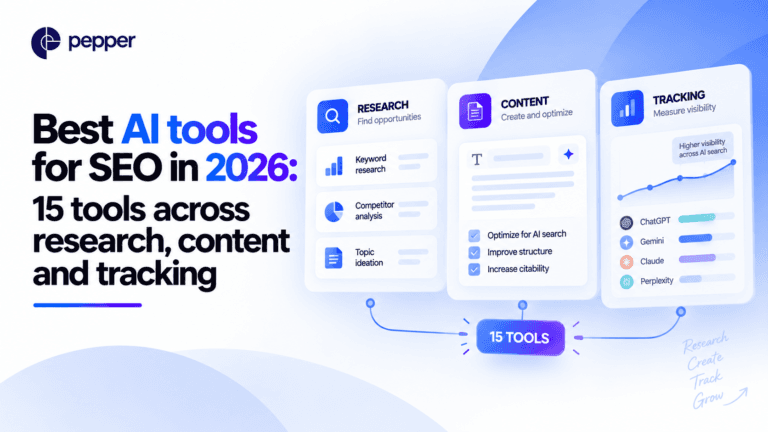
The short answer Fifteen tools, grouped by the three jobs people actually buy for, with every price re-read on 22 September 2026. Two things matter more than the rankings. First, this category rots fast: of the eight external tools on our own August list, two have withdrawn published pricing, one has changed its product line […]
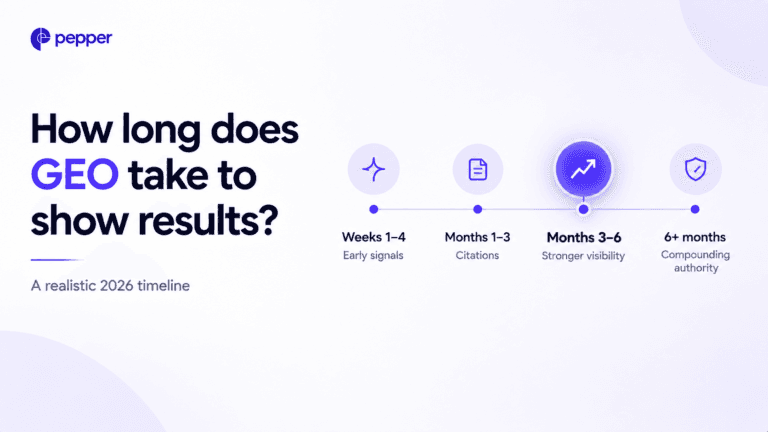
Nobody has published a credible GEO timeline, and the ones being sold are borrowed from SEO. Here is what actually gates the clock, which parts move in days, and what to promise your board instead.
Get your hands on the latest news!

Similar Posts
GEO / AI Search
17 mins read
Best AI tools for SEO in 2026: 15 tools across research, content and tracking
GEO / AI Search
10 mins read
How long does GEO take to show results?
GEO / AI Search
22 mins read