Competitor Benchmarks: Show Your Board Exactly Where You Stand
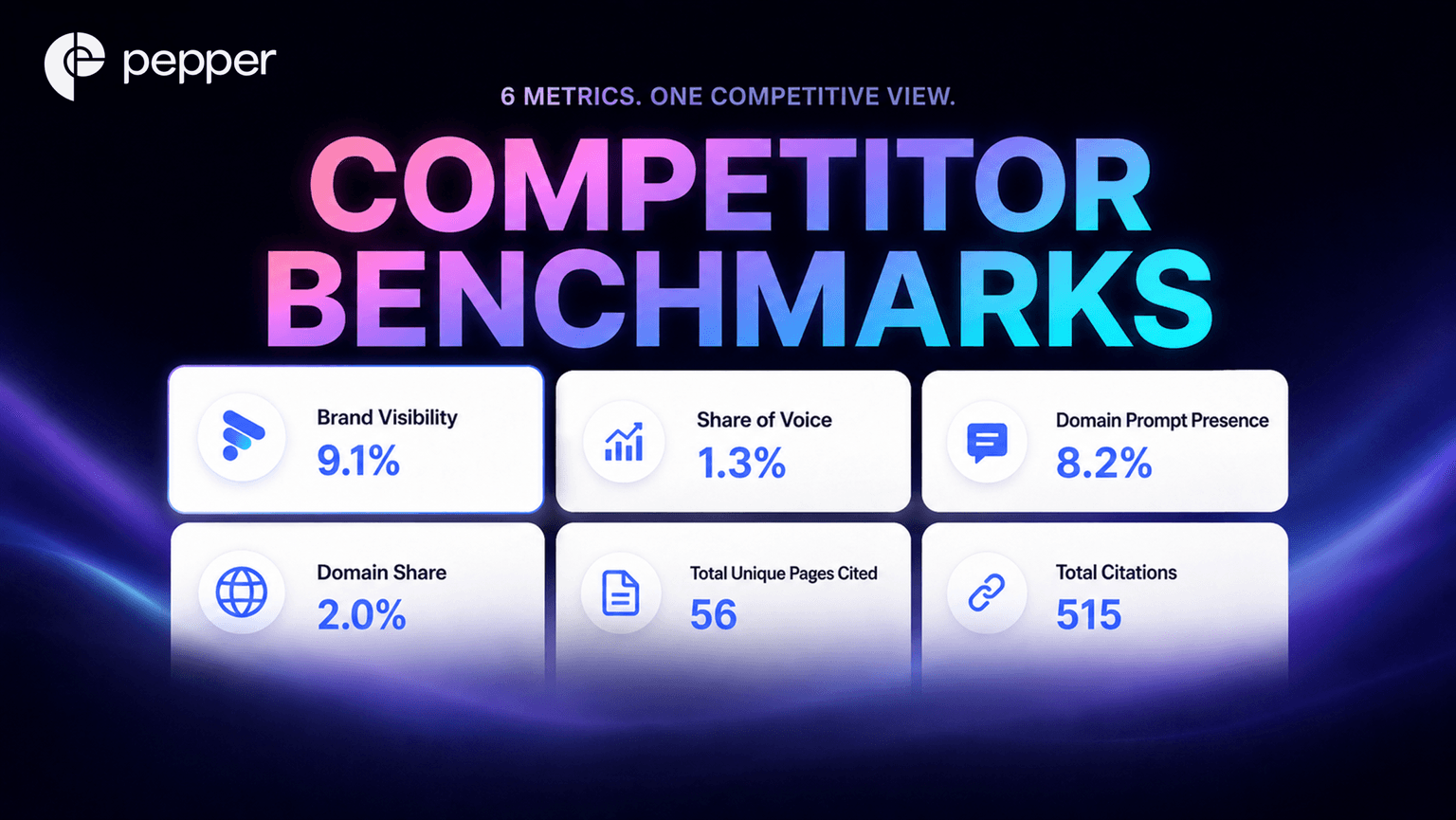
TL;DR: Leadership does not want to hear that AI search feels different this quarter. They want the number. Competitor Benchmarks in Pepper’s GEO platform puts six core GEO metrics in one view, your brand against your entire competitive set, tracked daily. You can slice it by engine, competitor, theme, or date range, zoom any single metric to see who is pulling ahead, and export the side-by-side breakdown straight into a board deck.
A GEO metric on its own is close to meaningless. Your brand visibility went up, and you still cannot tell whether that is good news, because an AI answer names a handful of brands and the only thing that counts is whether you are one of them.
Which is why “AI search is trending up” never survives a leadership meeting. Trending up against whom? By how much? Ahead of which competitor, and behind which one? Without those, a GEO number is a feeling with a decimal point, and leadership is right to push back on it.
They are not being difficult. They are asking the reasonable version of the question: compared to whom, and by how much. Competitor Benchmarks is built to answer exactly that.
What is a competitor benchmark in AI search?
A competitor benchmark is your performance on a given metric shown directly against the other brands competing for the same AI answers, over the same period. Not your number in isolation, which tells you almost nothing, but your number next to theirs, which tells you whether you are gaining ground or quietly losing it.
The distinction matters more in AI search than it did in SEO. An AI answer names a handful of brands. Your visibility going up means little if two competitors went up faster, because there are only so many slots in the answer.
The six metrics that actually define AI search
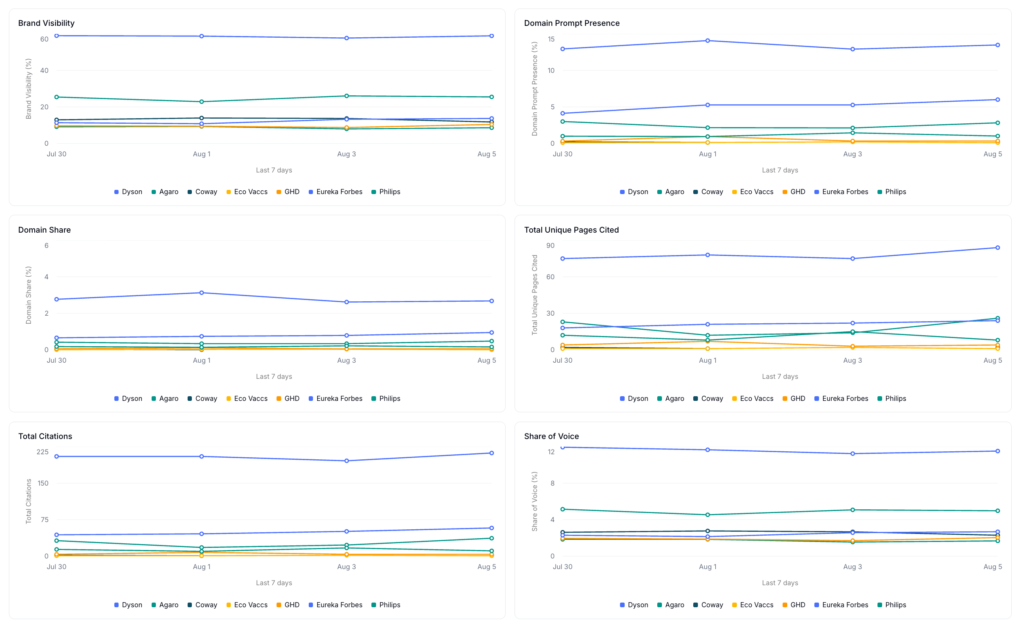
Competitor Benchmarks opens on six trend charts, your brand plotted against every competitor you track, refreshed daily.
| Metric | What it measures |
| Brand Visibility | The percentage of prompt runs that mentioned your brand by name, with or without a citation |
| Share of Voice | Your brand’s slice of total mentions across every brand detected in those runs |
| Domain Prompt Presence | The percentage of prompt runs that cited at least one page from your domain |
| Domain Share | Your domain’s slice of all citations across every domain detected, including third-party sites |
| Total Unique Pages Cited | The number of individual pages from your domain that appeared in AI responses |
| Total Citations | The overall volume of citations your domain earns across prompt runs |
Two of these are relative, and they are the ones to watch hardest. Share of Voice and Domain Share both count every brand and domain detected, not just the competitors you track, so they only rise when you genuinely take ground from someone else. The others can drift upward simply because engines started citing more sources overall.
Read together, the six separate two things most reporting blurs. Brand Visibility and Share of Voice tell you whether AI knows you. Domain Prompt Presence, Domain Share, Total Unique Pages Cited, and Total Citations tell you whether AI trusts you enough to source you. A brand can be winning the first pair and losing the second, and that is a very different problem with a very different fix.
Slice it the way leadership actually asks
Board questions are rarely neat. Someone wants to know about ChatGPT specifically. Someone else cares only about the two rivals in the same deal cycles. Someone wants last quarter, not last month.
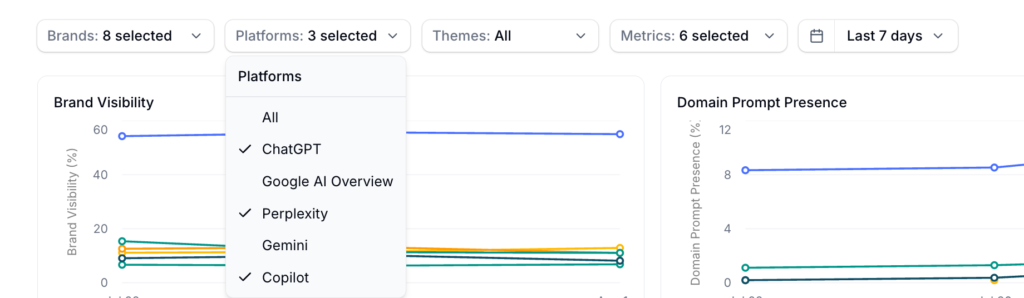
The filters answer each of those without rebuilding anything: by engine (ChatGPT, Perplexity, Claude, Copilot, Gemini, Google AI Overviews), by the exact competitors you care about, by theme, and by any date range. However the question gets framed in the room, the view can answer it live.
That matters more than it sounds. The reason these conversations stall is usually not a missing number. It is that the number cannot be re-cut fast enough to answer the follow-up.
One chart, and the whole story
Zoom a single metric and the pack separates. You see who is pulling ahead, who is flat, and exactly where your line sits between them, day by day across the range.
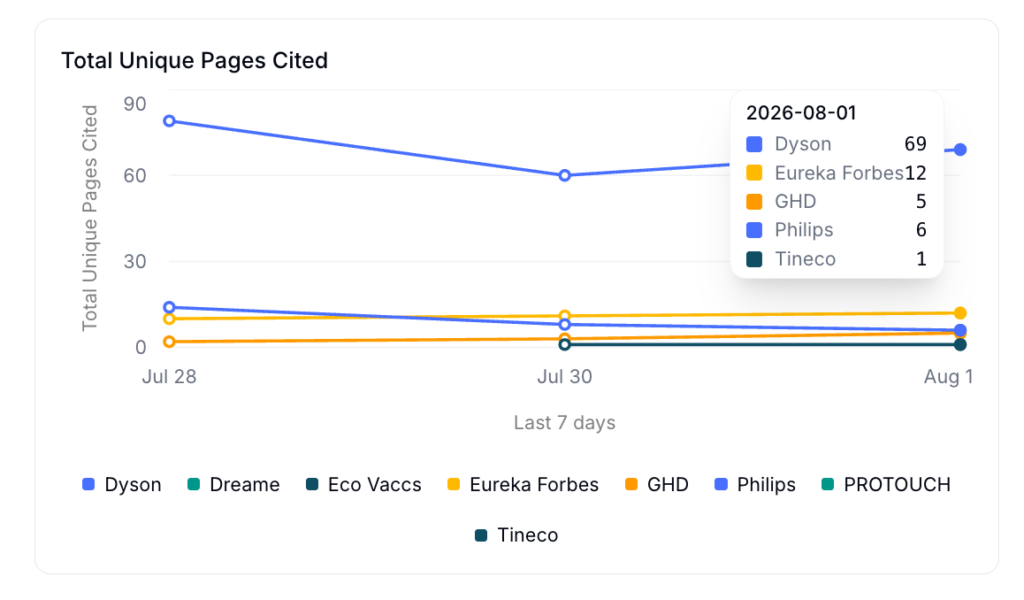
There is a way to read this that keeps you honest, and I would give any leadership team the same advice: watch movement, not just position.
A competitor climbing from 30 to 40 on a theme is a bigger story than one sitting steady at 60. The one sitting still is a known quantity. The one climbing is running a play, and while they are still climbing you can still catch them. Where a rival sits today describes last month. Which way they are moving tells you about next quarter.
The part that saves your reporting week
When it is time to build the deck, the side-by-side breakdown gives every brand’s exact numbers across all six metrics, one row per brand. One click exports the whole table.
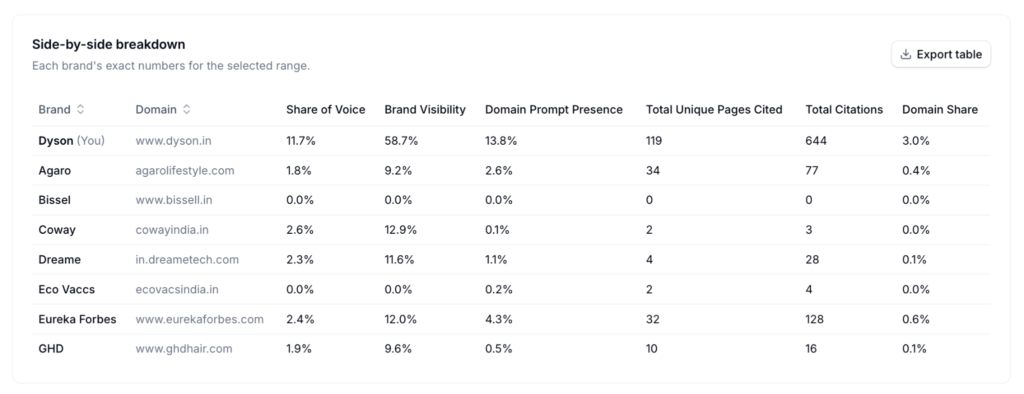
This is the difference between telling your leadership AI search is trending up, and showing them exactly where you win, where you are losing, and what it will take to close the gap.
What to bring to the next review
The benchmark is not the point. What you do with it is. Three things worth walking in with:
- One number with a comparison attached. Never present a GEO metric alone. Present it next to the leader’s number and the gap between them.
- The direction, not just the level. Show which competitor lines are climbing. That is the argument for acting now rather than next quarter.
- The specific gap you intend to close. Pick the one metric and the one rival you are going after, and say so. A benchmark with no chosen target is just a scoreboard.
For eight years we have run content and SEO for more than 250 enterprises, and the teams that get funded are rarely the ones with the prettiest dashboard. They are the ones who can say precisely who is beating them, on which metric, and what they are doing about it this quarter. Everyone else built a mirror. We built an engine.
FAQ
What is Competitor Benchmarks?
Competitor Benchmarks is the view in Pepper’s GEO platform that tracks six core GEO metrics daily, plotting your brand against your full competitive set, with filters by engine, competitor, theme, and date range, plus an exportable side-by-side table.
Which metrics does it track?
Brand Visibility, Share of Voice, Domain Prompt Presence, Domain Share, Total Unique Pages Cited, and Total Citations. Together they show both whether AI knows your brand and whether it trusts your pages enough to cite them.
Can I compare performance on a specific AI engine?
Yes. The platform filter lets you view any metric for a single engine, so you can see where a competitor leads on ChatGPT but trails on Perplexity, which are two different problems to solve.
How do I get these numbers into a board deck?
The side-by-side breakdown lists every brand’s exact figures across all six metrics, and one click exports the full table, so the reporting is done without rebuilding anything by hand.
Should I look at my position or my trend?
Both, but weight the trend. A competitor climbing quickly matters more than one sitting still at a higher number, because the climber is running a play you can still respond to.
Give your board the number
Stop arguing that AI search feels different. Show them where you stand, against whom, and by how much.
See where your brand ranks at pepper.inc, or book a demo.
Extended reading:
Latest Blogs
Most 90-day AI plans are sequenced by how hard the work feels rather than by how long it takes to land. So they spend week one on an llms.txt file that Google states it does not use, and they schedule earned media for phase three, which guarantees no result inside the quarter. This plan inverts that. It orders the work by lead time, starts the slowest thing on day one, and cuts four tactics Google explicitly says are unnecessary.
We priced this category nine days ago. Today we went back to the same four pricing pages to check the numbers before publishing. Three of the four had changed, and two had stopped publishing prices altogether. That is the real answer to what AEO costs in 2026: not a number, but a meter that moves, measured in prompts and responses and engines that are billed separately. Here is how each pricing model works, what unit it charges you for, and which incentive that unit creates.
Ask what AI search traffic is worth and you will be handed a multiplier. The ones in circulation right now run from 13% worse than organic search to 23 times better, a spread of roughly twenty-six fold on the single input your whole business case depends on. They disagree because they are measuring the same behaviour under different attribution models. So this is not a guide to finding the right multiplier. It is a guide to building a model whose assumptions are visible, and to being honest about the half you cannot prove.
Get your hands on the latest news!