What is LLM Visibility: When AI Decides to Talk About You
When you ask ChatGPT or Google’s AI a question, have you noticed it sometimes mentions specific brands or websites in its answer? That’s LLM Visibility at work.
What is LLM Visibility? (The Simple Version)
Think of LLM Visibility like being picked for show-and-tell at school. When the teacher (the AI) needs to answer a question, they look around the classroom (all the content they know about) and pick certain kids (brands or websites) to help answer. LLM Visibility measures how often YOUR brand gets picked for show-and-tell when AI answers questions.
Traditional SEO is like having your house appear on a map. LLM Visibility is like having someone actually mention your house when giving directions. The AI doesn’t just know you exist—it actively talks about you when answering questions.
How Does LLM Visibility Work?
When someone asks an AI a question, the system searches through content in two ways. First, there’s what happened during training—like all the books the AI read before school started. Second, there’s what happens right now—like looking up current information in real-time.
The AI uses something called semantic search. Instead of matching exact words (like old-school search engines), it understands meaning. If someone asks “how to sleep better,” the AI might mention your meditation app even if you never used those exact words. It’s looking for meaning, not word-for-word matches.
The big difference? Traditional search shows you a list of links. AI search puts information directly into the answer. Your content gets cited right there, no clicking required.
Why Does LLM Visibility Matter?
Here’s the thing: people are asking AI systems questions instead of typing into Google. When AI answers “best running shoes for beginners” without mentioning your brand, you’re invisible. You could rank #1 on Google, but if ChatGPT never names you, a huge chunk of potential customers won’t hear about you.
LLM Visibility matters because AI doesn’t send traffic to your website the same way search engines do. It’s a zero-click world. Getting cited in the answer IS the win. Think of it like being quoted in a newspaper article versus just having your ad appear next to the article.
LLM Visibility at a Glance
| Feature | Details |
| What It Measures | How often your brand appears in AI-generated answers |
| Key Difference from SEO | Citations in answers vs. rankings on a results page |
| Two Types | Training-time (baked into the model) and retrieval-time (pulled during answers) |
| How AI Finds You | Semantic similarity and vector embeddings, not keyword matching |
| Success Metric | Citation rate and share of voice in AI responses |
| Zero-Click Reality | Users see your content without visiting your site |
Real-World Examples
When someone asks Perplexity “what causes lower back pain,” medical websites with strong LLM Visibility get cited in the answer. The user sees “According to Mayo Clinic…” right there—no website visit needed.
Or imagine asking ChatGPT about project management tools. If Asana has high LLM Visibility, the AI might say “Asana offers features like…” even if the person never mentioned Asana by name. That’s semantic discovery in action.
Here’s another: a bakery’s recipe blog might have terrible Google rankings but fantastic LLM Visibility. When people ask Claude “how to make sourdough bread,” that bakery gets mentioned because the AI learned their content explains it really well.
FAQs
Q1: How is LLM Visibility different from regular SEO?
Regular SEO focuses on ranking high in search results so people click your link. LLM Visibility focuses on being mentioned inside AI-generated answers. One is about being on the list; the other is about being in the conversation.
Q2: What’s the difference between training-time and retrieval-time visibility?
Training-time visibility means your content was learned when the AI was built (like studying for a test). Retrieval-time visibility means the AI is looking up your content right now while answering (like checking notes during an open-book exam).
Q3: Can I optimize my content for better LLM Visibility?
Yes. Focus on clear, factual content that directly answers questions. AI systems prefer authoritative sources that explain things well. Structure matters—use headers, lists, and straightforward language.
Q4: How do I measure my LLM Visibility?
Track how often your brand appears when you ask AI systems questions related to your industry. Some specialized tools now monitor citation rates across different AI platforms, similar to how rank trackers work for Google.
Wrapping Up
LLM Visibility is your brand’s report card for the AI age. As more people turn to ChatGPT, Perplexity, and other AI assistants for answers, showing up in those answers becomes just as important as ranking on Google. Start paying attention to whether AI knows—and talks about—you.
Latest Blogs
Most advice on this is inference dressed as fact. OpenAI documents exactly one thing clearly, which is access. Here is what is documented, what is inferred, and how to verify the rest for yourself.
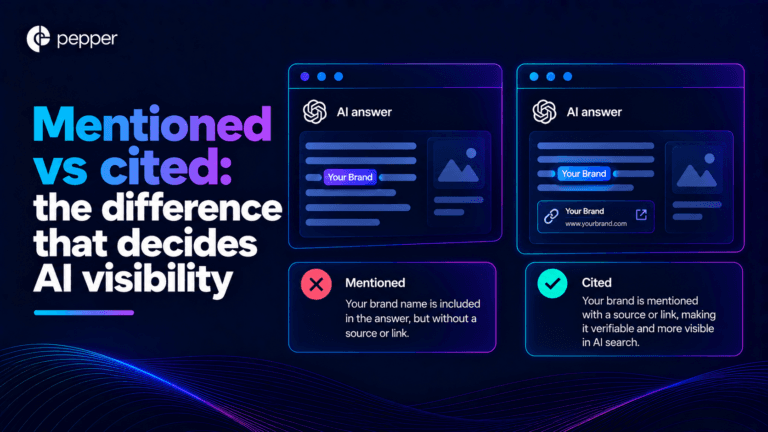
Being named in an AI answer and having your page used as its source are different outcomes with different causes and different fixes. The gap between them is the most useful diagnostic in AI search, and most reporting collapses it into one number.
Every platform reports share of voice and almost none of them define it the same way. Here is the definition worth using, the three choices that change the number, and how to measure it yourself without buying anything.
Get your hands on the latest news!

Similar Posts
GEO / AI Search
10 mins read
How to get cited by ChatGPT
GEO / AI Search
10 mins read
Mentioned vs cited: the difference that decides AI visibility
GEO / AI Search
13 mins read