GEO agency vs GEO tool: which do you actually need in 2026?
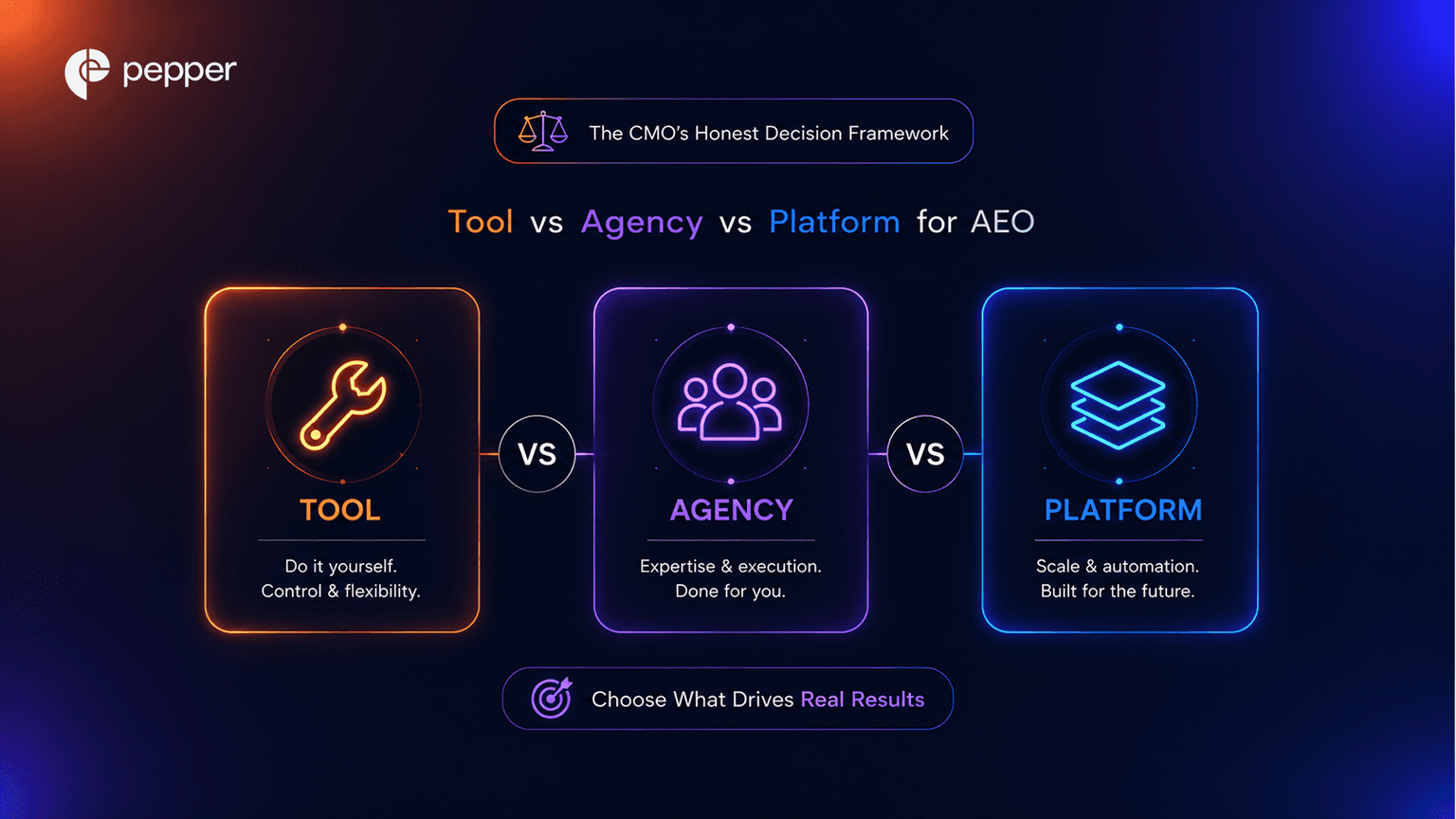
The framing is wrong, and it is wrong in a way that costs money.
“Tool or agency” implies two options. There are three, because the interesting middle case is a platform you actually log into with a team attached to it. Several vendors now claim to be both, and they mean genuinely different things by that claim, which is where most buying mistakes start.
Pepper is one of the companies claiming both, so read what follows with that in mind. Everything said about other vendors came from their own websites on 26 August 2026, and we have tried to describe the models rather than sell one.
The short answer
Buy a tool if you have people with capacity and you are missing the measurement layer. Hire an agency if your constraint is hands rather than knowledge. Buy the combined model if you need both and do not want to pay twice for the overlap.
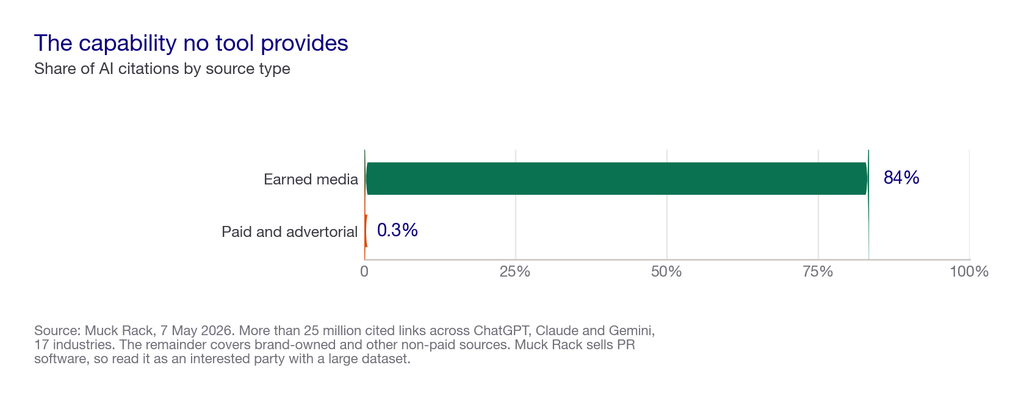
Budget is not the deciding variable. Capacity is.
Key takeaways
- A tool measures and stops. It tells you where you appear, which competitors appear instead, and which sources are winning. It changes none of it.
- An agency executes but usually keeps the instrument. You get the work and a monthly report rather than the underlying data.
- “Both” means two different things. Some firms run a platform internally to deliver a service. Others give you the platform and attach a team. Ask which.
- Most of the work is off your own site. Muck Rack found 84% of AI citations come from earned media, which no software can do for you.
- Some readers should buy nothing yet. Under roughly 30 meaningful commercial prompts, a spreadsheet and a quarterly review is the right answer.
A note on where this comes from. We run organic for more than 250 enterprises and track over 10 million prompts across every major engine. The view below is shaped by that, by the client reviews we sit in every week, and by conversations with buyers and operators at the events we run. This is our read on the category rather than a neutral directory.
What is a GEO agency, and what is a GEO tool?
A GEO tool is self-service software that runs a prompt set across AI engines and reports what came back: brand mentions, citations, the specific URLs cited, competitor share of voice and sentiment. You log in, you read it, you act on it yourself.
A GEO agency is a team of people who do the work on a retainer. Technical retrievability, content, and earned media. Reporting arrives monthly, usually assembled from tools you do not have access to.
The third model has no settled name, so the label gets used loosely by firms with very different structures underneath. That ambiguity is the practical problem, and it splits cleanly once you ask one question: do you get logins?
TripleDart describes itself as an “AI-Native B2B Marketing Agency” offering “a GTM operating system, delivered as expert service”, built on proprietary systems including Slate with 130+ AI workflow blocks. That is an agency whose tooling is internal. The platform makes their delivery better. You are buying the outcome rather than the software.
Pepper is the other shape. Customers log into the platform themselves: they set up a workspace, define brand profile, competitors and personas, connect GA4 and Search Console, manage themes and prompts, read GEO analytics, and build and run their own agents in the Agent Atlas. And a growth team is attached to the account and does the work alongside them. The platform is yours. The team is additional.
Neither structure is better in the abstract. They suit different buyers, and confusing them is expensive.
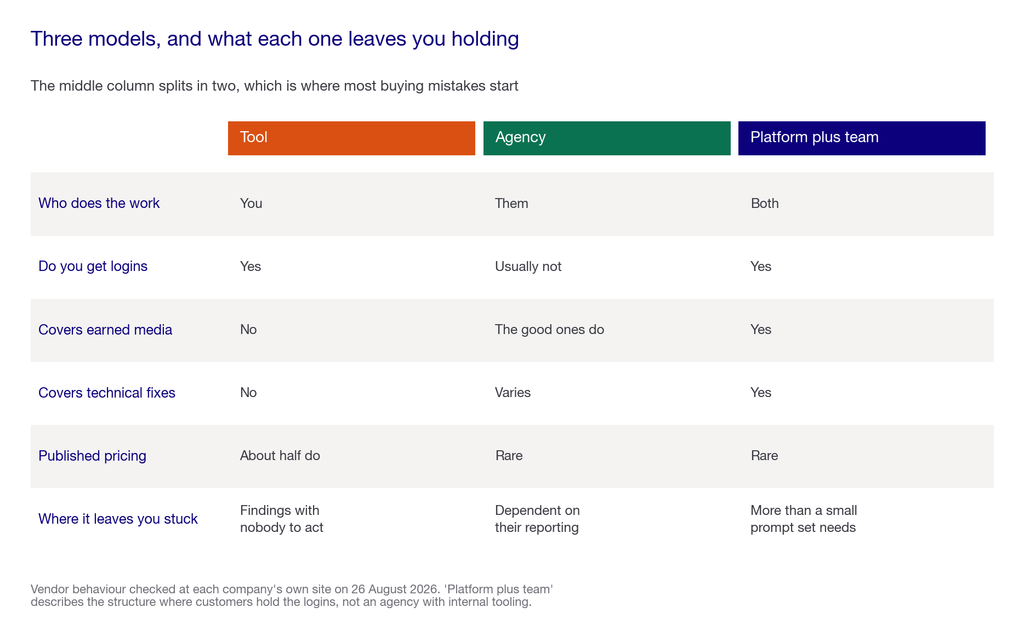
GEO agency vs GEO tool at a glance
| GEO tool | GEO agency | Platform with a team | |
|---|---|---|---|
| Who does the work | You | Them | Both |
| Do you get logins | Yes | Usually not | Yes |
| Typical cost | $99 to $399 per month published | Retainer, rarely published | Retainer, rarely published |
| Covers earned media | No | The good ones do | Yes |
| Covers technical fixes | No | Varies by firm | Yes |
| Time to first output | Days | Weeks | Weeks |
| Where it falls short | Findings with nobody to act on them | You depend on their reporting | More than a small prompt set needs |
How we weighted this comparison
We did not score vendors here, because the question is which model fits rather than which brand wins. We weighted the decision itself, and these weights are the ones we apply in client reviews.
| Area | Weight | What decides the score |
|---|---|---|
| Execution capacity | 35 | Whether anyone will act on findings, with hours protected and something else removed from their plate |
| Earned media reach | 25 | Whether the model can get you into third-party sources, which is where most citations originate |
| Data access | 20 | Whether you can see raw answers and cited URLs yourself, or only a composite score in a monthly deck |
| Technical capability | 15 | Whether rendering, crawler access and structured data can actually be fixed, not just flagged |
| Cost transparency | 5 | Whether the price is published, which shapes how quickly you can build a business case |
Execution capacity carries the most weight because it is the constraint that most often decides the outcome, and it is the one buyers most consistently leave out of the comparison. Cost transparency carries the least because a gated price slows a decision without changing what you eventually get.
Our full GEO agency ranking methodology explains how we build weightings like this one.
Where does each model actually fit?
The tool fits a team with hands and no instrument. Existing SEO competence, real capacity, missing only measurement. It also fits a cheap category test: a $99 tier for a quarter answers whether AI search matters to your buyers, which is worth knowing either way. Where it falls short: it will document a decline more precisely without slowing it down.
The agency fits a team whose constraint is hands. You know roughly what needs doing and there is nobody to do it. It is also the only model that reliably covers earned media. Where it falls short: you rarely get the instrument, so you cannot check a claim between reports or tell a model update apart from a performance change.
The combined model fits teams who need both and want one contract. Bought separately, you end up with two vendors and an agency reporting on data you are also paying to see. Where it falls short, including for Pepper: we do not publish pricing, so budget discovery is a conversation rather than a page. We are built for teams running organic as a long-term function, so a one-off audit is not what we are for. Our depth sits in content, authority and AI search rather than large technical migrations, so raise that early if it is your primary problem.
If you want the diagnostic run against your category before you compare vendors, book a growth audit and we will show you which sources decide your answers today.
Why earned media decides more than the software does
Muck Rack analysed more than 25 million cited links across ChatGPT, Claude and Gemini in May 2026, spanning 17 industries, and found earned media accounted for 84% of AI citations against 0.3% for paid and advertorial.
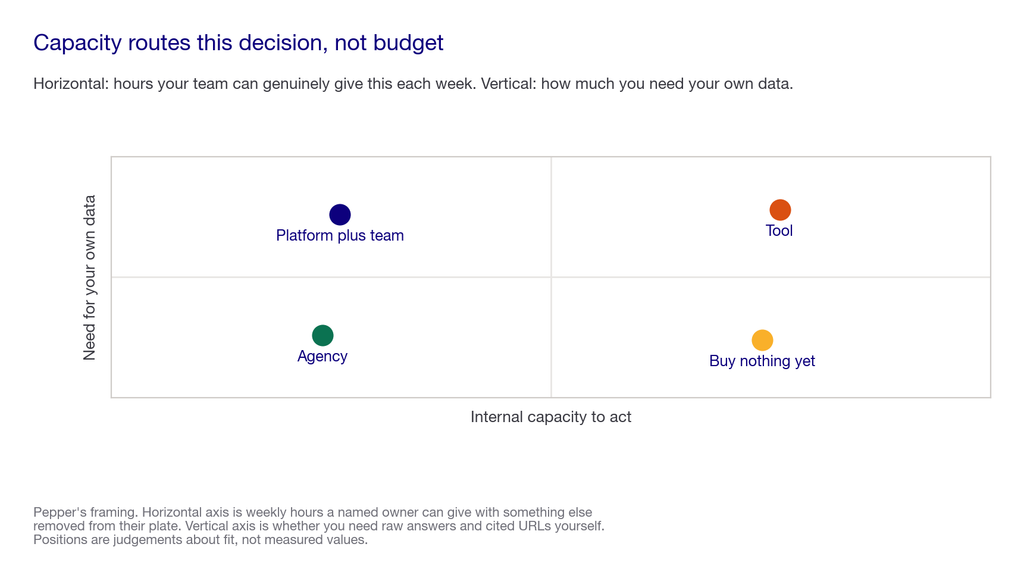
Read that against what software does. A tool will tell you which publications decide your category. It cannot get you into one of them.
There is a second reason this matters. Retrieval failures caused more than 70% of chatbot errors in a Stanford-led evaluation of six commercial chatbots covering 2,100 questions in May 2026. Fixing rendering and crawler access takes engineering time rather than a dashboard, and that is a different queue in most organisations.
What each path costs
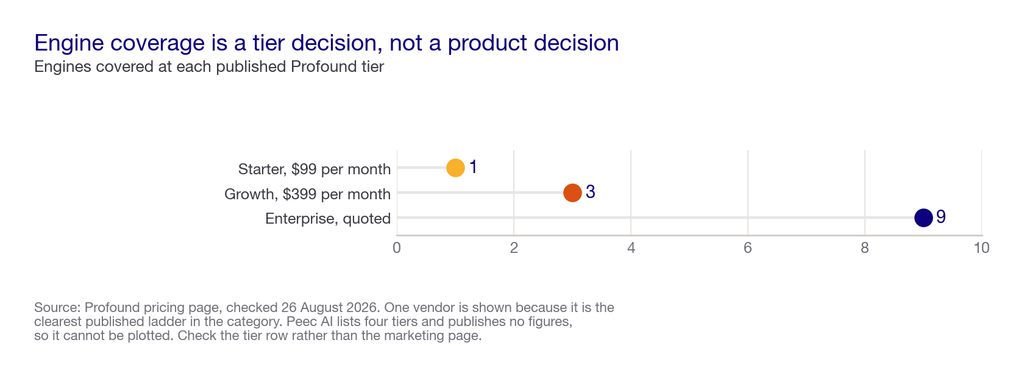
Published tool pricing is the only transparent part of this market. Profound publishes $99 for a Starter tier covering ChatGPT only with 50 prompts monthly, $399 for Growth across three engines, and a quoted Enterprise tier reaching nine. Peec AI lists four tiers, Starter through Enterprise, and publishes no figures for any of them, while tracking ChatGPT, Perplexity, Gemini, AI Mode and Copilot and reporting 3,000+ brands and agencies as customers.
Agency retainers and combined-model pricing are almost never published, ours included. Treat a missing price as information rather than an oversight. Our roundup of the best LLM SEO tools records which vendors publish and which gate.
Two things matter more than the headline number. Prompt volume caps the usefulness, so 50 prompts monthly is enough to test a category and not enough to run one. Engine coverage is sold by tier rather than by product, so a ChatGPT-only tier measures one engine accurately while your buyers may be asking three.
The larger cost is not on any pricing page. A tool that surfaces two hundred opportunities a quarter needs someone to act on them, and that internal time usually exceeds the subscription by a wide margin. Our cost breakdown of platforms against hiring models that line properly.
How to choose between a GEO agency and a GEO tool
I would start somewhere most comparisons never go, which is your own org chart rather than the vendor’s feature list.
Google’s May 2026 guidance is a useful anchor. Google states that AEO and GEO are part of SEO, and that AI Overviews and AI Mode run on core Search ranking systems with no separate AI index. That is correct for Google, and Google is one engine. ChatGPT and Perplexity retrieve differently, so hold both ideas at once: the fundamentals are shared, and the distribution is not.
With that settled, the choice reduces to a capacity question. Score it before you take a demo.
| Area | Weight | What a strong answer demonstrates |
|---|---|---|
| Named execution owner | 35 | A specific person with protected weekly hours and something explicitly removed from their plate to make room |
| Earned media route | 25 | A repeatable way into third-party publications, review sites and communities, not a plan to write more of your own posts |
| Raw data access | 20 | You can read the actual answer text and cited URLs yourself, and export them if you switch vendors |
| Technical remediation | 15 | Rendering, crawler access and structured data can be changed, with engineering time already agreed |
| Prompt methodology | 5 | Someone can explain how the reported prompt set was chosen, and it is not weighted toward branded queries |
Those weights sum to 100. Score your own situation first, then score each vendor against the same sheet.
The live test. Before you sign anything, give every shortlisted vendor the same 30 real commercial prompts from your category, in your buyers’ words rather than yours. Not “what is generative engine optimization” but questions a buyer would actually type. Four worked examples: “how do we find out if ChatGPT recommends our product”, “best tools for tracking brand mentions in AI answers”, “which vendor do enterprise teams pick for AI search visibility”, “is it worth hiring an agency for AI search”.
Ask for five things back. Where do we appear, and where do we not. Which competitors appear instead, and consistently. Which sources influence those answers. Why are those sources winning. What would you change in the next 90 days, and who does it. Engines are probabilistic, so require more than one run on more than one engine; a single run establishes nothing.
The weak playbook against the strong one. The weaker sequence is familiar because it is cheap to sell: find some prompts, rewrite a few blog posts, add FAQ blocks, sprinkle statistics, hope for a citation. It is all on-site, all owned media, and it is aimed at the 16% of citations that are not earned.
The stronger sequence runs eight steps: demand intelligence, technical discoverability, entity and brand authority, content, earned-media authority, distribution, visibility measurement, revenue attribution. The distinction matters because the weak version can be delivered entirely by software plus a junior writer, which is exactly why so much of the category sells it.
Red flags, each one a thing a vendor actually says. “We guarantee citations in ChatGPT.” Google explicitly advises against providers guaranteeing rankings, because third parties cannot access ranking systems, and nobody has that access for ChatGPT either. “Here is your AI visibility score”, offered as a single composite number with no way to audit it. “We track your branded prompts”, which always looks healthy because those answers were already yours. “We optimise for ChatGPT”, where one engine stands in for the category. “We publish 40 articles a month.” “We select the prompts”, with no stated methodology. “Citations are up”, quoted with no competitor share of voice next to it. And a proposal with no technical or digital PR line at all, which given the 84% figure is structurally mismatched to how visibility works.
Five questions for the first call.
- Do we get logins, and to what exactly? A good answer names the screens and offers a trial account. A weak one describes the reporting you will receive.
- Can we see raw answers and cited URLs, or only a score? A good answer shows you response text with sources on the call. A weak one explains why the composite score is more useful.
- How did you choose the prompts in this report? A good answer describes a documented method and admits which segments are under-covered. A weak one cannot say.
- What proportion of scope is earned media, and who does it? A good answer names people and a target list. A weak one calls it content amplification.
- What comes off our plate? A good answer is specific about throughput and hours. A weak one talks about strategy and partnership.
It all comes down to one principle: buy the thing that removes your actual constraint, not the thing that measures it more precisely. If you leave with nothing else, leave with that.
One closing note that costs us something. Very few firms are genuinely strong across measurement, execution, earned authority and attribution, ours included. The good ones will tell you which of the four is their weakest. If a vendor claims all four equally, you have learned something useful about the rest of their answers.
What nobody should promise you
Guaranteed citations. Google advises against providers guaranteeing rankings because third parties cannot access internal ranking systems. The same holds for AI answers.
That software alone will move your visibility. Measurement is not execution. Every tool in this category reports. None of them publish, pitch or fix rendering.
That an agency alone gives you the full picture. Without raw data you cannot separate a model update from a performance change, and you will spend a quarter chasing something nobody caused.
A single visibility score worth reporting. Composite numbers hide the gap between Brand Visibility, how often engines mention you, and Domain Prompt Presence, how often they cite your pages. That gap is the finding you could act on.
Frequently asked questions
Do I need a GEO agency or a GEO tool?
It depends on capacity rather than budget. A tool suits teams with hands to act on findings. An agency suits teams whose constraint is execution. If you lack both the data and the hands, a combined platform and team model avoids paying twice for the overlap.
What is the difference between a GEO tool and a GEO platform?
Very little in practice, because both describe software that measures AI visibility. The meaningful distinction is whether a team comes with it, and whether you get logins to the product or only a monthly report assembled by someone else.
Can a GEO tool improve my AI visibility on its own?
No. Tools measure mentions, citations and competitor share of voice. Improving visibility takes technical fixes, content and earned media, and Muck Rack found 84% of AI citations come from sources you do not own or control.
How much do GEO tools cost?
Published entry pricing runs from roughly $99 to $399 monthly at the tiers most teams start on. Profound publishes both figures. Several vendors including Peec AI list tiers without any numbers, so budget for quoted pricing on at least half your shortlist.
Is it cheaper to buy a tool or hire an agency?
A tool is far cheaper monthly and does none of the work. The honest comparison includes the internal hours needed to act on what it surfaces, which is usually the larger number and almost never appears in the business case.
What does “both a platform and an agency” actually mean?
Ask whether you get logins. Some firms run proprietary tooling internally to deliver a service, so the platform improves their output but you never touch it. Others give you the platform itself and attach a growth team to your account.
Should I buy a tool if I already have an agency?
Often yes, and it is under-used. Your own instrument lets you check agency reporting against raw data, and it separates a model update from a genuine performance change, which is otherwise an unwinnable argument.
Which GEO tools track Google AI Mode?
Coverage is thinner than for ChatGPT and varies by tier rather than by product. Peec AI names AI Mode on its pricing page. Verify at the specific tier you intend to buy rather than trusting the marketing page.
Where to go next
Answer the capacity question before you compare anything. Write down who acts on findings and what comes off their plate when they do. That single answer eliminates most of a shortlist.
Then run the diagnostic yourself, free. Take 30 real commercial questions from your category, run them across the engines your buyers use, and record where you appear, which competitors appear instead, and which sources are winning. Our guide to tracking brand mentions in AI search covers the five methods and what each one misses, and the Visibility, Citability and Retrievability framework explains which lever is usually stuck.
For the vendor landscape, AI SEO agencies covers which firms genuinely rebuilt their model, and how to choose an organic SEO agency covers the red flags worth walking away from. Our SalesHood case study documents what the combined model looks like in practice, with AI Overview keywords moving from 14 to 97 across five months.
One honest exit. If you have a capable in-house operator, an existing agency doing the execution, and fewer than about 30 target queries, you do not need to buy anything yet. Run the manual diagnostic quarterly and revisit when the prompt set outgrows what one person can track.
Sources
Vendor descriptions came from each company’s own website on 26 August 2026 rather than from other roundups. Every study cited was published in 2026.
- Muck Rack, Earned media still drives 84% of AI citations, 7 May 2026. More than 25 million cited links across ChatGPT, Claude and Gemini, 17 industries. Muck Rack sells PR software, so read it as an interested party with a large dataset.
- Suzgun et al., Evaluating Commercial AI Chatbots as News Intermediaries, arXiv, 21 May 2026. 2,100 questions across six commercial chatbots. Tested on news rather than commercial queries, so read the mechanism rather than the exact rate.
- Google Search Central, AI features and your website, 15 May 2026, including the guidance against providers guaranteeing rankings.
Latest Blogs
Most advice on this is inference dressed as fact. OpenAI documents exactly one thing clearly, which is access. Here is what is documented, what is inferred, and how to verify the rest for yourself.
Being named in an AI answer and having your page used as its source are different outcomes with different causes and different fixes. The gap between them is the most useful diagnostic in AI search, and most reporting collapses it into one number.
Every platform reports share of voice and almost none of them define it the same way. Here is the definition worth using, the three choices that change the number, and how to measure it yourself without buying anything.
Get your hands on the latest news!

Similar Posts
GEO / AI Search
10 mins read
How to get cited by ChatGPT
GEO / AI Search
10 mins read
Mentioned vs cited: the difference that decides AI visibility
GEO / AI Search
13 mins read