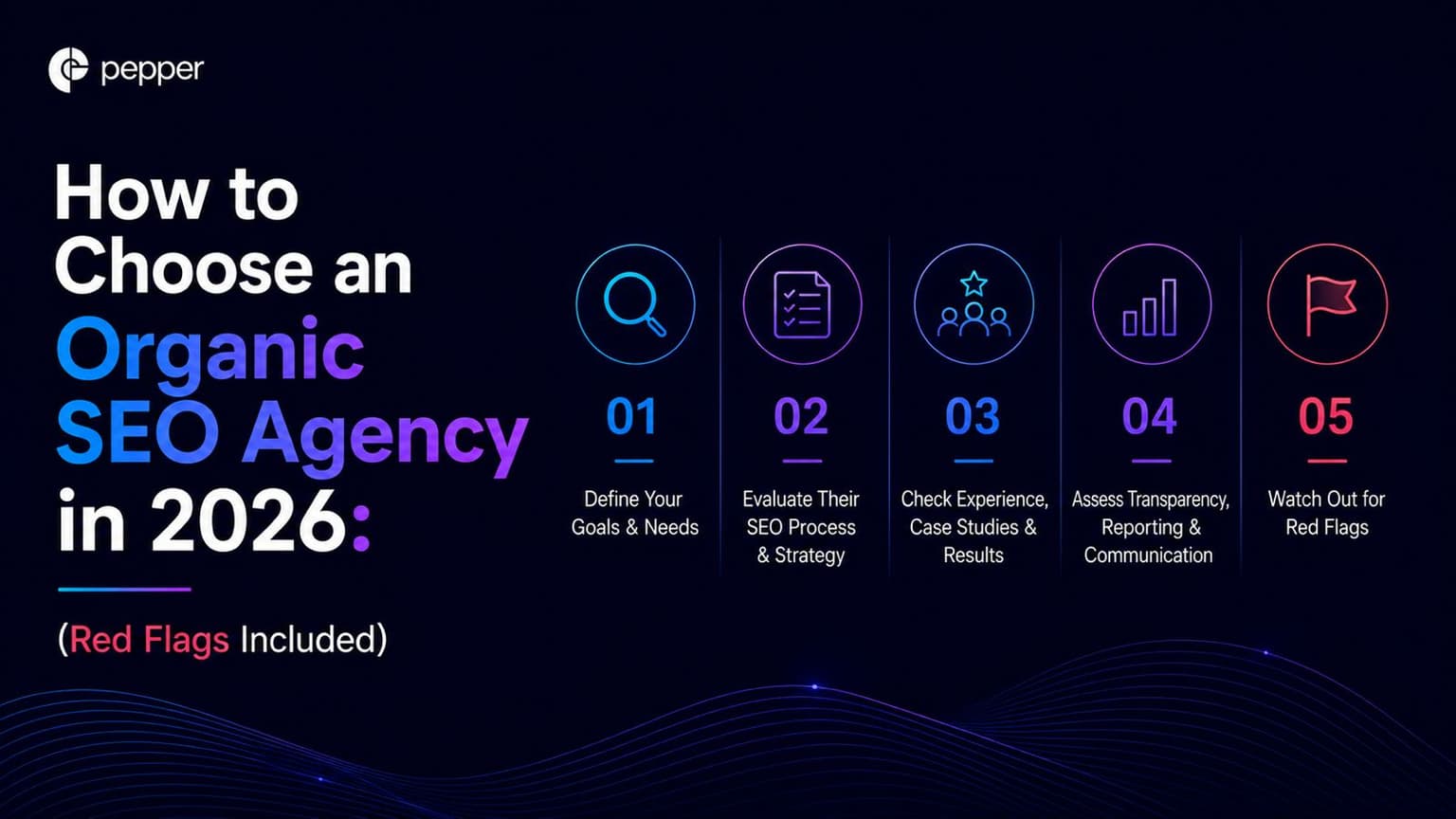
Most advice on choosing an SEO agency is written as a list of things to look for. That is the wrong shape, because good qualities are easy to fake in a pitch and hard to verify in one.
Filtering works better. Almost every bad engagement we inherit showed at least one warning sign during procurement that somebody noticed and did not act on. So this is organised around what should end a conversation, followed by the questions that surface those things early.
We have run organic for more than 250 enterprises across eight years, and we have also lost deals to firms making promises we would not make. Some of that shaped what follows.
First, decide what you are actually buying
Three different services get sold under the same name, and mismatching this is the most expensive error available.
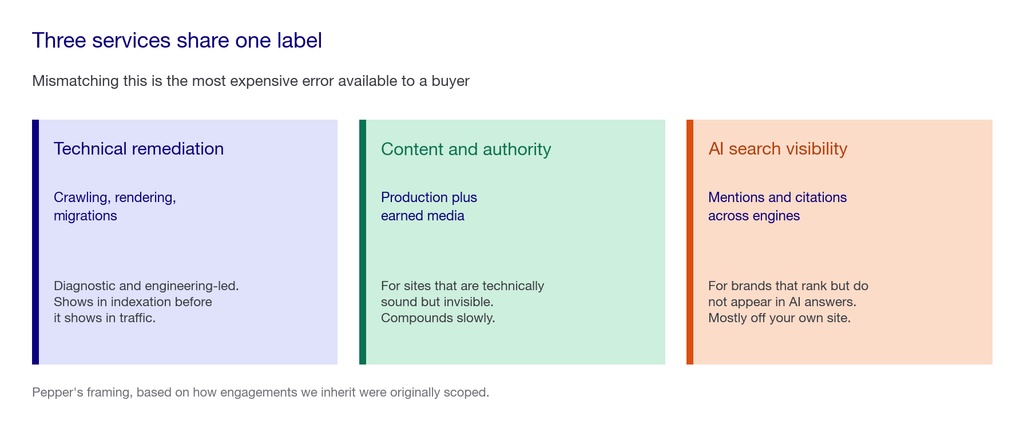
Technical remediation suits sites where crawling, rendering or a migration is the problem. The work is diagnostic and engineering-led, and success shows in indexation and crawl efficiency before it shows in traffic.
Content and authority suits sites that are technically sound but invisible. The work is production and earned media, and it compounds slowly.
AI search visibility suits brands that rank respectably but do not appear in AI answers. This is newer, and it moves the centre of gravity off your own website entirely.
Run a diagnostic before you brief anyone. Take 20 to 30 real commercial questions from your category, run them across the engines your buyers use, and pull your log files to see what crawlers actually reach. An afternoon of that tells you which of the three you need, and it turns you from a buyer into an informed one.
The eleven red flags
Not all of these are fatal on their own. Three together is a pattern, and any one of the first three should end the meeting.
1. They guarantee rankings or AI citations. Google explicitly advises against providers guaranteeing rankings, because third parties do not have access to internal ranking systems. Nobody has that access for ChatGPT either. This one is not a judgement call.
2. They set up analytics under their own account. Your Google Analytics, Search Console and any tracking must live in accounts you own, with the agency granted access. Anything else means your historical data leaves when they do.
3. They will not name who does the work. You meet the founder in the pitch and a junior account manager after signing. Ask for named roles and their throughput on an account your size, and ask who attends your weekly call.
4. The proposal is entirely deliverables with no implementation owner. An audit that surfaces two hundred fixes nobody can ship is a backlog, not a capability. We inherit accounts in exactly this state regularly.
5. Reporting stops at rankings and traffic. For a business, those are inputs. Ask what they report at month three, and whether it reaches demos, trials or pipeline.
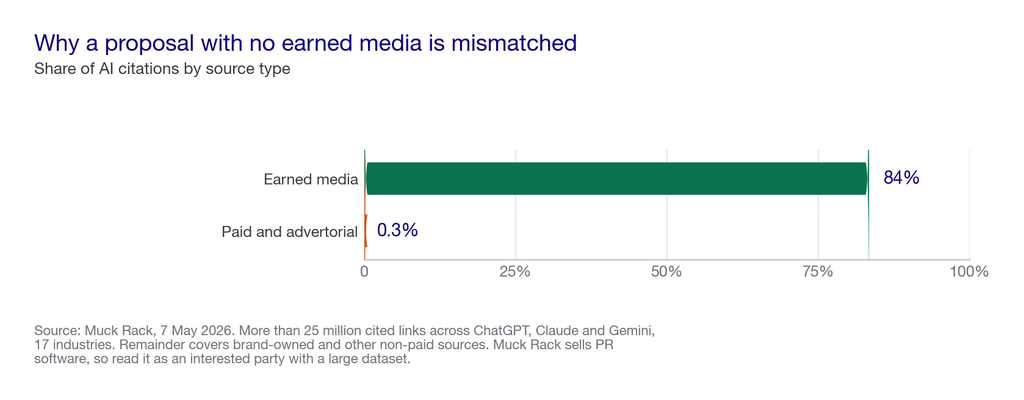
6. No earned media in the scope. Muck Rack’s analysis of more than 25 million cited links across ChatGPT, Claude and Gemini in May 2026 found earned media accounted for 84% of AI citations, against 0.3% for paid and advertorial. An all-on-site proposal is structurally mismatched to how visibility now works.
7. They cannot explain how they select prompts. If AI visibility is in scope and the methodology is undisclosed, the number they report is whatever the prompt list flatters. A set weighted toward branded queries always looks healthy.
8. A long lock-in with no exit. Twelve-month commitments with no break clause signal a firm that is not confident it can show progress month to month. Ask what happens at month four if nothing has moved.
9. Every case study is from a company an order of magnitude smaller. Failure modes differ genuinely at scale. A firm whose best work is on 200-page sites may struggle on 40,000.
10. Mass AI-generated content as the plan. Volume without specificity does not perform in classic search or AI answers. Ask who writes, and what subject matter expertise they bring.
11. They have never had anything go wrong. Everybody has had a migration go sideways. A firm that cannot describe one and what they changed afterwards is either inexperienced or not being straight with you.
The five questions that surface all eleven
You do not need to run through the list. These five expose most of it in the first hour.
“Take one query where a competitor beats us and explain why.” The best diagnostic question available. A capable firm moves between layers: how the competitor’s page renders, what earned sources reinforce it, why the engine trusts it. A weak one describes what a tool shows.
“Who does the work, and what is their throughput on an account our size?” Named roles, real capacity numbers. If the answer is about strategy, delivery remains your problem.
“What would you change in the first 90 days, in what order?” Look for sequencing across technical, content and earned media. A content calendar alone is not a strategy, and neither is a list sorted by severity colour.
“How do you prove this generated business?” Their measurement should reach qualified pipeline, and a good answer includes where attribution breaks. Anyone claiming a clean line from ranking to revenue is overstating.
“What would you not bother fixing on our site?” Serious partners prioritise ruthlessly. Anyone who wants to fix everything has not thought about your cost.
What a realistic engagement looks like
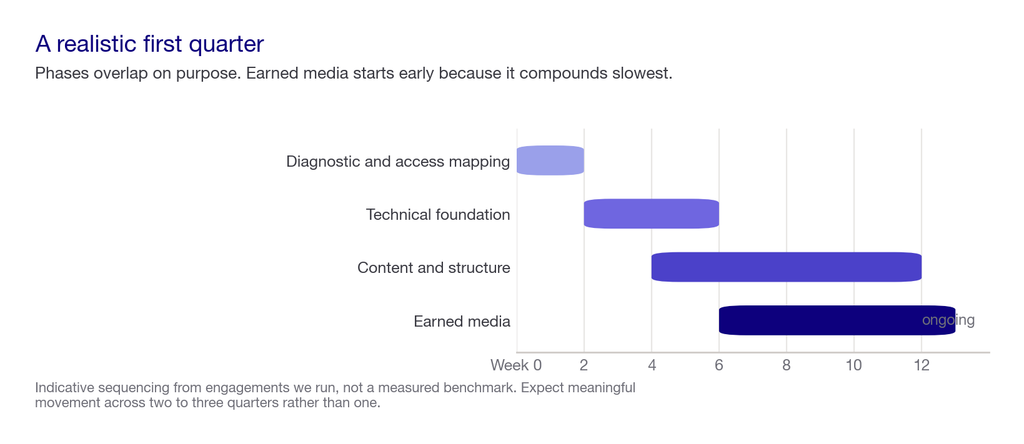
The first two weeks are diagnostic. Log files, crawl data, index coverage, a real prompt set, and a map of who internally can approve what. That last part is usually less documented than the technical picture and matters just as much.
Weeks two to six are foundational. Rendering, crawler access, redirect chains, template-level errors. These land fastest and make everything after them more effective.
Weeks four to twelve are content and structure, focused on the pages that matter rather than all of them.
Earned media starts around week six and never stops. It is the slowest to compound, which is exactly why it should start early rather than after the technical work finishes.
Expect meaningful movement across two to three quarters. Acceldata’s 6X organic traffic growth took nine months. TVS Eurogrip’s migration recovery ran from May to December. Anyone promising materially faster is describing paid media.
What good looks like, with numbers
Two of our own engagements, both published in full with named champions, because a buyer’s guide with no evidence behind it is just opinion.

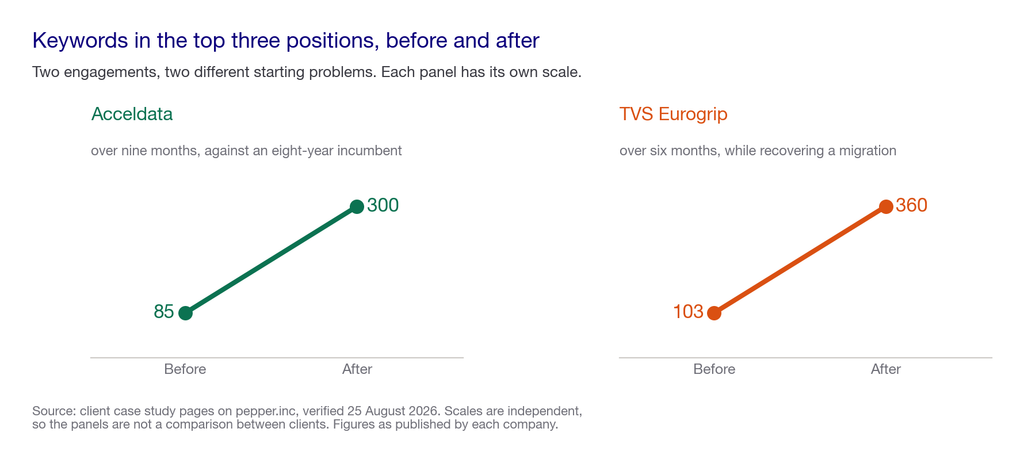
Acceldata was competing against a rival with an eight-year head start in data observability, with a lean marketing team. The work targeted bottom-of-funnel commercial keywords first rather than chasing volume. Over nine months, ranking keywords went from 4,400 to more than 10,000, top-three keywords from 85 to more than 300, and organic traffic grew 6X, bringing over 100,000 new users at a 47% engagement rate. Mahesh Kumar, their CMO, described the value as “their ability to hone in on a specific topic that really resonates and draw people in.”
TVS Eurogrip had lost roughly half its organic traffic to a domain migration and brand transition. Recovery ran in sequence: technical stabilisation first, then a content engine of 200+ blogs, non-brand keyword work, Google Merchant Center expansion and off-page authority. Between May and December, monthly clicks rose 8,592%, top-three keywords went from 103 to 360, and website orders grew 10x. Kavitha Ganesan, Head of Brand Marketing, framed the goal in a way we quote often: “For us, it’s always the right traffic that matters.”
Both figures are published on the client’s own case study page, and as with every case study in this category, they are reported by the company that ran the work rather than independently audited.
Where Pepper fits
We are an agentic organic growth engine, which is a different shape from an agency and worth understanding before you compare us to one.
Customers get a genuinely self-serve platform: they log in, set up a workspace, define brand profile, competitors and personas, connect GA4 and Search Console, manage themes and prompts, read GEO analytics, and build and run their own agents in the Agent Atlas. And a growth team is attached to the account, doing the work alongside them. Agents for scale, experts for judgement, one team accountable for the number.
That structure answers several of the red flags above directly. You own your accounts and your data, you can see the raw answers behind every visibility number rather than a score, and there is no gap between the people who diagnose and the people who deliver.
We are built for organisations treating organic as a long-term function, with an internal team we work alongside. That is where we do our best work, and it is why our published case studies run over quarters rather than weeks. We do not publish pricing, because scope varies enormously with site size, markets and how much production is included, so that conversation happens with a person.
What nobody should promise you
Guaranteed rankings or citations. Not from anyone, at any price.
Page one in 90 days. Either they have misjudged your market or they are using tactics that create a bigger problem later.
Clean attribution from ranking to revenue. It does not close cleanly. Corroborate with branded search lift and sourced pipeline instead.
That one agency is excellent at technical, content, earned media and attribution. Very few are strong across all four, ours included, and the good ones will tell you which is their weakest. That answer is worth more than a capabilities deck.
Frequently asked questions
How do I choose an organic SEO agency?
Decide first whether you need technical remediation, content and authority, or AI search visibility, since three services share that label. Then filter on red flags rather than promises, and ask any shortlisted firm to explain why a specific competitor outranks you.
What are the biggest red flags when hiring an SEO agency?
Guaranteed rankings, analytics set up under the agency’s account, and refusing to name who does the work. Any one of those should end the conversation. After that, watch for proposals with no earned media and no named implementation owner.
How much should an organic SEO agency cost?
It varies enormously with site size, markets and how much production is included, so most firms quote after scoping. What matters more than the total is the ratio: if you are spending more on being told what to do than on doing it, the engagement shape is wrong.
Should I sign a 12-month contract?
Be cautious of long lock-ins with no break clause. Organic takes quarters, so some commitment is reasonable, but a confident firm will agree a review point. Ask what happens at month four if nothing has moved.
How long before an SEO agency shows results?
Two to three quarters for meaningful movement. Technical fixes land faster, while authority compounds slowly. Acceldata’s 6X traffic growth took nine months, and TVS Eurogrip’s migration recovery ran May to December.
Should the agency handle AI search visibility too?
Increasingly yes, though ask specifically which engines they measure and how they select prompts. Since 84% of AI citations come from earned media, an agency with no digital PR capability cannot reach most of what decides your category’s answers.
In-house or agency for organic SEO?
Build in-house if you have execution capacity and need deep product context. Hire for surge capacity, digital PR, or skills you cannot recruit quickly. Most successful programmes run a hybrid, with the agency covering what headcount cannot.
What should an SEO agency report on?
Rankings and traffic are inputs rather than outcomes. Ask for reporting that reaches demos, trials or pipeline, plus per-engine AI visibility split between brand mentions and citations to your domain, since those two point to different work.
Where to go next
Do the diagnostic before you take a single call. Twenty to thirty real commercial questions across the engines your buyers use, plus a look at your log files to see what crawlers actually reach. That afternoon changes every conversation afterwards.
Our 7-point AI search audit is the checklist we run on every new account. For the technical side, can AI search bots crawl your website covers what to check first, and who owns AI search internally covers the ownership question that decides whether any of it ships.
If you want the diagnostic run for you, book a growth audit and we will show you which sources are deciding your category’s answers today. Customers run this themselves inside the platform, with a growth team attached. The Acceldata and TVS Eurogrip case studies document both engagements described above in full.
Sources
Every study cited here was published in 2026. Case study figures are as published on each client’s own case study page, verified 25 August 2026, and reported by the companies that ran the work.
- Muck Rack, Earned media still drives 84% of AI citations, 7 May 2026. More than 25 million cited links across ChatGPT, Claude and Gemini, 17 industries. Muck Rack sells PR software, so read it as an interested party with a large dataset.
- Google Search Central, AI features and your website, 15 May 2026, including the advice against providers guaranteeing rankings.
- Forrester, 2026 Buyers’ Journey Survey, January 2026. 18,000 global business buyers.
- Acceldata case study: 6X organic traffic, keywords 4,400 to 10,000+, top three 85 to 300+, 100,000+ new users at 47% engagement, nine months. Champion: Mahesh Kumar, CMO.
- TVS Eurogrip case study: 8,592% increase in monthly clicks May to December, top three keywords 103 to 360, website orders 10x. Champion: Kavitha Ganesan, Head of Brand Marketing.
Latest Blogs
Most advice on this is inference dressed as fact. OpenAI documents exactly one thing clearly, which is access. Here is what is documented, what is inferred, and how to verify the rest for yourself.
Being named in an AI answer and having your page used as its source are different outcomes with different causes and different fixes. The gap between them is the most useful diagnostic in AI search, and most reporting collapses it into one number.
Every platform reports share of voice and almost none of them define it the same way. Here is the definition worth using, the three choices that change the number, and how to measure it yourself without buying anything.
Get your hands on the latest news!

Similar Posts
Artificial Intelligence
11 mins read
What is anchor text, and does it still matter in 2026?
SEO
11 mins read
What is internal linking? Meaning, and what changed for AI search
SEO
15 mins read