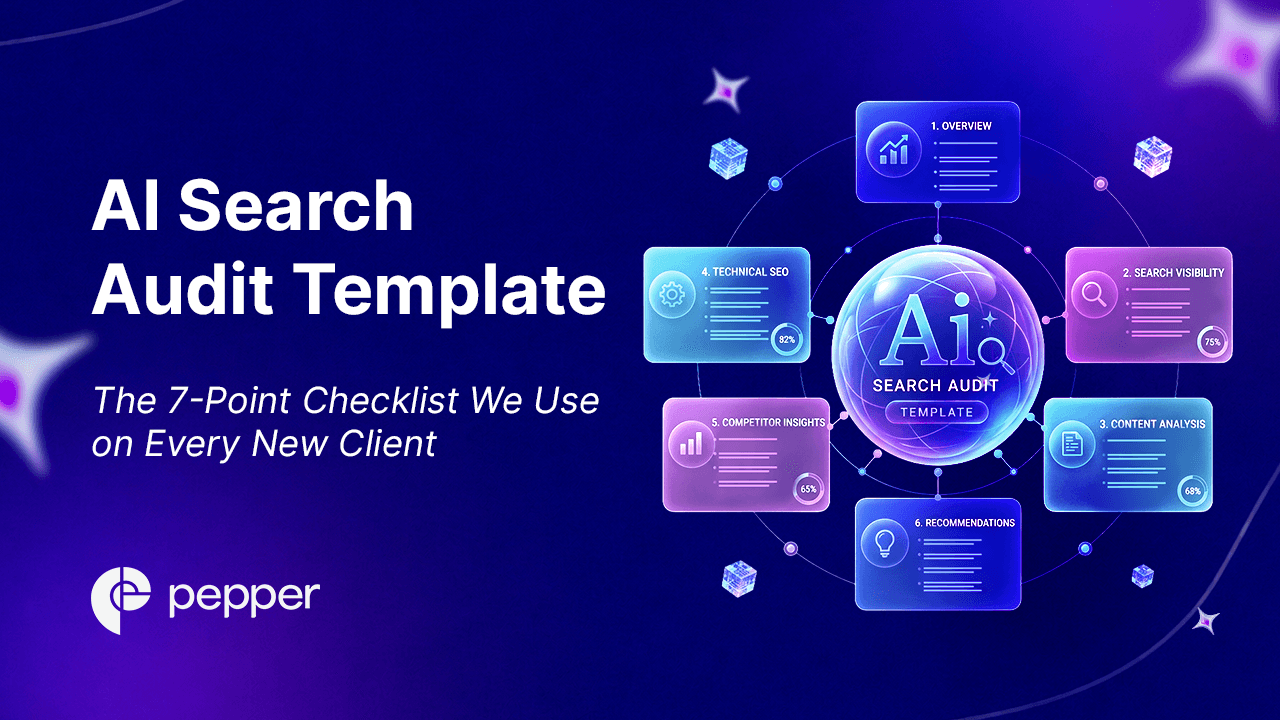
AI Search Audit Template: The 7-Point Checklist We Use on Every New Client
By Dhriti Goyal
Every new enterprise client at Pepper starts with the same forty-eight-hour exercise: a 7-point AI search audit. Not a deck of vague observations. Not a “content opportunities map” of two hundred keywords. A specific, structured diagnostic that produces seven numbers, seven lists, and one clear answer to the question every CMO is now asking – what is our brand’s position inside AI search, and what changes between now and the next quarter?
This piece is that audit, written down. The same template we run for B2B SaaS leaders, Fortune 500 retailers, and mid-market healthcare companies. The first three points are diagnostic – they tell you where you are. The middle two are technical – they tell you whether AI engines can read you. The last two are strategic – they tell you what to build.
It is also a self-service template. You can run it manually with the free measurement layers covered earlier in this hub, or you can let Pepper Atlas run it across your category in 24 hours and surface the same seven outputs at scale.
“Search is undergoing the most profound transformation of our time. Generative AI is redefining how people discover, trust, and engage with information – moving us from keywords and rankings to intelligence and context at scale.” – Anirudh Singla, Co-founder & CEO, Pepper Content (Index’25 keynote)
The audit below is how we operationalise that transformation in seven controllable inputs.
Why a Structured Audit Beats Ad-Hoc Optimisation
Most AI-search programs fail not because the team lacks effort, but because they lack a baseline. Without a fixed starting line, every gain is contestable and every plateau is invisible. The 7-point audit creates that baseline in a single artefact – one document, seven sections, one reproducible methodology. Run it once and you have a number. Run it the next quarter and you have a trajectory.
“Enterprise marketing is being re-architected around retrievability, not production volume. The first thing we did was audit. The second thing we did was stop doing everything that was not on the audit.” – Mandy Dhaliwal, CMO, Nutanix (Index’25)
The 7-Point Audit at a Glance
| # | Audit point | What it produces | Owner |
| 1 | Prompt Universe Definition | A locked set of 100–500 category prompts spanning intent layers. | Strategy |
| 2 | LLM Brand Mention Scan | Cross-platform inventory of where the brand is named, sourced, or quoted. | Analyst |
| 3 | Domain Citation Count | Total cited URLs and Cited Asset Concentration ratio. | Analyst |
| 4 | Schema Audit | Coverage report for FAQPage, HowTo, Article, Person, Organization, Product schema. | SEO / Eng |
| 5 | Crawlability Check | Robots.txt, render, llms.txt, and CDN edge-rule verification per AI bot. | Eng |
| 6 | Competitor Prompt Analysis | Side-by-side citation map of the brand against three named competitors. | Strategy |
| 7 | Content Gap Mapping | The rebuild and net-new content list, prioritised by citation lift potential. | Editorial |
→ Atlas: Atlas runs every row above as a single workflow. Upload your domain and three competitors; receive the seven outputs as a shared dashboard inside 24 hours. The DIY version below is the same methodology, executed manually.
Point 1 – Prompt Universe Definition
The denominator for every other audit point. Without a fixed prompt universe, no gain is comparable across quarters.
Define 100 to 500 category prompts spanning three intent layers: definitional (“what is X”), comparative (“X vs Y”), and decision-stage (“best X for [use case]”). Allocate roughly 40% definitional, 30% comparative, 30% decision. Lock the set for at least one quarter; quarterly audit only at the boundary.
Source prompts from three places: real customer-success transcripts (the highest-quality input), Search Console query reports, and competitor-targeted prompt mining. Avoid prompts that no buyer would ever type – they inflate brand-prompted recall and tell you nothing.
→ Atlas: Atlas auto-generates a starter universe per vertical from a corpus of 14,000 indexed prompts and lets the editorial team approve, edit, and lock the final set inside the workspace.
Point 2 – LLM Brand Mention Scan
Run the locked universe across ChatGPT, Perplexity, Gemini, Google AI Overviews, and Google AI Mode. For each prompt on each platform, record three fields: was the brand cited (Yes/No), if Yes which URL, and which competitors appeared in the same answer.
The output is a Share of Answer figure per platform and a competitor co-occurrence matrix. A healthy SaaS brand sits at 4–12% Share of Answer in its category; a leader sits at 20%+. Anything below 2% means the audit has just discovered the most consequential gap in the marketing function.
Joyce Hwang at Index’25 made the operational point: AI search collapses the distance between brand and demand. The mention scan is the first time most teams see, in a single number, whether their brand is in the answer flow at all.
→ Atlas: Atlas runs the scan daily across all five platforms, weights citations by user-intent traffic, and exposes the answer-text drift week-over-week. Manual probing produces the same directional read at zero cost.
Point 3 – Domain Citation Count
Count the total citations the brand earned in Point 2, then segment them by URL. The headline numbers are: total citations, distinct URLs cited, and Cited Asset Concentration – the percentage of total citations contributed by the top ten URLs.
Healthy concentration is 35–55%. Above 70% means the brand depends on too few pages and is structurally fragile; below 25% means citations are too diluted across the site to defend a category. Both extremes are diagnostic – and the playbook for each is different.
The single most useful artefact this point produces is the Cited URL Frequency table: each of your cited URLs ranked by how many prompts cite it. The top decile is the asset spine – reinforce it. The bottom decile is the rebuild list.
→ Atlas: Atlas surfaces concentration ratios automatically, flags single-page-dependence risk, and ranks Cited URL Frequency per platform – useful for spotting Perplexity-only winners that have not crossed over to Gemini yet.
Point 4 – Schema Audit
AI engines do not read your pages – they read your structured data. The schema audit is a coverage check across the five schema types that disproportionately drive citation: FAQPage, HowTo, Article, Person, and Organization. Add Product, Service, and Review for commerce; LocalBusiness for multi-location.
Audit by sampling: pull the top 25 priority URLs from Point 3, validate each through Google’s Rich Results Test, and tag every URL on a 0–5 schema-density score. Pages with all five core types in JSON-LD are 3.2× more likely to be cited; pages with no structured data drop out of the candidate set entirely. One enterprise reference case showed a 19.72% AI-Overview visibility lift from Organization and Person schema implementation alone.
→ Atlas: Atlas ingests live schema for every monitored URL, cross-references it with citation patterns, and ranks the lowest-coverage URLs by missed-citation opportunity. The audit becomes the editorial brief.
Point 5 – Crawlability Check
If AI bots cannot crawl, render, or fetch the brand’s pages, none of the previous four points matter. Most enterprise sites have at least one silent blocker.
Verify the following on a sample of 25 high-priority URLs: robots.txt explicitly allows GPTBot, ClaudeBot, PerplexityBot, GoogleOther, and Google-Extended; the CDN edge layer is not silently blocking AI crawlers (Cloudflare’s default Block AI Bots toggle is the most common offender); pages serve fully-rendered HTML on first request rather than relying on client-side JavaScript; and an llms.txt file is published at the root with curated, ranked URLs.
The output is a binary “crawlable / not crawlable” for each AI engine and a remediation list. Most teams find at least one engine they were silently excluding – a 30-minute fix that recovers months of lost citations.
→ Atlas: Atlas pings each AI bot user-agent against a sampled URL set every 24 hours and alerts when a CDN rule, firewall change, or robots.txt edit silently breaks crawlability.
Point 6 – Competitor Prompt Analysis
Pick three named competitors. For every prompt in the locked universe, record which of the four brands was cited (you and the three competitors) and the URL cited. The output is a 4-column citation matrix that tells the team where the brand is winning, where it is losing, and – most usefully – which competitor is winning each segment.
Two diagnostic patterns emerge. Concentrated competitor wins: one competitor dominates a single intent layer. The fix is targeted – a content cluster on that intent layer with stronger schema and original data. Diffuse competitor wins: three competitors split the Share of Answer evenly across the universe. The fix is structural – the brand’s positioning is not distinct enough for AI engines to summarise it favourably.
“In a world where AI summarizes everything, the brands that get summarized favourably are the ones with the clearest positioning and the most distinctive voice.” – Angelique Bellmer Krembs, former CMO, PepsiCo (Index’25)
→ Atlas: Atlas runs the competitor matrix as a default view, supports up to ten competitors at the enterprise tier, and tracks Share of Answer movement against each one week-over-week.
Point 7 – Content Gap Mapping
The synthesis point. Combine outputs from Points 1, 2, 3, 4, and 6 into one prioritised list: the prompts where the brand is not cited, the URLs that should be cited and are not, the schema gaps blocking the citations, and the competitor pages currently winning each prompt.
The output is two lists. Rebuild list: existing pages with the right topic but the wrong format – they need 50–70-word answer blocks, schema, named-author bylines, and original data. Net-new list: prompts with no eligible page on the site – they need a new asset, structured for citation from line one.
Prioritise by citation lift potential, not by traffic projection. A page that gets cited on a high-intent decision-stage prompt drives more pipeline than a page that gets ten times the impressions on a top-of-funnel definitional query. The audit must surface that ranking explicitly.
→ Atlas: Atlas auto-generates the rebuild and net-new lists from the audit data and lets editorial assign owners and due-dates inside the workspace. The audit becomes the production sprint.
How to Use the Audit
Run the full 7-point audit at the start of every quarter. Re-run Points 2, 3, and 6 every two weeks. Re-run Points 4 and 5 monthly, or on every major site release. Point 1 is locked for the quarter; Point 7 updates rolling, as Points 2–6 produce new data.
Ownership splits cleanly. Strategy owns Points 1, 6, and 7. Analytics or growth owns Points 2 and 3. SEO and engineering own Points 4 and 5. Editorial executes against Point 7. Six hours of human labour a month, distributed across four functions, is the realistic operating cost.
Insights: What Marketing Leaders Are Saying About AI-Search Audits
The marketing leaders at Index’25 were unusually direct about the role audits now play in the function.
“We measured by hand for six months before we bought anything. Those six months made us better operators than any tool ever did. The audit was the artefact that survived every team change, every re-org, and every budget review.” – Sydney Sloan, former CMO, G2 (Index’25)
“AI discovery rewards content that proves it has been lived. The audit is where you discover whether your content is proving it – or just saying it.” – Linda Caplinger, Head of SEO & AI Search, NVIDIA (Index’25)
“The first dashboard we built was a Google Sheet driven by an audit. The fact that it was structured is what got it adopted.” – Joyce Hwang, Head of Marketing, Dropbox (Index’25)
“Be the source worth citing. The audit tells you whether you are – and the gap list tells you what to fix.” – Neil Patel (Index’25 keynote)
“GEO is not just a buzzword, but a new rule book for brand discovery, trust, and selection in an AI-first marketplace.” – Kishan Panpalia, Pepper Content (Index’25)
The audit is the rule book’s opening chapter – the diagnostic that makes everything that follows defensible.
The Quiet Truth About AI-Search Audits
The brands compounding in AI search in 2026 share one trait: they have done the audit. They have a Share of Answer number, a Cited URL Frequency table, a schema coverage score, a crawlability matrix, and a competitor citation map sitting in a shared workspace. The audit is not a one-time event – it is the spine of the program.
The 7-point template above is the one Pepper has refined across hundreds of enterprise engagements. It can be run manually with the free layers covered elsewhere in this hub, or it can be run inside Atlas in 24 hours across your domain and three competitors. Either path leads to the same place: a baseline you can defend, improve, and compound for the rest of the decade.
→ Atlas: Run the 7-point audit on your domain inside Atlas – 24-hour turnaround, three competitor benchmarks included, full export of the audit artefact at the end of the trial. Start at atlas.peppercontent.io.
Frequently Asked Questions
How long does the full audit take? Manually, 12–16 hours across four functions for the first run; 4 hours for subsequent runs. Inside Atlas, 24 hours end-to-end.
How often should the audit be re-run? Full audit quarterly. Points 2, 3, and 6 bi-weekly. Points 4 and 5 monthly or on major releases.
What size site is this audit designed for? Anything from 50 priority URLs to 50,000. The methodology scales by sampling. Atlas auto-samples; manual audits sample the top 25–100 URLs.
Can the audit be shared with non-marketing stakeholders? Yes. The 7-point structure is the format we hand to CFOs, boards, and product leads. The numbers are the artefact; the gap list is the deliverable.
What is the single most consequential output? Point 7 – Content Gap Mapping. It synthesises the previous six points into the only thing that actually moves the metric: a prioritised editorial backlog.
Latest Blogs
The research pulls in two directions. Fan-out rewards covering many adjacent questions; absorption research finds longer pages get used. The resolution is that the passage competes, not the page.
Seven documented changes, not seven predictions. Google switched two rich results off, shipped two new AI reports, and added a channel to Analytics. Here is what actually moved and what it means.
Content chunking is the process of splitting a page into smaller pieces so a machine can retrieve one of them. Here is the part most articles get wrong: chunking is something engines do to your page, not something you do to it. You do not choose the chunk size.
Get your hands on the latest news!

Similar Posts
GEO / AI Search
9 mins read
How to structure content for answer engines
GEO / AI Search
9 mins read
What is changing in SEO in 2026?
GEO / AI Search
11 mins read