AI search video formats: what Google requires, and what we cannot prove
The short answer
Google publishes video indexing requirements, and they are more demanding than any format rule.
One requirement reorders the whole conversation. Google’s words: “The indexed watch page must be performing well in Search before its video can be considered.” Your video does not compete on its own merits. The page it sits on has to be ranking first.
Google states three more, also verbatim. “The watch page must be indexed.” “The video must be embedded on a watch page.” And “The video can’t be hidden behind other elements.”
What Google does not document is just as useful. Its video documentation says nothing about transcripts, captions or length as indexing requirements. Its generative AI guidance says there is no ideal page length and no special writing style for AI. So a six-to-ten-minute sweet spot with citation cliffs either side is not a documented rule. We should not have published it as one.
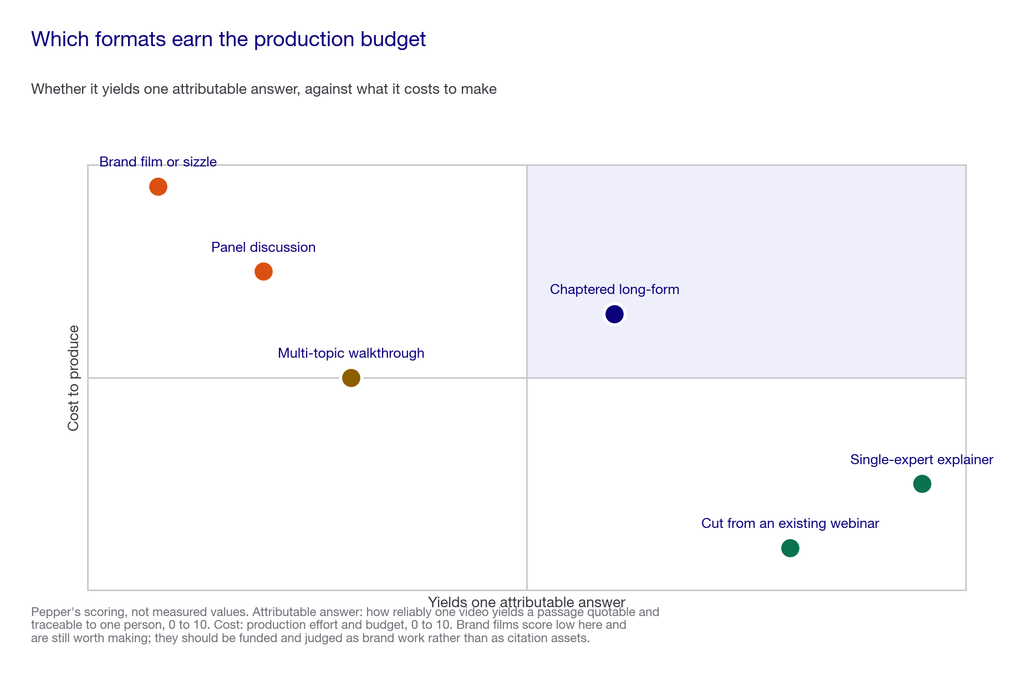
What survives is a craft argument, and we label it as one. A format earns citations when one video produces one self-contained, attributable answer. Panels, multi-topic walkthroughs and raw keynotes fail that test, and the reason is attribution rather than duration.
Key takeaways
- The watch page has to rank first. Google’s own requirement, and the constraint almost no video strategy accounts for.
- A video hidden behind other elements is not eligible. Which connects video directly to the retrievability problem rather than to production quality.
- Google auto-detects key moments “without any effort on your part”, so manual chaptering is useful for readers rather than a documented citation lever.
- No length rule exists in any Google documentation we could find. We removed ours.
- The useful test is attribution, not duration. One video, one expert, one claim somebody could quote and attribute, which is what Pepper’s agentic organic growth engine edits toward.
A note on where this comes from. We run organic for more than 250 enterprises and track more than 10 million prompts across every major engine. We deliberately derive no percentage from that, which is the correction this page makes for the second time in four articles. The Google requirements are Google’s, dated and linked. The format judgements are ours, labelled throughout.
Book a growth audit if you want to know which of your videos engines cite today, before commissioning more.
What are the AI search video formats that actually qualify?
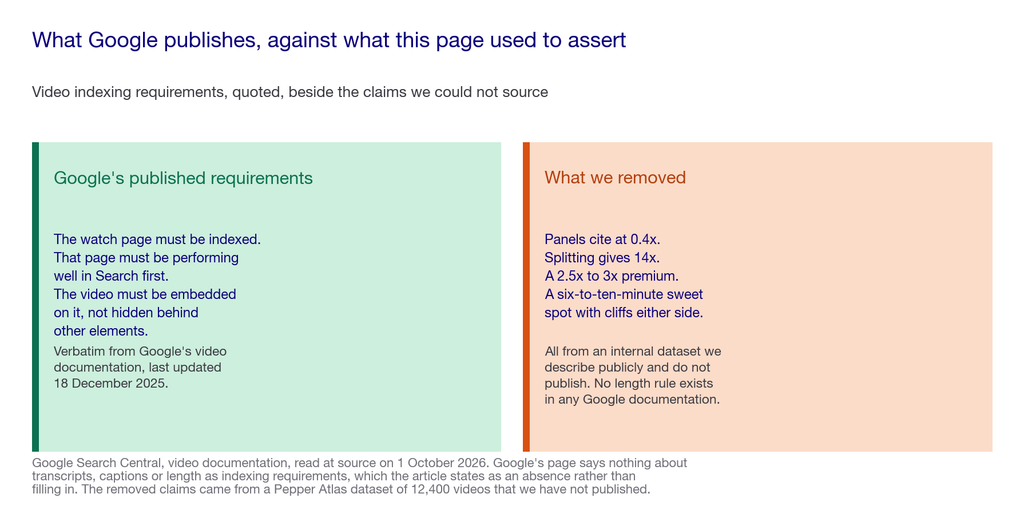
Before any question about format comes a question about eligibility. Google answers that one in writing.
Google’s video indexing requirements, quoted verbatim:
- “The watch page must be indexed”
- “The indexed watch page must be performing well in Search before its video can be considered”
- “The video must be embedded on a watch page”
- “The video can’t be hidden behind other elements”
- “The video must have a valid thumbnail that’s available at a stable URL”
Read the second one again. It puts video visibility downstream of conventional page performance. A brilliant explainer on a page nobody ranks never enters the running, whatever its format. That single requirement invalidates most format-first video strategies, including the one this page once published.
On key moments, Google says it does the work for you: “Google Search tries to automatically detect the segments in your video and show key moments to users, without any effort on your part.” Manual chaptering still helps a reader navigate. Google documents no citation benefit for it.
On transcripts, captions and length, Google’s video documentation says nothing at all. That absence matters in both directions: it does not say transcripts help, and it does not say length matters. We still recommend transcripts, for a reason below that does not depend on this document.
Where this falls short: these are Google’s requirements for Google’s video features. ChatGPT, Claude and Perplexity publish no equivalent, and we are not going to infer one.
Why transcripts still matter, on an argument that holds
Google’s video documentation does not mention transcripts. That is not evidence against them, and here is the argument that does not depend on it.
An answer engine quotes text. A video is not text. An engine can read only the text on the watch page: the title, the description, and the transcript if you render one.
So a video with no readable transcript gives an engine a page about a video rather than an answer it can lift. That follows from how retrieval works rather than from any video-specific guidance. It is the same argument as the three tiers of retrievability: text in the served HTML is retrievable, text outside it is not.
We would still not quantify it. We cut a citation-premium multiplier from this page precisely because we could not show the working.
The format argument, as craft judgement
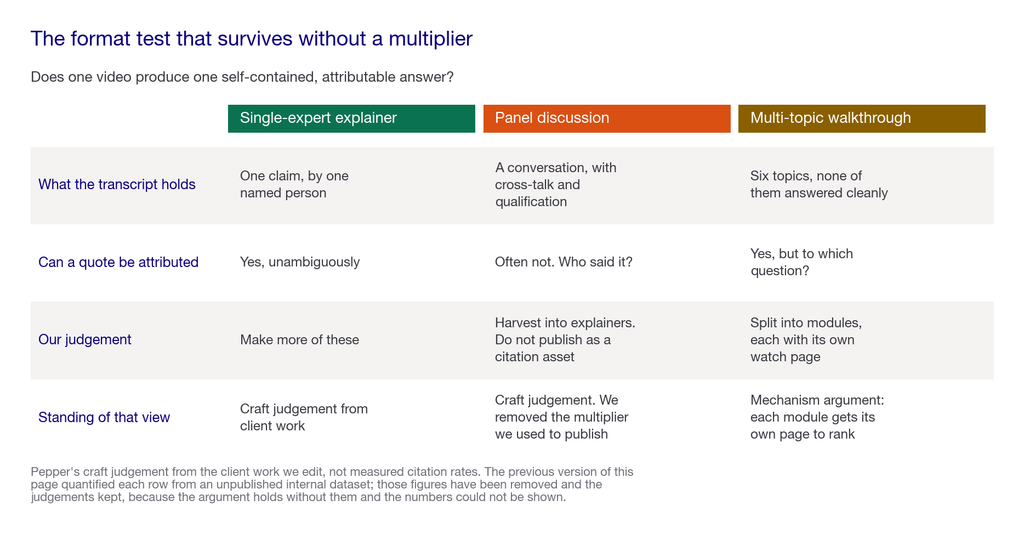
Strip the multipliers and a real argument remains. A format earns citations when one video produces one self-contained, attributable answer. Test each format against that and the pattern matches what we see in client work. That is the honest standing of everything in this section.
Single-expert explainers
One credentialed person, one topic, one thesis. The transcript contains a claim, made by a named person, that stands alone when lifted.
Why we think it works: attribution is unambiguous. An engine quoting the passage can say who said it.
Panel discussions
Three voices, interruption, qualification and cross-talk. The transcript contains a conversation rather than a claim.
Why we think it underperforms: a reader cannot attribute a quoted passage from a panel to anyone, and the sentence before it often contradicts it. We published a specific multiplier for this and could not source it. The judgement stands; the number does not.
What to do instead: treat the panel as source material. Cut each participant’s best answer into its own single-expert explainer with its own watch page.
Multi-topic walkthroughs
One video covering six things. The transcript is long, the topics blur, and no single passage answers one question cleanly.
Why we think splitting helps: each module gets its own watch page, its own title and description, and its own chance to rank, which is the eligibility requirement above. That is a mechanism argument rather than a measured effect.
Recorded webinars and raw keynotes
Long, multi-speaker, unstructured. Usually valuable material in an unusable container.
What to do: transcribe, then cut. A ninety-minute recording is a library of explainers nobody has edited yet. It is also the cheapest video asset most teams own.
Brand films and sizzle reels
Music-led, little speech, thin transcript.
These are not citation assets, so do not judge them as any. Fund them as brand work, measure them as brand work, and stop comparing them to explainers on a metric they cannot win.
What we removed, and why it matters beyond this page
Every claim we cut came from the same place: an internal dataset we describe publicly and do not publish.
| Claim on the previous version | Why it is gone |
|---|---|
| Panel discussions cite at ~0.4x the solo-expert rate | From “a Pepper Atlas reference dataset of 12,400 videos” that we do not publish |
| Splitting a multi-topic video produced ~14x more citations | Same |
| A citation premium of 2.5x to 3x, up to 4x with Person schema | Same, and the schema half contradicts Google’s statement that no special structured data is needed |
| A six-to-ten-minute sweet spot, with sharp decline past ten minutes and near-zero past twenty-five | Same, and no Google documentation we could find states any length requirement |
| Raw event keynotes cite at under 0.2x | Same |
| G2’s citation rate quadrupled after cutting solo clips from panels | Attributed to a conference talk rather than to published data. A named client result needs a source |
| 37.1% of AI-cited pages ranked top 10, across 863,000 keyword SERPs | This one is real and was uncredited. It is Ahrefs’ data, now cited properly on our AI Overviews playbook |
Why this matters beyond one page. This is the second article in four where we have removed statistics drawn from an unpublished internal dataset, after the same correction on our (https://www.pepper.inc/blog/video-strategy-for-ai-search-search-vs-discovery/). **Two occurrences make a pattern.** Either we publish the underlying analysis and make these claims properly, or we stop making claims of that shape. We cannot keep doing the third thing.
Our methodology: how we judge a format claim
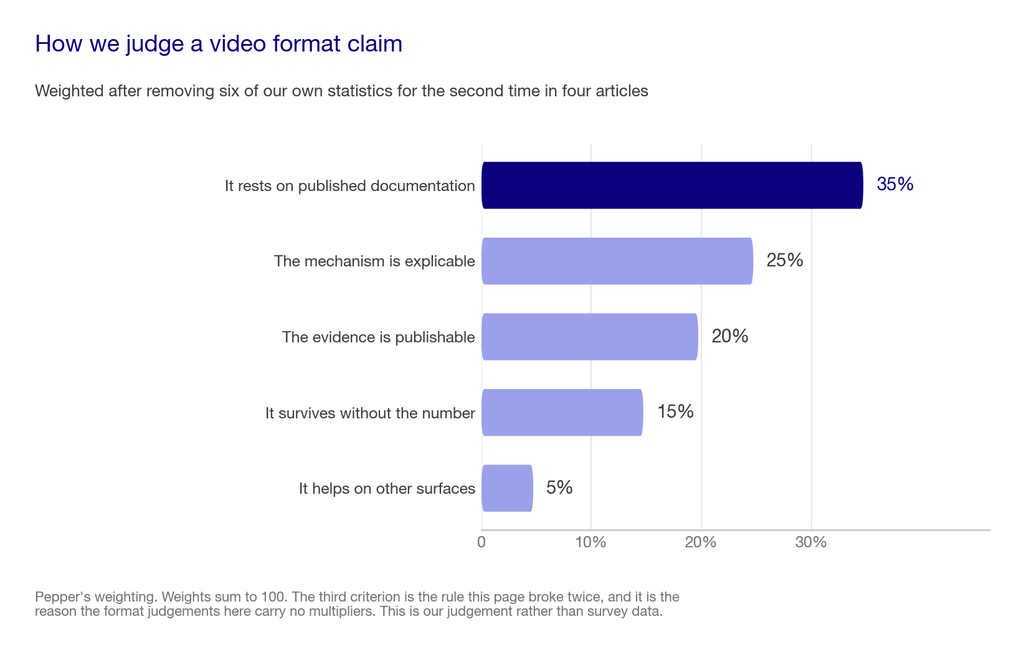
| Criterion | Weight | Why it carries that weight |
|---|---|---|
| It rests on published documentation | 35 | Google publishes video indexing requirements. A format claim that ignores them while quantifying something else has skipped the binding constraint. |
| The mechanism is explicable | 25 | “A panel transcript has no attributable claim” is an argument you can check. “Panels cite at 0.4x” is a number you cannot. |
| The evidence is publishable | 20 | If we cannot show the working, we present it as judgement. The specific rule this page broke twice. |
| It survives without the number | 15 | A format judgement that collapses when you remove the multiplier was resting on the multiplier. |
| It helps on other surfaces | 5 | Only Google publishes video guidance. A tactic built for one surface is a narrow bet. |
Weights sum to 100. Documentation and mechanism carry 60 between them. That is Pepper’s judgement rather than a fact, and it is the judgement this page rests on. We publish our weightings the same way we publish [how we rank GEO agencies](https://www.pepper.inc/blog/geo-agency-ranking-methodology/), so you can argue with them precisely.
What would change these weights. If we published the Atlas analysis with its method and sample, the third criterion would stop being a constraint and this page could carry numbers again. That is a decision for us, not for a reader.
AI search video formats at a glance
| Format | One attributable answer | Transcript usable | Google eligibility risk | What to do | Cost of getting it wrong |
|---|---|---|---|---|---|
| Single-expert explainer | Yes | Yes, if rendered | Low, if the watch page ranks | Make more of these | Low |
| Chaptered long-form | Partly, per chapter | Yes | Medium. One page carries everything | Consider splitting | Medium |
| Multi-topic walkthrough | No | Long and blurred | Medium | Split into modules | Medium. Wasted good material |
| Panel discussion | No | Conversation, not claim | Low | Harvest into explainers | High. Expensive to make, hard to cite |
| Recorded webinar | Not as recorded | Yes, and usually unrendered | Low | Transcribe, then cut | Low to fix, high to ignore |
| Raw keynote | No | Long, unstructured | Medium | Transcribe, then cut | High |
| Brand film or sizzle | No | Thin or none | Low | Fund as brand work | Low, unless judged on citations |
| Any video on a page that does not rank | Irrelevant | Irrelevant | Disqualifying | Fix the page first | Highest |
What this costs
- Transcribing and rendering what you already own: cheap and unglamorous. Most teams have a library of webinars with no transcript on the page, and this is the highest-return item here.
- Cutting a panel into explainers: editing time, not production budget. The expensive part, filming a group of experts, is already paid for.
- Making the watch page rank: ordinary SEO, and per Google’s requirement it is the prerequisite rather than a nice-to-have.
- What you should not pay for: a format package priced on citation multipliers. Ask which study. We could not answer that question about our own page, which is why this rewrite exists.
For what a broader programme costs, our generative engine optimization cost benchmarks collects 30 published prices.
Where Pepper fits
We are an agentic organic growth engine, and on this page our position is uncomfortable and worth stating plainly.
- An organic growth partner. You get a growth team on your account, a senior strategist plus always-on agents, accountable for the number rather than for a content calendar.
- Pepper’s GEO platform. Genuinely self-serve and included rather than billed as a separate licence. You log in and set up a workspace. Define your brand profile, competitors and personas, then connect GA4 and Search Console, and manage your own themes, prompts and analytics across six engines including ChatGPT, Perplexity, Gemini, Claude and Google AI Overviews.
- The Agent Atlas. Your team builds, versions and runs its own agents, and keeps them.
Atlas does index video against citation outcomes, which is what the previous version described. That capability is real. Publishing multipliers from it while keeping the analysis private was not defensible, and we have stopped.
Where it falls short: we are not a video production company. We will tell you which of your existing videos engines cite, and which formats we would make more of. Somebody else films them. We also cannot give you a citation multiplier for any format, which makes us less useful than a supplier who will, and the multiplier was the problem.
How to choose which video formats to make
I will write this in the first person, because a recommendation nobody will defend is worth nothing.
Start with eligibility rather than format. Google’s requirement is explicit. The watch page has to be indexed and performing well in Search before Google considers the video at all. I have watched teams argue about explainer length while their videos sat on pages that did not rank. That is arguing about paint while the foundations move.
So my order is: fix eligibility, transcribe what exists, then commission deliberately. Here is the scorecard I would use on any proposed video, on a 100 point scale.
| Area | Weight | What a video worth making demonstrates |
|---|---|---|
| The watch page can rank | 30 | Google’s stated prerequisite. If the page will not rank, the format question is premature. |
| It produces one attributable answer | 25 | One expert, one claim, quotable and traceable to a person. This is the format test that survives without numbers. |
| The transcript will be rendered | 20 | As text on the watch page. An engine quotes text, and auto-captions in a player are not text on a page. |
| It is not already sitting in an archive | 15 | Most teams should cut an existing webinar before filming anything new. |
| The metric matches the intent | 10 | Brand films measured on citations will always look like failures. Match the measure to the job. |
Five questions I would ask before commissioning, in this order.
- “Does the page this will sit on rank today?” A stronger answer is a Search Console screenshot. A weaker one is a plan to promote it later, which does not satisfy Google’s stated requirement.
- “Who is the single person making the claim?” If the answer is four people, you are making source material rather than a citation asset.
- “Where does the transcript go?” On the watch page, as text. If the answer is “YouTube has captions”, the answer is no.
- “What do we already have on this topic?” Usually a webinar nobody has cut up.
- “How will we judge it, and is that fair to the format?” Decide before production, and do not judge a brand film on citations.
Red flags, each one something a supplier actually says. A citation multiplier for any format, offered without a study. An optimal video length, which no Google documentation states. Chaptering sold as a citation lever, when Google says it detects key moments without any effort on your part. Schema sold as a video citation lever, which Google’s generative AI guidance contradicts. And our own previous version of this page, which did four of those five.
Before commissioning anything, measure what you own. Write 25 real commercial questions your buyers would type. Run each of those 25 prompts three times across every engine you care about, because engines are probabilistic and one run is an anecdote. Then give any fix 90 days before you judge it. Four worked examples for a mid-market B2B software company:
- “best data observability platform for enterprise”
- “how do I monitor data quality across Snowflake and Databricks”
- “what should I look for in a data observability vendor”
- “who competes with Monte Carlo in data observability”
Note whether any video appears at all, and whose. In most categories the answer is few or none, and that alone should size the investment before any argument about format.
And the answer that loses Pepper the sale: if your watch pages do not rank, you do not need a video format strategy and you do not need us for one. Fix the pages, and revisit when the prerequisite is met.
It comes down to one principle: make videos that produce one attributable answer, on pages that already rank, and refuse every multiplier including ours. We published the multipliers, ours included, which is the strongest argument we can make for the principle.
What nobody should promise you
- A citation multiplier for any video format. We published several and could not source them.
- An optimal video length. No Google documentation we could find states one, and its generative AI guidance says there is no ideal page length.
- That chaptering earns citations. Google says it detects key moments “without any effort on your part”.
- That schema is a video citation lever. Google states that its generative AI features need no special structured data.
- Eligibility without ranking. Google requires the watch page to be performing well in Search before the video is considered.
Frequently asked questions
Which video formats get cited in AI search?
Formats that produce one self-contained, attributable answer, in our judgement: single-expert explainers and well-cut modules. Panels and multi-topic walkthroughs rarely yield a passage you can attribute to one person, which is the mechanism rather than a measured rate.
What does Google require before it indexes a video?
Five things, in its own words. The watch page needs indexing, and it must already perform well in Search. The video sits embedded on that page, never hidden behind other elements, with a valid thumbnail at a stable URL.
Is there an ideal video length for AI search?
No documentation we could find states one, and Google’s generative AI guidance says there is no ideal page length. We previously published a six-to-ten-minute sweet spot from an internal dataset we do not publish, and we have removed it.
Do I need a transcript before an engine will quote my video?
Google’s video documentation requires none. We still recommend rendering a transcript as text on the watch page, because an answer engine quotes text and a video is not text. That argument stands on retrieval rather than on video guidance.
Should I chapter my videos?
For readers, yes. As a citation tactic, Google says it “tries to automatically detect the segments in your video and show key moments to users, without any effort on your part”, so manual chaptering is a usability improvement rather than a documented lever.
Are panel discussions bad for AI search?
In our experience they rarely produce citable passages. A reader cannot attribute a quoted line to anyone, and the surrounding conversation qualifies it. We would harvest the panel into single-expert explainers rather than publish it as a citation asset.
What should I do with old webinar recordings?
Transcribe them, render the transcript on the page, then cut the strongest answers into separate explainers with their own watch pages. It is the cheapest video asset most teams own and the one most often left untouched.
Why did you remove the statistics from this page?
They came from an internal Pepper dataset we do not publish. Our own rules say a statistic derived from the tracked prompt set is not publishable unless we publish the data, and this is the second time in four articles we have had to apply that.
Where to go next
If the question is whether to fund video at all and in which mode, our video strategy page covers search against discovery and the contested citation evidence. This page is the format layer under that one.
If watch pages are the constraint, the AI Overviews playbook covers what Google documents for that surface, and what a crawler actually receives covers whether a crawler can read your transcript at all. If the transcript is readable and still not quoted, the passage craft guide is the next constraint, and where video sits in a wider plan covers the allocation question. To measure any of it, the GEO measurement stack sets out which KPIs mean anything.
Sources and further reading
- Google Search Central, “Video SEO best practices”, last updated 18 December 2025, read at source on 1 October 2026. The article quotes all five indexing requirements verbatim, including the two that do most of the work: the watch page performing well in Search first, and the video not sitting behind other elements. On key moments: “Google Search tries to automatically detect the segments in your video and show key moments to users, without any effort on your part.” The page makes no mention of transcripts, captions or video length as indexing requirements, which the article states as an absence rather than filling in.
- Google Search Central, “Optimizing your website for generative AI features on Google Search”, last updated 10 July 2026. The statements that there is no ideal page length and no special schema.org structured data needed, both of which bear on removed claims.
A note on the statistics that are not here. Six claims were removed because they came from “a Pepper Atlas reference dataset of 12,400 brand-owned YouTube videos” that we describe publicly and do not publish: panel citation rates, a module-splitting multiplier, a citation premium, a length sweet spot with cliffs, and a keynote figure. A seventh, a named client’s citation rate quadrupling, was attributed to a conference talk rather than to published data. An eighth was real and uncredited: the 863,000-keyword AI Overview overlap figures are Ahrefs’, now cited properly elsewhere on our site. This is the second page in four where we have removed proprietary statistics for the same reason.
Further reading on Pepper, each checked live on 1 October 2026:
- Video strategy for AI search, whether to fund video and in which mode.
- The AI Overviews playbook, what Google documents for that surface.
- What a crawler actually receives, and whether your transcript reaches a crawler at all.
- The GEO measurement stack, which KPIs mean anything.
- How to structure content for answer engines, because a transcript still has to read as a self-contained answer.
- AI search statistics that hold up in 2026, the market numbers with their samples attached.
Latest Blogs
The research pulls in two directions. Fan-out rewards covering many adjacent questions; absorption research finds longer pages get used. The resolution is that the passage competes, not the page.
Seven documented changes, not seven predictions. Google switched two rich results off, shipped two new AI reports, and added a channel to Analytics. Here is what actually moved and what it means.
Content chunking is the process of splitting a page into smaller pieces so a machine can retrieve one of them. Here is the part most articles get wrong: chunking is something engines do to your page, not something you do to it. You do not choose the chunk size.
Get your hands on the latest news!

Similar Posts
GEO / AI Search
9 mins read
How to structure content for answer engines
GEO / AI Search
9 mins read
What is changing in SEO in 2026?
GEO / AI Search
11 mins read