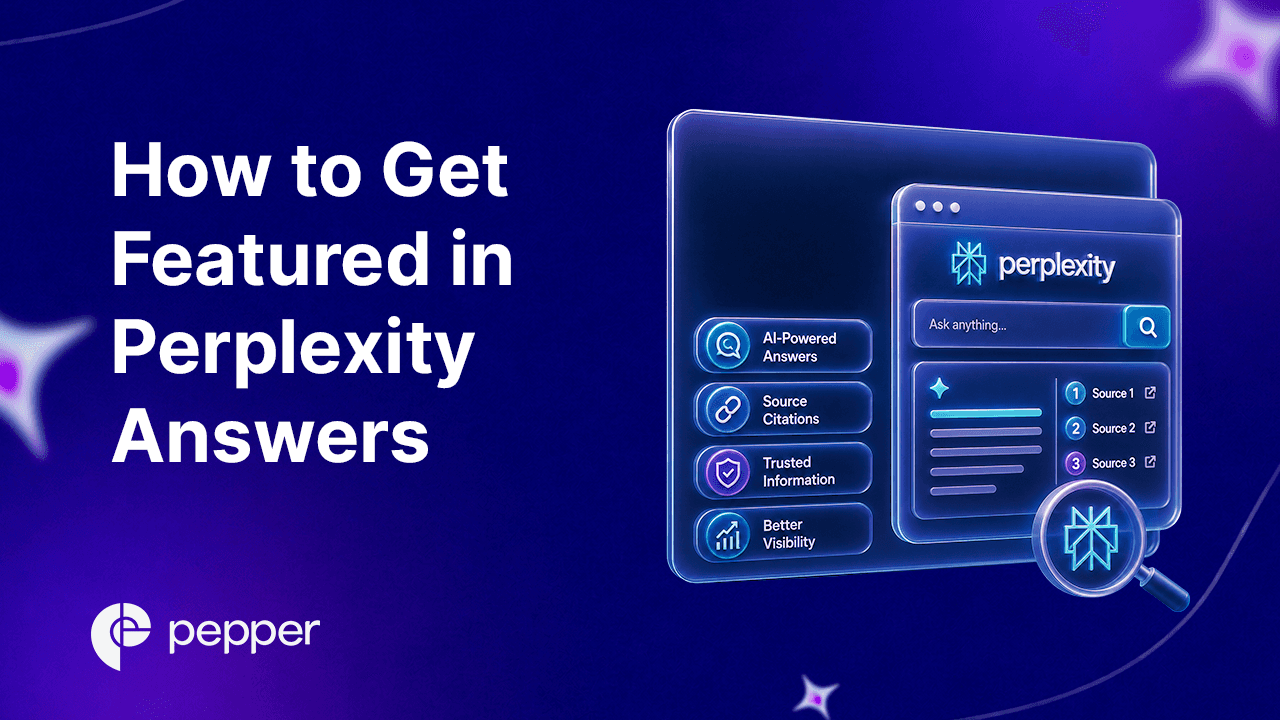
How to Get Featured in Perplexity Answers: The 2026 Operator’s Guide
By Anirudh Singla
Perplexity is no longer an interesting experiment at the edge of the search market. In May 2025, Perplexity processed 780 million search queries in a single month – up from 230 million in mid-2024, a tripling in under a year. Analyst projections now put the platform at 1.2 to 1.5 billion queries per month by mid-2026, with 35 to 45 million searches per day. In the United States, Perplexity already accounts for roughly one in five AI-search queries.
What makes Perplexity different – and what makes it the single most actionable AI-search surface for brands – is something simple: Perplexity cites. Every answer arrives with a numbered list of sources, clickable, with the domain visible. ChatGPT hides its citations. Google’s AI Overviews cite selectively. Perplexity treats citation as a first-class UX feature. When users click through, they stay – the average Perplexity referral session lasts 552 seconds, more than nine minutes per visit. That is the highest-quality traffic most brands will receive all year.
At Index’25, the world’s first AI-Search conference we hosted at Pepper, I put it plainly:
“Search is undergoing the most profound transformation of our time. Generative AI is redefining how people discover, trust, and engage with information – moving us from keywords and rankings to intelligence and context at scale.” – Anirudh Singla, Co-founder & CEO, Pepper Content (Index’25 keynote)
Perplexity is where that thesis has become most measurable, most quickly. What follows is a working guide to getting featured in Perplexity answers in 2026 – the platform’s explicit citation model, a three-step optimization playbook, an insights section with quotes from CMOs and marketing leaders, and a seven-point checklist you can run on any page this week.
Why Perplexity is the Most Actionable Platform for Brands
There are four AI-search surfaces that matter today: ChatGPT, Google’s AI Overviews, Gemini, and Perplexity. Of those four, Perplexity is the most actionable for brands for three reasons.
Citations are visible and clickable. ChatGPT’s citations are tucked behind tool calls; users rarely see them. Google AI Overviews show a handful of links in an expansion panel. Perplexity renders a numbered citation bar directly inside the answer, with the domain visible at every position. There is no second tier.
Citations travel with attribution. When users share Perplexity answers, the citations travel with them. For B2B and consideration-stage queries, this is a quiet distribution engine most marketing teams have not yet built for.
Referral traffic is unusually high intent. At roughly nine minutes per session, visitors arriving from Perplexity are far more engaged than average organic traffic. They come pre-qualified. The AI has already summarized your argument; they click because they want the full version.
Neil Patel, who keynoted Index’25, framed the opportunity this way:
“Be the source worth citing. Publish facts, stats, and expert insights that tools like ChatGPT and Perplexity can’t ignore.” – Neil Patel (Index’25)
That line is the whole strategy in one sentence. The next three sections operationalize it.
Step 1: Allow PerplexityBot (And Actually Verify It)
This is the step most teams skip or botch and it is the reason roughly two-thirds of enterprise sites are invisible to Perplexity right now.
The rule. If your robots.txt blocks PerplexityBot – or blocks the broader user-agents Perplexity uses for retrieval – you cannot be cited. The platform will not crawl you, will not index you, and will not surface you in any answer.
What to allow. Add explicit allowances for PerplexityBot and Perplexity-User in robots.txt. Some enterprise CDN configurations -especially Cloudflare’s “Block AI Bots” defaults – silently block these agents at the edge. Check your firewall rules, not just your robots.txt file.
Technical verification. Once allowed, query a page you control through Perplexity and inspect the cited sources. If other domains are being cited for queries your page should win, you likely have a rendering or latency problem. Perplexity retrieves pages in real-time during query processing; pages that take longer than three to four seconds to load may time out silently, returning no content to the model.
Render HTML, not JavaScript. Perplexity does not execute complex JavaScript. If your content lives inside a React or Vue shell with client-side rendering, move to server-side rendering (SSR) or static site generation (SSG). Pages that serve a fully-rendered HTML response on the first request are materially more likely to be cited.
Use semantic HTML. Wrap content in proper article, section, main, h2, h3, and strong tags. These elements are not cosmetic for Perplexity – they are how the retrieval model understands structure and hierarchy.
Step 2: Structure Content for Citation Triggers
Perplexity’s retrieval model has a preference profile. According to the platform’s February 2026 publisher guidelines, four signals carry disproportionate weight: structured data markup (a ~23% lift in citation weight), author entity recognition (a 15% preference for verified experts), source freshness, and citation diversity within the answer.
Four content patterns trigger Perplexity citations more reliably than any others.
Quotable definitions. Open every article with a 50–70 word, self-contained definition or answer to the primary query. This is the passage Perplexity is most likely to quote verbatim. Make it tight, factual, and written to survive without surrounding context.
Proprietary statistics. Content with original, first-party statistics is cited 3.2x more often than articles without unique data. Run your own study. Publish internal usage benchmarks. Share survey results. The moment you have a number that no other URL on the internet can provide, Perplexity has a reason to cite you specifically.
Author-attributed content. Perplexity’s citation engine rewards verified authorship. Add a clear byline, an author bio with credentials, Person schema in JSON-LD, and a link to the author’s LinkedIn profile. Verified experts receive a 15% citation preference over anonymous content covering the same topic.
Schema combinations. The highest-performing schema stack for Perplexity is Article schema + FAQPage schema + author markup. Pages with all three achieve an 89% higher citation probability than pages with no structured data. Implement in JSON-LD, validate with Google’s Rich Results Test, and make sure the markup matches the visible content.
Mandy Dhaliwal, CMO of Nutanix, made the operational point at Index’25: enterprise content functions are being re-architected around retrievability, not production volume. For Perplexity specifically, that translates directly – one well-structured, schema-rich, author-attributed article outperforms ten generic articles on the same topic, because the AI can only cite URLs it can parse, trust, and verify quickly.
Step 3: Build Authority on Perplexity-Favoured Domains
Here is the single most important data point for Perplexity optimization: Reddit accounts for 46.7% of Perplexity’s top-10 citations. No other AI search platform weights any single domain that heavily. ChatGPT favours Wikipedia. Google AI Overviews favour YouTube. Claude leans toward independent blogs. Perplexity, structurally, trusts community-verified, discussion-driven, real-user-voice content – and Reddit is the world’s largest instance of that.
The Perplexity-favoured domain hierarchy, ranked roughly by citation frequency:
1. Reddit. Subreddits relevant to your category. User voice. Real questions, real answers.
2. News and journalism sites. Tier-one publications with editorial standards.
3. LinkedIn. Particularly long-form LinkedIn posts from verified experts.
4. GitHub. For technical categories, READMEs and documentation.
5. Wikipedia. Baseline authority; often cited alongside a primary source.
6. Amazon. For product and comparative queries.
7. Coursera and similar education domains. For learning-intent queries.
8. Brand-owned content. Distant last – but citable when the domains above support it.
What this means in practice:
Engage authentically on Reddit. Not with promotional posts. With helpful, detailed, disclosed-affiliation answers in the subreddits where your customers ask questions. One expert-level comment from a verified account often earns more Perplexity visibility than a month of blog posts.
Pursue earned media aggressively. PR is not a nice-to-have for Perplexity – it is a primary input. Coverage in mid-tier and tier-one journalism outlets does more for your Perplexity citation rate than most on-site SEO. The insight from Index’25 was blunt: press mentions in trusted editorial sources are increasingly influencing AI search outcomes.
Build a real LinkedIn thought-leadership function. Long-form posts from verified executives and subject-matter experts are indexed and cited. Publish consistently. Keep credentials visible. Make the writing substantive rather than promotional.
Publish open-source assets on GitHub. For any technical category, maintained repos with clear READMEs get cited for how-to and troubleshooting queries.
Earn your way into Wikipedia. Not through self-edits, which are removed. Through earned notability – press coverage, third-party references – that makes your brand a candidate for a Wikipedia entry maintained by the community.
The CMOs at Index’25 were unified on this point: organizations winning Perplexity visibility are treating “AI search” as a cross-functional responsibility. It cannot live only inside SEO. PR, community, executive brand-building, and product documentation all feed the same retrieval layer.
Insights: What Marketing Leaders Are Saying About Perplexity
Angelique Bellmer Krembs, former CMO of PepsiCo, framed the shift at Index’25 as a return to brand primitives. In a world where AI summarizes everything, the brands that get summarized favourably are the ones with the clearest positioning and the most distinctive point of view. Generic content cannot be summarized distinctly. Commoditized messaging becomes invisible inside AI answers.
Sydney Sloan, former CMO of G2, argued that AI search has collapsed the distance between brand and demand. On Perplexity especially, because citations are clickable and users arrive high-intent, top-of-funnel awareness and bottom-of-funnel consideration happen in the same answer panel. The classic funnel compresses into a single citation.
Linda Caplinger, Head of SEO and AI Search at NVIDIA, emphasized that AI discovery rewards content that proves it has been lived – first-hand experience, original photography, real deployment data. On Perplexity, that shows up as a clear preference for URLs that carry attribution, credentials, and evidence.
And from my own conversations with CMOs across Pepper’s enterprise customer base, one operational insight recurs: Perplexity is the platform where measurement works. Because every citation is explicit and linkable, teams can build a Perplexity visibility dashboard within weeks and watch the impact of each optimization in near-real time. ChatGPT and Gemini visibility are still inferred. Perplexity visibility is observed.
Kishan Panpalia, part of Pepper’s founding team, summarized the era at Index’25:
“Once in a generation, technology doesn’t just improve – it changes the way we see the world. GEO is not just a buzzword, but a new rule book for brand discovery, trust, and selection in an AI-first marketplace.” – Kishan Panpalia, Pepper Content
Perplexity is the clearest expression of that rule book today.
The 7-Point Perplexity Optimization Checklist
Run every priority page through these seven checks. Pages that score 7/7 have the highest probability of being cited.
9. PerplexityBot allowed? Confirm robots.txt and CDN firewall rules permit PerplexityBot and Perplexity-User. Verify there is no silent block at the edge.
10. Server-rendered HTML, under 3 seconds? The page must return a fully-rendered HTML response in under three seconds. Client-side JavaScript content will not be retrieved.
11. 50–70 word definition block? The page opens with a concise, quote-ready answer to the primary query that a retrieval model can extract verbatim.
12. Original statistic or first-party data? At least one piece of information on the page exists nowhere else. This is the single strongest citation trigger.
13. Article + FAQPage + author (Person) schema in JSON-LD? All three present, validated, and matching the on-page content.
14. Verified author with credentials and LinkedIn entity? Named byline, author bio, credentials, linked LinkedIn profile. No “admin” or “team” bylines.
15. External signal stack: Reddit, earned media, LinkedIn thought leadership? Your topic or brand is being discussed, cited, or covered on at least one Perplexity-favoured domain beyond your own site.
A page scoring 7/7 is not guaranteed to be cited on day one. But over a 60 to 90 day window, as Perplexity re-indexes and the external signals compound, pages at that score are the ones that consistently appear in answers.
Why This Matters More Than the Raw Numbers
Perplexity’s 170 million monthly visits are significant. Its 85% retention rate and nine-minute average session are more significant. But the deepest reason to optimize for Perplexity in 2026 is strategic: this is where you learn how to be cited by AI, period.
Every practice that earns a Perplexity citation – fast HTML delivery, schema discipline, author verification, original data, external authority – is the same practice that will earn citations in ChatGPT, Gemini, and every AI search layer that follows. Perplexity is the proving ground. Get your pages to 7/7 here, and downstream visibility across the entire AI search surface compounds.
The brands that understand this are not chasing Perplexity as a tactic. They are using Perplexity as a mirror – a visible, measurable, explicit-citation model that teaches them what the AI era of search actually rewards. That mirror is the most valuable marketing asset most teams have access to right now.
Latest Blogs
Healthcare SEO advice has one dominant theme: this is YMYL, so build clinical authority. An analysis of 824,997 health citations shows that advice is correct and badly incomplete. Only 17.3 percent of citations go to authoritative medical sources. Three quarters go somewhere else entirely.
Gartner expects more than 40 percent of agentic AI projects to be cancelled by the end of 2027. In marketing the reason has a specific shape: the agent produces a finding, and a person still does all the work. Here is what separates the projects that survive.
A SERP is the page you get back after a search. That definition has not changed, but what sits on the page has changed almost completely. The most useful way to understand one in 2026 is that it is not a ranking you hold. It is a page that re-renders, and three in four top-10 positions change URL daily.
Get your hands on the latest news!

Similar Posts

GEO / AI Search
11 mins read
Healthcare SEO services: what actually moves patient acquisition in 2026
GEO / AI Search
12 mins read
Agentic AI in marketing: why most projects fail, and what a working one looks like
GEO / AI Search
10 mins read