SaaS SEO in 2026: the complete playbook and the best SaaS SEO agencies
SaaS SEO is the practice of growing a software company through organic search. It covers technical health, content, authority and now AI search visibility. The goal is qualified signups, not sessions.
We have run organic for more than 250 enterprises over eight years. Pepper started as a pure content play, and content is still the core of what we do. So the view below comes from doing this work, not from watching it.
Here is what changed. Buyers now build their shortlist inside AI answers, before they ever reach your site. That single shift breaks most SaaS SEO reporting, and it is why half this guide is about agencies and half is about the work itself.
Disclosure: Pepper is included on this list and published the guide, so we have placed ourselves in a separate category rather than ranking ourselves against agencies we do not directly compete with. We have also applied the same scrutiny to ourselves as to everyone else, including a “where it falls short” section. Every competitor description is based on that company’s own website as of 14 August 2026, rather than another roundup or secondary source. Where a company does not publish pricing, we have said so rather than estimating it.
Key takeaways
- AI answer engines now outrank vendor websites as a research source. Forrester surveyed 18,000 global business buyers in 2026. Generative AI use in the buying process rose from 89% in 2025 to 94% in 2026.
- Traffic can fall while your position improves. The same survey reports companies seeing 10% to 40% traffic declines as research moves into AI engines.
- Most citations are not yours. Muck Rack analysed more than 25 million cited links in May 2026. Earned media accounted for 84% of AI citations.
- Pick an agency for the job you actually have. Technical at scale, content and authority, or AI search visibility. Almost nobody is strong at all three.
- You may not need an agency yet. If you have fewer than roughly 30 target queries and one good in-house operator, spend the money on earned media instead.
What is SaaS SEO, and how is it different?
SaaS SEO is organic growth for a product with a free trial, a demo or a self-serve signup at the end of it. That end point changes everything upstream.
By comparison, ecommerce SEO sells a product page, and local SEO sells proximity. SaaS SEO sells a decision that takes months and involves several people. As a result, the work skews toward comparison content, integration pages, use-case pages and documentation, rather than toward high-volume informational posts.
Three things make it distinct. First, the buying committee is large, so you need content for the champion, the economic buyer and the security reviewer. Second, product-led content converts better than blog traffic, because it demonstrates rather than describes. Third, your competitors publish constantly, so authority compounds slowly and disappears quickly.
For the fuller framing, our guide to AI search for B2B covers how this plays out at enterprise scale.
Why did SaaS SEO change in 2026?
Because the research moved. Buyers used to search, click and compare. Now they ask an engine, read one answer and form a shortlist.
Forrester’s 2026 Buyers’ Journey Survey put numbers on it. Across 18,000 global business buyers, twice as many named AI as their most meaningful research source than named any other. AI answer engines now outrank vendor websites, product experts and direct sales contact.
More specifically, 55% compare vendors inside AI tools. In addition, 54% research products there, and 47% build the internal business case before contacting anyone.
Read that last number again. The business case gets written before you know the buyer exists.
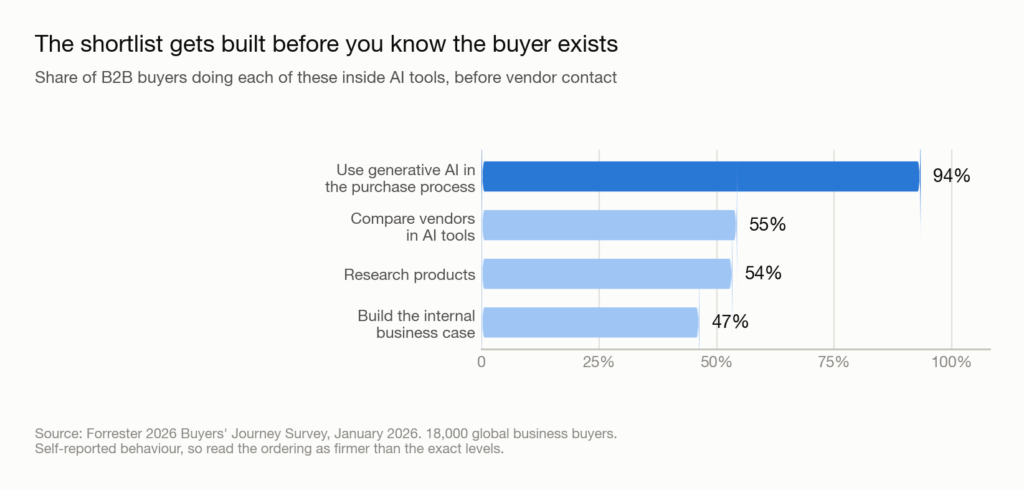
Meanwhile, the same research reports 10% to 40% traffic declines as this shift plays out. Consequently, a SaaS team watching sessions will conclude that organic is failing. Often the opposite is true. The answer is being resolved upstream, and nobody is measuring whether the brand appears in it.
This is the most common problem we get called into. A team reports flat traffic, pauses content, and six months later their category’s answers name three competitors instead of them.
The 2026 SaaS SEO playbook
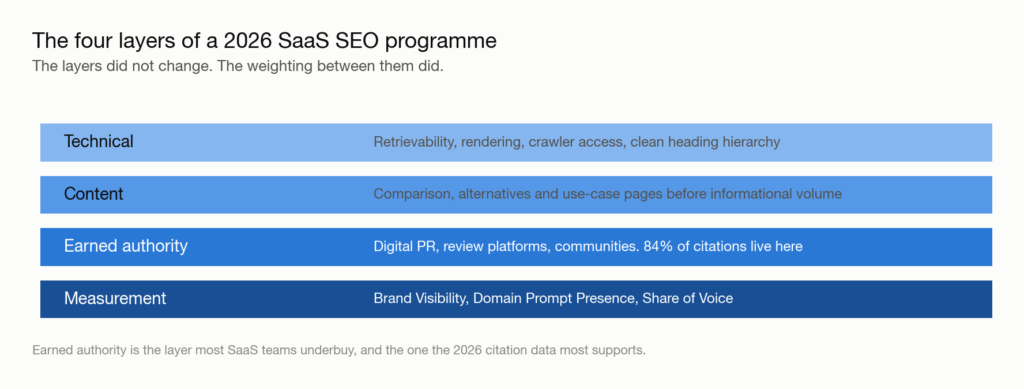
The work still has four layers. However, the weighting between them has changed.
Layer 1: technical and retrievability
First of all, your site has to be readable by crawlers that are not Googlebot. Therefore, check how you handle AI crawlers in robots.txt before anything else.
Key moves: server-side render anything you want cited, keep claims next to their evidence in the same block, and use clean heading hierarchy so a model can lift an answer. Furthermore, structured data helps machines resolve what your product actually is.
Layer 2: content that answers real questions
Volume stopped working. Specificity did not.
Therefore, build comparison pages, alternatives pages and use-case pages first, because those match how buyers actually search in a shortlist phase. Then support them with the definitional content that earns citations. Our guide to structuring content for AI citation covers the formatting that gets lifted.
Answer-led openings matter more than ever. Models extract from the top of a section, not the middle.
Layer 3: earned authority
This is the layer most SaaS teams underbuy, and it is where the evidence is strongest.
Muck Rack analysed more than 25 million links cited by ChatGPT, Claude and Gemini in May 2026, across 17 industries. Earned media accounted for 84% of AI citations. Paid and advertorial content accounted for 0.3%.
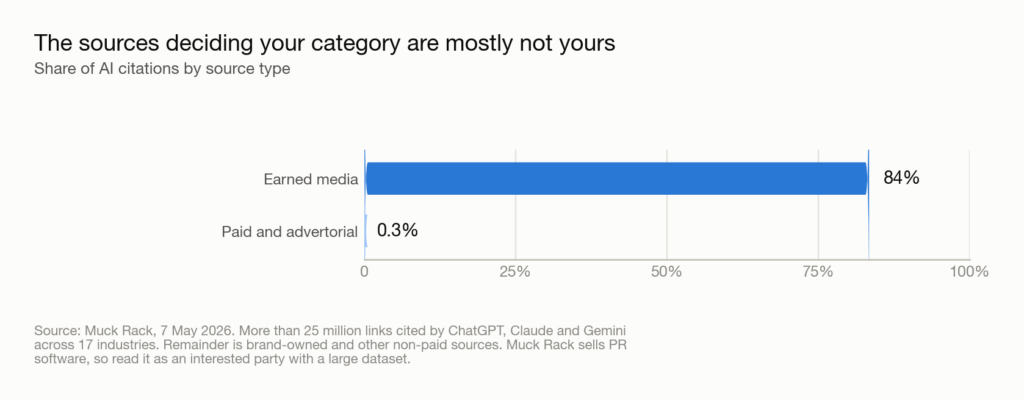
In other words, the sources deciding your category are mostly not yours. So the work is digital PR, review platforms, comparison sites, communities and expert content. You cannot publish your way out of this one.
Layer 4: measurement
Rankings and sessions no longer describe the outcome. Instead, track three things.
Brand Visibility is how often engines name you. Domain Prompt Presence is how often engines cite a page from your domain. Share of Voice is your slice of category mentions.
The gap between the first two is the diagnostic. If engines name you but never cite you, that is a citability problem. As a result, more blog posts will not fix it. We break the full model down in the Visibility, Citability and Retrievability framework.
Want to see where you stand before you hire anyone? Book a growth audit and we will run your category’s prompts and show you which sources are winning.
How we evaluated these SaaS SEO agencies
Above all, we weighted the criteria by how much each one changes the outcome. Then we published the weights, so you can disagree with them.

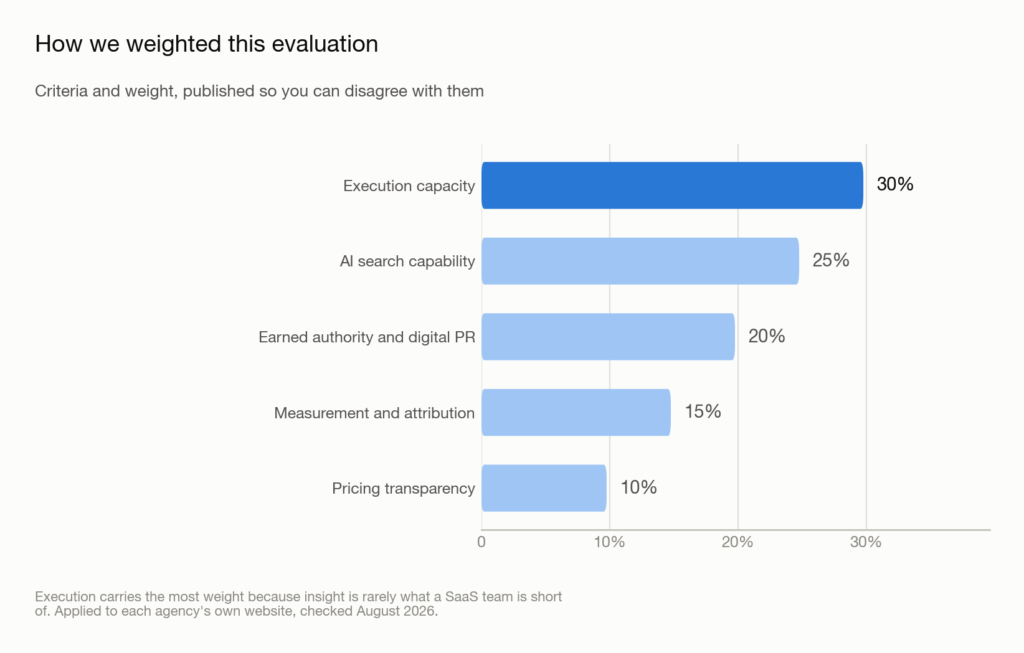
| Criterion | Weight | What a strong agency shows |
|---|---|---|
| Execution capacity | 30% | Ships technical fixes, content and placements, rather than handing over a backlog |
| AI search capability | 25% | Measures mentions and citations across engines, and can explain prompt selection |
| Earned authority and digital PR | 20% | Real placements in the sources your category is cited from |
| Measurement and attribution | 15% | Connects visibility to trials, demos and pipeline |
| Pricing transparency | 10% | Gives you a model or a floor early, instead of three discovery calls |
Execution carries the most weight, because insight is rarely what a SaaS team is short of. Hands are.
The best SaaS SEO agencies in 2026, at a glance
| Agency | Best for | AI search capability | Pricing model |
|---|---|---|---|
| Pepper (own category) | Organic run as one function, platform plus growth team | Core to the product, five engines tracked | Not published |
| MADX Digital | SaaS-only teams wanting pipeline and price clarity | Named GEO and AI search service | Published. $2,500 per pillar, $5,500 fully managed |
| Omniscient Digital | Established B2B SaaS, editorial depth | Content-led | From $10,000 per month |
| Skale | Tech and SaaS brands measuring SQLs and pipeline | AI search-first, GEO and AI brand mentions | Not published |
| Siege Media | Large-scale content plus digital PR | Repositioned around GEO | Not published |
| Grow and Convert | Conversion-first, bottom-of-funnel content | Named GEO frameworks | Not published |
| Minuttia | Established B2B SaaS, 60+ clients | AEO, agent analytics and Reddit | Not published |
| Animalz | Thought leadership and brand authority | AEO as a named service | Not published |
Two publish real numbers, and MADX publishes more detail than anyone else in this category. Keep that in mind when a proposal arrives.
The eight, in detail
1. Pepper, in its own category
We are an agentic organic growth engine, and we have been doing pure content work for eight years across more than 250 enterprises. That history matters here, because SaaS SEO is fundamentally a content and authority problem wearing a technical hat.
The product is genuinely two things at once. Customers log in and run it themselves: they set up a workspace, define competitors and personas, connect GA4 and Search Console, manage prompts and themes, and build their own agents in the Agent Atlas. In addition, a growth team is attached to the account and does the work alongside them. Agents give you scale, experts give you judgement, and one team owns the number.
Where we fall short: we do not publish pricing, so budget discovery is a conversation rather than a page. We are built for teams running organic as a long-term function, so a one-off technical audit is not what we are for. Our depth sits in content, authority and AI search rather than very large technical migrations, so raise that directly if it is your primary problem.
2. Omniscient Digital
Founded in 2019 and based in Austin, Omniscient works with established B2B SaaS companies and originated the Barbell Content Strategy. Their editorial quality is genuinely high, and they publish their own agency rankings with a disclosure that they rank themselves.
They publish a floor of $10,000 per month, which is more transparency than almost anyone else offers. Where they fall short: the model is content-led, so deep technical SEO at scale and AI search engineering are not the core strength.
3. Siege Media
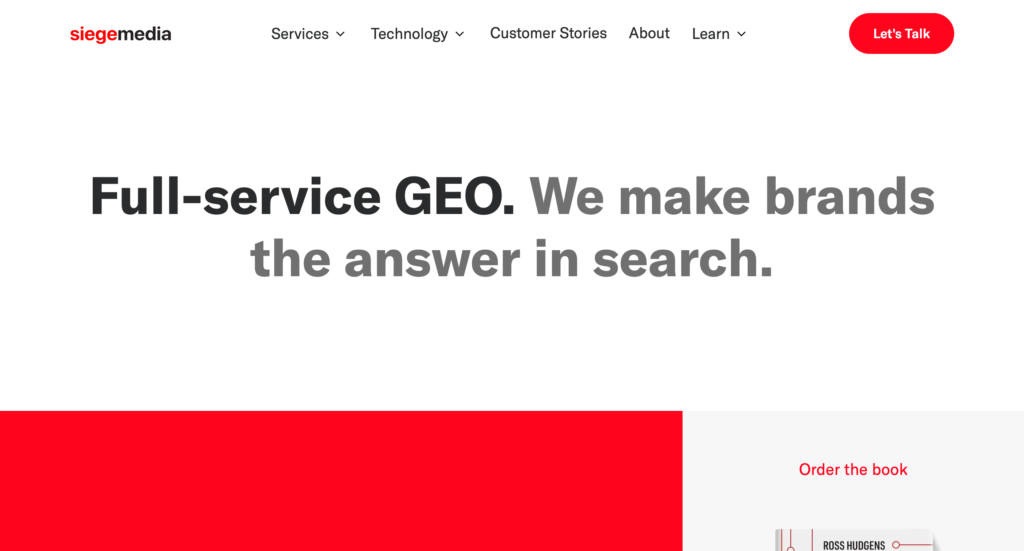
Siege now describes itself as a full-service GEO agency, with the promise to make brands the answer in search. Their scope runs from content strategy through content production and design into digital PR, Reddit marketing and research reports. Clients include Zapier, Zendesk, HubSpot and Asana.
That Reddit and research-report capability matters more than it used to, because those are sources engines lean on heavily. Where they fall short: the centre of gravity is content and PR, so a complex technical migration may need a second partner. They publish no pricing.
4. Skale
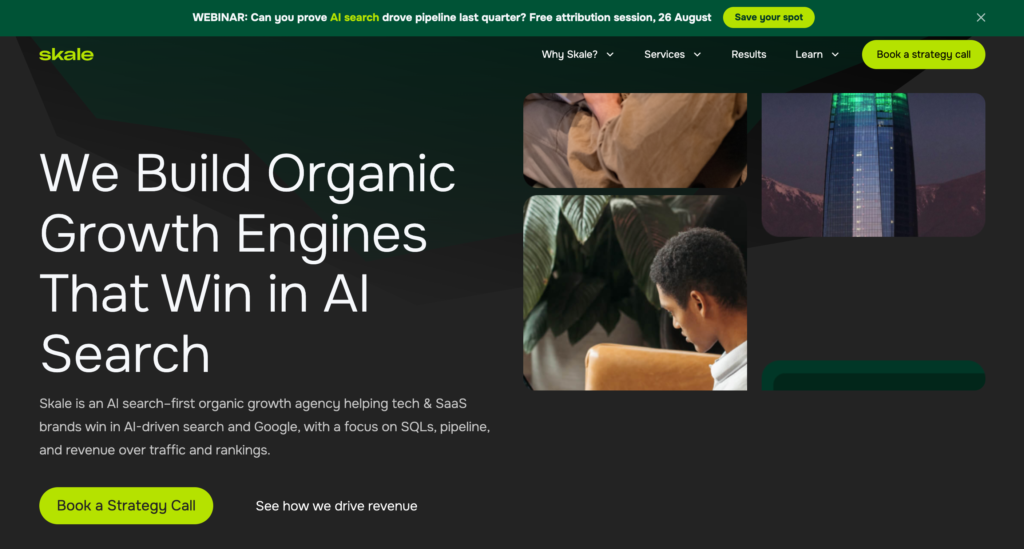
Similarly, Skale now describes itself as “an AI search-first organic growth agency” for tech and SaaS brands, with a stated focus on SQLs, pipeline and revenue rather than traffic and rankings. Generative Engine Optimization and AI Brand Mentions sit alongside SaaS SEO, link building and site migrations. Clients include G2, Wealthsimple, Maze and Lodgify.
For a team justifying spend to a board each quarter, that pipeline framing is genuinely useful. Where they fall short: the AI-search-first repositioning is recent, so ask what changed operationally rather than on the website. They publish no pricing.
5. Grow and Convert
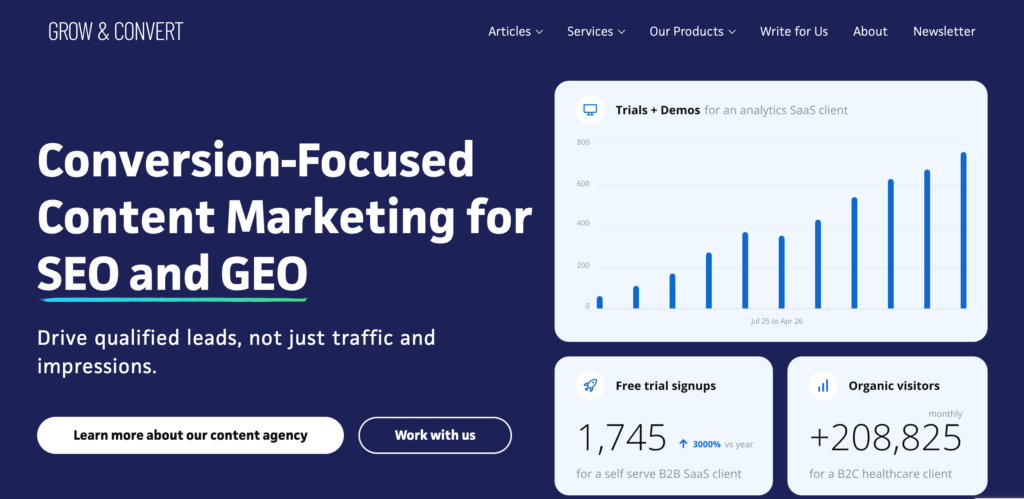
Grow and Convert built their reputation on Pain Point SEO, a bottom-of-funnel method they describe as proven across hundreds of clients. Their promise is qualified leads rather than traffic and impressions. They will happily tell you most SaaS content targets keywords that never convert, and usually they are right.
They now position as a “content-focused SEO and GEO agency”, with published frameworks called Prioritized GEO and Topic-Based GEO. Where they fall short: the conversion-first focus means less top-of-funnel authority work, so you may need a second motion for earned media. No published pricing.
6. Animalz
Meanwhile, Animalz calls itself “a content marketing and SEO agency for leading B2B SaaS brands”, built around intelligent content for compounding growth. Client logos include Atlassian, Amplitude, Airtable, Intercom and Google. Answer Engine Optimization now sits as a named service beside brand and authority work.
If your differentiation is a genuine point of view, they are a strong fit. Where they fall short: earned-media link acquisition is not the core offering, and thought leadership takes longer to show in pipeline than comparison content does. No published pricing.
7. MADX Digital
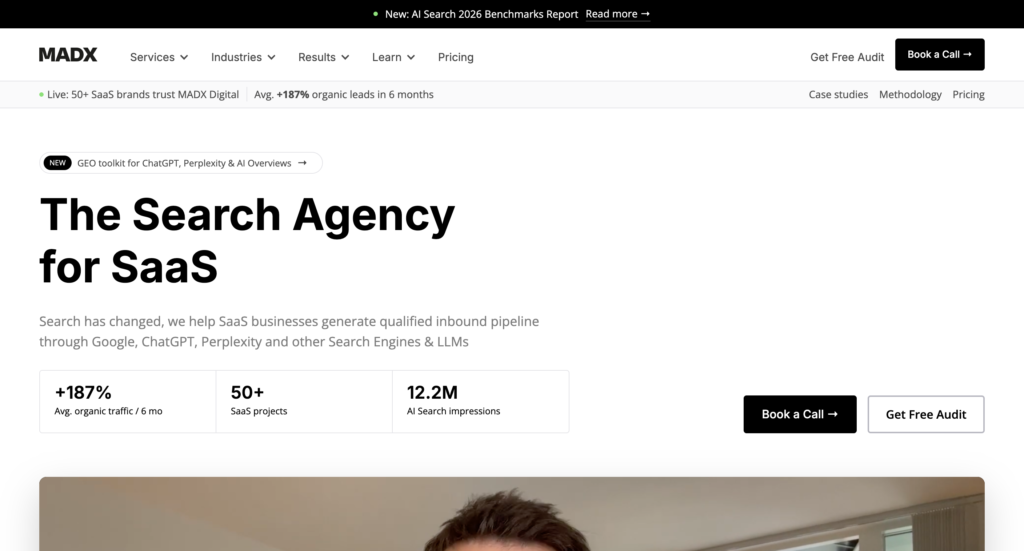
MADX calls itself “the search agency for SaaS” and says plainly: “we only work with SaaS, so we move fast.” Services cover GEO and AI search, traditional SEO, content strategy, digital PR and link building. Published results include Parcel Tracker at +13,400% organic traffic, MoonPay at +175%, and Postalytics reaching 80% AI search share of voice.
They also publish the most detailed pricing in this category. Single pillars run $2,500 per month each, a fully managed bundle is $5,500 per month, and a one-off AI Search and SEO Growth Plan is $4,500 over three to four weeks. Retainers carry a three-month initial term, then move to month by month.
Where they fall short: they are smaller than several firms here, so check throughput against your page count. In addition, a narrow single-pillar retainer may under-serve a programme that needs all three at once.
8. Minuttia
Minuttia works with established B2B SaaS brands and reports more than 60 clients, including Toggl, LearnWorlds and Moosend. Their framing is worth quoting: “SEO isn’t dying; it’s evolving. AEO isn’t replacing SEO; it’s expanding it.” Services span Google and AI search strategy, human and AI content creation, digital PR, Reddit marketing and agent analytics.
That Reddit and agent-analytics pairing is unusual and it matters, because those are surfaces engines lean on. Where they fall short: the focus on established brands means they are not built for early-stage SaaS. No published pricing.
What does a SaaS SEO agency cost?
In practice, most SaaS SEO retainers land between $5,000 and $30,000 per month. However, that range circulates between vendors rather than coming from a survey, so treat it as folklore with a basis in fact.
Two firms here publish real numbers. MADX lists single pillars at $2,500 per month, a fully managed bundle at $5,500, and a one-off growth plan at $4,500. Omniscient Digital publishes a $10,000 monthly floor. Everyone else, Pepper included, asks you to book a call.
Three things move the number. Site size and technical debt come first. Content volume comes second, and it is usually the largest line. Digital PR comes third, and it is the one most often cut when budgets tighten, which is unfortunate given where citations actually come from.
The cost nobody quotes is your own team’s time. Every recommendation-led engagement assumes someone internal implements. Therefore, an agency that surfaces 200 fixes nobody can action has added a backlog, not a capability.
Pepper does not publish pricing either, so we will not pretend to give you a number. What we will say is that the ratio matters more than the total. If you spend more on being told what to do than on doing it, the shape is wrong.
How to choose a SaaS SEO agency
Choosing well is less about finding the longest capability list and more about naming the job you actually have. Most bad engagements we inherit were scoped against a label rather than a problem.
One shift is worth reading first. Google’s official AI search guidance, published 15 May 2026, states that AEO and GEO are part of SEO from Google’s perspective. It confirms that AI Overviews and AI Mode run on core Search ranking systems, with no separate AI index. It also advises checking whether a provider’s advice aligns with official guidance.
Google is right, for Google. However, Google is one engine. ChatGPT, Perplexity and Claude retrieve differently, so a programme built only around Google’s guidance will be blind where much B2B research now happens.
The 100-point scorecard I would use
| Area | Weight | What a strong partner demonstrates |
|---|---|---|
| Execution capacity | 30% | Names who writes, who ships the technical fix and who pitches the placement, with real throughput on an account your size |
| AI search and citation capability | 25% | Tracks mentions, cited URLs, competitors and share of voice across a real prompt set, and shows raw answers rather than screenshots |
| Earned authority and digital PR | 20% | Has earned placements in the sources your category is cited from, and can name the ten to twenty that decide it |
| Measurement and attribution | 15% | Connects visibility to trials, demos and pipeline, and is honest about where attribution breaks |
| Pricing transparency | 10% | Gives a model, floor or range in the first conversation |
Ask them to show you this first
Give them 20 to 30 real commercial questions from your category. Then ask for a mini audit rather than a capabilities deck.
For example:
- “Best [your category] tools for B2B SaaS”
- “Best alternatives to [your closest competitor]”
- “Which [category] platform should I choose?”
- “How do I solve [your core problem]?”
Next, ask them to show you five things. Where does my brand appear today? Which competitors appear instead? Which sources influence those answers? Why are those sources winning? Finally, what exactly would you change in the next 90 days?
That conversation separates firms that have done this from firms that have read about it. It also reveals whether their answer is a content calendar or a real plan.
A serious partner will also tell you, unprompted, that AI answers are probabilistic. One query, run once, on one engine, proves nothing.
The weak playbook and the strong one
The weaker model looks like this: find keywords, publish posts, add FAQs, report rankings, hand the implementation problem back to you.
The stronger model looks like this: demand intelligence, then technical retrievability, then entity and brand authority, then content, then earned media, then distribution, then visibility measurement, then revenue attribution. Crucially, the agency owns delivery at each step.
That distinction matters because engines synthesise answers from many sources. Therefore, optimising only the pages you own competes for a fraction of what decides the result.
Red flags
Any agency guaranteeing rankings or AI citations should end the meeting. Google explicitly advises against guaranteed rankings, because third parties cannot access internal ranking systems.
I would also be cautious about these: the whole proposition is a dashboard, they optimise for ChatGPT only, they produce hundreds of AI-generated articles, they cannot explain prompt selection, they report citation counts without competitor share of voice, or they have no digital PR capability. One of those is survivable. Three together is a pattern.
Five questions that would decide it for me
- “Who does the work, and what is their throughput?” You want named roles and real capacity. If the answer is about strategy, delivery is still your problem.
- “Take one query where a competitor beats us. Explain why.” This separates people who understand retrieval from people reading a dashboard aloud.
- “What would you change in the first 90 days?” Look for technical, content and earned media, in sequence.
- “How do you prove this drove signups?” Measurement should reach trials, demos and pipeline, not stop at visibility.
- “Which part of your methodology will be obsolete in 12 months?” A thoughtful answer beats a confident one.
If I reduced the whole decision to one principle, it would be this. Hire for the job you have, not for the label the category uses.
One honest note that costs us something. The right partner needs execution capacity, AI search capability, earned authority and credible attribution. Very few firms are equally strong across all four, including us. The good ones will tell you which is their weakest, so ask.
What nobody should promise you
Guaranteed rankings or guaranteed AI citations. Nobody controls the ranking systems, and Google says so about its own.
A single AI visibility score. Composite numbers hide the diagnostic you need.
Results in one quarter. Organic compounds. Anyone promising a spike is describing paid.
Clean attribution from citation to closed revenue. It does not close cleanly yet. Corroborate with branded search and pipeline instead.
Frequently asked questions
What does a SaaS SEO agency do?
A SaaS SEO agency grows organic signups for software companies. The work spans technical health, comparison and use-case content, earned authority through digital PR, and now AI search visibility. Good ones measure trials and pipeline rather than sessions.
How much does a SaaS SEO agency cost?
Most retainers land between $5,000 and $30,000 per month, though that range circulates between vendors rather than a survey. MADX Digital publishes single pillars at $2,500 monthly and a bundle at $5,500. Omniscient Digital publishes a $10,000 floor. Most agencies, including Pepper, publish nothing.
Is SaaS SEO still worth it in 2026?
Yes, but the measurement changed. Forrester found 94% of B2B buyers now use generative AI during purchases, so visibility inside AI answers matters as much as rankings. Teams tracking only sessions will misread a working programme as a failing one.
What is the difference between SaaS SEO and regular SEO?
SaaS SEO targets a signup or demo rather than a purchase, and serves a buying committee rather than one person. Consequently, comparison pages, alternatives pages, integration pages and documentation matter far more than high-volume informational blog posts.
How long does SaaS SEO take to work?
Expect meaningful movement across two to three quarters. Technical fixes can land faster, but authority and citations compound slowly. Any agency promising material results within a single quarter is describing paid media.
Should we hire an agency or build in-house?
Build in-house if you have execution capacity and need deep product context. Hire an agency for surge capacity, digital PR, or skills you cannot recruit quickly. Most successful SaaS teams run a hybrid of both.
How do I measure SaaS SEO in AI search?
Track Brand Visibility, Domain Prompt Presence and Share of Voice across ChatGPT, Perplexity, Gemini, Claude and AI Overviews. The gap between the first two tells you whether your problem is awareness or citability, which need different fixes.
Do SaaS SEO agencies handle AI search visibility?
Some do and some do not, and the label will not tell you. Several agencies now describe themselves as GEO firms, while others make no AI search claims. Ask specifically which engines they measure and how they select prompts.
Where to go next
To begin with, name the job you have. Technical at scale, content and authority, or AI search visibility. Then test your shortlist against that one job.
If you already have an agency and the numbers look flat, run the diagnostic before you switch. Compare how often engines mention you against how often they cite your domain. If mentions are healthy and citations are not, changing SEO agencies will not fix it.
Want to see your category’s answers today? See where you show up across the engines your buyers actually use. Customers run this themselves in the platform, with a growth team attached to do the work alongside them.
For a worked example, our Acceldata case study documents 6X organic traffic growth and top-three keywords rising from 85 to more than 300. Our B2B SaaS work covers the vertical in more depth, and our GEO agency ranking methodology explains how we weight these evaluations.
Finally, one honest exit. If you have fewer than about 30 target queries and one strong in-house operator, you do not need an agency yet. Spend the money on earned media instead. We would rather say that now than sell you a retainer you resent in nine months.
Sources
Every study cited here was published in 2026.
- Forrester, 2026 Buyers’ Journey Survey, January 2026. 18,000 global business buyers. Forrester sells research subscriptions.
- Muck Rack, Earned media still drives 84% of AI citations, 7 May 2026. More than 25 million cited links across ChatGPT, Claude and Gemini, 17 industries. Muck Rack sells PR software.
- Google Search Central, AI features and your website, 15 May 2026.
- Agency descriptions and all pricing figures were taken from each company’s own website in August 2026, not from competing roundups. MADX pricing comes from their published pricing page.
Latest Blogs
Healthcare SEO advice has one dominant theme: this is YMYL, so build clinical authority. An analysis of 824,997 health citations shows that advice is correct and badly incomplete. Only 17.3 percent of citations go to authoritative medical sources. Three quarters go somewhere else entirely.
Three questions bring people here and only one of them has a clean answer. Profound no longer publishes prices. The $99 Starter and $399 Growth tiers that most comparison pages still quote, including one of ours, are gone from its pricing page, which now shows a free trial and a custom Enterprise tier. The trial is specified in detail and is genuinely useful: 50 prompts run daily for seven days across three engines, with unlimited seats. On reviews, the counts in circulation range from 140 to over 1,100, so we publish no rating at all.
On 3 August 2026 the IAB published the first industry standard for measuring AI visibility. It splits measurement into two tiers: Directional, which it says supports early signal detection but is unsuitable for budget decisions, and Decision-Grade, which requires rigour on query volume, sample size and reproducibility. We then checked what nine leading citation platforms publish about their own methods. Reproducibility is the requirement almost nobody meets, and our own earlier census of fourteen platforms found not one disclosing run-to-run variance.
Get your hands on the latest news!

Similar Posts
SEO
15 mins read
Primary and secondary keywords in 2026: what they were always for, and what changes now
Content Creation
11 mins read
What is a SERP? A complete guide to search engine results pages in 2026

SEO
15 mins read