Robots.txt for AI Crawlers: Your Website’s Guest List
Ever had someone show up at your house uninvited? Your website gets visitors like that too-except they’re robots. Specifically, AI robots that want to read everything on your site. A robots.txt file is how you tell them which rooms they can enter.
What is robots.txt? (The Simple Version)
Think of robots.txt as a set of house rules posted on your front door. When an AI crawler (a robot that collects information from websites) visits your site, it checks this file first to see what it’s allowed to read.
The file sits at your website’s main address-like putting a sign right at your front gate. If your site is mywebsite.com, the file lives at mywebsite.com/robots.txt. It’s just plain text. No fancy coding required.
Here’s the fun part: different robots have different names. GPTBot collects data for ChatGPT. ClaudeBot works for Claude. PerplexityBot and OAI-SearchBot each have their own jobs. You can give each one different instructions.
How Does robots.txt Work?
When a robot visits your website, it reads your robots.txt file before doing anything else. The file has two main parts:
First, you name the robot using a “User-agent” line. Then you add “Disallow” or “Allow” rules that tell it where it can and can’t go.
Here’s a simple example:
User-agent: GPTBot
Disallow: /private/
User-agent: ClaudeBot
Allow: /
This says: “Hey GPTBot, stay out of my /private/ folder. Hey ClaudeBot, you can look anywhere.” Each robot reads only the rules written for it.
The catch? Robots.txt is more like a polite request than a locked door. Well-behaved robots follow the rules. Rude ones might ignore them.
Why Does robots.txt Matter?
Having hundreds of AI robots crawl your site at once is like having too many people in your kitchen-things slow down. Robots.txt helps you avoid that traffic jam.
You might also have content you don’t want AI systems to learn from-maybe customer data, draft posts, or private documentation. Robots.txt tells AI crawlers to skip those areas.
Plus, you get to choose which AI systems can use your content. Want ChatGPT to see your blog but keep Perplexity out? Robots.txt makes that possible.
robots.txt for AI Crawlers at a Glance
| Feature | Details |
| File Location | Must be at website root: yoursite.com/robots.txt |
| File Type | Plain text (.txt) |
| GPTBot | OpenAI’s crawler for ChatGPT training |
| ClaudeBot | Anthropic’s crawler for Claude AI |
| PerplexityBot | Perplexity’s crawler for their AI search |
| OAI-SearchBot | OpenAI’s crawler for search features |
| Common Use | Block AI from training on your content |
Real-World Examples
A news website might block all AI crawlers from their paid articles section but allow them to read free content. Their robots.txt would list each AI bot and add Disallow: /premium/.
An e-commerce store could block AI from crawling their checkout pages (which wouldn’t help anyone anyway). They’d add Disallow: /checkout/ for each AI user-agent.
A blogger who wants ChatGPT to learn from their recipes but not Perplexity would allow GPTBot full access while blocking PerplexityBot completely.
FAQs
Q1: Do I need separate rules for each AI crawler?
Yes. Each AI bot has its own name (user-agent). If you want to block GPTBot, that won’t block ClaudeBot. You need to list each one separately with its own rules.
Q2: Can robots.txt completely prevent AI from using my content?
Not really. Robots.txt is a request, not a security measure. Polite crawlers follow it, but there’s no technical barrier stopping a bot from ignoring your file. Think of it as a “Please don’t” sign.
Q3: Where exactly do I put the robots.txt file?
Right in your website’s root folder-the main directory where your homepage lives. It must be accessible at yoursite.com/robots.txt (with nothing before “robots.txt”). Putting it anywhere else won’t work.
Q4: What happens if I don’t have a robots.txt file?
Crawlers assume everything is fair game. They’ll read your entire site unless you specifically tell them otherwise. Creating a robots.txt file gives you control over who accesses what.
Wrapping Up
Robots.txt for AI crawlers is your website’s bouncer. It won’t stop every unwanted visitor, but it helps you manage which AI systems can read your content. A few simple lines of text give you that control.
Latest Blogs
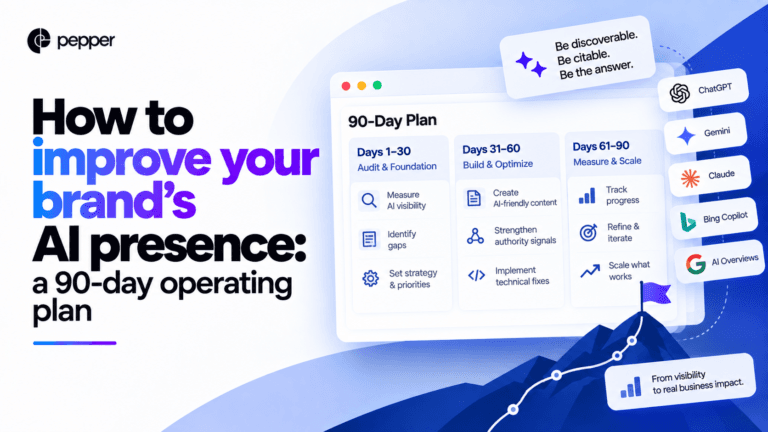
Most 90-day AI plans are sequenced by how hard the work feels rather than by how long it takes to land. So they spend week one on an llms.txt file that Google states it does not use, and they schedule earned media for phase three, which guarantees no result inside the quarter. This plan inverts that. It orders the work by lead time, starts the slowest thing on day one, and cuts four tactics Google explicitly says are unnecessary.
We priced this category nine days ago. Today we went back to the same four pricing pages to check the numbers before publishing. Three of the four had changed, and two had stopped publishing prices altogether. That is the real answer to what AEO costs in 2026: not a number, but a meter that moves, measured in prompts and responses and engines that are billed separately. Here is how each pricing model works, what unit it charges you for, and which incentive that unit creates.
Ask what AI search traffic is worth and you will be handed a multiplier. The ones in circulation right now run from 13% worse than organic search to 23 times better, a spread of roughly twenty-six fold on the single input your whole business case depends on. They disagree because they are measuring the same behaviour under different attribution models. So this is not a guide to finding the right multiplier. It is a guide to building a model whose assumptions are visible, and to being honest about the half you cannot prove.
Get your hands on the latest news!

Similar Posts
Artificial Intelligence
16 mins read
How to improve your brand’s AI presence: a 90-day operating plan

Artificial Intelligence
16 mins read
What does AEO cost in 2026? Pricing models explained

Artificial Intelligence
17 mins read