Healthcare SEO services: what actually moves patient acquisition in 2026

The short answer
Healthcare SEO advice has one dominant theme. This is YMYL, so build clinical authority. That advice is correct, and it is badly incomplete.
One analysis covered 824,997 citations from AI answers to non-branded US health questions, collected between mid-April and mid-July 2026. 17.3 percent went to authoritative medical sources. 75.4 percent went to commercial and platform domains.
Credentials are the entry ticket rather than the win condition. Three quarters of the citation pool sits in territory most healthcare SEO programmes never touch.
Key takeaways
- Healthcare is the most AI-exposed vertical there is. Aggregated 2026 measurements put AI Overview prevalence near 88 percent on healthcare queries. That is the highest of any sector.
- Clinical authority is necessary and insufficient. 17.3 percent of health citations go to authoritative medical sources. You need to be in that group. Being in it is not enough.
- The engines disagree sharply. ChatGPT sends 24.1 percent of its health citations to authoritative medical sources. Google’s AI Mode sends 15.1 percent.
- On social sources the gap is wider still. AI Overviews sends 8.5 percent of health citations to social content. Gemini sends 1.2 percent, roughly seven times less.
- No single domain dominates. The most-cited health source, PubMed Central, takes 4.08 percent. There is no first place to win here.
Where this comes from. We run organic for more than 250 enterprises at Pepper and track over 10 million prompts across every major engine. We have run healthcare at scale, including the programme described below. Clinician review time is the binding constraint here. Most of what follows is shaped around that fact, along with the client reviews we sit in every week.
What are healthcare SEO services?
Healthcare SEO services are the work of getting a practice or health brand found when patients search. In 2026 that means being cited in an AI answer rather than ranked tenth on a page.
Four things separate it from general SEO, and all four raise the cost.
- Every clinical claim needs a credentialed reviewer. A named author, a medically-reviewed-by line, a review date. This is the YMYL standard. It is also the biggest scheduling constraint on output.
- Compliance sits in the workflow rather than at the end. Patient privacy rules shape what you publish, which testimonials you use, and what your analytics may record.
- The queries are unusually AI-exposed. Healthcare sits near the top of every prevalence measurement. A programme chasing only blue links is optimising a shrinking surface.
- Trust signals carry more weight than in any other vertical. Engines are demonstrably more conservative on health. That is why the authoritative share runs as high as it does.
For the vendor comparison rather than the discipline, see our healthcare agency breakdown. For why this sector is the most exposed of any, see which industries GEO works for.
See where you show up. Pepper’s GEO platform tracks Brand Visibility, Domain Prompt Presence and Share of Voice across ChatGPT, Perplexity, Gemini, Claude and Google AI Overviews. Your team can log in, connect Search Console and GA4, manage the prompt set and run your own agents in the Agent Atlas. A growth team works the same account alongside you. Book a growth audit or see where you show up.
Where health citations actually go
This is the finding that should redirect most healthcare SEO budgets.
Read the bottom two bars together. Authoritative medical sources and social content take under a quarter of the pool between them. Everything else is commercial and platform territory, and that is where a practice can realistically compete.
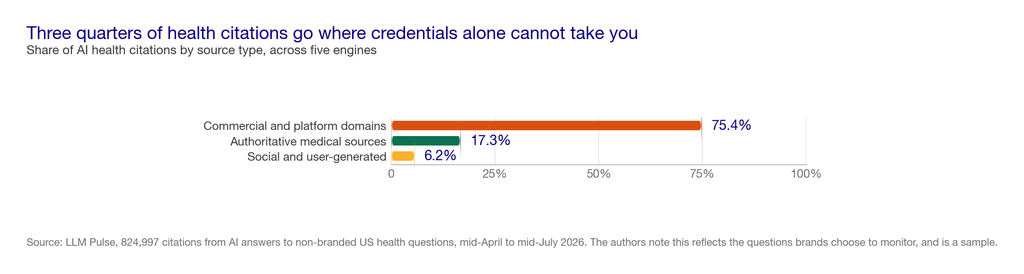
That does not mean credentials are optional. It means they qualify you rather than win for you. A page carrying a clinician byline and nothing else competes for a 17.3 percent slice against NIH, Mayo Clinic and PubMed Central. A page carrying the byline and a better answer to a specific patient question competes in the other three quarters.
On the concentration question. No single domain runs away with this. PubMed Central leads at 4.08 percent, then YouTube at 3.27 percent, Google.com at 3.16 percent and Reddit at 1.35 percent. There is no first place to win, which is unusually good news at practice scale.
Read the caveat with the finding. The authors state that the data reflects the health questions brands choose to monitor. It is a sample rather than a census. Pages owned by tracked brands were excluded, along with competitor citations at 0.3 percent. We treat the proportions as directional and the ordering as reliable.
The engines disagree, and it changes what you build
A single healthcare content plan cannot be optimal everywhere, and the spread is large enough to matter.
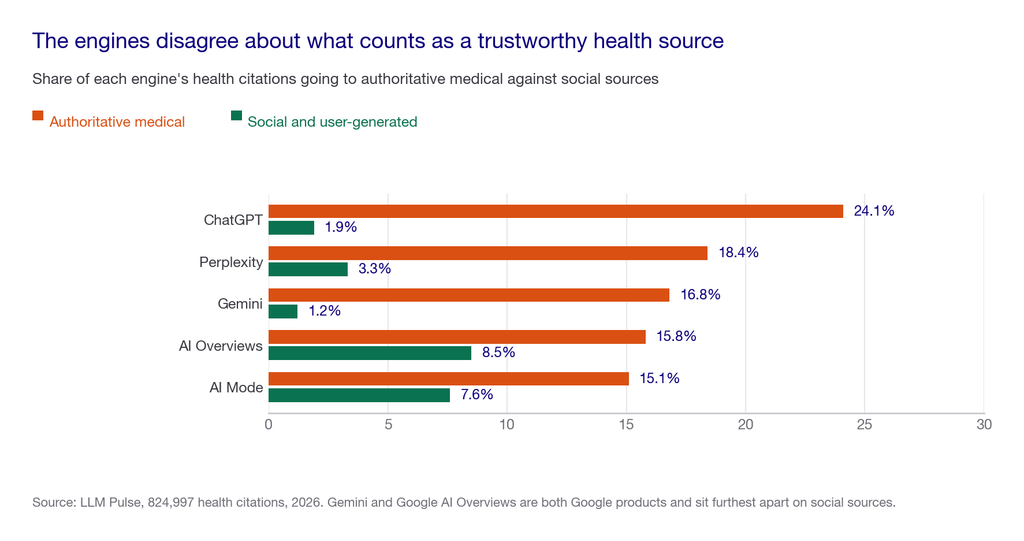
Two patterns are worth pulling out.
- ChatGPT is the most conservative on health. It routes 24.1 percent of health citations to authoritative medical sources and just 1.9 percent to social content. If your patients research there, clinical credibility matters more for you than the pooled average suggests.
- Google’s surfaces are the most socially permissive. AI Overviews sends 8.5 percent to social content, and AI Mode 7.6 percent. Gemini sends 1.2 percent. That is the widest internal disagreement between two Google products in the dataset.
That last point is the practical one. Community presence, forums and video do almost nothing for ChatGPT health citations. On Google’s AI surfaces they matter. Which engines your patients use should decide whether you fund that work at all, and we covered the video half in the YouTube citation data.
What this looked like at enterprise scale
Apollo 24/7 is the largest healthcare programme we have published, and its shape reflects everything above.
The work was built on credentialed authorship rather than volume. It ran to 400 doctor-authored blogs, 200 expert-authored articles and more than 100 YouTube videos. Over two years it produced 700 percent organic traffic growth and a 177 percent increase in revenue attributed to organic search, with video reach up 16x.
The constraint was never writing capacity. It was doctor review time. The programme was sequenced around clinician availability rather than a content calendar.
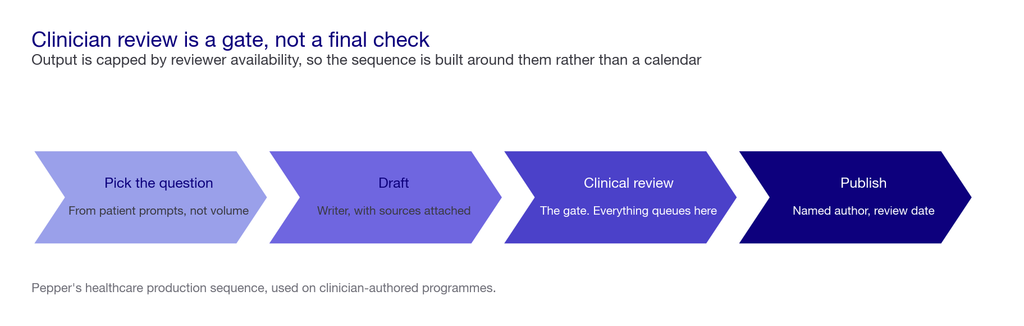
Where this evidence fits. One account, published on our own case study page, and not a controlled study. It ran at enterprise scale rather than practice scale. A single-location practice should read the shape of the programme rather than the size of the numbers.
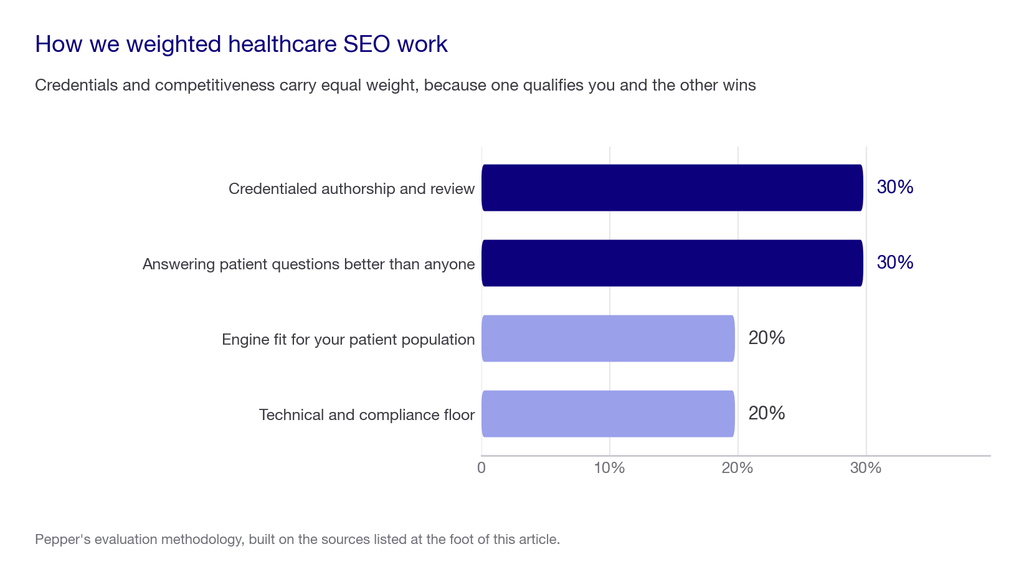
Our methodology: how we weighted healthcare SEO work
| Lever | Weight | Why it carries this much |
|---|---|---|
| Credentialed authorship and review | 30% | The YMYL entry condition. Nothing else counts without it, and it gates throughput |
| Answering specific patient questions better than anyone | 30% | Where the other three quarters of the citation pool sits |
| Engine fit for your patient population | 20% | The authoritative share runs from 24.1% to 15.1% depending on the engine |
| Technical and compliance floor | 20% | Indexable, crawlable, and privacy-compliant in what it publishes and records |
Healthcare SEO services at a glance
| Service | What it actually delivers | Typical 2026 cost | Who it suits | Where it falls short |
|---|---|---|---|---|
| Technical and compliance audit | Indexable, crawlable, privacy-safe analytics | Free to run yourself, or a project fee | Everyone, first | A gate rather than a lever. It wins nothing on its own |
| Clinician-reviewed content | The YMYL entry ticket, and depth on patient questions | The main line item, gated by reviewer time | Anyone publishing clinical claims | Slow by design, and reviewer availability caps output |
| Local and practice listings | Proximity-driven discovery for a physical practice | Low, largely internal time | Single-site and multi-site practices | Barely touches AI citation, which is a different surface |
| Review platform presence | Trust signals patients and engines both read | Time, plus platform fees in some categories | Practices competing on choice | Buying reviews is detectable and damaging |
| AI visibility tracking | Whether engines name and cite you, per engine | Roughly $99 to $400 a month | Anyone past the technical floor | Diagnoses, never fixes |
| Platform plus a growth team | Tracking, plus the people doing the work it points at | Custom | Health brands without internal capacity | Still gated by your clinicians’ review time |
—
How to choose a healthcare SEO provider
This discipline is unusually easy to sell badly, because compliance language sounds like expertise.
The scorecard
Score a provider out of 100.
| Factor | Weight | How to score it honestly |
|---|---|---|
| They ask who reviews clinical claims | 25% | The question comes up in the first conversation, before scope or price |
| They measured your AI exposure | 25% | Someone ran your patient questions and counted how many returned an AI answer |
| They separate credentials from competitiveness | 20% | They can explain why a clinician byline qualifies you rather than wins for you |
| They know which engines your patients use | 20% | The plan differs for a ChatGPT-heavy population and a Google-heavy one |
| They understand your privacy constraints | 10% | They raise analytics and testimonial limits without being prompted |
The live test, over 90 days
Fix 30 prompts in your patients’ words. Real questions, such as “how long is recovery after knee replacement”, “best paediatric clinic near me”, “is a mole that changed colour serious” and “what does a high A1C mean”.
Run them across Google, ChatGPT and Perplexity. Record whether you are named, whether a page of yours is cited, and which sources appeared instead.
Rerun the identical set monthly for 90 days. Three readings is the shortest honest window. One is a snapshot, two could be noise, three shows direction. Keep the set fixed, because changing it resets the comparison. The free method is in how to measure AI search visibility without expensive tools.
Read the third column against the split above. If NIH and Mayo Clinic fill your results, you are fighting for the 17.3 percent, and that is hard. If commercial domains fill them, you are looking at the winnable three quarters.
Weak approach versus strong approach
The weaker approach: add clinician bylines to existing pages, publish a monthly medical blog, then expect authority to become citations. It earns a ticket into the smallest slice of the pool.
The stronger approach: keep the bylines, then compete where the volume is. Answer specific patient questions in more useful detail than the commercial sites currently filling those answers.
The weak version optimises for looking credible. The strong version optimises for being the most useful answer to a question a patient actually typed.
Red flags
- Guaranteed rankings or citations. Nobody controls generated output, and Google warns against providers guaranteeing rankings.
- No question about clinical review. In YMYL, that omission tells you everything.
- One plan for all engines. The authoritative share ranges from 24.1 percent to 15.1 percent depending on where you look.
- Patient testimonials used without privacy sign-off. A compliance problem dressed as a trust signal.
- Buying reviews. Detectable, damaging, and it poisons the exact signal patients rely on.
- Volume pricing on clinical content. Output is capped by reviewer time, so per-article pricing usually means somebody is skipping review.
Five questions worth asking
- “Who reviews the clinical claims, and what are their credentials?” If this is vague, stop.
- “What is our measured AI exposure on our own patient questions?” Not the sector average.
- “Which sources appear instead of us today?” That tells you whether you are fighting NIH or a commercial site.
- “Which engines do our patients use?” It changes the plan materially.
- “What would you tell us not to publish?” A good partner declines work that cannot pass review.
Reduced to one principle: earn the credentials, then compete where the volume actually is.
One closing note that costs us something. Clinician-reviewed content is slow, capped by people who are not marketers, and far less profitable than volume content. Agencies prefer throughput, ours included. A provider promising high monthly output on clinical topics is either skipping review or writing around the clinical parts.
What does healthcare SEO cost?
| What you are buying | Typical 2026 cost | What it covers |
|---|---|---|
| Measuring your own AI exposure | Free, an afternoon | Thirty patient questions across three engines |
| Technical and compliance floor | Free to run, project fee to fix | Indexable, crawlable, privacy-safe |
| Clinician review time | The binding constraint, and usually internal | The YMYL entry ticket |
| Patient-question content depth | The main external line item | Where three quarters of citations sit |
| Review platform and listings work | Low, largely internal time | Trust signals and local discovery |
| AI visibility tracking | Roughly $99 to $400 a month | Named and cited, tracked per engine |
| Platform plus a growth team | Custom | Pepper: tracking, plus the people and agents doing the work |
The first row is free, and in healthcare it is the one that tells you whether you are fighting institutions or commercial sites.
What nobody should promise you
A guaranteed citation or ranking on health queries. Nobody controls generated output, and health is the category where engines are most conservative.
That clinical credentials alone will earn citations. They qualify you for 17.3 percent of the pool.
A single plan that works across all engines. The authoritative share varies by nine points between ChatGPT and AI Mode.
High monthly output on clinical content. Throughput is capped by reviewer availability, not by writing capacity.
When to fix something else first
The answer that costs us the sale. If you run a single-location practice and your patients find you by proximity, you do not need AI visibility work yet. We would tell you not to buy it.
Local services show AI answers on a small minority of queries. Maps, reviews and proximity still decide most of that market. Get your listings, hours and reviews right first, which is largely free. Come back to this once you compete on a condition or procedure rather than a postcode. That is when the AI surface starts deciding who patients call.
Frequently asked questions
What do healthcare SEO services include?
Technical and compliance groundwork, clinician-reviewed content, local listings and review presence, and AI visibility tracking. The distinguishing feature is that every clinical claim needs a credentialed reviewer. That caps how fast the content half can move.
Do medical credentials guarantee AI citations?
No. Across 824,997 health citations, only 17.3 percent went to authoritative medical sources. 75.4 percent went to commercial and platform domains, so credentials qualify you rather than win for you.
Which AI engine matters most for healthcare?
It depends on your patients, and the engines differ sharply. ChatGPT routes 24.1 percent of health citations to authoritative medical sources, against 15.1 percent for Google AI Mode. The same content earns different returns on each.
How exposed is healthcare to AI search?
More than any other sector. Aggregated 2026 measurements put AI Overview prevalence near 88 percent on healthcare queries. A programme built only around blue links is optimising a shrinking surface.
Which health sources do AI engines cite most?
PubMed Central leads at 4.08 percent, then YouTube at 3.27 percent, Google.com at 3.16 percent and Reddit at 1.35 percent. No domain dominates. That gives smaller practices more room than a ranked list suggests.
Does YMYL still apply in AI search?
Yes, and it shows in the data. Health is the category where engines lean hardest on credentialed sources. Named authors, review lines and review dates remain the entry condition for clinical pages.
How long does healthcare SEO take to work?
Plan on three monthly readings of a fixed prompt set before judging direction, so roughly 90 days for a signal. The content half runs slower than other sectors, because clinician review sets the pace rather than writing.
Should a small practice invest in AI visibility?
Only after the basics. If patients find you by proximity, listings and reviews matter more. AI visibility becomes the priority once you compete on a condition or procedure rather than on location.
Where to go next
Take thirty questions your patients ask and run them across Google, ChatGPT and Perplexity. Write down which sources appear instead of you.
If those results are full of NIH and Mayo Clinic, you are fighting for the 17.3 percent. If they are full of commercial sites, you are looking at the winnable majority. That changes what you should commission.
Learn AI Search · Compare healthcare GEO agencies · Book a growth audit
Sources and further reading
- LLM Pulse. Analysis of 824,997 citations from AI responses to generic, non-branded US health questions, collected between mid-April and mid-July 2026 across ChatGPT, Google AI Mode, Google AI Overviews, Gemini and Perplexity. Source type split: authoritative medical 17.3 percent, social and user-generated 6.2 percent, commercial and platform 75.4 percent. By engine, authoritative medical share: ChatGPT 24.1 percent, Perplexity 18.4 percent, Gemini 16.8 percent, AI Overviews 15.8 percent, AI Mode 15.1 percent. Social and user-generated share: AI Overviews 8.5 percent, AI Mode 7.6 percent, Perplexity 3.3 percent, ChatGPT 1.9 percent, Gemini 1.2 percent. Top domains: PubMed Central 4.08 percent with 33,669 citations, YouTube 3.27 percent, Google.com 3.16 percent, Reddit 1.35 percent. Pages owned by tracked brands were excluded, along with competitor citations at 0.3 percent. The authors state the data reflects the health questions brands choose to monitor and is a sample rather than a census. Link
- AI Overview prevalence by industry, Q1 2026 benchmarks, aggregating seven measurement datasets. Source of the healthcare figure near 88 percent, the highest of any vertical measured. The datasets disagree with each other, so the ordering is more reliable than any single percentage. Link
- Google Search Central. AI search optimisation guidance, 15 May 2026. Confirms AI Overviews and AI Mode run on core Search ranking and quality systems, and warns against providers guaranteeing rankings.
- Pepper. Apollo 24/7 case study. Figures as published on the page.
- Pepper. GEO agencies for healthcare for the vendor comparison, E-E-A-T in AI search for how engines judge credibility, and the free AI visibility audit for the technical floor.
- Deliberately excluded: the widely repeated claims that Google processes roughly 70,000 health searches a minute and that more than 40 million people ask AI health questions daily. Neither traces to a current primary source with a stated method.
Latest Blogs
Choosing a GEO agency for mid-market B2B used to be a shortlisting problem. It is now a procurement problem, because the published prices have largely gone. Of four agencies publishing a GEO-specific figure in September 2026, two had withdrawn their pricing pages by early October and one had moved domains. Exactly one still publishes a number a mid-market buyer can act on. So the useful question is no longer which agency is best in the abstract, but how to compare three quotes when only one of them arrived with a method attached.
Third-party sources and AI citations are tightly linked, and the link stops short of where most plans assume. Off-page work decides whether an engine retrieves and cites you. It does not decide whether the answer names you, and 61.7% of brand appearances are citations with no name attached. The two largest 2026 datasets also disagree about how much of the citation surface is third-party at all, one saying 84% and the other putting the brand bucket above half. That disagreement is definitional rather than factual, and it decides where a budget goes.
Why is my competitor showing up in ChatGPT and not me? Before accepting the premise, check it. Across 3,981 brand appearances studied in 2026, 61.7% were citations with no brand name in the answer and only 13.2% produced both. So there are three states that look identical from where you are sitting: genuinely absent, present as an unnamed source, and named less often than a rival. Each has a different cause and a different fix, and working on the wrong one is the most common way this gets expensive.
Get your hands on the latest news!