E-E-A-T in the age of AI search: how engines decide which brands to trust
The short answer
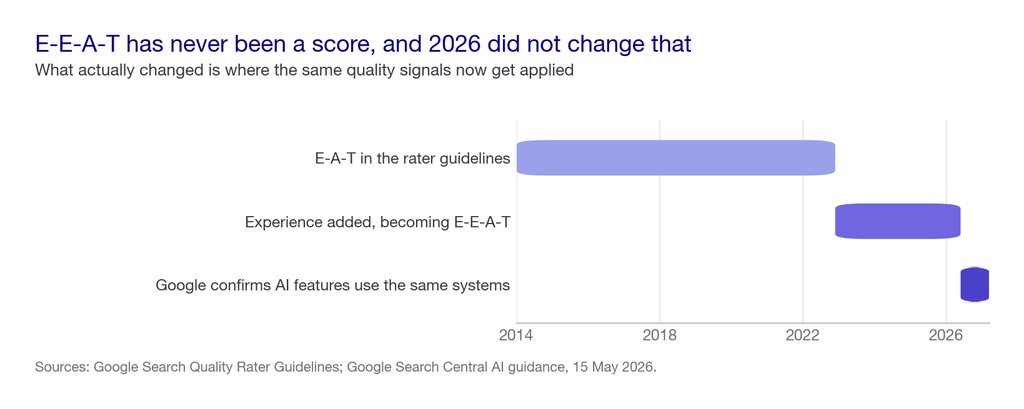
E-E-A-T stands for Experience, Expertise, Authoritativeness and Trustworthiness. It describes what Google’s human quality raters are asked to assess. It has never been a score in the algorithm.
That distinction matters more now, not less. When an engine gives one answer instead of ten links, it has to commit to whose sentence it repeats. And it makes that commitment on evidence you mostly do not host.
Key takeaways
- E-E-A-T is not a ranking factor and never was. Nobody can raise your E-E-A-T score, because there is no such score. Treat any vendor selling one as disqualified.
- The signals behind it are real and measurable. Named credentialed authorship, consistent entity description and third-party corroboration all move whether an engine will quote you.
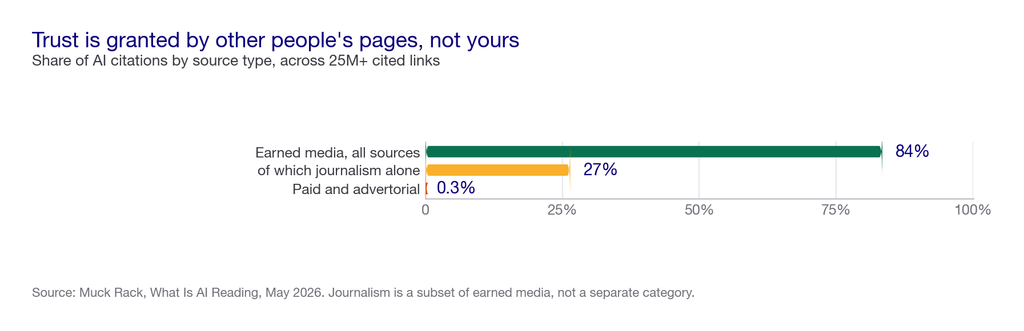
- 84 percent of AI citations come from earned media, and paid or advertorial content accounts for 0.3 percent. Trust is granted by other people’s pages, not yours.
- Google confirmed in May 2026 that AI Overviews and AI Mode run on core Search ranking and quality systems, with no separate AI index. So the trust work you already do compounds into AI answers.
- Pepper measures this as three numbers, not one: Brand Visibility, Domain Prompt Presence and Share of Voice, tracked per engine.
Where this comes from. We run organic for more than 250 enterprises at Pepper and track over 10 million prompts across every major engine. The signals below are the ones we watch move on real accounts, and the ones we can point to a client result for. Where we think the standard advice is wrong, we say so plainly.
What is E-E-A-T?
E-E-A-T is the framework in Google’s Search Quality Rater Guidelines describing how a human evaluator should judge a page. Four parts:
- Experience. Has the author actually done the thing? First-hand use, first-hand treatment, first-hand deployment. This is the newest of the four, added in December 2022 when E-A-T became E-E-A-T. It is also the one most B2B content fails outright.
- Expertise. Does the author have genuine subject knowledge, ideally a credential a stranger can check? For a health page that means a clinician. For a security page it means someone who has run a SOC, not a copywriter who interviewed one.
- Authoritativeness. Is the site, and the author, recognised by others as a go-to source on this subject? This one is explicitly about reputation held by third parties. Which is why it cannot be self-declared.
- Trustworthiness. Is the page accurate, honest, safe and transparent about who is behind it? Google describes this as the most important of the four. It is also the one that collapses fastest when a single number turns out to be wrong.
The critical thing to understand is what E-E-A-T is not. It is not a metric, not a score, and not a dial in the ranking system. Raters use it to evaluate whether search results are good, and those evaluations tune the systems over time. There is nothing to optimise directly.
See where you show up. Pepper’s GEO platform tracks Brand Visibility, Domain Prompt Presence and Share of Voice across ChatGPT, Perplexity, Gemini, Claude and Google AI Overviews. Your team can log in, connect Search Console and GA4, manage the prompt set and run your own agents in the Agent Atlas. A growth team works the same account alongside you. Book a growth audit or see where you show up.
So how do AI engines actually decide which brands to recommend?
This is the question underneath the keyword, and it has a more concrete answer than most E-E-A-T articles give.
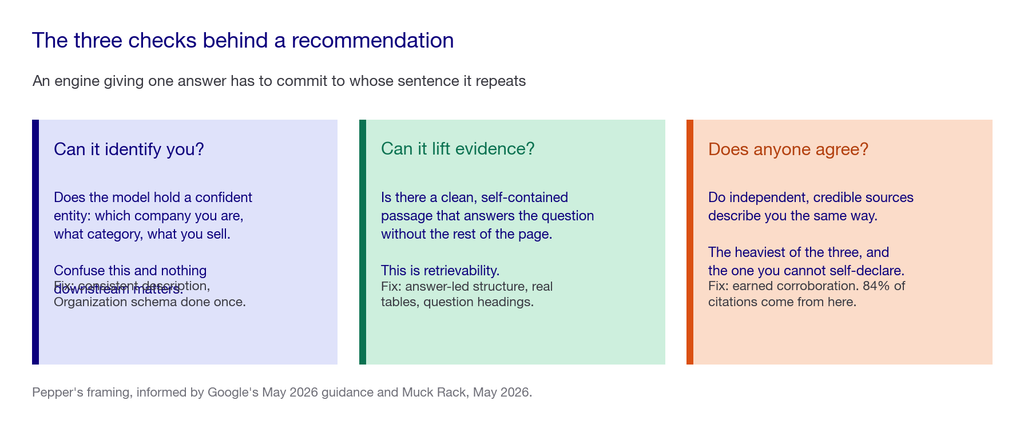
An engine composing an answer runs three checks, roughly in this order:
- Can it identify you at all? The model needs a confident entity: which company you are, what category you sit in, what you sell. Confuse it with a similarly named business and nothing downstream matters. We covered the fix in entity optimization and LLM brand recognition.
- Can it find evidence it can lift? A clean, self-contained passage that answers the question without requiring the rest of the page. This is retrievability, and it is why a well-structured page beats a better-written one that buries its answer in paragraph nine. The mechanics are in how to structure content for AI citation.
- Does anyone independent agree? The corroboration check, and the one that carries the most weight. If four credible third parties describe your category position the same way, you become the safe answer. If nobody does, the model reaches for someone else. Working those sources is its own discipline, covered in LLM seeding and the LLM trust hierarchy.
Google’s May 2026 guidance closes off a common escape route here. There is no separate AI index and no separate AI ranking algorithm. AI Overviews and AI Mode run on the core Search ranking and quality systems. So you cannot bypass the trust work with an AI-specific tactic. Equally, the trust work you already do carries into AI answers rather than being wasted.
The evidence, and where trust actually comes from
Here is the number that reorganises the whole discussion.
Muck Rack analysed more than 25 million cited links across ChatGPT, Claude and Gemini in May 2026. Earned media accounted for 84 percent of AI citations. Journalism alone made up 27 percent. Paid and advertorial content accounted for 0.3 percent.
Read the last figure twice. You cannot buy your way into an AI answer. The channel that works for demand capture is almost entirely absent from the surface where the recommendation gets made.
That is E-E-A-T’s Authoritativeness leg expressed as measurable behaviour: reputation held by other people, weighted heavily, and not purchasable.
Why this matters commercially
Because the buying decision has moved onto the surface where paid does not reach.
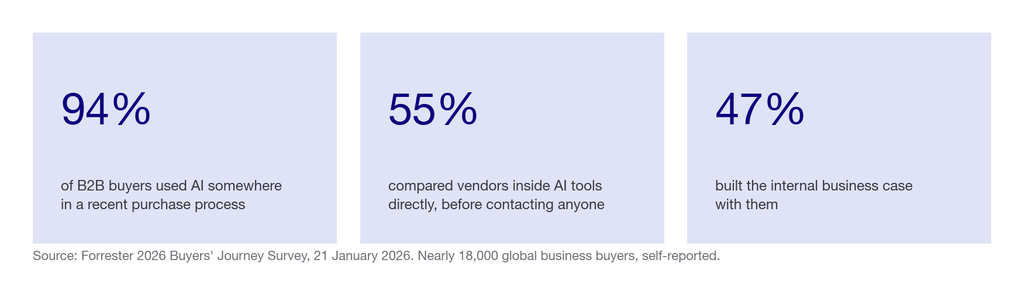
Forrester’s 2026 Buyers’ Journey Survey, published 21 January 2026 and covering nearly 18,000 global business buyers, found that:
- 94 percent used AI somewhere in a recent purchase process.
- 55 percent compared vendors inside AI tools directly.
- 54 percent researched products there.
- 47 percent built the internal business case with them.
Self-reported behaviour, so read the ordering as firmer than the exact levels. The direction is unambiguous: the shortlist is now often assembled before anyone contacts you, in a place that cites earned sources 84 percent of the time and paid ones 0.3 percent of the time.

How Pepper works these signals, with results
We measure trust as three separate numbers rather than one composite, because they fail differently and need different fixes:
- Brand Visibility. How often engines mention your brand by name. Low means you are absent from the answer entirely, which is usually an identity or corroboration problem.
- Domain Prompt Presence. How often engines cite a page on your domain. Lagging behind Brand Visibility means engines talk about you and link to somebody else, which is a retrievability or authority problem.
- Share of Voice. Your slice of all brand mentions in the category. Yours can rise while this falls, if competitors rose faster.
Two client examples where the signals moved.
Acceldata is the expertise-and-depth case. Rather than filling a calendar, we built content deep enough to be worth citing in a technical category. Organic traffic grew 6X and top-three keyword rankings went from 85 to more than 300. The site added over 100,000 new organic users at a 47 percent engagement rate, and a single hero guide produced more than 260,000 impressions on its own.
SalesHood is the visibility case. Across seven workstreams including GEO and AEO tracking in Atlas, AI Overview visibility went from 14 keywords to 97. Rich results grew 291 percent in five months, and clicks rose 20 percent against an industry-wide decline. Their CMO, Elay Cohen, described seeing a direct connection between the investment and closed deals originating from LLMs.
Neither was an E-E-A-T project. Both were entity, depth and corroboration projects, which is what E-E-A-T describes when you stop treating it as a score.
Our methodology: how we weighted the trust signals
| Signal | Weight | Why it carries this much |
|---|---|---|
| Third-party corroboration | 40% | 84% of AI citations come from sources you do not own, in a 25M-link corpus |
| Named, credentialed authorship | 25% | Directly addresses Experience and Expertise, and it is the cheapest gap to close |
| Retrievability of the evidence | 20% | Being named is not being cited, and this closes that specific gap |
| Accuracy and transparency | 15% | Trustworthiness collapses fastest, and one wrong number undoes the rest |
E-E-A-T signals at a glance
| Signal | What it looks like when working | What it costs | Where it falls short |
|---|---|---|---|
| Named clinical or technical author | A real person, credential stated, biography at its own URL, author markup | Specialist hours, the real constraint | Does nothing alone if no third party repeats the claim |
| Third-party corroboration | Credible sources in your category describe you accurately, unpaid | The largest line item, and slow | Cannot be bought. Paid content is 0.3% of citations |
| Answer-led structure | Question headings, first two sentences answer them, real tables | A day of editing per page | Improves citation odds, not whether you are known at all |
| Consistent entity description | One buyer-language sentence, identical everywhere | Internal, roughly a day | Invisible until an engine describes you in the wrong category |
| Organization schema, done once | Legal name, URL, logo, sameAs links that resolve | A few hours of developer time | A floor. Google names over-optimisation as unnecessary |
| Per-engine measurement | Named and cited tracked separately, per engine | Free manually, or roughly $99 to $400 a month | Diagnoses the problem, never fixes it |
—
How to evaluate your own E-E-A-T signals
There is no score, so stop looking for one. Score the underlying signals instead.
The scorecard
Score your site out of 100. Your lowest area is where the budget goes.
| Area | Weight | How to score it honestly |
|---|---|---|
| Third-party corroboration | 35% | Credible independent sources describe you accurately and in the right category, without payment |
| Named authorship with credentials | 25% | Substantive pages carry a real named author whose expertise a stranger could verify in one click |
| Retrievability | 20% | Headings are real questions, answers come first, tables are text rather than images |
| Accuracy and transparency | 10% | Claims are sourced, dated and correct, and it is obvious who published the page |
| Entity and schema floor | 10% | Organization schema correct once, and your self-description is identical across properties |
The live test, over 90 days
Fix 30 prompts in your buyers’ words. Real questions, such as “who are the leading data observability vendors”, “which sales enablement platform is best for mid-market”, “is Acceldata credible” and “what does Pepper do”.
Run them across Google, ChatGPT and Perplexity, and log three things per prompt rather than two:
- Are you named? The Brand Visibility question.
- Is a page on your domain cited? The Domain Prompt Presence question.
- Are you described correctly? The one almost everyone forgets, and the only one where a high score can still be bad news.
Rerun the identical set monthly for 90 days. Three readings is the shortest honest window: one is a snapshot, two could be noise, three shows direction. Keep the prompt set fixed, because changing it resets the comparison.
Weak approach versus strong approach
The weaker approach: commission an E-E-A-T audit, add author boxes site-wide, nest more schema, publish a trust page, and wait. Every item is on-domain, and the evidence says the majority of the signal is not.
The stronger approach: fix authorship and schema in a fortnight because they are cheap, then spend the rest of the quarter getting credible third parties to describe you accurately, and measure named, cited and described-correctly separately.
The difference is where the effort lands. On-domain work is tractable and visible in a sprint report, which is exactly why it gets over-bought. Corroboration is neither, which is why it works.
Red flags in an E-E-A-T pitch
- “We will improve your E-E-A-T score.” There is no score. This single sentence should end the meeting, because it means the vendor has not read the source material.
- An author-box rollout as the whole engagement. Named authorship matters, and on its own it addresses roughly a quarter of the signal.
- More schema as the answer. Google’s May 2026 guidance names structured-data over-optimisation as unnecessary for its AI features.
- Paid placements sold as authority building. Paid and advertorial content is 0.3 percent of AI citations. You are buying the least-cited category on the internet.
- A single blended trust or visibility score. It hides the gap between being named and being cited, which is the entire diagnostic.
- Guaranteed citations or knowledge panels. Nobody controls generated output, and Google warns against providers guaranteeing rankings.
Five questions worth asking a partner
- “Is E-E-A-T a ranking factor?” The correct answer is no. Anyone who says yes is reciting a blog post rather than the guidelines.
- “How much of your proposed scope sits off our domain?” If the answer is none, it addresses the minority of the citation signal.
- “Show me a query where a competitor is cited and explain why.” Separates retrieval understanding from content production.
- “How will you tell a naming problem from a citation problem?” You want two separate numbers, per engine.
- “What would you tell us to stop doing?” A good partner cuts something. A weak one only adds.
Reduced to one principle: stop trying to raise a score that does not exist, and start making it easy for other people to describe you correctly.
One closing note that costs us something. Corroboration work is slow, it photographs badly in a monthly report, and it is genuinely harder to sell than an audit, ours included. Any partner whose plan is entirely on-domain is proposing the comfortable half of the job.
What does trust work cost?
| What you are buying | Typical 2026 cost | What it covers |
|---|---|---|
| Organization schema, done once | A few hours of developer time | The identity floor. Doing more buys nothing further |
| Named authorship programme | Specialist hours, the real constraint | Credentialed authors rather than reviewed copy |
| Answer-led restructuring | A day of editing per page | Retrievability, so being named turns into being cited |
| Third-party corroboration | The largest line item, and the slowest | Directories, analysts, journalism, comparison pages you do not own |
| Manual measurement | Free, about two hours a month | 30 prompts, three engines, named and cited logged separately |
| Multi-engine tracking platform | Roughly $99 to $400 a month | Automated per-engine tracking, competitor share of voice |
| Platform plus a growth team | Custom | Pepper: tracking, plus the people and agents doing the work it points at |
—
What nobody should promise you
An E-E-A-T score, or an improvement to one. It does not exist as a number anywhere in the ranking system.
A guaranteed citation, knowledge panel or position in an AI answer. Nobody controls generated output.
That paid placements will build authority with AI engines. Paid and advertorial content is 0.3 percent of AI citations.
A single composite trust score that means something on its own. There is no universal good number. Trend on a fixed prompt set and distance from the category leader carry the information.
When you should not start here
The answer that costs us the sale. If your important pages are not indexed, or your site does not plainly state what you sell on the page an engine would retrieve first, you do not need an E-E-A-T programme yet and we would tell you not to buy one.
Fix indexing and your plain description first. Both are free. Trust work layered on a site engines cannot read or parse is paying to amplify a problem you already have.
Frequently asked questions
What is E-E-A-T?
E-E-A-T stands for Experience, Expertise, Authoritativeness and Trustworthiness. It is the framework in Google’s Search Quality Rater Guidelines that human evaluators use to judge page quality, and Google describes Trustworthiness as the most important of the four.
Is E-E-A-T a ranking factor?
No. There is no E-E-A-T score in the ranking systems. Raters use the framework to evaluate whether results are good, and those evaluations tune the systems over time, so the underlying signals matter even though the score does not exist.
How do AI engines decide which brands to recommend?
Roughly three checks: whether the model can confidently identify you as an entity, whether it can find an extractable passage of evidence, and whether independent sources corroborate what you claim. The third carries the most weight.
Does E-E-A-T apply to AI search?
Yes, through the same machinery. Google confirmed in May 2026 that AI Overviews and AI Mode run on core Search ranking and quality systems with no separate AI index, so the quality signals behind E-E-A-T carry into AI answers.
What is the most important part of E-E-A-T?
Google identifies Trustworthiness as the most important of the four. In practice for AI citation, the Authoritativeness leg does the heavy lifting, because 84 percent of AI citations come from third-party sources rather than from brand-owned pages.
Can I pay to improve my authority with AI engines?
Not effectively. Paid and advertorial content accounted for 0.3 percent of AI citations in a study of more than 25 million cited links, against 84 percent for earned media, so budget for being described accurately rather than for placement.
How do I show Experience rather than just Expertise?
Publish work only someone who has done the thing could write: real deployments, real numbers, real failure modes, attributed to a named person whose involvement is verifiable. Generic overviews signal neither.
How long does it take to improve trust signals?
Plan on three monthly readings of a fixed prompt set before judging anything, so roughly 90 days. Authorship and schema move in weeks; corroboration is slower because it depends on third parties publishing, which you do not control.
Where to go next
Run the 30-prompt test and log three columns rather than two: named, cited, and described correctly. That third column is where most of the surprises live.
Then compare what you found against the scorecard above, and start with your lowest area rather than your most tractable one.
Book a growth audit · Read the case studies · Explore Pepper’s platform
Sources and further reading
- Google Search Central. First official AI search optimisation guidance, published 15 May 2026, filed under SEO fundamentals. Confirms AI Overviews and AI Mode run on core Search ranking and quality systems with no separate AI index, names structured-data over-optimisation as unnecessary, and warns against guaranteed-ranking claims.
- Google Search Quality Rater Guidelines. Source of the E-E-A-T framework and of Trustworthiness being the most important of the four. Experience was added in December 2022.
- Muck Rack. “What Is AI Reading?” May 2026. More than 25 million cited links across ChatGPT, Claude and Gemini, 17 industries. Source of the 84 percent earned media, 27 percent journalism and 0.3 percent paid figures. Link
- Forrester. 2026 Buyers’ Journey Survey, published 21 January 2026. Nearly 18,000 global business buyers. Source of the 94, 55, 54 and 47 percent figures. Self-reported behaviour.
- Pepper. Acceldata case study and SalesHood case study. Metrics as published on those pages.
- Pepper. Entity optimization and LLM brand recognition and Visibility, Citability and Retrievability.
- Deliberately excluded: the “75 percent versus 1 percent” third-party trust signal claim and the “4 percent overlap with GPT-4o citations” figure. Neither traces to a study with a stated sample and method published in 2026.
Latest Blogs
The research pulls in two directions. Fan-out rewards covering many adjacent questions; absorption research finds longer pages get used. The resolution is that the passage competes, not the page.
Seven documented changes, not seven predictions. Google switched two rich results off, shipped two new AI reports, and added a channel to Analytics. Here is what actually moved and what it means.
Content chunking is the process of splitting a page into smaller pieces so a machine can retrieve one of them. Here is the part most articles get wrong: chunking is something engines do to your page, not something you do to it. You do not choose the chunk size.
Get your hands on the latest news!

Similar Posts

Content Marketing
11 mins read
Is content marketing still effective when AI answers first?
Advertising
9 mins read
LinkedIn Posts vs. LinkedIn Pulse: What Actually Gets Indexed by LLMs

Content Marketing
5 mins read