Entity optimization: what the documentation actually says about making LLMs recognise your brand

Key takeaways
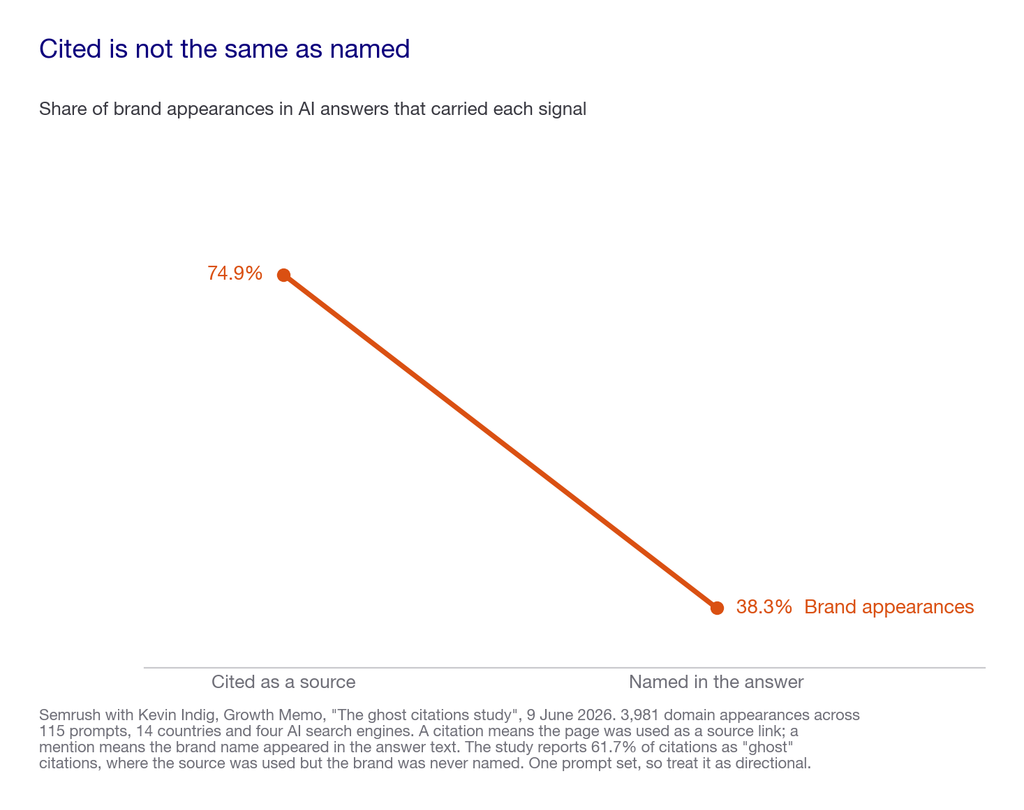
- Being cited is not the same as being named. In June 2026 research, 61.7% of AI citations used a page as a source without the brand ever appearing in the answer text.
- Brand recognition in AI answers is topic-level, not global. Engines recognise a brand for a subject rather than flagging it once and everywhere.
- Conventional SEO strength predicts topic ownership only about half the time, so authority scores are a poor proxy for entity recognition.
- Of the four entity levers people sell, you fully control one and may legitimately create a second. You can only claim the third if it already exists, and the fourth is not yours to make.
- Google documents Organization structured data for disambiguation in Search, states that it has no required properties, and guarantees nothing.
A note on where this comes from. We run organic programmes for 250+ enterprises and track more than 10 million prompts across AI engines. Entity confusion is one of the most common problems we inherit in client reviews. The judgements here come from that work. The facts come from Google, Wikipedia, Wikidata and named third-party research, and we have kept the two apart on purpose.
The short answer
The problem is not that engines cannot find you. It is that they cite your page without saying your name.
That gap now has a measurement. In June 2026, Semrush and Kevin Indig’s Growth Memo published a study of 3,981 domain appearances across 115 prompts, 14 countries and four AI search engines. 61.7% of the time, a platform used a page as a source link and the brand name never appeared in the answer. Their own summary is blunt: “Being cited is not the same as being mentioned.”
That is what entity optimization is actually for. Not getting crawled, and not getting linked. Getting named.
If you would rather have someone diagnose this with you than work through it alone, you can book a growth audit and we will check your entity signals directly.
What is entity optimization, and why does it matter for LLMs?
An entity is a thing a machine can identify unambiguously: an organisation, a person, a product, a place. Entity optimization is the work of making sure a system resolves every reference to your brand, across every spelling and context, to one correct thing.
The practical failure is mundane. “Pepper”, “Pepper Content” and “pepper.inc” can resolve to three different objects, or to a condiment. When that happens, your page can be read, quoted and used, and the answer still credits nobody.
Google’s own language for this is useful. Its structured data documentation says Organization markup “can help Google better understand your organization’s administrative details and disambiguate your organization in search results”. Disambiguation is the whole job, described by the company in one word.
This article is about resolution specifically. For the broader citability sequence, read how to get cited in LLMs. The category definitions sit in our guide to generative engine optimization.
Recognition is topic-level, not brand-level
Here is the finding that changes how you should budget for this.
In July 2026, Semrush and Growth Memo published a larger study. It covered 1,094 US categories, more than 50,000 brands and over 600,000 citations, tracked monthly through ChatGPT from January to June 2026. They measured brand mentions in answer text rather than source links, which is the right measure for recognition.
Only 15.2% of categories had a clear owner. In the other 85%, no brand consistently appeared across the related prompts. They also found ownership was rarer in high-demand topics, at 11.3%, than in lower-demand ones, at 19%.
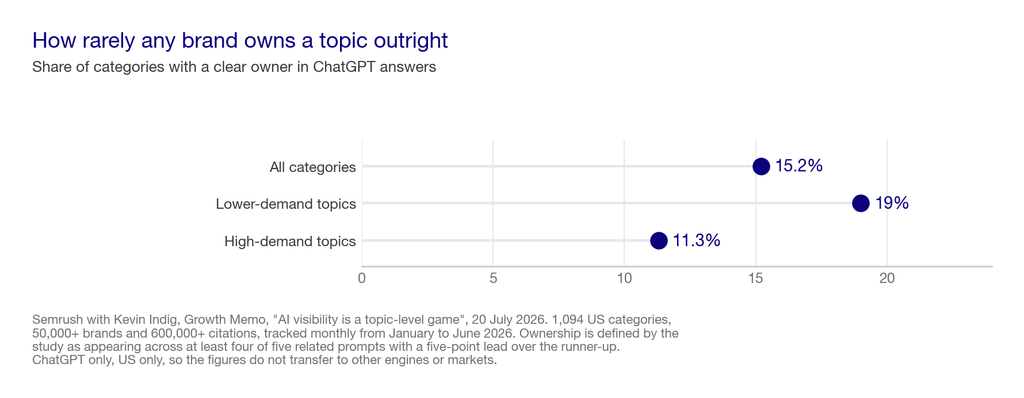
And this line should be read twice by anyone selling entity work as a one-time setup: “Broad SEO signals do not consistently predict topic ownership.” Domain-level metrics correlated with ownership roughly half the time.
So recognition is not a flag you set on your brand. You earn it subject by subject. A brand can be unmistakable in one category and invisible in the next, and the second fact is not a technical fault.
The four levers, and who actually controls them
Most entity advice presents four tactics as one checklist. They are not comparable, because they differ in the only way that matters: how much control you have.
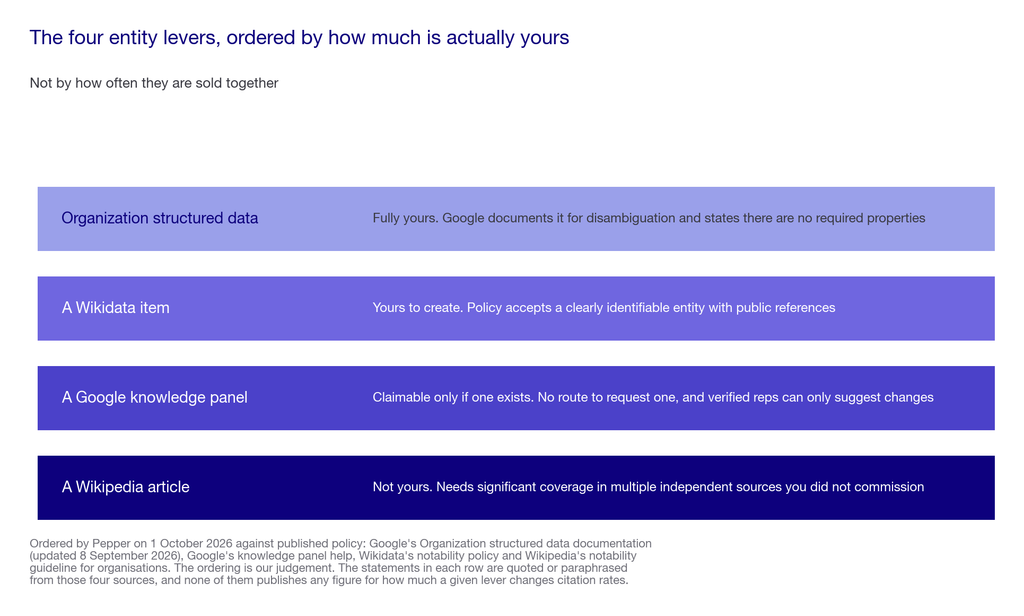
Organization structured data. Fully yours. Google documents it, you own the page, and you can ship it today. Two details from the documentation get routinely misreported. Google says “There are no required properties”. It also says “Google does not guarantee that features that consume structured data will show up in search results.” Put it on your home page or your about page, as Google recommends. Do it because Google documents disambiguation, not because somebody promised a citation multiplier.
A Wikidata item. Legitimately yours to create. Wikidata’s notability policy accepts an item that “refers to an instance of a clearly identifiable conceptual or material entity that can be described using serious and publicly available references”. A real company with real references qualifies. This is the most underused lever in the category, and it is the one most often lumped in with Wikipedia, which has completely different rules.
A Google knowledge panel. Claimable, not creatable. You cannot apply for one. Google’s process begins with a panel that already exists. You search for the entity, and if the option appears you “Claim this knowledge panel”. Google states plainly that “Not all knowledge panels are claimable as of now.” Once verified, you can suggest changes. That is the extent of it.
A Wikipedia article. Not yours at all. Wikipedia’s guideline for organisations requires “significant coverage in multiple reliable secondary sources that are independent of the subject”. It explicitly excludes press releases, “any material that is substantially based on such press releases even if published by independent sources”, marketing materials, “any paid or sponsored articles”, and talks given by your own staff. It adds that “a single significant independent source is almost never sufficient”.
Read that list again as a marketer. The guideline disqualifies, by name, almost everything a brand can commission about itself. A Wikipedia article is a consequence of other people finding you worth writing about. Treating it as a deliverable is how brands end up with deleted pages and a conflict-of-interest notice attached to their name.
The invented numbers
The previous version of this page stated that “three independent, reliable source mentions are the minimum for Google to trigger a Knowledge Panel.”
Google publishes no such threshold. Its knowledge panel documentation never explains how Google creates a panel, and no number appears anywhere in it.
The Wikipedia version of the same claim is closer but still wrong in the same way. WP:NCORP requires multiple independent sources and says one is almost never enough. It does not say three. The principle is right, the precision is invented, and the invented part is what readers remember.
This is the same failure we corrected in our AI Mode coverage, where the category quotes query fan-out counts that Google has never published. A real mechanism gets a fake number attached to it, and the number then travels.
Our methodology: how we ordered the levers
We ordered the four levers by control rather than by impact, because impact here is not measurable and control is. We scored each lever on three inputs.
| Input | Weight | What it means |
|---|---|---|
| Documented by the source of truth | 50% | Google, Wikidata or Wikipedia states it in published policy or guidance |
| Degree of control you hold | 30% | Whether you can execute it directly, apply for it, or only earn it |
| Supported by named 2026 research | 20% | A dated study with a stated sample size supports the priority |
Organization schema scores on all three, which is why it comes first despite being unglamorous. Wikipedia scores highest on documentation and lowest on control, which is exactly why it belongs last in a plan and first in a long-term PR conversation.
Entity levers at a glance
| Organization schema | Wikidata item | Knowledge panel | Wikipedia article | |
|---|---|---|---|---|
| Can you create it | Yes | Yes, if references exist | No | No |
| Governed by | Google structured data docs | Wikidata notability policy | Google, undocumented | WP:NCORP |
| Required properties | None, per Google | References required | Not applicable | Multiple independent sources |
| Guaranteed outcome | None, stated by Google | None | None | None |
| Typical cost | Developer hours, one-off | Hours, in-house | None, claim only | Earned, not purchased |
Where it falls short as a comparison:the cost row is the weakest. Nobody publishes defensible benchmarks here, because nobody has standardised the work. The Wikipedia row has no honest price at all. Treat that row as a shape, not a quote.
What this costs
Organization schema is a developer ticket, not a project. Most teams ship it in a day and never touch it again.
A Wikidata item is a few hours of careful work, done once, by someone who reads the policy first. It is the best return in the list.
Knowledge panel claiming costs nothing and is purely administrative, assuming a panel exists.
Consistent naming across your own properties is the hidden expense. A brand name can appear four ways across a website, a help centre, a careers site and a dozen profile pages. Fixing that is unglamorous editorial work. It is also, usually, the thing causing the confusion.
Where Pepper fits
We are not a neutral recommender in this section, and you should read it knowing that.
Pepper works as an organic growth partner rather than a tool vendor. Agent Atlas is our agentic engine for research, briefing and production. That is what topic-level coverage demands, once you accept that you earn recognition subject by subject. Pepper’s GEO platform tracks prompts and mentions rather than positions, so you can see the cited-versus-named gap in your own data. Customers log in and run it themselves, and a growth team sits alongside for the judgement calls about which topics to contest.
The framework we run this on is visibility, citability and retrievability. Entity resolution sits underneath all three, because an engine that cannot tell who you are cannot credit you for anything.
For a worked example in B2B SaaS, our SalesHood case study shows topic-level coverage built out deliberately.
Where it falls short. We cannot give you a single entity score, and we would not trust one if a vendor offered it. We can show you where engines name your brand, where they only cite it, and where it is missing. The resolution work itself is ordinary engineering and editorial discipline, and no platform does it for you.
How to choose what to fix first
I will write this in the first person, because an ordering nobody will defend is not worth printing.
Start with consistency, not with schema. If your own properties disagree about your name, every downstream signal inherits the confusion. I have seen a company ship beautiful Organization markup while its help centre, careers site and three partner directories each used a different legal name. The markup was correct and useless.
So my order is simple. Agree on the name, ship the schema, create the Wikidata item, then claim the panel if one exists. Treat Wikipedia as a long-term consequence of being worth writing about. Here is the scorecard I would use on any proposed entity programme, on a 100 point scale.
| Area | Weight | What a programme worth funding demonstrates |
|---|---|---|
| Naming is consistent across owned properties | 30 | One legal name, one trading name, applied the same way everywhere a machine can read it. |
| Organization schema live and valid | 25 | Live on the home page or about page, validating cleanly, and updated whenever details change. |
| A Wikidata item exists with real references | 20 | Created against the published notability policy, not stuffed, and pointing at genuine third-party sources. |
| Topic coverage planned subject by subject | 15 | The plan names which topics to contest, rather than assuming recognition transfers across a category. |
| Nothing in the plan rests on invented numbers | 10 | Every claim traces to published policy or a dated study with a stated sample size. |
Five questions I would ask before funding any of this, in this order.
- “What is our name, exactly, and where does it differ?” A stronger answer is an audit of owned properties. A weaker one is “everyone knows who we are”, which is the belief the data contradicts.
- “Is Organization schema on the home page today?” Check it rather than assume. A stronger answer includes a validator screenshot from this quarter.
- “Do we qualify for a Wikidata item under the actual policy?” Read criterion two aloud. If you have serious, publicly available references, you qualify, and nobody needs to sell you that.
- “Which topics do we want engines to recognise us for?” If the answer is the whole category, the plan is wrong. The research measures ownership per subject.
- “Has anyone promised us a Wikipedia page?” If a supplier has, that is the end of the conversation for me.
Red flags, each one something a supplier actually says. A guaranteed Wikipedia article, which the notability guideline makes impossible to promise honestly. A specific source count that triggers a knowledge panel, when Google documents no such thing. A required schema stack, when Google states there are no required properties. A single entity score presented as an industry standard. And our own previous version of this page, which did three of those four.
Before commissioning anything, measure what you own today. Write 25 real commercial questions your buyers would type, covering definitions, comparisons and alternatives rather than your brand name. Run each of those 25 prompts three times across every engine you care about, because engines are probabilistic and one run is an anecdote. Then give any fix 90 days before judging it. Four worked examples for a mid-market B2B software company:
- “what is sales enablement software and who are the main providers”
- “compare sales enablement platforms for a 200 person sales team”
- “what are the alternatives to the biggest sales enablement vendors”
- “how do I choose a sales enablement platform for financial services”
Record two things for each run, not one. Whether your page was used as a source, and whether your brand name appears in the answer text. The gap between those two columns is your entity problem, stated in your own numbers rather than someone else’s study.
And the answer that loses Pepper the sale: if your naming is already consistent, your schema already live, and your brand named in most of those 25 answers, you do not need an entity programme, and you do not need us to run one. Spend the budget on topics you are not yet recognised for.
It comes down to one principle: fix what you control, create what policy permits, claim what already exists, and earn the rest. Refuse every precise number nobody will source, ours included. We published nine of those numbers ourselves on this very page, which is the strongest argument we can make for the principle.
The claims we removed
Every statistic on the previous version of this page, and what happened to it.
| Claim on the old page | Source named | What we found | Action |
|---|---|---|---|
| “93% of enterprise brands have zero mentions in AI search responses” | None, attributed to our own platform | Underlying data not published, so not publishable under our own rules | Removed |
| “Ranked 612th” with zero mentions across tracked themes | None, our own brand | An internal platform readout with no published method | Removed |
| “40 to 65%” citation weight for authoritative lists | None | No published source located | Removed |
| “G2 alone drives 14 LLM citation pages” | None | No published source located | Removed |
| “LinkedIn has 45 pages cited in LLM responses” | None | No published source located | Removed |
| “YouTube is the number one most-cited domain, 95 pages indexed” | None | No published source located | Removed |
| “Only 13.2 percent were both cited and named” | None | Real research exists and says 38.3% of brand appearances included a mention | Removed, replaced with the sourced figure |
| “Three independent sources are the minimum for Google to trigger a Knowledge Panel” | None | Google documents no threshold and does not describe panel creation | Removed and corrected |
| “Three independent, reliable sources” for Wikipedia notability | None | WP:NCORP says multiple, and that one is almost never sufficient. No number is stated | Removed and corrected |
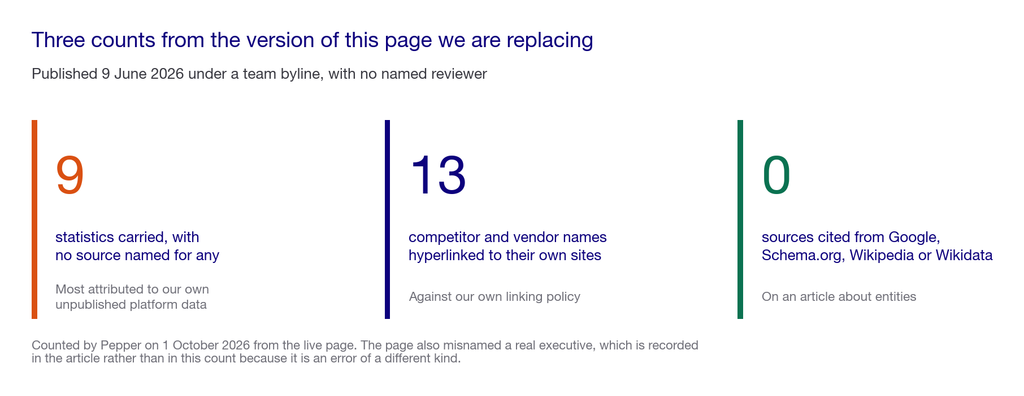
Two further fixes that are not statistics. The page hyperlinked thirteen competitor and vendor names to their own sites, which sends authority to companies we compete with and is against our linking policy. We have removed every one of those links while keeping the mentions themselves, because naming the platforms is useful and linking to them is not.
And we misnamed a real person. The page quoted “Cindy Sloan, former CMO at G2”. Her name is Sydney Sloan. We have removed the quotation rather than correct it in place, because we cannot verify the wording from a published record. A misattributed quotation is a worse error than a missing statistic, and this one sat live for nearly four months.
What nobody should promise you
Be sceptical of any of these.
- A Wikipedia article as a deliverable. The notability guideline disqualifies almost everything a brand can commission about itself.
- A knowledge panel on request. Google provides no route to create one, only to claim one that exists.
- A single composite AI visibility score. It hides more than it reveals, and no two vendors compute it the same way.
- A universal benchmark. Recognition is topic-level, so a category-wide number tells you very little.
- A required schema stack. Google states there are no required properties.
Frequently asked questions
What is entity optimization in AI search?
It is the work of making a system resolve every reference to your brand, across spellings and contexts, to one correct thing. The aim is not to get crawled or linked, but to get named inside the generated answer itself.
Why does being cited not mean being mentioned?
Because a model can use your page as a source without naming you in the text. Research published in June 2026 found this happened 61.7% of the time across 3,981 domain appearances in four AI search engines.
Can I create a Google knowledge panel for my brand?
No. Google provides no route to request or create one. You may be able to claim an existing panel as a verified representative. Google states that not all panels are claimable, and a claim only lets you suggest changes.
Should I create a Wikipedia page for my company?
No, and attempting it tends to backfire. Wikipedia requires significant coverage in multiple independent secondary sources, and explicitly excludes press releases, sponsored articles and material produced by your own staff.
Is a Wikidata item different from a Wikipedia article?
Yes, and the difference matters. Wikidata accepts any clearly identifiable entity describable with serious, publicly available references. A legitimate company with real third-party coverage can hold an item without any Wikipedia article.
Which schema should I use for entity optimization?
Organization structured data on your home page or about page. Google documents it for disambiguating your organisation in Search, states there are no required properties, and does not guarantee that any feature consuming it will appear.
Does strong SEO mean an LLM will recognise my brand?
Not reliably. A July 2026 study of 1,094 categories tested this directly. Domain-level metrics such as authority score and organic traffic predicted topic ownership only about half the time, so conventional strength is a weak proxy.
How long does entity work take to show up?
Nobody publishes a defensible timeline, so treat any specific figure with suspicion. We recommend giving changes 90 days before judging them, and measuring the cited-versus-named gap on a fixed prompt set throughout.
Where to go next
- How to get cited in LLMs, for the broader citability sequence
- What generative engine optimization is, if you want the category definitions first
- Ranking in Google AI Overviews
- How AI search differs from traditional search
- How we rank and score GEO providers
Sources and further reading
- Google Search Central, “Organization structured data”, last updated 8 September 2026. Source of the disambiguation purpose, the “no required properties” statement and the no-guarantee statement.
- Google, “Claim a knowledge panel”, read at source on 1 October 2026. Source of the claiming process and the statement that not all panels are claimable.
- Wikipedia, “Notability (organizations and companies)”, read at source on 1 October 2026. Source of the significant-coverage requirement and the excluded source types.
- Wikidata, “Notability”, read at source on 1 October 2026. Source of the clearly-identifiable-entity criterion.
- Semrush and Kevin Indig, Growth Memo, “The ghost citations study”, 9 June 2026. 3,981 domain appearances across 115 prompts, 14 countries and four AI search engines. Source of the 61.7%, 74.9% and 38.3% figures.
- Semrush and Kevin Indig, Growth Memo, “AI visibility is a topic-level game: a study of 50,000 brands in ChatGPT”, 20 July 2026. 1,094 US categories, 50,000+ brands and 600,000+ citations, tracked monthly from January to June 2026.
- Removed for age: a Semrush most-cited-domains study of 230,000+ prompts published in November 2025. It is the best available evidence that citation patterns are volatile between engines, and it falls outside our 2026 sourcing rule.
Latest Blogs
Most advice on this is inference dressed as fact. OpenAI documents exactly one thing clearly, which is access. Here is what is documented, what is inferred, and how to verify the rest for yourself.
Being named in an AI answer and having your page used as its source are different outcomes with different causes and different fixes. The gap between them is the most useful diagnostic in AI search, and most reporting collapses it into one number.
Every platform reports share of voice and almost none of them define it the same way. Here is the definition worth using, the three choices that change the number, and how to measure it yourself without buying anything.
Get your hands on the latest news!

Similar Posts
GEO / AI Search
10 mins read
How to get cited by ChatGPT
GEO / AI Search
10 mins read
Mentioned vs cited: the difference that decides AI visibility
GEO / AI Search
13 mins read