LLM seeding: an AI search strategy to get mentioned and cited
The short answer
LLM seeding promises something the data does not support.
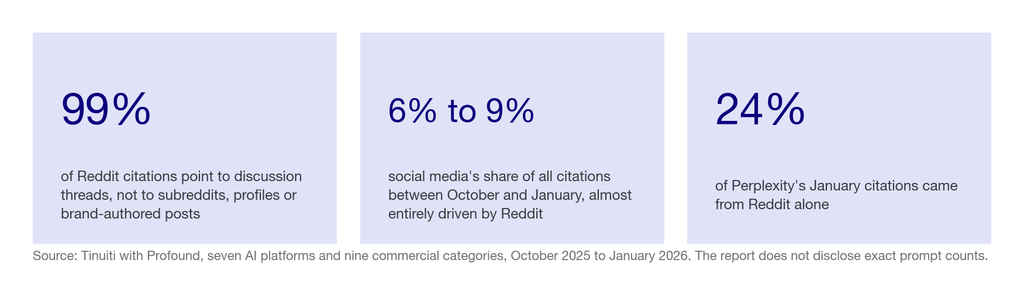
LLM seeding suggests you can plant content in the places models read, then get picked up. One number settles that. Roughly 99 percent of Reddit citations point to individual threads with substantive discussion, rather than to subreddits, profiles or brand-authored posts.
So the thing getting cited is a conversation you did not write. You can influence whether it happens. You cannot author it.
Key takeaways
- Community citations are rising fast. Social media’s share went from 6 percent in October to 9 percent in January, with the lift almost entirely Reddit.
- Reddit nearly doubled, from about 2 percent of all citations to about 5 percent.
- The platform spread is enormous. Perplexity drew 24 percent of its January citations from Reddit. On Gemini, Reddit is about 5 percent of a social slice that is only 3 percent of the total.
- Brand-authored posts are not what gets cited. Threads with real discussion are.
- So seeding is a product and reputation job, not a posting job.
Where this comes from. We run organic for more than 250 enterprises at Pepper and track over 10 million prompts across every major engine. We get asked to run seeding programmes often, and we turn some of them down. That work shapes the view here, along with the client reviews we sit in and the talks we have at the events we run.
What is LLM seeding?
LLM seeding is the practice of getting your brand into the third-party sources that AI engines draw on, so your name appears when someone asks a question in your category.
The term covers a wide range of behaviour, and the ends of that range are very different.
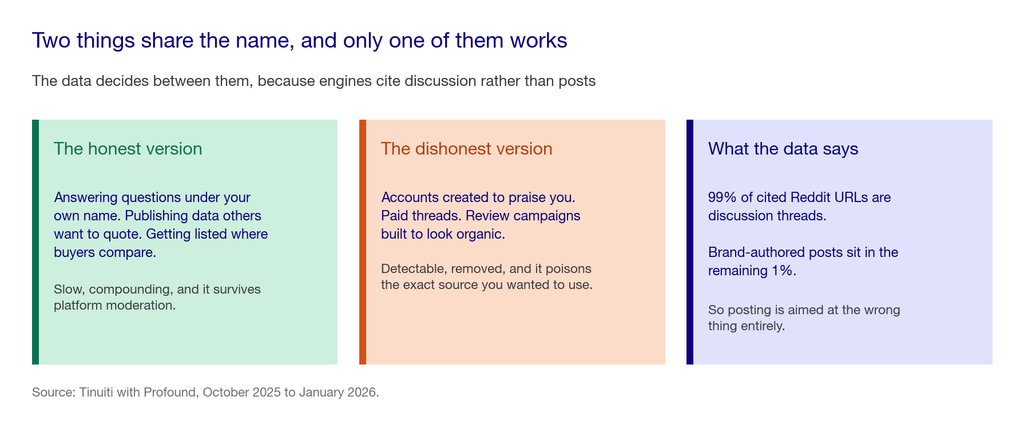
The honest version
Giving people something worth discussing, then showing up where they discuss it. Answering questions in communities under your own name. Getting listed where buyers compare. Publishing data others want to quote.
The dishonest version
Creating accounts to post about yourself, paying for positive threads, or running review campaigns that look organic. This is astroturfing with a new name, and platforms remove it.
We only cover the first. The second is detectable, it damages exactly the source type you were trying to use, and it is the reason this tactic has a poor reputation.
See where you show up. Pepper’s GEO platform tracks Brand Visibility, Domain Prompt Presence and Share of Voice across ChatGPT, Perplexity, Gemini, Claude and Google AI Overviews. Your team can log in, connect Search Console and GA4, manage the prompt set and run your own agents in the Agent Atlas. A growth team works the same account alongside you. Book a growth audit or see where you show up.
What the citation data shows
Tinuiti and Profound tracked mid to lower funnel prompts across seven AI platforms and nine commercial categories, from October 2025 to January 2026.
Community citations are growing
Social media citations rose from 6 percent of all citations in October to 9 percent in January. Almost all of that lift came from one platform. Reddit went from roughly 2 percent to 5 percent of all citations, while YouTube held flat near 1 percent and every other social platform stayed below 1 percent.
The platform spread is the real story
A single seeding strategy cannot serve every engine, and the gap is wide enough to decide whether you bother at all.
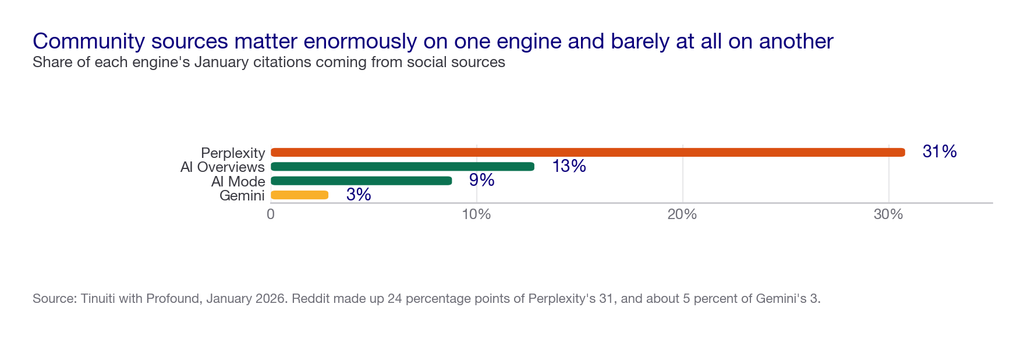
- Perplexity: 31 percent social, 24 percent Reddit. The most community-driven engine by a distance.
- AI Overviews: about 13 percent social, with Reddit roughly 44 percent of that slice.
- AI Mode: about 9 percent social, Reddit roughly 40 percent of the slice.
- Gemini: about 3 percent social, and Reddit only about 5 percent of that. Medium accounts for 28 percent of Gemini’s social citations.
So Reddit presence is close to a quarter of the citation picture on Perplexity, and a rounding error on Gemini.
Read the limits
The report does not disclose exact prompt counts or sample sizes, and the window runs from October 2025 into January 2026. We are treating the direction and the platform ordering as reliable, and the specific percentages as approximate.
The finding that changes the tactic
This is the number that should end most seeding proposals as written.
Roughly 99 percent of Reddit citations point to individual threads with substantive discussion. Not subreddits. Not profiles. Not brand-authored posts.
Why that matters
A seeding plan built on publishing your own posts is aimed at the 1 percent. The engines are citing arguments between strangers, not your announcement.
That reframes the work entirely. You are not trying to place content. You are trying to become the thing people bring up when they answer each other.
What that looks like in practice
- Be genuinely useful under your own name. Answer questions where your buyers already ask them, disclosed, without pitching. E-E-A-T covers how engines read that kind of credibility.
- Give people a reason to mention you. Original data, a free tool, a clear price. Things that come up naturally in an answer, as the citation evidence shows.
- Fix what people say that is wrong. A correction in a thread is worth more than a new post nobody engages with.
- Accept the timeline. This compounds over quarters, and it reports badly in month one.
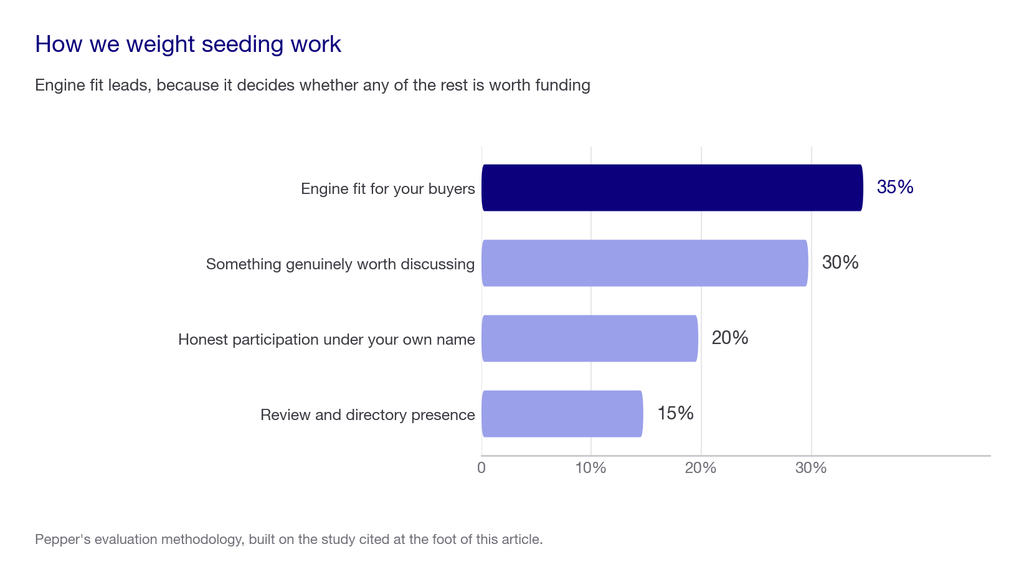
Our methodology: how we weight seeding work
| Factor | Weight | Why it carries this much |
|---|---|---|
| Engine fit for your buyers | 35% | Reddit is 24 percent of Perplexity citations and a rounding error on Gemini |
| Something genuinely worth discussing | 30% | 99 percent of cited threads are real discussion, which you cannot author |
| Honest participation under your own name | 20% | The only version that survives platform moderation |
| Review and directory presence | 15% | Shows up on the recommendation queries buyers ask before a shortlist |
Seeding approaches at a glance
| Approach | What it delivers | Typical 2026 cost | Who it suits | Where it falls short |
|---|---|---|---|---|
| Honest community participation | Mentions in threads engines cite | Sustained internal time | Teams with a real practitioner | Slow, and it cannot be outsourced convincingly |
| Original data worth quoting | Reasons for others to mention you | The real cost, and the real return | Anyone with access to data | You have to actually have something |
| Review platform presence | Recommendation query coverage | Time, plus listing fees | B2B software especially | Buying reviews is detectable and damaging |
| Directory and listing work | Baseline category presence | Low, largely admin | Everyone, once | Thin on its own |
| Paid placements | Reach, not citation | Media spend | Brand campaigns | Paid content is 0.3 percent of AI citations |
| Astroturfing | Short-term noise, then removal | Reputational, and it is severe | Nobody | Detectable, and it poisons the source you wanted |
| Platform plus a growth team | Tracking, plus the work it points at | Custom | Teams without capacity | Still gated by other people publishing |
—
How to choose whether to seed at all
Engine fit decides this, and checking takes an afternoon.
The scorecard
Score the opportunity out of 100.
| Factor | Weight | How to score it honestly |
|---|---|---|
| Your buyers use Perplexity, ChatGPT or Google AI surfaces | 35% | Checked rather than assumed, since Gemini barely uses community sources at all |
| You have something worth discussing | 25% | Original data, a free tool or a clear price, rather than a product announcement |
| A named person can participate credibly | 20% | Someone who would be welcome in the community without the logo |
| You already appear on review platforms | 10% | Listed and reviewed on whichever platform your category uses |
| You can sustain it for two quarters | 10% | Because month one will show nothing, and most programmes stop there |
The live test, over 90 days
Fix 30 prompts in your buyers’ words. Real ones, such as “best data observability tool for a small team”, “is sales enablement software worth it”, “what is LLM seeding” and “alternatives to the market leader in our category”.
Run them on Google, ChatGPT and Perplexity. Record whether you were named, and which community threads appear in the sources.
Rerun the same set monthly for 90 days. Three readings is the shortest honest window. One is a snapshot, two could be noise, three shows direction. Keep the set fixed, because changing it resets the comparison.
That thread column is your target list. It shows the exact conversations engines are reading in your category, which beats any subreddit list compiled by hand. The free method sits in how to measure AI search visibility without expensive tools.
Weak approach versus strong approach
The weaker approach: create accounts, post about your product in relevant threads, and count posts as output. You are aiming at the 1 percent of citations that are not organic discussion, and the platform will eventually remove the accounts.
The stronger approach: find the threads engines already cite in your category, read what is being said about you, and participate honestly where you can add something.
One tries to manufacture the conversation. The other tries to deserve it, and only the second survives moderation.
Red flags
- A seeding proposal with post volume as the metric. Roughly 99 percent of cited Reddit URLs are discussion threads, not brand posts.
- Undisclosed accounts. Astroturfing, and platforms remove it.
- One strategy across all engines. Reddit is 24 percent of Perplexity citations and about 0.15 percent of Gemini’s total.
- Paid placement sold as seeding. Paid content is 0.3 percent of AI citations.
- Review campaigns that look organic. Detectable, and they damage the source type you need.
- Guaranteed mentions. Nobody controls generated output, and Google warns against guaranteed rankings.
Five questions worth asking
- “Which engines do our buyers use?” This single answer decides whether seeding is worth funding.
- “Which threads already cite our category?” That is the target list, and it is free to build.
- “Who would participate, under their own name?” If nobody, the honest version is not available to you.
- “What do we have that is worth discussing?” Without an answer, there is nothing to seed.
- “What would you refuse to do?” A good partner names astroturfing without being asked.
Reduced to one principle: become worth mentioning, then show up honestly where it happens.
One closing note that costs us something. Seeding is slow, it cannot be convincingly outsourced, and a retainer is the wrong shape for it, ours included. The work is mostly your own practitioners spending time in public, and that is not something an agency can do for you.
What does LLM seeding cost?
| What you are buying | Typical 2026 cost | What it covers |
|---|---|---|
| Finding the threads engines cite | Free, an afternoon | Thirty prompts, with the source threads recorded |
| Reading what is said about you | Free, a few hours | Corrections worth making, and gaps worth filling |
| Honest participation | Sustained internal time | The only version that works, and it is a people cost |
| Original data or a free tool | The real cost, and the real return | Giving people a reason to mention you |
| Review platform presence | Time, plus listing fees in some categories | The recommendation queries before a shortlist |
| Multi-engine tracking | Roughly $99 to $400 a month | Whether any of it is landing, per engine |
| Platform plus a growth team | Custom | Pepper: tracking, plus the people and agents doing the work |
The first two rows are free, and together they tell you whether the rest is worth funding.
What nobody should promise you
A guaranteed mention in any engine. Nobody controls generated output.
That posting gets you cited. Roughly 99 percent of cited Reddit URLs are discussion threads, not brand-authored content.
That one community strategy serves every engine. Reddit is about a quarter of Perplexity’s citations and close to nothing on Gemini.
Fast results. Community reputation compounds over quarters, and the first month will show nothing.
When not to seed
The answer that costs us the sale. If your buyers use Gemini, or your category has no active community, seeding is not your lever and we would tell you not to fund it.
Gemini drew about 3 percent of citations from social sources, and Reddit was roughly 5 percent of that. Chasing community presence for an audience that lives there is good work. Chasing it for an audience that does not is a quarter spent on a rounding error. Check which engines your buyers use first, because that single fact decides this.
Frequently asked questions
What is LLM seeding?
Getting your brand into the third-party sources AI engines draw on, so your name appears in answers. In practice that means communities, review platforms and directories, rather than content you publish on your own domain.
Does LLM seeding actually work?
The honest version does, and slowly. Roughly 99 percent of cited Reddit URLs are discussion threads rather than brand-authored posts, so the mechanism is being worth discussing rather than posting about yourself.
How much do AI engines cite Reddit?
It depends enormously on the engine. Perplexity drew 24 percent of its January citations from Reddit. On Gemini, Reddit was about 5 percent of a social slice that made up only 3 percent of citations overall.
Is community seeding growing?
Yes. Social media citations rose from 6 percent of all citations in October to 9 percent in January, and almost all of that increase came from Reddit, which roughly doubled from 2 percent to 5 percent.
Can I just post about my product in relevant threads?
You can, and it will not do much. That content falls in the roughly 1 percent of Reddit citations that are not organic discussion, and undisclosed promotional accounts get removed by platform moderation.
What is the difference between seeding and astroturfing?
Disclosure and intent. Participating under your own name and adding something useful is seeding. Creating accounts to praise yourself or paying for threads is astroturfing, and platforms remove it when they find it.
Which platforms should I focus on?
Start from the engines your buyers use. Reddit matters most on Perplexity and the Google AI surfaces, while Medium carries more weight on Gemini, at 28 percent of its social citations.
How long does seeding take to show results?
Plan on three monthly readings of a fixed prompt set, so roughly 90 days before a direction is readable. The community half compounds over quarters, because it depends on other people choosing to mention you.
Where to go next
Run thirty of your buyers’ questions and write down which community threads appear in the sources.
That list is the real seeding plan. It shows the conversations engines are reading in your category, and it costs an afternoon rather than a retainer.
Learn AI Search · The earned authority case · Book a growth audit
Sources and further reading
Primary studies
- Tinuiti with Profound. AI citation trends, tracking mid to lower funnel prompts across seven AI platforms and nine commercial categories, October 2025 to January 2026. Platforms covered ChatGPT, Perplexity, Google AI Mode, AI Overviews, Gemini, Copilot and Meta AI. Social media citations rose from 6 percent in October to 9 percent in January, with Reddit roughly doubling from 2 percent to 5 percent of all citations while YouTube held near 1 percent. By platform in January: AI Overviews about 13 percent social with Reddit roughly 44 percent of that slice, AI Mode about 9 percent social with Reddit roughly 40 percent, Gemini about 3 percent social with Reddit about 5 percent and Medium 28 percent, and Perplexity 31 percent social with Reddit at 24 percent of total citations. Roughly 99 percent of Reddit citations point to individual threads with substantive discussion rather than subreddits, profiles or brand-authored content. The report does not disclose exact prompt counts or sample sizes. Link
- Muck Rack. “What Is AI Reading?” May 2026. More than 25 million cited links across ChatGPT, Claude and Gemini. 84 percent of citations from earned media, 0.3 percent from paid. Link
- BrandMentions, 21 September 2026. Roughly 410,000 brand mentions across 240 brands. Repeatedly visible brands drew 70 to 80 percent of their mention footprint from third parties. Link
Further reading
- Google Search Central. AI search optimisation guidance, 15 May 2026. Warns against providers guaranteeing rankings.
- Pepper. Earned authority for the wider third-party case, brand visibility for measuring the result, and AI trust signals for why being cited and being named differ.
- Deliberately excluded: the claim that domains with millions of Quora and Reddit mentions have roughly four times higher odds of citation, which appears in secondary write-ups with no traceable method. Also excluded, the figure that 48 percent of citations come from community platforms, which conflicts with the per-platform numbers above in a way we could not reconcile.
Latest Blogs
Most advice on this is inference dressed as fact. OpenAI documents exactly one thing clearly, which is access. Here is what is documented, what is inferred, and how to verify the rest for yourself.
Being named in an AI answer and having your page used as its source are different outcomes with different causes and different fixes. The gap between them is the most useful diagnostic in AI search, and most reporting collapses it into one number.
Every platform reports share of voice and almost none of them define it the same way. Here is the definition worth using, the three choices that change the number, and how to measure it yourself without buying anything.
Get your hands on the latest news!