
The short answer
Most advice on this subject is guesswork. There is now a study large enough to replace it.
Ahrefs analysed 1.4 million ChatGPT prompts, covering roughly 23.4 million cited URLs and 23.4 million non-cited ones. The engine retrieves about 33 pages per prompt. It cites 49.98 percent of them.
So half the pages an engine finds never get quoted. Everything here is about which half you land in.
Key takeaways
- Retrieval is not citation. Getting found is roughly half the job. The other half is reading as the cleanest answer among about sixteen competitors on the same prompt.
- Your title does more work than your body copy. Cited URLs scored 0.602 on similarity to the prompt, against 0.484 for non-cited ones. That was the strongest signal measured.
- Readable URLs beat opaque ones by nearly nine points. Natural-language slugs were cited 89.78 percent of the time, against 81.11 percent for opaque ones.
- You have to rank first. Pages pulled from the search channel were cited 88.46 percent of the time. Reddit results were cited 1.93 percent of the time.
- Old pages get cited more than you would expect. The median cited page was about 500 days old. That changes what you do with your archive.
Where this comes from. We run organic for more than 250 enterprises at Pepper and track over 10 million prompts across every major engine. The study below is not ours. We set our own writing rules against it. Where it contradicted what we believed, we changed the rules rather than the reading.
What is generative engine optimization content writing?
It is writing judged by a machine choosing which two hundred words to quote, rather than by a reader choosing whether to keep scrolling.
Three things separate it from classic SEO writing.
- The unit is the passage, not the page. An engine scores sections against sub-questions it wrote itself. Your article competes paragraph by paragraph, not as a whole.
- The reward is a citation, not a click. You may be quoted without anyone visiting. That changes what success looks like and how you measure it.
- The competition is invisible. About sixteen other candidates are scored against the same sub-question, and you never see them.
None of that replaces SEO writing. It sits on top of it, which the evidence below makes unusually clear.
How do I create content that ranks in AI search?
Start by understanding what the engine is doing, because the mechanism dictates the craft.
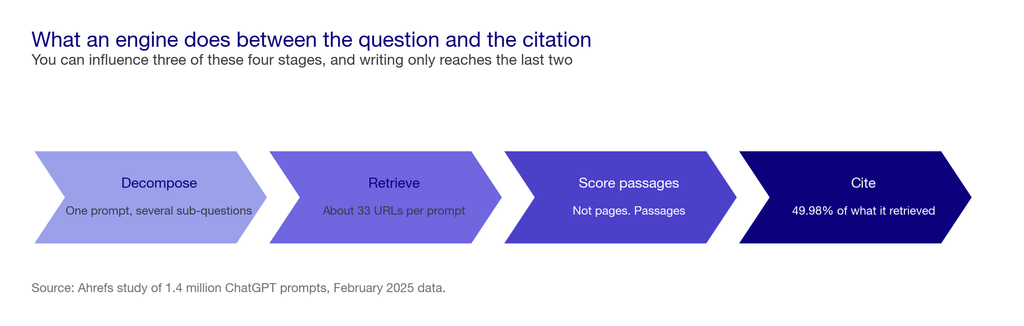
An engine answering a question does four things in order.
- It decomposes your question into sub-questions. One prompt becomes several smaller things it needs to establish before it can answer.
- It retrieves candidates. Roughly 33 URLs per prompt in the ChatGPT data. That splits almost evenly between what it cites and what it discards.
- It scores passages against those sub-questions. Not whole pages. Passages, each judged on how cleanly it answers one thing on its own.
- It cites the winners. About half of everything retrieved, and the rest is dropped without trace.
That third step is the one that should change how you write. The unit of competition is the best two hundred words inside your article, judged against fifteen other candidates answering the same sub-question.
See where you show up. Pepper’s GEO platform tracks Brand Visibility, Domain Prompt Presence and Share of Voice across ChatGPT, Perplexity, Gemini, Claude and Google AI Overviews. Your team can log in, connect Search Console and GA4, manage the prompt set and run your own agents in the Agent Atlas. A growth team works the same account alongside you. Book a growth audit or see where you show up.
The pipeline, and where writing actually intervenes
Four stages, and you can only influence three of them.
Classic SEO buys stage two. Writing buys stages three and four. Stage one is outside your control entirely, which is why guessing at prompt phrasing wastes a writer’s time.
What the data says separates cited pages
Three findings, all from the same 1.4 million prompt analysis, and all measurable on your own pages this afternoon.
Your title is the strongest single signal
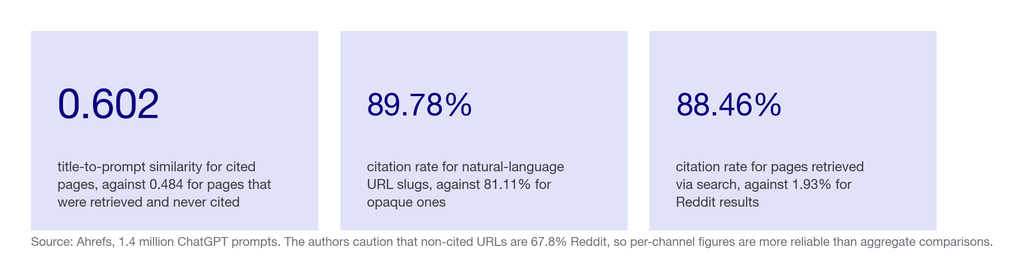
The study measured how semantically close each URL sat to the original prompt. Cited URLs averaged 0.602. Non-cited URLs averaged 0.484.
That gap was the clearest differentiator the researchers found. In plain terms, the closer your title reads to the question someone actually asked, the likelier an engine quotes you.
This is a phrasing instruction rather than a keyword one. Compare “Enterprise Data Observability Solutions” against “How much does data observability cost”. Only one of those matches a question somebody asks.
Readable URLs get cited more
Pages with natural-language slugs were cited 89.78 percent of the time. Pages with opaque slugs were cited 81.11 percent of the time.
Nearly nine points, for a decision a CMS default usually makes. It costs nothing to get right on new pages. It is rarely worth retrofitting on old ones, where redirects put existing equity at risk.
The channel you arrive through decides most of it
This is the finding that should temper any pure-GEO pitch. Citation rates by retrieval channel:
- Search: 88.46 percent.
- News: 12.01 percent.
- Reddit: 1.93 percent.
- YouTube: 0.51 percent.
- Academia: 0.40 percent.
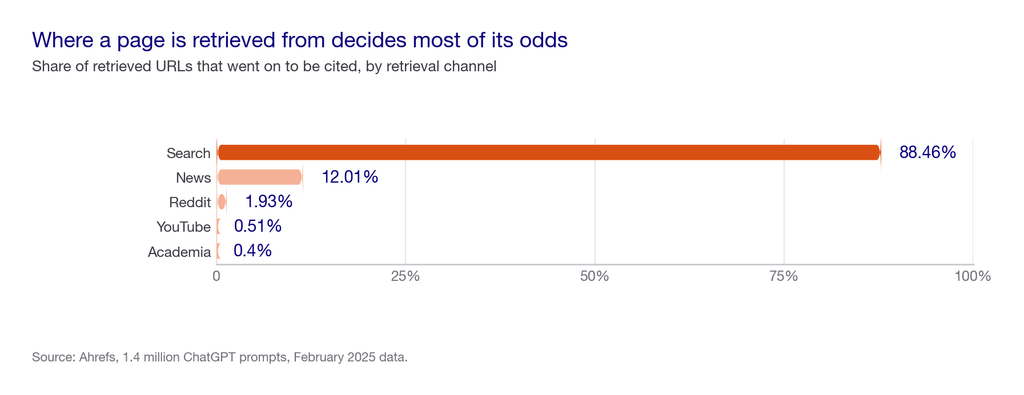
The authors put it plainly. To earn a ChatGPT citation, you need to sit in the search selection pool. Ranking still matters, and more than most AI-search advice admits. We made the same argument from a different direction in AEO vs SEO.
Read the caveat with the finding. The researchers warn that non-cited URLs are overwhelmingly Reddit, at 67.8 percent. That creates compositional artefacts. Comparing cited against non-cited in aggregate misleads unless you isolate source types, so we quote their per-channel figures instead.
The age finding, which contradicts common advice
The median cited page was around 500 days old.
The authors flag this as counterintuitive and explain why both things hold at once. ChatGPT prefers fresh content. It also cites comparatively older content more often, because older pages have the authority and rankings that get them into the retrieval pool at all.
The practical reading is not “let pages age”. It is that a well-maintained old page beats a new page with no standing. Age alone does nothing. That aligns with what we found writing about content audits: updating an established page is usually a better investment than publishing another new one.
The three rules we write to now
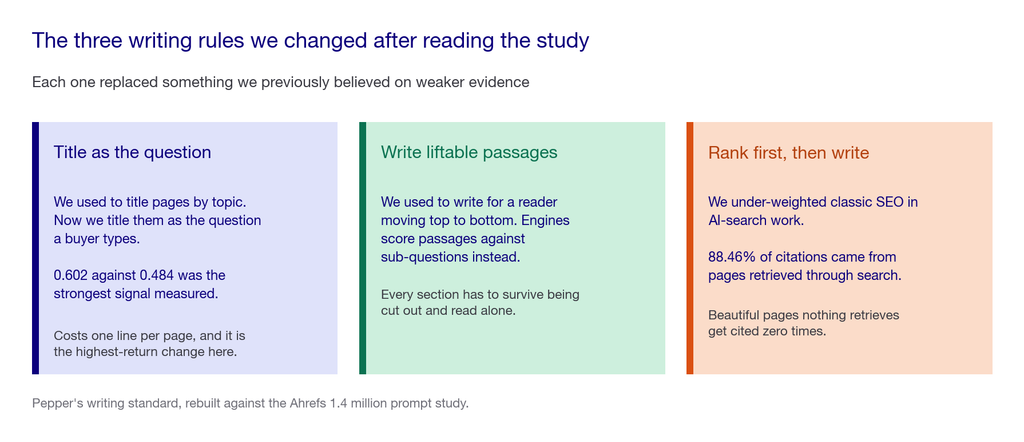
We rebuilt our own writing standard against this study. Three rules changed.
What this looks like in practice
Concretely, on a page you are writing this week.
- Title the page as the question. Use the phrasing a buyer would type rather than your positioning deck’s. This is the highest-return change available, and it costs one line.
- Answer in the first two sentences under every heading. The engine scores passages, so a buried answer loses to a thinner page that leads with one.
- Write in self-contained passages. Each section should make sense lifted out of the page, because that is exactly what an engine does to it. Avoid “as we saw above” and similar back-references.
- Put something in it a model cannot compose. A price, a sample size, a named method, a dated observation. Generic explanation is the one thing an engine does not need you for.
- Use real HTML for tables and lists. A table rendered as an image is invisible. The detail is in how to structure content for AI citation.
- Give it a readable slug. Nine points, for free, on any new page.
None of that is exotic. It is a small number of specific decisions, and the evidence now says which ones matter most.
What this looked like on a real account
Writing standards resist isolation in a case study, because they ship alongside everything else. Two results are worth citing anyway.
On a data observability account, a single hero guide produced more than 260,000 impressions on its own, outperforming a quarter of the scheduled content calendar. Depth on one question beat volume across many.
On a sales enablement account, a content engine of 20 new pieces and 8 refreshed took AI Overview visibility from 14 keywords to 97, while clicks rose 20 percent against a declining category.
Where this evidence is limited. Both are our own published results, selected because they worked. Neither isolates writing craft from the technical and authority work running alongside it. The study above carries the craft claims. These two show the craft inside a working programme.
Our methodology: how we weighted the writing decisions
| Decision | Weight | Why it carries this much |
|---|---|---|
| Title phrased as the question | 35% | The strongest differentiator in a 1.4 million prompt study, at 0.602 against 0.484 |
| Self-contained passages | 30% | The engine scores passages against sub-questions, not whole pages |
| Something a model cannot compose | 20% | Generic explanation is the one thing an engine can produce without you |
| Readable slug and parseable markup | 15% | Nearly nine citation points, and free on any new page |
Writing decisions at a glance
| Decision | Evidence behind it | Effort | Typical cost | Where it falls short |
|---|---|---|---|---|
| Title as the question | 0.602 against 0.484 semantic similarity | One line per page | Free | Fails if the page then does not answer that question |
| Answer-first passages | Engines score passages, not pages | Structural, roughly a day per page | Cheap on new pages | Retrofitting a large archive is slow |
| Self-contained sections | Passages get lifted out of context | Habit change for writers | Free once learned | Reads slightly repetitive to a linear reader |
| Non-composable specifics | Generic text is what engines replace | The real work, and the real cost | Highest line item here | You have to actually have something to say |
| Readable slugs | 89.78% against 81.11% citation | Minutes, on new pages | Free | Not worth retrofitting, redirects risk the equity |
| Ranking in classic search | 88.46% citation from the search channel | An entire discipline | Your existing SEO budget | Slowest of everything here, and unavoidable |
How to choose what to fix first
Most teams cannot rewrite everything. This orders the work.
The scorecard
Score a page out of 100 before you decide whether to rewrite it.
| Factor | Weight | How to score it honestly |
|---|---|---|
| Title matches a real question | 30% | Read the title aloud. Would a buyer type something close to it? Positioning language scores zero here |
| Answer in the first two sentences | 25% | Under every heading, rather than only the first one |
| Passages survive being lifted | 20% | Cut any section out and read it alone. If it needs the rest of the page, rewrite it |
| Contains something non-composable | 15% | A price, a number, a named method, a dated observation |
| Ranks or could rank | 10% | Search was the retrieval channel for 88.46% of citations, so this gates the rest |
The live test, over 90 days
Fix 30 prompts phrased as your buyers would type them. Real questions, such as “how much does data observability cost”, “what is generative engine optimization content writing”, “best sales enablement platform for mid-market” and “how do I get cited by ChatGPT”.
Run them across Google, ChatGPT and Perplexity. Log three things per prompt. Whether you were named, whether a page on your domain was cited, and which passage of yours the engine actually quoted.
That third column is worth adding here. It tells you which two hundred words are doing the work, and those passages rarely turn out to be the ones you expected.
Rerun the identical set monthly for 90 days. Three readings is the shortest honest window. One is a snapshot, two could be noise, three shows direction. Keep the set fixed, because changing it resets the comparison.
Weak approach versus strong approach
The weaker approach: rewrite everything into question-and-answer format, add FAQ blocks everywhere, and hope structure substitutes for having something to say.
The stronger approach: retitle your twenty most valuable pages as the questions they answer, make the first two sentences under each heading answer it, and put one non-composable thing in each.
The weak version is a format change, easy to commission and easy for a competitor to match. The strong version requires knowing something, which is why fewer competitors bother.
Red flags
- Advice with no evidence attached. This subject is full of confident rules that nobody has tested. Ask what study is behind each one.
- “Ranking no longer matters.” Search was the retrieval channel behind 88.46 percent of citations in the largest study available.
- FAQ blocks as the whole strategy. Structure helps an engine lift an answer. It does not create one worth lifting.
- Rewriting slugs across an existing archive. Nine points on new pages is worth having. Redirect risk on established ones usually is not.
- Word count targets. Nothing in the evidence supports a length rule, and long pages that bury the answer lose to short ones that lead with it.
- Guaranteed citations. Nobody controls generated output, and Google warns against providers guaranteeing rankings.
Five questions worth asking
- “What evidence is this rule based on?” If the answer is category consensus, treat it as a hypothesis.
- “Does our title read like the question people ask?” The single highest-return check on this page.
- “Can this section be lifted out and still make sense?” If not, it will not get quoted.
- “What is in here that a model could not write without us?” If nothing, the page is replaceable.
- “Are we in the search pool for this query at all?” If not, the writing work is premature.
Reduced to one principle: write the page as an answer to one question, and put something in it a model cannot invent.
One closing note that costs us something. Retitling twenty pages is a far smaller engagement than rewriting a hundred, ours included in the general point that agencies are paid more for the second. The evidence supports doing the first one properly before anyone commissions the second.
What does this cost?
| What you are buying | Typical 2026 cost | What it covers |
|---|---|---|
| Retitling your top pages | Free, an afternoon | The strongest single signal in the evidence |
| Answer-first restructuring | Roughly a day of editing per page | Making passages liftable |
| Original data or named expertise | The real cost, and the real return | The non-composable part nobody can match |
| Readable slugs on new pages | Free | Nearly nine citation points, on publication |
| Classic SEO to reach the retrieval pool | Your existing budget | The gate on 88.46% of citations |
| Manual citation tracking | Free, about two hours a month | 30 prompts, three engines, plus the quoted-passage column |
| Platform plus a growth team | Custom | Pepper: tracking, plus the people and agents doing the work it points at |
The first row is free and it is the one the evidence ranks highest.
What nobody should promise you
A guaranteed citation. Nobody controls generated output, and about half of everything retrieved is discarded.
A word count that earns citations. No credible study supports a length rule.
That structure alone is enough. Formatting makes an answer liftable. It does not make one worth lifting.
That you can skip ranking. Search was the retrieval channel behind 88.46 percent of citations in the largest analysis published.
When rewriting is not your problem
The answer that costs us the sale. If your pages are not in the search results for the questions you care about, rewriting them will not get you cited and we would tell you not to start there.
Retrieval comes first. Get into the pool through ordinary ranking work, then make the passage worth quoting. Doing it the other way round produces beautifully structured pages that no engine ever retrieves, and that is an expensive way to learn the order.
Frequently asked questions
How do I create content that ranks in AI search?
Write the page as an answer to one specific question. Answer it in the first two sentences under each heading, and include something a model cannot compose without you. Then make the page rank, because search was the retrieval channel behind 88.46 percent of citations.
Does ChatGPT cite everything it retrieves?
No. Across 1.4 million prompts it retrieved roughly 33 URLs per prompt and cited 49.98 percent of them. Getting found is roughly half the job. The rest is reading as the cleanest answer among about sixteen competing candidates.
What makes a page more likely to be cited?
Semantic closeness between the title and the question asked was the strongest measured signal, at 0.602 for cited pages against 0.484 for non-cited. Readable URL slugs also helped, at 89.78 percent citation against 81.11 percent.
How long should content be for AI search?
No credible evidence supports a word count. What matters is whether individual passages answer a sub-question cleanly on their own, because engines score passages rather than whole pages.
Do older pages get cited less?
The opposite, on the evidence available. The median cited page was around 500 days old. Established pages carry the authority and rankings that get them into the retrieval pool at all.
Should I rewrite my URLs to be more readable?
On new pages, yes, since it is free at publication and worth nearly nine citation points. On an established archive, usually not, because redirect risk to existing equity outweighs the gain.
Do FAQ blocks help with AI citations?
They help an engine lift an answer that already exists. They do not create one worth lifting, and a page that is all structure and no substance is easy for competitors to match.
Is generative engine optimization content writing different from SEO writing?
It extends SEO writing rather than replacing it. The retrieval half is classic SEO, since ranking gets you into the pool. The citation half is writing craft, judged at passage level rather than page level.
Where to go next
Open your five most valuable pages and read the titles aloud. Would a buyer type anything close to them?
That is the strongest signal in the largest study available, and fixing it costs one line per page.
Learn AI Search · Choose the right topics first · Book a growth audit
Sources and further reading
- Ahrefs. “Why ChatGPT cites one page over another”, a study of 1.4 million ChatGPT 5.2 desktop prompts from February 2025, led by Louise Linehan with data scientist Xibeijia Guan and reviewed by Ryan Law. Roughly 23.4 million cited and 23.4 million non-cited URLs, averaging about 16.57 cited and 16.58 non-cited per prompt, with 49.98 percent of retrieved URLs cited. Title semantic similarity of 0.602 for cited against 0.484 for non-cited. Natural language slugs cited 89.78 percent against 81.11 percent for opaque ones. Citation rate by channel: search 88.46 percent, news 12.01 percent, Reddit 1.93 percent, YouTube 0.51 percent, academia 0.40 percent. Median cited page age around 500 days. The authors warn that non-cited URLs are 67.8 percent Reddit, creating compositional artefacts that make aggregate cited-versus-non-cited comparisons misleading without isolating source types. Link
- Google Search Central. AI search optimisation guidance, 15 May 2026. Confirms AI Overviews and AI Mode run on core Search ranking and quality systems with no separate AI index, and warns against providers guaranteeing rankings.
- Pepper case studies, figures as published: Acceldata and SalesHood.
- Pepper. Topical authority for AI search for choosing subjects, and how to get cited in LLMs for the off-page half.
- Deliberately excluded: the widely repeated claim that 44.2 percent of citations come from the first 30 percent of a page. It is attributed to an analysis of 1.2 million ChatGPT answers, and we could not trace it to a primary publication with a stated method.
Latest Blogs
Most advice on this is inference dressed as fact. OpenAI documents exactly one thing clearly, which is access. Here is what is documented, what is inferred, and how to verify the rest for yourself.
Being named in an AI answer and having your page used as its source are different outcomes with different causes and different fixes. The gap between them is the most useful diagnostic in AI search, and most reporting collapses it into one number.
Every platform reports share of voice and almost none of them define it the same way. Here is the definition worth using, the three choices that change the number, and how to measure it yourself without buying anything.
Get your hands on the latest news!

Similar Posts
Content
11 mins read
What is content chunking, and why does it decide whether you get cited?
Content
17 mins read
How to structure content for answer engines, when the structure is not the hard part

Blogging
14 mins read