Topical authority for AI search: clusters, coverage and consensus

The short answer
Every guide to topical authority describes the same thing: a pillar page, a set of cluster pages, and internal links between them. That model is correct and it is incomplete, because it is entirely an on-domain architecture.
84 percent of AI citations come from sources you do not own. So a perfect cluster addresses the minority of the signal. The missing layer is consensus: whether independent sources agree that you are the authority on this subject.
Key takeaways
- Topical authority has three layers, not one. Coverage is what you publish, consistency is how you describe yourself, and consensus is whether anyone independent backs it up.
- Depth beats breadth, measurably. On one Pepper account a single hero guide produced more than 260,000 impressions on its own, against a content calendar producing far more pages and far less.
- Clusters still matter. They are how an engine understands the shape of your expertise, and how internal links pass context between related pages.
- Google confirmed in May 2026 that AI Overviews and AI Mode run on core Search ranking systems with no separate AI index, so cluster work compounds into AI answers rather than needing a parallel programme.
- Pepper measures this per engine as Brand Visibility, Domain Prompt Presence and Share of Voice, which is how you tell a coverage problem from a consensus problem.
Where this comes from. We run organic for more than 250 enterprises at Pepper and track over 10 million prompts across every major engine. The build order below is the one we run on client accounts, and the results cited are from published case study pages. Where we think the standard advice is incomplete, we say so.
What is topical authority?
Topical authority is the degree to which engines treat you as a reliable source on a specific subject. So do the people whose pages those engines read.
It is not a metric you can look up. There is no topical authority score in any ranking system, and a tool offering you one is showing its own model rather than Google’s. What exists instead is a set of observable signals:
- How completely you cover the subject. The head term matters least. What counts is the questions surrounding it, including the awkward ones competitors avoid because they have no good answer.
- How consistently you describe yourself. Suppose your homepage, about page and category pages disagree about what you are. An engine then holds a fuzzy entity, and it hedges accordingly.
- How often independent sources treat you as the reference. This is the part the standard cluster advice omits entirely, and it carries the most weight of the three.
- Whether the pages are structurally retrievable. A comprehensive page that buries its answer in paragraph nine loses. A thinner page answering in its first two sentences wins.
See where you show up. Pepper’s GEO platform tracks Brand Visibility, Domain Prompt Presence and Share of Voice across ChatGPT, Perplexity, Gemini, Claude and Google AI Overviews. Your team can log in, connect Search Console and GA4, manage the prompt set and run your own agents in the Agent Atlas. A growth team works the same account alongside you. Book a growth audit or see where you show up.
The three layers, and the one everybody skips
Read the current top results and you will find the pillar-cluster model described nine different ways. A pillar page in the centre, cluster pages around it, every cluster linking back, related clusters linking to each other. That advice is sound.
It is also entirely about pages you control. And the evidence says most of the signal is not.
Muck Rack analysed more than 25 million cited links across ChatGPT, Claude and Gemini in May 2026. Earned media accounted for 84 percent of AI citations. Journalism alone made up 27 percent. Paid and advertorial content accounted for 0.3 percent.
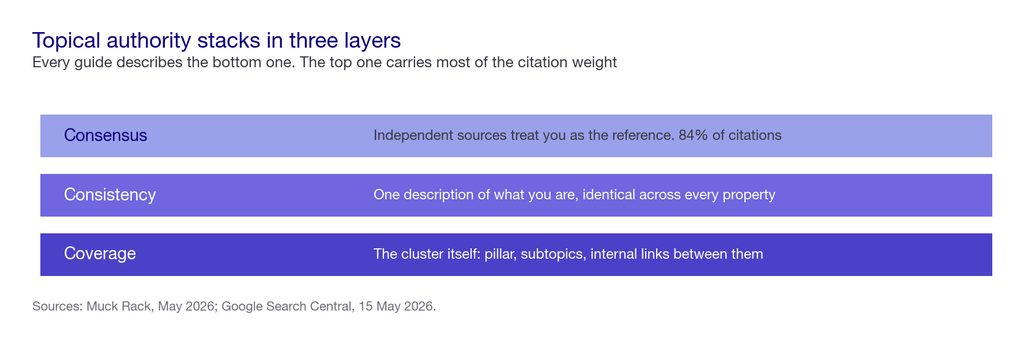
So topical authority stacks in three layers:
- Coverage. The cluster itself: a pillar, the subtopics around it, and internal links carrying context between them. It is necessary, fully in your control, and the layer every guide describes.
- Consistency. One description of what you are, in buyer language, identical across every property. Cheap to fix and invisible until an engine puts you in the wrong category. It is the fastest way to undermine an otherwise good cluster.
- Consensus. Independent, credible sources treating you as the reference on this subject. Slowest, least controllable, and the layer carrying the majority of the citation weight.
A cluster without consensus produces a site that ranks and does not get quoted. That is the specific failure we are called in to fix most often.
How to build it, in order
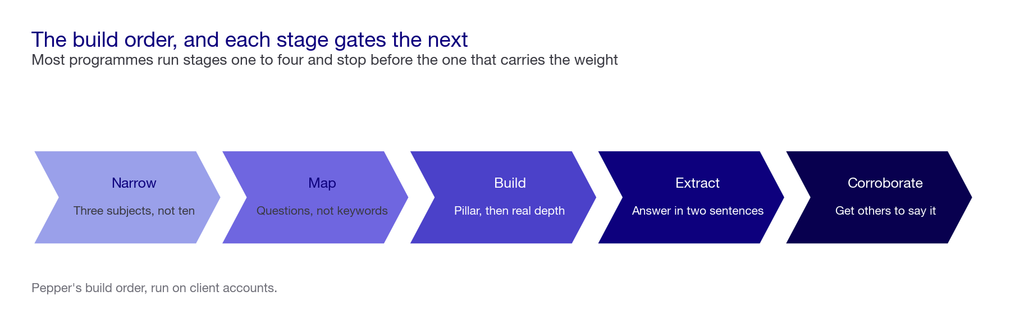
Five stages. Each is wasted effort if the one before it is incomplete.
1. Pick fewer subjects than feels comfortable
The most common mistake is claiming too much ground. Three subjects you genuinely own beat ten you cover thinly, because authority is judged per subject rather than per domain.
Choose based on commercial relevance and honest capability. If you cannot staff a genuine expert on a subject, it is not your subject yet.
2. Map the questions, not the keywords
Write down every question a buyer asks on the way to a decision on that subject. Include:
- Definitional questions, which are how people enter the subject and how engines learn what you cover.
- Comparison questions, including comparisons against named competitors. This is where most brands go quiet, and where they lose the citation by default.
- Objection questions, the ones your sales team answers every week and your site never addresses.
- Operational questions, the how-do-I-actually-do-this ones. These are the most citable, because they contain specifics nobody can paraphrase.
3. Build the pillar, then the depth
The pillar page defines the subject and routes to everything else. The cluster pages each own one question completely.
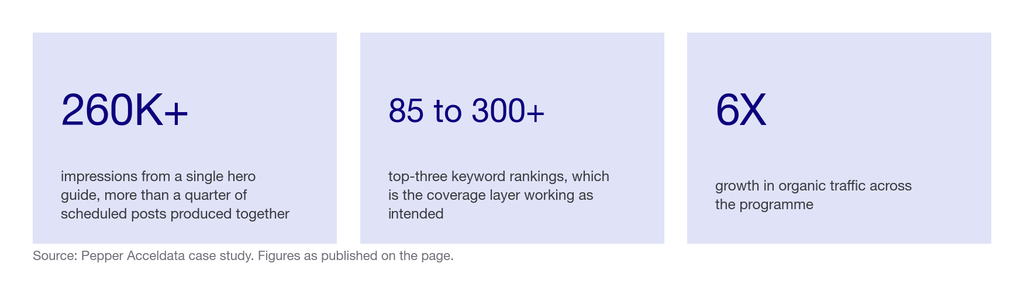
Depth is the variable that matters. We have watched this play out directly. On one enterprise account, a single hero guide produced more than 260,000 impressions on its own. That is more than a quarter of the scheduled posts produced between them. Volume fills a calendar. Depth gets cited.
4. Make every page extractable
A cluster of comprehensive pages that bury their answers will rank and not get quoted.
- Headings as real questions, phrased the way a buyer types them rather than as noun phrases.
- The answer in the first two sentences under each heading, with the depth below for the reader who needs it.
- Real HTML tables, not screenshots of tables, because an engine cannot read a picture.
- Specifics over adjectives. Numbers, dates, named methods and stated limitations are what a model can lift and attribute.
5. Work the consensus layer
This is where most programmes stop and where the majority of the citation weight sits.
Open the answers where a competitor is cited and you are not, and look at which sources the engine trusted. That list, not a keyword report, is your target list. Then get those sources to describe you accurately. Directories, analyst notes, journalism, and comparison pages you do not own. The mechanics are in LLM seeding.
What this looked like on a real account
Acceldata is the clearest proof we have that depth beats breadth in a technical category.
The published results:
- 6X growth in organic traffic.
- Top-three keyword rankings from 85 to more than 300, which is the coverage layer working.
- More than 100,000 new organic users, at a 47 percent engagement rate.
- More than 260,000 impressions from a single hero guide, which is the depth argument in one number.
SalesHood shows the same principle on the AI surface specifically. Alongside technical fixes and a content engine of 20 new pieces and 8 refreshed, AI Overview visibility went from 14 keywords to 97, and clicks rose 20 percent against an industry-wide decline.
Neither account got there by publishing more. Both got there by owning fewer subjects properly.
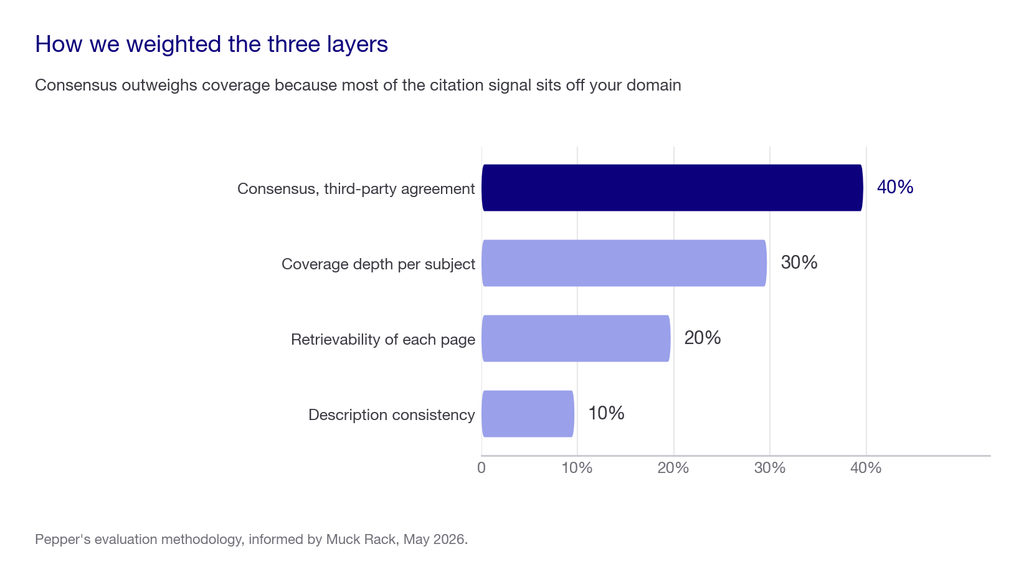
Our methodology: how we weighted the layers
| Layer | Weight | Why it carries this much |
|---|---|---|
| Consensus, third-party agreement | 40% | 84% of AI citations come from sources you do not own, in a 25M-link corpus |
| Coverage depth per subject | 30% | Depth is what gets quoted. One hero guide outperformed a quarter of scheduled posts on a real account |
| Retrievability of each page | 20% | Being comprehensive is not being extractable, and this closes that specific gap |
| Description consistency | 10% | Cheapest to fix, and it silently caps everything above it when wrong |
Cluster strategies at a glance
| Strategy | What it looks like | Typical cost | Where it falls short |
|---|---|---|---|
| Broad and thin | Ten-plus subjects, a handful of pages each | Highest volume, lowest cost per page | Owns nothing. Ranks for long tail, rarely cited, and expensive to maintain |
| Deep and narrow | Three subjects, genuinely complete coverage | Fewer pages, higher cost each | Slower to show breadth, and it fails if you picked the wrong three subjects |
| Pillar-only | One comprehensive page, no cluster | Cheapest to start | The pillar cannot answer every question, so it caps out fast |
| Cluster plus consensus | Deep clusters, plus earned third-party coverage | Highest total, and the slowest | Hardest to staff, and the earned half cannot be bought outright |
| Volume publishing | High cadence across everything | Predictable and easy to sell | Produces pages, not authority. Paid and advertorial placement is 0.3% of citations |
—
How to choose where to start
Most teams already have a cluster of some kind. The question is which layer is actually broken.
The scorecard
Score your strongest subject out of 100. Do this per subject, not per site, because authority is judged per subject.
| Area | Weight | How to score it honestly |
|---|---|---|
| Consensus | 35% | Independent credible sources describe you as a reference on this subject, unpaid, and you can name three |
| Coverage depth | 30% | You answer the definitional, comparison, objection and operational questions, including the ones that are awkward for you |
| Retrievability | 20% | Headings are questions, answers come first, tables are text, specifics beat adjectives |
| Consistency | 10% | Every property describes the subject and your role in it identically |
| Internal linking | 5% | The pillar and cluster genuinely interlink, with anchors that describe the destination |
### The live test, over 90 days
Fix 30 prompts covering one subject, phrased the way buyers ask. Real questions, such as “what is data observability”, “how does Acceldata compare to its competitors”, “which sales enablement platform suits mid-market” and “how do I build topical authority for AI search”.
Run them across Google, ChatGPT and Perplexity, and log three things:
- Are you named at all, which is the coverage and consensus question combined.
- Is a page from your cluster cited, which isolates retrievability.
- Which sources were cited instead, which becomes your consensus target list.
Rerun the identical set monthly for 90 days. Three readings is the shortest honest window: one is a snapshot, two could be noise, three shows direction. Keep the prompt set fixed, because changing it resets the comparison.
Weak approach versus strong approach
The weaker approach: pick fifteen subjects, brief forty articles a month, publish on cadence, interlink everything, and report on pages shipped. It produces a large site with no subject anyone would cite it on.
The stronger approach: pick three subjects, answer every real question on each including the awkward comparisons, make each page extractable, then spend the saved production budget on getting independent sources to describe you as the reference.
The difference is what the budget buys. The weak version buys pages. The strong version buys a reputation on a smaller number of subjects, which is what topical authority actually is.
Red flags
- A topical authority score. No such metric exists in any ranking system. A tool showing you one is showing you its own model.
- Cluster maps with no consensus work attached. On-domain architecture addresses the minority of the citation signal.
- Article-count commitments as the headline. Pieces per month is an input, and in this discipline a misleading one.
- No competitor comparison pages in the plan. Going quiet on comparison questions cedes the citation by default.
- Advice to add more schema. Google’s May 2026 guidance names structured-data over-optimisation as unnecessary for its AI features.
- A single blended visibility score. It hides whether you are un-named or merely un-cited, which need different fixes.
Five questions worth asking a partner
- “How many subjects should we drop?” A good partner narrows. A weak one adds a cluster.
- “What proportion of this scope is off our domain?” If none, it addresses the minority of the signal.
- “Show me a query where a competitor is cited and explain why.” Separates retrieval understanding from production capacity.
- “Which awkward questions will you make us answer?” Comparison and objection pages are where authority is won and where most brands flinch.
- “How will you tell a coverage problem from a consensus problem?” You want two separate numbers, per engine.
Reduced to one principle: own fewer subjects, completely, and get other people to say so.
One closing note that costs us something. Consensus work is slow, it reports badly month to month, and it is genuinely harder to sell than a content calendar, ours included. A partner proposing only pages is proposing the tractable half of the job.
What does building topical authority cost?
| What you are buying | Typical 2026 cost | What it covers |
|---|---|---|
| Question mapping for one subject | A few days, internal or with a partner | The definitional, comparison, objection and operational questions |
| A genuine pillar page | The most expensive single page you will commission | The page the whole subject routes through |
| Cluster pages with real depth | Priced per page, and higher than volume content | Each owning one question completely |
| Retrievability pass on existing pages | Roughly a day of editing per page | Turning ranked pages into quotable ones |
| Consensus and earned coverage | The largest line item, and the slowest | Directories, analysts, journalism, comparison pages you do not own |
| Manual measurement | Free, about two hours a month | 30 prompts, three engines, named and cited logged separately |
| Platform plus a growth team | Custom | Pepper: per-engine tracking, plus the people and agents doing the work |
The recurring pattern: teams budget generously for pages and not at all for the consensus layer, then conclude that content does not work.
What nobody should promise you
A topical authority score, or a specific improvement to one. No such metric exists in any ranking system.
A guaranteed citation or position in an AI answer. Nobody controls generated output, and Google warns against providers guaranteeing rankings.
That a fixed number of cluster pages produces authority. The prescriptions circulating on this topic are agency rules of thumb, not findings from a study with a stated method.
That paid placement builds authority with AI engines. Paid and advertorial content accounted for 0.3 percent of AI citations.
When you should not build a cluster yet
The answer that costs us the sale. If you cannot name three subjects you genuinely want to be known for, or you have no in-house expert on any of them, you do not need a cluster strategy yet and we would tell you not to commission one.
Pick the subjects first and find the expert. A cluster built on a subject nobody at your company can speak to authoritatively produces pages that read like everyone else’s, which is the one outcome guaranteed not to earn a citation.
Frequently asked questions
What is topical authority?
It is the degree to which engines, and the sources engines read, treat you as a reliable reference on a specific subject. It is judged per subject rather than per domain, and it comes from coverage depth, consistent self-description and independent corroboration.
How do I build topical authority for AI search?
Pick fewer subjects than feels comfortable, map the real buyer questions including comparisons and objections, build a pillar with genuinely deep cluster pages, make every page extractable, then work the third-party sources that engines already cite in your category.
What is a topic cluster?
A pillar page defining a subject, surrounded by cluster pages that each own one question within it, interlinked so that context passes between them. It is the coverage layer of topical authority, and on its own it addresses only part of the signal.
How many topic clusters should I have?
Fewer than most guides suggest. Three subjects covered completely beat ten covered thinly, because authority is assessed per subject. The honest constraint is how many subjects you can staff a genuine expert on.
Is there a topical authority score?
No. No ranking system exposes one. Tools that display a topical authority score are showing their own model’s estimate, which is useful as a relative tracker and not as a target to maximise.
Do topic clusters still work for AI search?
Yes, as the coverage layer. Google confirmed in May 2026 that AI Overviews and AI Mode run on core Search ranking systems with no separate AI index, so cluster work compounds into AI answers rather than requiring a parallel programme.
Why is my content ranking but not getting cited?
Usually retrievability or consensus. Either the answer is buried where a model cannot lift it cleanly, or no independent source corroborates your claim, so the engine reaches for a source it trusts more.
Should I write comparison pages against competitors?
Yes, and most brands avoid them. Comparison questions are asked constantly and answered by somebody, so declining to answer them cedes the citation to whoever does, including your competitors.
Where to go next
Pick your strongest subject and run the 30-prompt test on that subject alone. Then score it against the five areas above.
If consensus is your lowest score, and for most teams it is, the fix starts with the source list the test hands you rather than with another content brief.
Book a growth audit · Read the case studies · Explore Pepper’s platform
Sources and further reading
- Muck Rack. “What Is AI Reading?” May 2026. More than 25 million cited links across ChatGPT, Claude and Gemini, 17 industries. Source of the 84 percent earned media, 27 percent journalism and 0.3 percent paid figures. Link
- Google Search Central. AI search optimisation guidance, 15 May 2026. Confirms AI Overviews and AI Mode run on core Search ranking systems with no separate AI index, names structured-data over-optimisation as unnecessary, and warns against guaranteed-ranking claims.
- Pepper. Acceldata case study and SalesHood case study. All figures as published on those pages.
- Pepper. How to structure content for AI citation, for the retrievability layer in detail.
- Pepper. E-E-A-T in the age of AI search, for how engines decide which sources to trust in the first place.
- Deliberately excluded: the “8 to 15 cluster pages”, “3 to 7 clusters” and “30 to 50 articles per cluster” prescriptions that recur across this SERP. They are agency and vendor rules of thumb rather than findings from a study with a stated sample and method.
Latest Blogs
Most advice on this is inference dressed as fact. OpenAI documents exactly one thing clearly, which is access. Here is what is documented, what is inferred, and how to verify the rest for yourself.
Being named in an AI answer and having your page used as its source are different outcomes with different causes and different fixes. The gap between them is the most useful diagnostic in AI search, and most reporting collapses it into one number.
Every platform reports share of voice and almost none of them define it the same way. Here is the definition worth using, the three choices that change the number, and how to measure it yourself without buying anything.
Get your hands on the latest news!

Similar Posts
Content
11 mins read
What is content chunking, and why does it decide whether you get cited?
Content
17 mins read
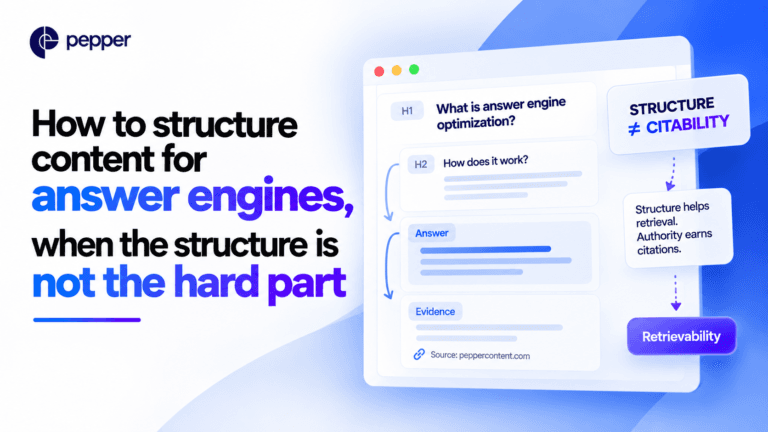
How to structure content for answer engines, when the structure is not the hard part

Content
12 mins read