How to structure content for answer engines, when the structure is not the hard part
The short answer
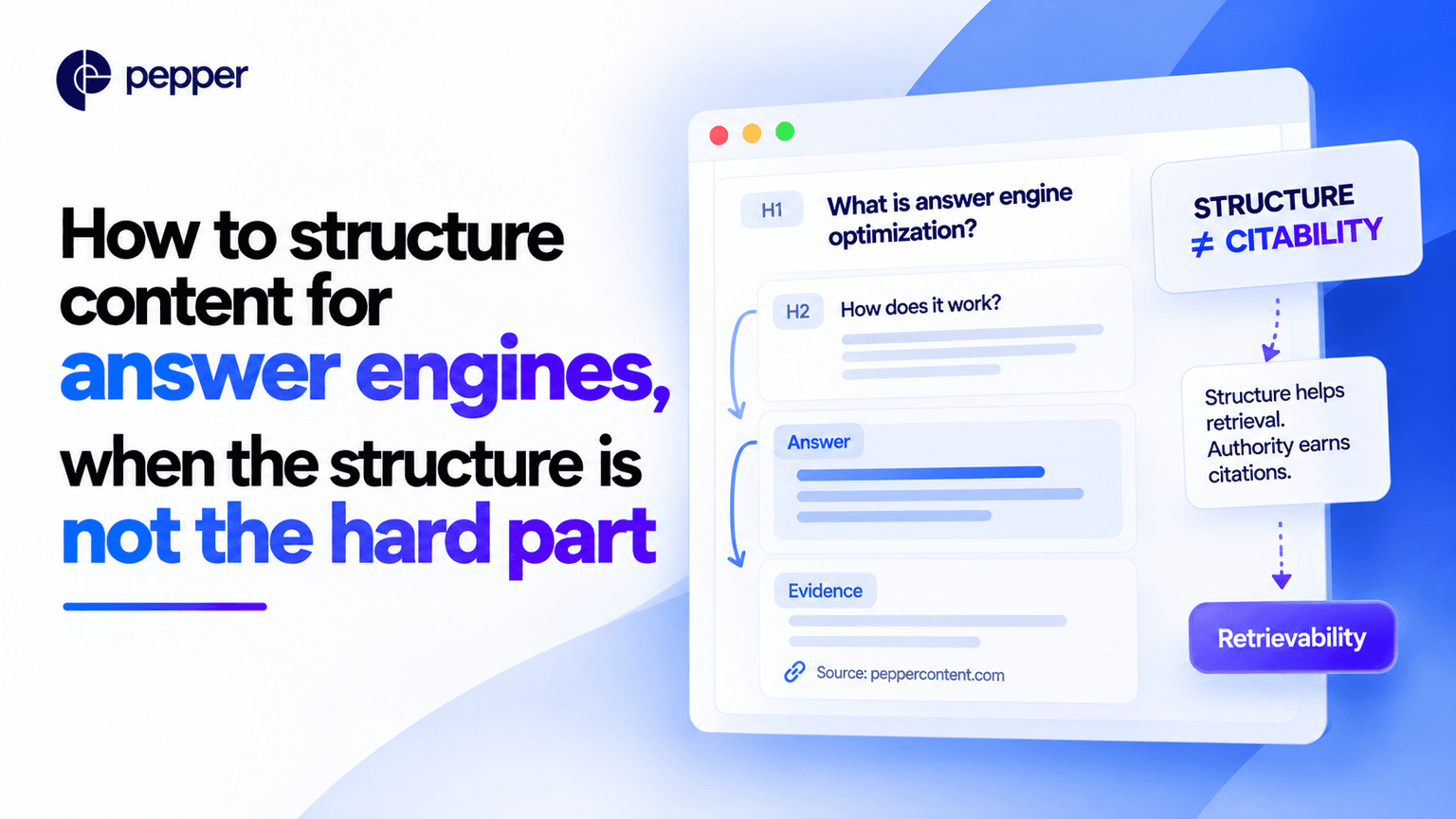
Most advice on how to structure content for answer engines is about the container: heading levels, FAQ blocks, schema, chunk sizes. Google’s own guidance says, in writing, that most of that is unnecessary.
Its guide to generative AI features contains five explicit statements about what you do not need to do. It contains three about what to actually do. The five are all technical. The three are all about the writing.
So the structural work is real but small. It is covered properly in our page structure, H1 and FAQ playbook. This page is about the other part, and almost nobody writes about it. How do you compose a passage that still makes sense after an engine tears it out of your page and drops it into an answer beside two competitors?
That is the whole job. An engine does not quote your page. It quotes a passage, stripped of everything around it. Whether that passage survives the journey is a writing problem, not a markup problem.
Key takeaways
- Google’s guidance is mostly a list of work you can stop doing. No chunking, no llms.txt or AI-specific files, no special schema, no ideal page length, and no special writing style for AI.
- What it does ask for is plain: write for humans, organise in paragraphs and sections with clear headings, add good images and video, and bring first-hand experience you actually have.
- The unit is the passage, not the page. Write each answer so it survives being lifted. Name the subject, carry its own date and units, and never depend on the sentence before it.
- The most common failure we see is the orphaned pronoun. A passage opening with “It” or “This approach” is unquotable. The engine cannot tell what it refers to once the context is gone.
- Structure removes reasons not to quote you. It does not create a reason to. That part sits outside your site. It is why Pepper’s agentic organic growth engine pairs the writing with earned media rather than selling markup.
A note on where this comes from. We run organic for more than 250 enterprises and track more than 10 million prompts across every major engine. This is shaped by that, by the editing we do on client drafts every week, and by what buyers ask at the events we run. The Google quotations are Google’s. The craft judgements are ours.
Book a growth audit if you want to see which of your pages are being mentioned but not quoted, which is usually a writing problem.
What does Google actually ask you to do?

Figure 1: Google’s guidance on generative AI features, counted by type. Applies to Google only.
Google’s guide to optimizing for generative AI features was last updated on 10 July 2026. Read it as a list and the shape is striking.
Five things it says you do not need. Quoted verbatim:
- On chunking: “There’s no requirement to break your content into tiny pieces for AI to better understand it.”
- On special files: “You don’t need to create new machine readable files, AI text files, markup, or Markdown.”
- On writing style: “You don’t need to write in a specific way just for generative AI search.”
- On structured data: “Structured data isn’t required for generative AI search, and there’s no special schema.org markup you need to add.”
- On length: “There’s no ideal page length, and in the end, make pages for your audience, not just for generative AI search.”
Three things it asks for. Also verbatim:
- “Write content for your human audience and make sure the content is well written and easy to follow. People generally appreciate it when web pages are organized by paragraphs and sections, along with headings that provide a clear structure to navigate content.”
- “Add high-quality images and video” where they support the text.
- “Create the content yourself based on what you know about the topic, and consider what in-depth experience you can bring to your content.”
Notice what is missing from the second list. It asks for headings, and never names a level. It never gives a recommended answer length, a chunk size or a schema type. Every positive instruction is about the quality and the origin of the writing.
Where this falls short, and it matters. This is Google’s guidance about Google. ChatGPT, Claude and Perplexity publish no equivalent, and their behaviour need not match. We read this as documentation of what is unnecessary rather than as a promise about what works. We still keep FAQPage and Article schema on client sites, for rich results and entity clarity. We stopped selling it as an AI citation lever.
What is a passage, and why is it the unit of work?
An answer engine does not show your page. It shows a sentence or two from it, next to sentences from other people’s pages, under a question you did not write.
That has three consequences for how you write, and they are the whole method.
- Your passage loses its neighbours. Everything the paragraph above established is gone.
- Your passage loses its page. The title, the heading it sat under and the section it belonged to are not travelling with it.
- Your passage is read beside competitors. It will be compared with two or three others, in the same answer, by a reader who cannot see where any of them came from.
So the test for any paragraph is simple. Cut it out and read it alone. Does it still say something true, specific and attributable? Most drafts fail on the first paragraph, and the fix is usually four words long.
Sometimes engines are not quoting you because they cannot reach you at all. That is a different problem. The page structure and crawlability playbook covers the container, and the Visibility, Citability and Retrievability framework separates the three failure modes.
The extraction test

Figure 2: The five-step test we run on client drafts. It takes about a minute per passage.
This is the exercise Pepper runs on drafts every week. It takes a minute and it catches most of what matters.
- Write the answer as a single paragraph directly under the question it answers. Two to four sentences.
- Cut and paste it into an empty document. Nothing else comes with it.
- Read it as a stranger. Can you tell what product, company or category it is about? Is there a date on any claim that needs one? Would you know what “this” refers to?
- Fix it in place, in the empty document. Name the subject. Add the year. Replace the pronoun. Put the unit inside the sentence.
- Paste it back. If it now reads slightly repetitive on the page, that is correct. A passage that works alone always feels a little over-explained in context. Readers skim past that easily. Engines never forgive an orphan.
The repetition is the price, and it is a small one. No client has ever complained that a paragraph names the company twice. Many have asked why a competitor is quoted from a thinner page.
How to structure content for answer engines: the six rules that survive extraction
1. Name the subject in the first sentence
The most common failure in the drafts Pepper edits is the orphaned pronoun. A passage that begins “It reduces onboarding time by about a third” is unusable, because the engine has no way to tell a reader what “it” is.
- Weaker: “It reduces onboarding time by about a third.”
- Stronger: “Acme’s guided setup reduces onboarding time by about a third.”
The same applies to “this approach”, “the platform”, “the company” and “our solution”. Each is an orphan once the paragraph above is gone.
2. Put the date inside the sentence
A claim with no date attached gets quoted years after it stopped being true. You will not be there to explain.
- Weaker: “Most enterprise buyers now start their research in an AI assistant.”
- Stronger: “In a February 2026 Pew survey, 42% of US adults said they use chatbots to search for information.”
Notice that the stronger version also moves from an assertion to an attributed number, which is the next rule.
3. Attribute the number in the same breath
A statistic is more useful to a reader when the source travels with it. It is also more likely to be quoted at all, because the passage is then verifiable on its own.
- Weaker: “Studies show earned media drives the majority of AI citations.”
- Stronger: “Muck Rack’s May 2026 analysis of more than 25 million cited links found earned media accounted for 84% of AI citations.”
4. Answer first, explain second
Put the answer in the first sentence of the paragraph and the reasoning after it. This is not an AI technique. It is how people read, which is what Google’s guidance asks for. It also happens to be what makes a passage liftable.
- Weaker: “There are several factors to consider, including team size, existing capability and budget, before deciding whether to hire an agency.”
- Stronger: “Hire an agency when the work itself is the bottleneck. Team size, existing capability and budget decide which kind.”
5. Keep the unit and the qualifier in the sentence
Numbers that live in a table cell or a caption do not travel. If a figure matters, write it into a sentence. Give it a unit, a population and a limit.
- Weaker: “Conversion improved by 60%.” (In a table headed “US retail, July 2026”.)
- Stronger: “In July 2026, AI-referred traffic to US retail sites converted 60% better than non-AI traffic, on Adobe Analytics data.”
6. Write one idea per paragraph, and let the heading ask the question
This is the only rule here that is about structure. It is also the one Google explicitly endorses: paragraphs, sections and headings that give a clear structure.
A heading phrased as the question a reader would type, with a self-contained answer under it, gives an engine an obvious unit to lift. It is also easier to read.
What we would not do: break a coherent argument into six sub-headings to create more “chunks”. Google says plainly that there is no requirement to break content into tiny pieces, and a fragmented page reads worse for the human audience the same guidance tells you to write for. For the measurement side, AEO metrics and the AI visibility score covers what to hold a page to.
How the three passage types differ

Figure 3: Three kinds of passage, and what each one has to carry to survive on its own.
Not every passage has the same job, and the failure modes differ. These are the three shapes Pepper sees most often in client drafts.
- Definitions are the most quoted and the least carefully written. A definition names the thing, places it in a category, and says what distinguishes it. None of that can refer to anything above it.
- Comparisons break in a specific way. They get quoted about one side only, so write each side to stand alone, and never rely on a shared subject established two paragraphs earlier.
- Procedures lose their numbering and their prerequisites. State the precondition inside the step. An introductory sentence will not travel with it.
Which techniques are worth the effort

Figure 4: Both axes are defined on the image. Positions are our scoring, not measured values.
Two questions decide whether a technique earns a place in your editing checklist: how much it improves the odds of a passage surviving extraction, and how much work it is to apply.
- Naming the subject and replacing pronouns is the best trade on the page. It costs seconds per paragraph and it is the difference between quotable and unquotable.
- Attributing numbers in the sentence is high value and moderate cost, because the work is in having the source to hand rather than in the writing.
- Answer-first construction is high value and free once a writer has the habit.
- Rewriting a whole page into question-shaped headings is moderate value and high cost. It is also easy to overdo, to the point where the page reads like a quiz.
- Chunking into tiny sections and adding schema for AI is low value and high cost, and Google says both are unnecessary.
Our methodology: how we weighted the techniques
| Criterion | Weight | Why it carries that weight |
|---|---|---|
| Does the passage survive on its own | 40 | The single test that matters. A passage that cannot be understood alone will not be quoted, whatever else is true about the page. |
| Is it endorsed by published guidance | 20 | Google is the only engine publishing any. A technique it explicitly calls unnecessary should not be sold as essential. |
| Does it also improve the page for a reader | 20 | Anything that helps machines and hurts humans will be reversed within two quarters, usually by a reader complaint. |
| How cheap is it to apply at scale | 20 | A rule a writer can hold in their head beats one that needs a checklist, because only the first survives contact with a deadline. |
Weights sum to 100. Survival on its own carries 40. That is Pepper’s judgement rather than a fact, and it is the judgement this page rests on. We publish our weightings the same way we publish [how we rank GEO agencies](https://www.pepper.inc/blog/geo-agency-ranking-methodology/), so you can argue with them precisely.
What would change these weights. If your pages are not being reached at all, none of this matters until the crawl and rendering problems are fixed, and the container playbook outranks everything here. If you publish in several languages, cheapness at scale rises sharply.
Writing techniques for answer engines at a glance
| Technique | What it fixes | Cost in editing time | Google’s published position | Worth doing |
|---|---|---|---|---|
| Name the subject in the first sentence | Orphaned pronouns, the most common failure | Seconds per paragraph | Consistent with writing well for humans | Always |
| Date inside the sentence | Claims quoted after they expire | Seconds | Consistent | Always |
| Attribute numbers in the sentence | Unverifiable statistics nobody quotes | Minutes, if you have the source | Consistent | Always |
| Answer first, explain second | Buried answers that do not lift | Free, once it is a habit | Consistent | Always |
| Units and qualifiers in the sentence | Figures stranded in tables and captions | Seconds | Consistent | Always |
| Question-shaped headings | Passages with no obvious boundary | Moderate | Endorsed: headings give clear structure | Usually |
| FAQ block where questions are real | Genuine repeat questions | Moderate | Not required, but not discouraged | Sometimes |
| Schema markup for AI citations | Nothing, on Google’s own account | High | “Structured data isn’t required for generative AI search” | No, not for this reason |
| Chunking into tiny sections | Nothing | High | “There’s no requirement to break your content into tiny pieces” | No |
| llms.txt and AI-specific files | Nothing, on Google’s own account | Moderate | “You don’t need to create new machine readable files” | No |
## What this costs to do properly
The honest answer is that it costs editing time rather than budget. That is why it is both cheap and rarely done.
- On a new draft: roughly ten minutes per 1,500 words, once a writer has the six rules. Most of it is replacing pronouns and moving dates into sentences.
- On an existing library: this is the expensive version. Budget an hour per page for anything you intend to keep, and do not do it to pages you would not otherwise update.
- What it does not cost: a platform, a schema consultant or a replatform. If a supplier quotes a project to make your content AI-ready and the deliverable is markup, check it against Google’s published position first.
- What it will not do on its own: get you cited. Engines cite third-party sources far more than brand sites, and our AI search statistics page collects the numbers on that. If citations rather than writing are the constraint, what AI search optimisation actually involves is the wider read. Writing well makes you quotable. It does not make you visible.
Where Pepper fits
We are an agentic organic growth engine, and on this page the relevant part is that we edit for extraction as a standing practice rather than as a project.
- An organic growth partner. A growth team is attached to your account, a senior strategist plus always-on agents, accountable for the number rather than for a word count.
- Pepper’s GEO platform. Genuinely self-serve and included rather than billed as a separate licence. You log in and set up a workspace. Define your brand profile, competitors and personas, connect GA4 and Search Console, then manage your own themes, prompts and analytics across six engines including ChatGPT, Perplexity, Gemini, Claude and Google AI Overviews.
- The Agent Atlas. Your team builds, versions and runs its own agents, including editing agents that apply rules like the six above at volume, and you keep them.
The measurement is what makes this checkable rather than a matter of taste. Brand Visibility is how often engines mention you by name. Domain Prompt Presence is how often they cite a page from your domain. When the first is healthy and the second is flat, you are being talked about and not quoted. That is a writing problem. For what the combination produces, the Acceldata case study records 6X organic traffic and top-three keywords rising from 85 to more than 300, mostly through B2B SaaS programmes.
Where it falls short: editing for extraction is a habit rather than a deliverable. It is hard to price and harder to show on an invoice, and we lose deals to suppliers who will sell a schema project instead. We are built for teams running organic as a long-term function, so a one-off rewrite of forty pages is not what we are for. And none of this helps if your pages cannot be crawled or rendered, which is a technical problem we are not the deepest specialists in.
How to choose what to fix first
I will write this in the first person, because a recommendation nobody will defend is worth nothing.
Start by finding out whether you have this problem at all. Being absent from answers and being present but never quoted are different failures with different fixes. Most teams start editing before they know which one they have. If engines do not mention your brand at all, writing better passages will not help this quarter. If they mention you constantly and cite somebody else’s page, this is exactly your problem.
So my order is: diagnose, then fix the pages that already get mentioned, then hold the line on new drafts. Here is the scorecard I would use on any page before editing it, on a 100 point scale.
| Area | Weight | What a page worth editing demonstrates |
|---|---|---|
| Engines already mention the topic | 30 | You appear in answers on this subject, even if the citation goes elsewhere. Editing a page nobody surfaces changes nothing. |
| The page has a real answer in it | 25 | Something specific, dated and attributable that a reader could act on. Editing cannot add substance that was never there. |
| The passages fail the extraction test | 20 | Orphaned pronouns, undated claims, numbers stranded in tables. If they pass already, move on to the next page. |
| It is a page you would update anyway | 15 | Editing for extraction is cheap on a page in the refresh cycle and expensive as a standalone project. |
| Someone owns it afterwards | 10 | A page edited once and then abandoned drifts back. Rules only hold where somebody applies them to the next draft. |
Five questions I would ask before spending a day on this, in this order.
- “Are we mentioned on this topic, and is anyone citing our page?” A stronger signal is healthy mentions with flat domain citations, which is precisely the gap this work closes. A weaker one is silence, which means the problem is upstream.
- “Does this page contain a claim worth quoting?” If the answer is a page of generalities, editing it is polishing.
- “Which paragraph would we want quoted?” Ask the writer to point at it. If they cannot, an engine will not find it either.
- “Can that paragraph be read alone?” Cut it out and try. This is the whole method in one question.
- “Who applies these rules to the next draft?” Without an answer, you are buying a one-off clean-up.
Red flags, each one something a supplier actually says. “We will make your content AI-ready with structured data”, which Google’s own guidance says is not required for generative AI search. “Chunk your pages for better AI comprehension”, which Google explicitly says is not a requirement. “We will add an llms.txt”, which Google says you do not need. A guarantee of citations, which nobody can promise. And a rewrite quoted per page with no diagnostic first, which is selling volume rather than judgement.
Before committing, run the diagnostic yourself. Write 25 real commercial questions your buyers would type. Run each of those 25 prompts three times across every engine you care about, because engines are probabilistic and one run is an anecdote. Then give any fix 90 days before you judge it. Four worked examples for a mid-market B2B software company:
- “best data observability platform for enterprise”
- “how do I monitor data quality across Snowflake and Databricks”
- “what should I look for in a data observability vendor”
- “who competes with Monte Carlo in data observability”
Read which passages the engines quoted, from whose pages. That tells you what a winning passage looks like in your category better than any guide can, including this one. Checking whether your brand appears in AI search walks through it properly.
And the answer that loses Pepper the sale: if engines are not mentioning your brand at all, do not spend a day editing passages and do not hire us to do it. Fix the reason you are absent first. Usually it is that nobody outside your site is talking about you. Editing is for pages that are already in the room.
It comes down to one principle: write every passage so it survives being taken away from you. That is the entire method, it is free, and it is the one thing on this page that no engine’s guidance will ever tell you to stop doing. It is also the weakest commercial argument we make, ours included, because a habit is almost impossible to sell as a deliverable and we lose those deals to firms quoting a schema project instead.
What nobody should promise you
- A guaranteed citation or position in an AI answer. Engines are probabilistic and nobody controls their ranking systems.
- That schema or llms.txt will get you cited. Google’s published guidance says neither is required for generative AI search.
- An ideal passage length. Google says there is no ideal page length, and we have seen two-sentence and six-sentence passages quoted from the same site in the same week.
- That writing well is sufficient. It makes you quotable. Being quotable is not the same as being visible.
- That any of this applies equally to every engine. Google is the only one publishing guidance. The rest we infer from behaviour, and we say so.
Frequently asked questions
How do I structure content for answer engines?
Write each answer as a self-contained passage under a question-shaped heading. Name the subject in the first sentence, and keep dates, units and attribution inside it. Google says explicitly that chunking, special markup and an AI-specific writing style are not required.
Does Google recommend any special formatting for AI search?
No. Its guidance says there is no requirement to break content into tiny pieces, no need for AI text files or Markdown, no special schema, no ideal page length and no special writing style. What it asks for is clear paragraphs, sections and headings written for humans.
Do I need schema markup for AI citations?
Not for that reason. Google states that structured data is not required for generative AI search and there is no special schema you need to add. We still keep FAQPage and Article schema for rich results and entity clarity, and we no longer sell it as a citation lever.
What is the extraction test?
Cut a paragraph out of your page, paste it into an empty document and read it as a stranger. If you cannot tell what it is about, when the claim was true, or what a pronoun refers to, an engine cannot either. Fix it there, then paste it back.
Why do engines mention my brand but never cite my page?
Usually because your passages do not survive being lifted. Orphaned pronouns, undated claims and numbers stranded in tables are the three most common causes in drafts we edit. It can also mean third-party sources answer the question better.
How long should an answer paragraph be?
There is no ideal length and Google says so directly. In practice we write two to four sentences under a question-shaped heading. That is usually the shortest span that can carry a subject, a claim, a date and a qualifier without becoming a summary.
Should I add an FAQ section to every page?
No. Add one where readers genuinely ask repeated questions that do not fit the main argument. An FAQ block invented to create extractable chunks reads as padding to a human and adds nothing on Google’s published account.
Does writing for extraction hurt readability?
Slightly, and it is worth it. A passage that works alone reads a little over-explained in context, because it names things the reader already knows. Readers skim past that easily. Engines do not forgive an orphaned pronoun at all.
Where to go next
If engines cannot reach or render your pages, the writing is not the constraint yet. The page structure, H1 and FAQ playbook covers the container, crawlability and what to do about schema.
To find out which failure you actually have, checking whether your brand appears in AI search is the free diagnostic, and our model of visibility against citability separates the three. If the vocabulary is the sticking point, the types of SEO in 2026 sorts the terms out. For the numbers behind all of it, our AI search statistics page shows what holds up and what does not.
Sources and further reading
- Google Search Central, “Optimizing your website for generative AI features on Google Search”, last updated 10 July 2026, read at source on 22 September 2026. All eight quotations on this page are verbatim from this document. Five statements about what is not required: chunking, machine readable files and Markdown, a specific writing style, structured data, and an ideal page length. Three about what to do: write well for a human audience with paragraphs, sections and headings; add high-quality images and video; create content yourself from what you know. This is Google’s guidance about Google. No other engine publishes an equivalent.
- Pew Research Center, “Americans’ Views on AI Chatbots, Smart Devices and AI’s Impact”, published 17 June 2026. The 42% of US adults who say they use chatbots to search, used as a worked example of a dated, attributed claim. American Trends Panel, 5,119 US adults, fielded 17 to 23 February 2026. US adults only.
- Muck Rack, “What Is AI Reading?”, May 2026 edition. Earned media accounted for 84% of AI citations across more than 25 million cited links from ChatGPT, Claude and Gemini in 17 industries. Used as a worked example of attribution inside a sentence. Muck Rack sells PR software and benefits if this result is true. Not hyperlinked, per our policy on vendor links.
- Adobe Analytics, July 2026, on AI-referred traffic to US retail sites converting 60% better than non-AI traffic. Used as a worked example of units and qualifiers inside a sentence. Figures move monthly and are covered properly on our statistics page.
Further reading on Pepper, each checked live on 22 September 2026:
- AEO page structure, H1s and FAQ strategy, the container this page deliberately does not cover.
- Visibility, Citability and Retrievability, the model that separates the three failure modes.
- AI search statistics that hold up in 2026, the numbers, with their samples and dates.
- The half-hour AI visibility check, free and self-serve.
A note on scope and on corrections. This page covers the writing: how to compose a passage that survives extraction. It deliberately does not re-cover page structure, heading hierarchy, crawlability or schema implementation, all of which sit in the playbook linked above. It does not restate the earned media argument beyond one worked example. Everything from the previous version has been replaced rather than updated. Its ten techniques were about keyword placement, URLs and posting frequency, and it contained no reference to answer engines of any kind.
Latest Blogs
Most advice on this is inference dressed as fact. OpenAI documents exactly one thing clearly, which is access. Here is what is documented, what is inferred, and how to verify the rest for yourself.
Being named in an AI answer and having your page used as its source are different outcomes with different causes and different fixes. The gap between them is the most useful diagnostic in AI search, and most reporting collapses it into one number.
Every platform reports share of voice and almost none of them define it the same way. Here is the definition worth using, the three choices that change the number, and how to measure it yourself without buying anything.
Get your hands on the latest news!

Similar Posts
Content
11 mins read
What is content chunking, and why does it decide whether you get cited?

Content
12 mins read
How to write content that AI engines actually cite
Blogging
14 mins read