How to optimize for answer engines: page structure, H1s and FAQ strategy
The short answer
Structure your pages so an answer engine can find and lift a single passage. That means one front-loaded H1, question-shaped H2s that stand alone, and a direct 40 to 60 word answer under each one. That work buys retrievability. It does not buy citation. Confusing the two is the most expensive mistake on this topic.
Key takeaways
- Retrieval is the bottleneck, not comprehension. A Stanford-led evaluation of commercial chatbots published in May 2026 found that retrieval failures, not reasoning failures, drive over 70% of all errors. Structure is how you stop being the page that never gets retrieved.
- Citation is a different problem. Muck Rack’s May 2026 analysis of more than 25 million cited links puts earned media at 84% of AI citations. No heading hierarchy manufactures that.
- Google has now told you what to skip. Its own guidance says you do not need llms.txt, content chunking, AI-specific rewrites or special schema to appear in Google Search. Several of the top-ranking AEO guides still prescribe all four.
- An FAQ earns its place when readers have genuine follow-up questions that nothing else on the page answers cleanly. Five generic questions bolted onto every article is formatting, not strategy.
- If your brand gets mentioned constantly and your pages never get cited, structure is not your problem. Authority is.
A note on where this comes from. We run organic for more than 250 enterprises and track over 10 million prompts across every major engine. The view below is shaped by that, by the client reviews we sit in each week, and by what operators tell us at the events we run. Pepper is an agentic organic growth engine, so we have a commercial interest here. This is our read on the category, not a neutral checklist.
What is answer engine optimization, and what does page structure actually do?
Answer engine optimization is the practice of making content retrievable and quotable by systems that answer a question instead of returning ten links. For the acronym boundaries, see AEO vs GEO vs AIO vs LLMO and our glossary of core AEO terms.
Page structure does one specific job inside that. It decides whether a machine can locate the passage that answers a question and lift it without mangling it.
That is narrower than most guides imply, and the narrowness is the useful part. We think in three levers, and structure touches one: Visibility, Citability and Retrievability. Visibility is whether an engine names you at all. Citability is whether it trusts your pages enough to cite them. Retrievability is whether you surface however the question gets phrased.
Structure is a retrievability instrument. Treat it as one and it works. Treat it as a citation strategy and you will do a lot of markup for nothing.
Why retrievability is the part you can actually fix
In May 2026, a Stanford-led team published an evaluation of commercial AI chatbots acting as news intermediaries. Their headline result: “retrieval, not reasoning, failures drive over 70% of all errors”. When the models found the right source, they usually extracted the right answer. The failure was upstream, in finding the source at all.<!–
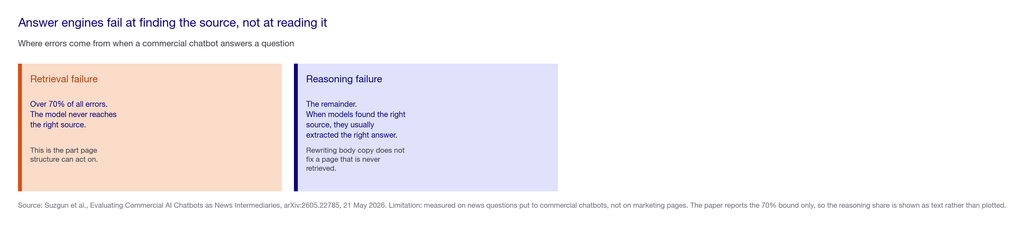
The engine is not failing to understand your argument. It is failing to reach it. That is a structural problem, and structural problems have fixes. So we would not spend a sprint making body copy sound more quotable before the page is reliably reachable.
One caution. That study measured news questions put to commercial chatbots, not marketing pages on your site. It tells you where the machinery breaks. It does not tell you your page is broken.
Our view: structure is necessary and nowhere near sufficient
Every guide ranking for this query agrees on the mechanics, and they are broadly right. Front-load the H1, shape headings like questions, put a direct answer under each one, keep answers out from behind accordions and JavaScript, add FAQPage schema.
The pattern we see in accounts we take over is that teams do all of it competently, then stall. Brand mentions look healthy. Citations to their own domain stay flat. Nobody on the SERP tells them what to do next, because every one of those pages ends where the formatting ends.
Structure removes the reasons an engine cannot use your page. It does not create a reason for the engine to prefer it.
Muck Rack’s May 2026 edition of What is AI reading? analysed more than 25 million links cited by ChatGPT, Claude and Gemini across 17 industries. Earned media accounted for 84% of citations. Journalism alone was 27% of cited sources. Paid and advertorial content was 0.3%.
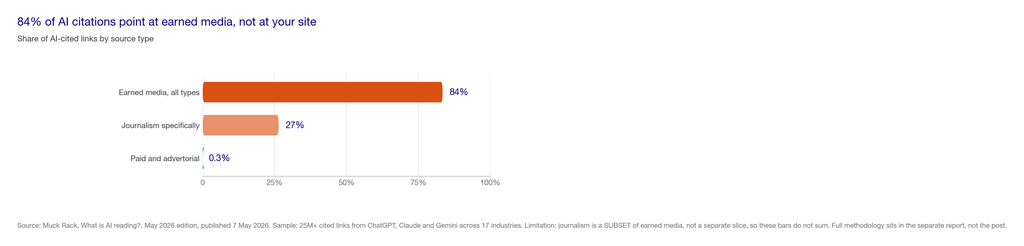
Your own site is not in the 84%. It sits in the remainder, competing with every other brand-owned page. That is not a reason to skip the structural work. It is a reason to size it correctly: a week of effort, not a quarter.
Want to see that split before you decide where to spend? Pepper’s GEO platform reports it as Brand Visibility against Domain Prompt Presence. Book a growth audit and we will show you which of the two is your constraint.
How we built this playbook
We scored candidate structural moves against five criteria before writing a word, and cut anything that failed the first two. Weights were fixed in advance.
| Criterion | Weight | What a move has to demonstrate |
|---|---|---|
| Removes a known retrieval failure | 30 | The move addresses something that demonstrably stops a passage being found or lifted, rather than something that only looks tidier in the HTML |
| Survives a change in phrasing | 20 | The page still answers when the question is asked in different words, because winning one phrasing and vanishing on the next is winning by luck |
| Consistent with Google’s published guidance | 20 | The move is not something Google has explicitly said is unnecessary, and where we disagree with Google we say so and explain why |
| Implementable without a rebuild | 15 | An editorial or template change a content team can ship, not a six-month replatform |
| Observable within 90 days | 15 | You can tell whether it worked by watching citations and cited URLs, not by waiting for a vibe to shift |
](https://wordpress.peppercontent.io/wp-content/uploads/2026/09/image-4-1024x550.png)
The structural moves at a glance
| Move | What it buys | Where it falls short | Cost to implement |
|---|---|---|---|
| One front-loaded H1 per page | Tells the engine and the reader what the page resolves, in the words most heavily weighted | Cannot rescue a page whose body never answers the H1 | Editorial hours, no engineering |
| Question-shaped, standalone H2s | Lets a model match a heading to a query and lift what sits beneath it | Turns into keyword stuffing if every heading becomes a query string | Editorial hours |
| A 40 to 60 word direct answer under each heading | Gives the engine a clean, complete passage to quote | Reads as robotic if the answer is not then developed for a human | Editorial hours |
| Crawlable, render-free answers | Removes the most common reason a passage is never seen at all | Needs template work, so it is the one move that can stall in a backlog | Engineering time, usually days |
| Clear entity and internal-link structure | Helps engines connect your pages to each other and to your brand | Slow to show effect, and easy to over-engineer | Editorial and engineering, ongoing |
| FAQPage schema on genuine FAQs | Maps cleanly to question-and-answer retrieval where engines use it | Not required by Google, and does nothing for a bad FAQ | An hour, once, per template |
| Earned authority alongside all of it | The 84% of citations that structure cannot reach | Slowest and least controllable of everything here | Retainer or headcount, quarters not weeks |
How to structure a site so answer engines can reach it
Start with reachability. Nothing below it matters if this is broken. An answer rendered client-side, hidden behind a tab, or sitting behind a consent wall is an answer the engine may never see. We would fix that before touching a single H1.
Get the crawler rules right next. Different bots have different jobs, so blocking them fails in different ways. Blocking a scheduled index crawler removes you from the index. Blocking an on-demand fetcher breaks live citation of a page you are otherwise happy to rank. That is why we treat crawlability for AI and robots.txt for AI crawlers as separate exercises.
Then give the site a shape a machine can follow. One page per question cluster. Anchor text that describes the destination, not the source. Consistent naming of your products and category terms, so an engine can tell that fifteen pages belong to one brand.
Where it falls short: none of this shows up in a rankings report, so it gets deprioritised. The next move is to give it a named owner and a number, not a nice-to-have ticket.
The H1 and heading hierarchy that gets extracted
One H1 per page, front-loaded, phrased the way a person would ask. If the query is how to optimize for answer engines, the H1 should resolve that. It should not gesture at it.
Then the rule most teams get wrong: headings have to stand alone. A heading reading “The strategy” tells a model nothing. A heading reading “When does an FAQ earn its place on a page?” is matchable to a real query and announces exactly what the passage below it resolves.
Keep the hierarchy honest: H2 for the questions a reader arrives with, H3 for the sub-questions inside them, no skipped levels. Unglamorous, and the highest-yield editorial change available on most sites, which is why we wrote how to structure content for AI citation as its own guide.
Google’s own position is calmer than the category’s. Its guidance says: “People generally appreciate it when web pages are organized by paragraphs and sections, along with headings.” Headings are good because readers use them. The AI benefit follows from the same work.
Where it falls short: a perfectly structured page with nothing original in it still loses to a messier page that has something to say. Structure only delivers substance you already have.
FAQ strategy: when an FAQ earns its place
An FAQ earns its place when readers have genuine follow-up questions that nothing else on the page answers cleanly. That is the whole test.
What we would not do is append five generic questions to every article so the page has an FAQ. We see it constantly in accounts we inherit, and it carries a real cost: it teaches an engine that your question-shaped content is thin.
When an FAQ is real, build it properly. Pull the questions from what people ask, not from a keyword tool’s related terms. Put each one in an H2 or H3, with the answer directly beneath it. Keep each answer complete in 35 to 50 words. Never make the reader expand anything to see it.
Then mark it up with FAQPage schema, while knowing exactly what that does and does not do.
What Google says you can skip
In May 2026 Google published its first consolidated guidance on optimising for generative AI in Search. It retired several things the top-ranking AEO guides still recommend. Its position on the relationship is direct: “From Google Search’s perspective, optimizing for generative AI search is optimizing for the search experience, and thus still SEO.”
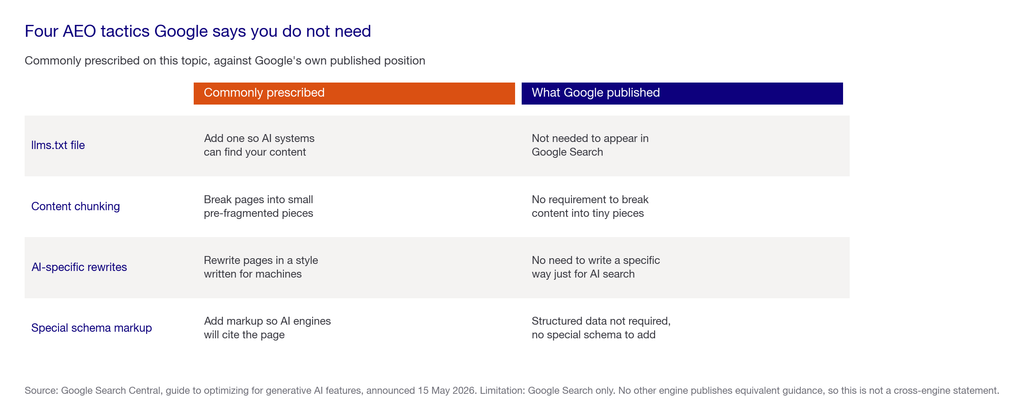
The relevant quotes, verbatim. The relevant quotes, verbatim.
- On machine-readable files, including llms.txt: “You don’t need to create new machine readable files, AI text files, markup, or Markdown to appear in Google Search.”
- On chunking: “There’s no requirement to break your content into tiny pieces for AI to better understand it.”
- On writing style: “You don’t need to write in a specific way just for generative AI search.”
- On schema markup: “Structured data isn’t required for generative AI search, and there’s no special schema.org markup you need to add.”
Now the Pepper view, because this is where we part company with a literal reading. Google is right, for Google. Google is one engine. Structured data still earns its place for rich results, for entity clarity, and for engines that publish nothing, so we keep FAQPage and Article schema on client sites. We no longer sell schema as an AI citation lever. We would push back on anyone who does.
Where it falls short: we read Google’s guidance as documentation, not as a ranking commitment. It tells you what is unnecessary. It does not promise what works.
What to do when the structure is right and you are still not cited
No page on this SERP answers this, and it is the question that brings people to us.
Run the diagnostic first. Compare how often engines mention your brand against how often they cite a page from your domain. Healthy mentions with flat citations is a citability problem, and no amount of heading work will move it. That is what Brand Visibility against Domain Prompt Presence is for. It is the fastest read on whether structure was ever your constraint.
If that is your gap, three moves matter, roughly in this order.
Go and earn the 84%. Engines cite third parties far more than they cite brands. That means the comparison articles, category publications, communities and reviews your buyers already read. This is PR and partnership work, not CMS work. It is why we treat getting cited in AI Overviews as a separate discipline from ranking in them.
Publish something a model cannot reconstruct. Original data, a real methodology, a number nobody else has. Commodity explainers are the most substitutable content on the internet, and answer engines substitute freely.
Measure it properly, per engine. Microsoft shipped first-party citation reporting in Bing Webmaster Tools in February 2026. It covers Copilot, Bing AI summaries and select partner integrations, and it shows cited URLs plus the queries that triggered them. Nothing equivalent exists for most engines. So track citation rate as a trend across a stable prompt set instead. Engines are probabilistic, and one run on one engine establishes nothing.
Our own proof point sits here rather than in the structural section, because that is where the work actually was. Acceldata went from 85 to more than 300 top-three keywords, with 6X organic growth. One hero guide carried over 260,000 impressions.
What this costs to implement
Honest numbers, in effort rather than invoices, because the effort is what teams underestimate.
The editorial half is days, not months. Rewriting H1s, reshaping headings into standalone questions and adding direct answers runs roughly one to two days per twenty pages for a writer who knows the subject.
The engineering half is smaller than it looks and slower than it should be: making answers render server-side and fixing crawler rules is days of work that sits in a backlog for weeks.
The authority half is the expensive one. Earned coverage, original research and third-party presence run in quarters and need a retainer or a hire.
Pepper does not publish pricing, so budget discovery with us is a conversation rather than a page. Customers log in and run this themselves. They set up a workspace, define brand profile, competitors and personas, connect GA4 and Search Console, and manage themes and prompts. They also build and run their own agents in the Agent Atlas. A growth team is attached to the account and does the work alongside them: agents for scale, experts for judgement, one team on the hook for the number.
What we will say plainly is that the structural work above does not need us. It needs an afternoon with this article and a willing developer.
How to choose what to fix first
I would not start from a checklist. I would start by working out which of the three levers is actually broken. The honest answer changes what you do for the next quarter, and most teams get it wrong in the same expensive direction.
The framing judgement first. Google’s guidance says optimising for generative AI search is still SEO. It also tells companies evaluating AEO and GEO services to check whether the advice matches official search guidance. I think that is correct for Google and incomplete as a strategy, because the other engines publish nothing comparable. Hold both. Do not buy a separate AI methodology, and do not assume Google’s answer covers Perplexity or ChatGPT.
Here is the 100-point scorecard I would use, or on a partner pitching me.
| Area | Weight | What a strong implementation should demonstrate |
|---|---|---|
| Retrievability basics | 30 | Answers render without JavaScript, nothing sits behind an accordion or consent wall, and crawler rules distinguish scheduled index bots from on-demand fetchers rather than blocking both |
| Heading and answer architecture | 20 | One front-loaded H1, standalone question-shaped H2s, and a complete 40 to 60 word answer directly beneath each one, with no skipped heading levels anywhere |
| Question and FAQ selection | 15 | Questions come from real buyer language and search behaviour, and someone can explain why a question was excluded, not only why five were included |
| Entity and internal-link clarity | 15 | Consistent naming of products and category terms, and internal anchors that describe the destination so a model learns what the target page covers |
| Earned authority | 20 | A named plan for third-party presence in the sources your category actually cites, with the acknowledgement that this is most of the citation opportunity |
Then run the live test, on yourself or on whoever wants your budget. Give them 25 real commercial questions from your category and ask for a mini audit. For example: “best answer engine optimization tools for enterprise”, “how should a B2B SaaS company improve visibility in ChatGPT”, “what is the difference between AEO and GEO”, “alternatives to our largest competitor”.
Ask them to come back with five things. Where does my brand appear today. Which competitors appear instead. Which sources are influencing those answers. Why are those sources winning. What exactly would you change in the next 90 days. A partner who answers with named sources and a sequenced plan is worth more than a capabilities deck. A partner who cannot admit that answers vary run to run does not understand the medium.
The weaker playbook, and most of what gets sold: find prompts, rewrite blogs into question format, add FAQs, sprinkle statistics, hope for a citation. Every step is real work. The sequence has no theory of why a citation would follow.
The stronger sequence: demand intelligence first, then technical discoverability, then entity and brand authority, then content, then earned-media authority, then distribution, then visibility measurement, then revenue attribution. It matters because engines build an answer from several sources rather than ranking one page. Being retrievable, being selected, and influencing the answer are three separate things, and each is worth measuring on its own.
Red flags, each one a thing we have heard said out loud. “We guarantee ChatGPT citations” should end the meeting. Google itself advises against providers guaranteeing rankings, because no third party has access to the ranking systems. “Here is your AI visibility score” as the entire proposition, with no prompts or cited URLs behind it, is a number you cannot act on. We wrote about the limits of a single AI visibility score separately. Then: tracking only branded prompts, so the report always looks good. Optimising for one engine and calling it AI search. Hundreds of AI-generated articles as the content plan. No stated methodology for prompt selection. Citation counts with no competitor share of voice, which tells you nothing about whether you are winning.
Five questions I would ask, and what a good answer sounds like.
- “Show me exactly how you measure whether a page got retrieved.” They should reach for cited URLs, triggering queries and per-engine behaviour, not a composite score.
- “Take one question where a competitor gets cited and we do not. Explain why.” A good answer names the competing source and what makes it citable, and separates a retrieval failure from an authority gap.
- “Which of my pages would you not restructure?” Anyone restructuring everything is selling hours. The right answer excludes pages where structure was never the constraint.
- “What proportion of the citation opportunity in my category is on my own site?” If they say most of it, they have not read the research. The honest answer is a minority of it.
- “Which part of this advice do you expect to be wrong in twelve months?” Google retired four widely sold tactics in a single May 2026 update. A partner with no answer here is not tracking the field.
If I reduce this to one principle: fix retrievability because it removes failure, and pursue authority because it creates preference. Never let a vendor sell you the first as though it delivers the second.
The honest closing note, and it costs us something. Almost nobody is equally strong across technical structure, editorial execution, earned authority and measurement, ourselves included. The good partners will tell you which of the four is their weakest. Ask, and treat a straight answer as a positive signal.
What nobody should promise you
No one can guarantee a citation or a position in an AI answer. Google advises against exactly that kind of guarantee. No external party has access to the ranking systems that would make it possible.
Nobody should sell you a single composite visibility score as the answer, or a universal benchmark for what a good citation rate looks like. There is no such benchmark. Your own trend and the category leader are the only useful comparisons.
Nobody should claim results from one engine on one run. Nobody should promise clean attribution from a citation to closed revenue, or tell you structure alone will get you cited. We will not, and we would rather lose the deal than pretend otherwise.
Where this stops working, including for us
If your brand barely gets mentioned in your category, this article is the wrong priority. That is a visibility problem. Structural work on pages nobody reaches will not fix it. Go and build presence first.
Say your category has fewer than roughly thirty meaningful commercial questions, or nobody has capacity to act on what you find. Then you do not need a monitoring platform yet, ours included. Spend the money on earned media and revisit in two quarters.
Where Pepper falls short: we do not publish pricing, so budget discovery is a conversation rather than a page. We are built for teams running organic as a long-term function, with an internal team to work alongside. A one-off structural audit is not what we are for. If organic is not a real commitment for the next several quarters, we will say so and turn the work down.
Where to go next
Do the retrievability audit this week. It is cheap and it removes real failure. Then run the mentions-against-citations diagnostic before you commit a quarter to anything.
Want that diagnostic run against your own category rather than described? See where you show up across the engines your buyers use, or book a growth audit and we will bring the prompts.
Frequently asked questions
What is answer engine optimization? Answer engine optimization is the practice of making content retrievable and quotable by systems that answer a question directly instead of returning a list of links. It covers page structure, crawlability, entity clarity and the earned authority that makes a source worth citing.
Does page structure actually affect AI citations? Page structure affects whether your passage can be found and lifted, which is a precondition for citation rather than a cause of it. Muck Rack’s May 2026 analysis puts 84% of citations on earned media, so structure removes barriers rather than creating preference.
How long should a direct answer under a heading be? Aim for 40 to 60 words: long enough to answer the heading completely, short enough to be quoted whole. Write it so it stands alone if lifted, then develop the idea underneath it for the human who kept reading.
Do I need FAQPage schema for answer engine optimization? Google states plainly that structured data is not required for generative AI search and that no special schema.org markup is needed. We still use FAQPage schema for rich results and entity clarity, and for engines that publish no guidance, but not as a citation lever.
Is llms.txt worth adding to my site? Google says you do not need to create machine readable files, AI text files, markup or Markdown to appear in Google Search. No engine currently documents a benefit. It costs almost nothing, so add it if you like, but do not count it as work that moved anything.
How many FAQs should a page have? As many as there are genuine follow-up questions that nothing else on the page answers cleanly, which is often two or three and sometimes none. Adding five generic questions to every article is formatting, and it signals thin content to engines.
Should my H1 be a question? It should match how a person would ask, which often means a question and sometimes a direct statement of what the page resolves. Front-load the substance either way, because opening words carry more weight than anything buried lower.
How do I tell whether structure or authority is my problem? Compare how often engines mention your brand against how often they cite pages from your domain. Healthy mentions with flat citations means authority is the constraint. Low mentions everywhere means visibility is, and structure is the wrong first fix.
Sources and further reading
- Suzgun, Shen, Bianchi, Spangher, Icard, Ho, Jurafsky and Zou, “Evaluating Commercial AI Chatbots as News Intermediaries”, arXiv:2605.22785, submitted 21 May 2026. Source of the finding that retrieval, not reasoning, failures drive over 70% of all errors. Limitation: the task is news questions on commercial chatbots, not marketing pages.
- Muck Rack, “Earned media still drives 84% of AI citations”, What is AI reading? May 2026 edition, published 7 May 2026. Sample: more than 25 million cited links across ChatGPT, Claude and Gemini in 17 industries. Journalism is reported as a subset of earned media at 27%; paid and advertorial at 0.3%. Full methodology sits in the separate report, not the post.
- Google Search Central, guide to optimizing for generative AI features, and the announcement post, 15 May 2026. Every Google quotation in this article appears on one of those two pages. Applies to Google Search only.
- Microsoft, AI Performance in Bing Webmaster Tools, public preview announced 10 February 2026. Covers Copilot, Bing AI summaries and select partner integrations, so it is not a read on every engine.
Latest Blogs
Most advice on this is inference dressed as fact. OpenAI documents exactly one thing clearly, which is access. Here is what is documented, what is inferred, and how to verify the rest for yourself.
Being named in an AI answer and having your page used as its source are different outcomes with different causes and different fixes. The gap between them is the most useful diagnostic in AI search, and most reporting collapses it into one number.
Every platform reports share of voice and almost none of them define it the same way. Here is the definition worth using, the three choices that change the number, and how to measure it yourself without buying anything.
Get your hands on the latest news!

Similar Posts
GEO / AI Search
10 mins read
How to get cited by ChatGPT
GEO / AI Search
10 mins read
Mentioned vs cited: the difference that decides AI visibility
GEO / AI Search
13 mins read