What is Citation Rate: Your Brand’s Report Card in AI Search
Think about raising your hand in class. If the teacher asks 100 questions and you get called on 30 times, you got picked 30% of the time. That’s exactly how citation rate works for your brand when AI answers questions.
What is Citation Rate? (The Simple Version)
Citation rate tells you how often AI platforms mention your brand when people ask relevant questions. If someone tracks 100 questions about dog training, and your pet blog gets mentioned in 25 of those AI answers, your citation rate is 25%.
It’s like keeping score in a game. The scoreboard shows how many times you got picked out of all the times you could have been picked. This number helps you see if AI platforms think your content is worth sharing.
How Does Citation Rate Work?
Here’s the math part (but easy, promise): You count how many times AI mentions your brand, then divide that by the total number of relevant questions you tracked. Multiply by 100, and boom – you have your percentage.
For example, a cooking website tracks 200 recipe questions. AI cites them in 60 answers. The calculation is 60 ÷ 200 = 0.30, which equals 30%. Their citation rate is 30%.
The tricky part? AI has to actually name you or link to you. If AI uses your recipe but doesn’t say where it came from, that doesn’t count. It’s like when your friend repeats your joke but doesn’t give you credit – annoying and not tracked in citation rate.
Why Does Citation Rate Matter?
Citation rate is the number one way to measure success in Answer Engine Optimization (AEO). It’s basically the new version of ranking on Google’s first page.
When your citation rate goes up, more people discover your brand through AI assistants. If you run a gardening blog and your citation rate jumps from 10% to 40%, that means AI recommends you four times more often. More recommendations mean more visitors, more trust, and more chances to help people.
Citation Rate at a Glance
| Feature | Details |
| What it measures | Percentage of AI answers where your brand gets cited |
| How to calculate | (Your citations ÷ Total tracked prompts) × 100 |
| What counts | Direct mentions, links, and clear attribution only |
| What doesn’t count | Paraphrased content without credit |
| Role in AEO | Primary metric for measuring AI search performance |
| Comparison to SEO | Works like ranking position in traditional search |
Real-World Examples
A fitness app tracks 500 workout-related questions across ChatGPT and Perplexity. They get cited in 175 answers. Their citation rate is 35%.
A local bakery monitors 50 questions about birthday cakes in their city. They appear in 12 AI responses. That’s a 24% citation rate.
A tech reviewer watches 1,000 smartphone questions. AI mentions their reviews 280 times. They have a 28% citation rate. This tells them they’re becoming a trusted source for phone advice.
FAQs
What is citation rate in AEO?
Citation rate measures what percentage of relevant AI answers include your brand. It shows how often AI platforms choose to recommend your content when people ask related questions.
How is citation rate calculated?
Divide the number of times AI cites you by the total number of relevant questions you tracked, then multiply by 100. For example, 40 citations out of 200 questions equals a 20% citation rate.
What’s the difference between citation rate and reference rate?
Citation rate tracks breadth (how many different prompts cite you), while reference rate tracks depth (how frequently you’re mentioned overall). One measures coverage, the other measures frequency.
Why does citation rate matter for brands?
It shows how visible you are in AI search results. A higher citation rate means more people discover your brand through AI assistants, similar to ranking higher on traditional search engines.
Wrapping Up
Citation rate is your brand’s batting average in the AI world. Track it, work to improve it, and watch as more people find you through AI-powered answers.
Latest Blogs
Most advice on this is inference dressed as fact. OpenAI documents exactly one thing clearly, which is access. Here is what is documented, what is inferred, and how to verify the rest for yourself.
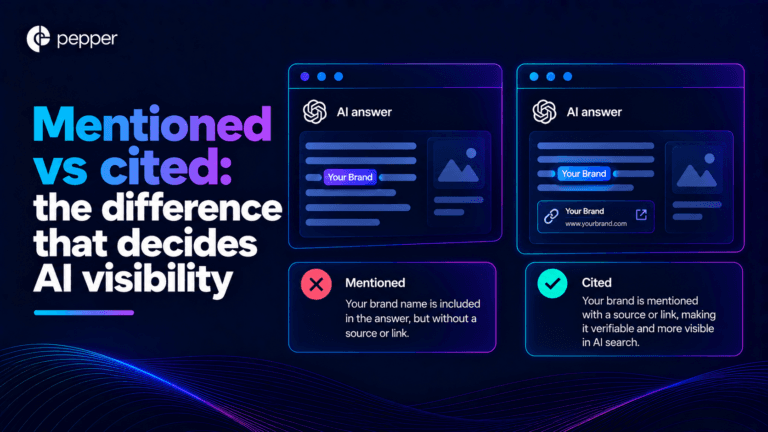
Being named in an AI answer and having your page used as its source are different outcomes with different causes and different fixes. The gap between them is the most useful diagnostic in AI search, and most reporting collapses it into one number.
Every platform reports share of voice and almost none of them define it the same way. Here is the definition worth using, the three choices that change the number, and how to measure it yourself without buying anything.
Get your hands on the latest news!

Similar Posts
GEO / AI Search
10 mins read
How to get cited by ChatGPT
GEO / AI Search
10 mins read
Mentioned vs cited: the difference that decides AI visibility
GEO / AI Search
13 mins read