
The short answer
You can find out in about half an hour, for free, without signing up for anything.
Open a logged-out session, ask ten category questions, repeat on three engines, then tally whether you were named, cited, or absent. That is the entire method. Everything else on this page is about reading the result and deciding whether to go deeper.
The one thing that ruins it: checking while logged in, on an account that has been researching your own company for months. That session is personalised and will flatter you.
Key takeaways
- Ten questions, three engines, one afternoon. Category questions, not your brand name. Branded prompts are the ones you already win.
- Log out, and use a temporary chat. A personalised session is not what a prospect sees, and it is the most common reason a self-run check gives the wrong answer.
- Three results, three different next moves. Named and cited, named but not cited, or absent. The middle one is the most common and the cheapest to fix.
- One run proves nothing. Engines are probabilistic, so the same question resolves differently on different days.
- Most teams should stop after this check. If you find the answer and nobody has capacity to act on it, a paid audit will not change that.
A note on where this comes from. We run organic for more than 250 enterprises and track more than 10 million prompts across every major engine. This is the cut-down version of what we do on day one of an account, shaped by the client reviews we sit in every week. It is our method rather than a published standard, and the charts say so.
What is an AI visibility audit?
An AI visibility audit is a structured check of what AI engines say about you. Do they mention your brand, cite your pages, and describe you accurately when someone asks a question you should own? It differs from an SEO audit, which examines your site. This examines what engines say about you, most of which is assembled from sources you do not control.
There are two honest versions. The free one you can run yourself in half an hour, which is what this page covers. And the client-grade one, which runs hundreds of prompts alongside schema and crawlability checks, covered in our 7-point AI search audit template.
Start with the free one. It tells you whether the paid one is worth commissioning.
Why bother
Because the behaviour is mainstream now, and a brand that is absent from the answer does not know it.
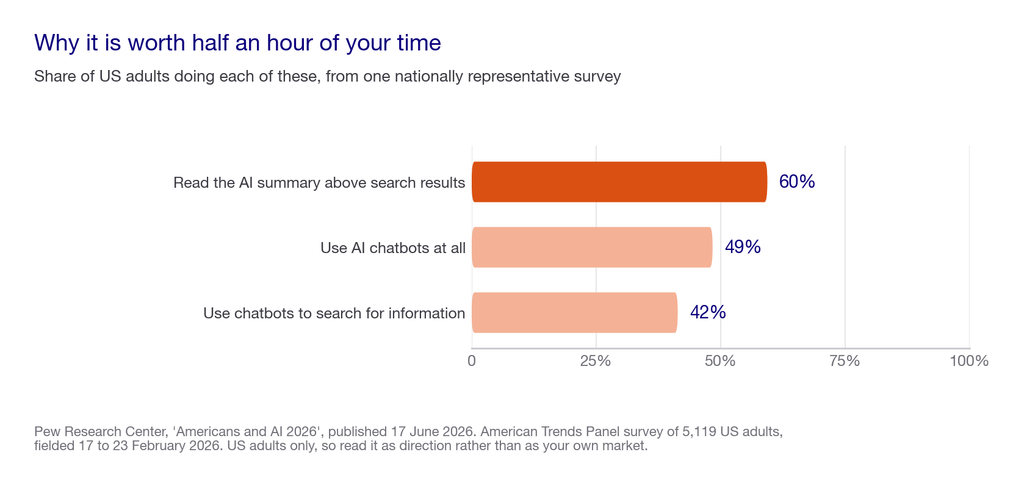
Pew Research Center surveyed 5,119 US adults in February 2026 and published in June. 60% read the AI summary above search results, 49% use AI chatbots at all, and 42% use chatbots to search for information. Those are US figures, so treat them as direction rather than as your own market.
The practical consequence is that you can hold every ranking you had and still lose the introduction, because the answer arrives before the click.
The free check, step by step
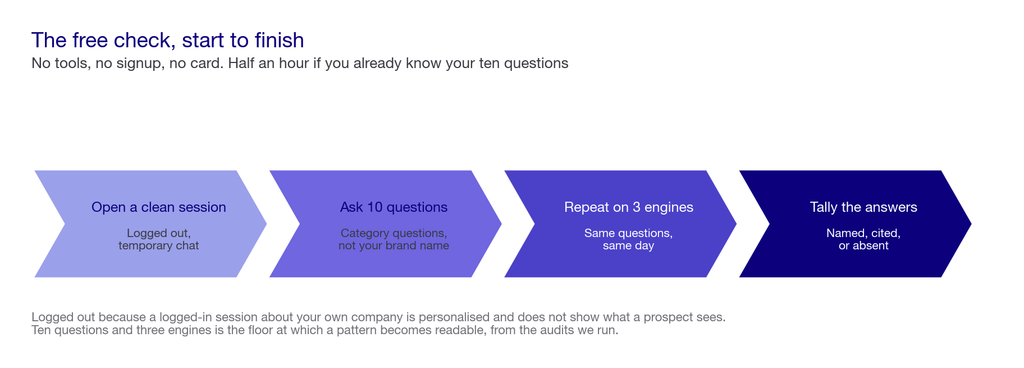
1. Open a clean session
- Log out of the engine entirely, or use a temporary or incognito chat.
- Do not use the account you have been researching your own company on. It is personalised, and it will show you a flattering answer that no prospect sees.
- Set your location if the engine offers it, because answers vary by market.
2. Write ten questions a buyer would actually type
Category questions, not your brand name. You already win your own name, and testing it tells you nothing.
Four worked examples for a mid-market B2B SaaS analytics company:
- “best data observability platform for enterprise”
- “how do I monitor data quality across Snowflake and Databricks”
- “what should I look for in a data observability vendor”
- “alternatives to Monte Carlo for data observability”
Mix three kinds: definitional questions, comparison questions, and decision-stage questions. Ten is the floor at which a pattern becomes readable rather than anecdotal.
3. Repeat across three engines
- Run the same ten questions on ChatGPT, Perplexity and Google AI Overviews, at minimum.
- Add Gemini or Claude if your buyers use them.
- Keep one question per fresh conversation, so the engine does not carry context between answers.
4. Tally what came back
For each answer, record one of three things: were you named and cited, named but not cited, or absent entirely. Thirty data points across ten questions and three engines is enough to see the pattern.
Reading the result
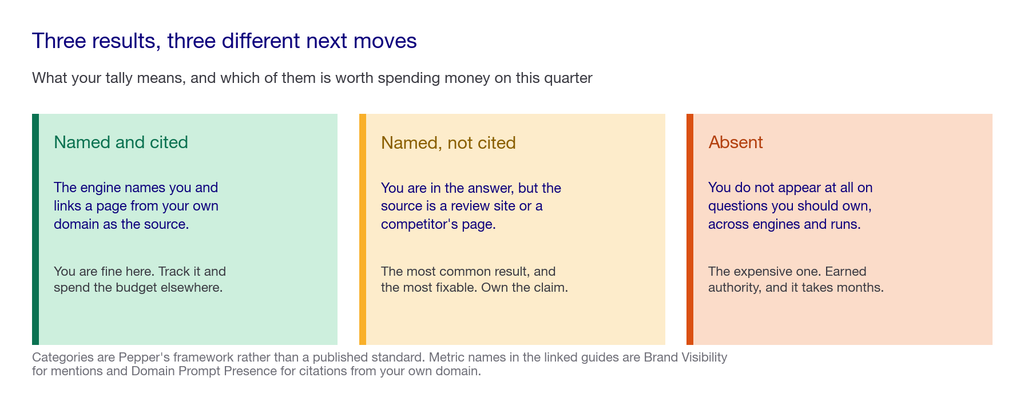
- Named and cited. The engine names you and sources the claim to a page on your own domain. You are in good shape on that question. Track it and spend your budget somewhere else.
- Named but not cited. You appear in the answer, but the source is a review site, a roundup, or a competitor’s comparison page. This is the most common result we see, and the cheapest to fix, because the engine already believes you exist.
- Absent. You do not appear at all on questions you should own, across engines and across runs. This is the expensive one. It means earned authority, and it takes months.
If your tally is mixed, weight the decision-stage questions highest. Being absent from “best X for enterprise” matters more than being absent from a definitional query.
Our point of view
We think most teams buy a paid audit one step too early. It is an expensive way to learn something the free version would have told them.
The pattern we see in accounts we take over is a team with a completed audit, a slide deck, and no shipped work. The audit was not wrong. It answered a question nobody had the capacity to act on. That is why this page is deliberately free and deliberately shallow. Find out which of the three results you have, then decide whether a deeper look changes anything.
The corollary is the honest one. If the free check tells you that you are absent everywhere, you do not need a more precise measurement of how absent you are. You need earned coverage, and the money is better spent there.
Book a growth audit if you would rather we ran this across six engines and told you which of the three results you have.
Our methodology: how we weighted what to check
We are not ranking products here, so there is no vendor scorecard. What we publish is how we weight the parts of this check. A free method still involves choices, and you should be able to argue with them.
| Element | Weight | Why it carries that weight |
|---|---|---|
| Logged-out sessions | 30 | The single biggest source of a wrong answer. A personalised session about your own company is not a test, and no amount of extra prompts corrects for it. |
| Question quality | 25 | Ten real commercial questions beat fifty keyword variants. If the questions are wrong, every downstream number is wrong in the same direction. |
| Multiple engines | 20 | Coverage is genuinely uneven between engines, so a single-engine conclusion is unsafe regardless of how many prompts you run. |
| Repeat runs | 15 | Engines are probabilistic. Repeats matter, but less than the three above, which is why we put them fourth rather than first. |
| Recording citations as well as mentions | 10 | Cheap to do and it is what separates the two fixable results from each other. Low weight because it costs you nothing. |
Weights sum to 100. Logged-out sessions and question quality carry 55 between them, which is a judgement, and it is the judgement this page rests on.
The four levels at a glance, and what each costs
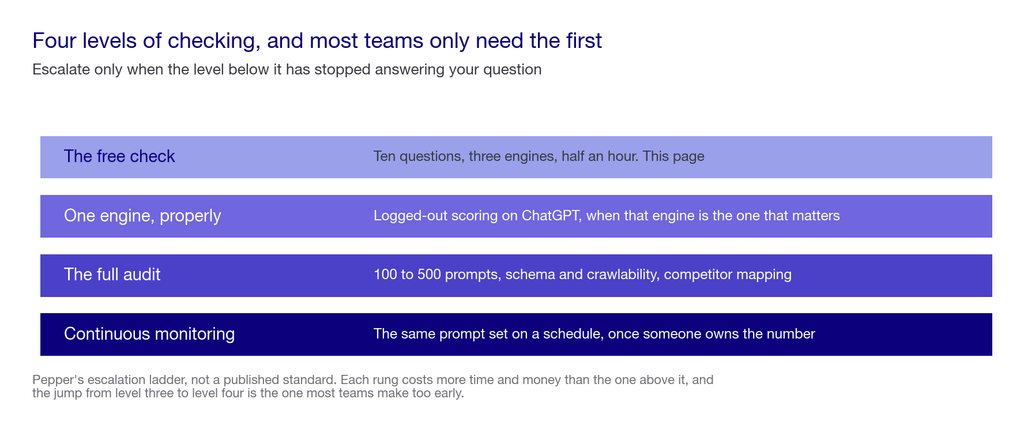
| Level | What it is | Time | Cost | When it is the right call |
|---|---|---|---|---|
| The free check | Ten questions, three engines, by hand | 30 minutes | Free | Always. Start here, every time |
| One engine, properly | Logged-out scoring on a single engine | Half a day | Free | When one engine is clearly where your buyers are |
| The full audit | 100 to 500 prompts, plus schema and crawlability | Two to three weeks | A project fee, or your own team’s time | When you have capacity to act and need to know exactly where |
| Continuous monitoring | The same prompt set on a schedule | Ongoing | Free tiers up to roughly $300 a month | Once somebody owns the number and reports on it |
The jump most teams make too early is from level three to level four. Monitoring is only worth paying for once somebody is accountable for the number moving. [Whether you need a monitoring tool at all](https://www.pepper.inc/blog/ai-search-tracking-citation-monitoring-tools/) is worth reading first.
Where Pepper fits, and where it does not
Nothing above needs us. If you want the same check run properly and repeatedly, that is what we do.
We are an agentic organic growth engine, which is three things together. An organic growth partner, meaning a growth team attached to your account running this and acting on it. Pepper’s GEO platform, which is genuinely self-serve. You log in, set up a workspace, and define your brand profile, competitors and personas. You connect GA4 and Search Console, and manage your own themes and prompts across six engines. And the Agent Atlas, where your team builds, versions and runs its own agents. That is how ten questions becomes a standing prompt set without anybody doing it by hand.
The platform reports Brand Visibility and Domain Prompt Presence side by side, which is the three-way result above turned into two numbers you can watch.
Where it falls short: we do not publish pricing, so budget discovery is a conversation rather than a page. We are built for teams treating organic as a long-term function. A one-off audit is genuinely not what we are for, and this page is the version you should run instead. Our depth sits in content, authority and AI search rather than large technical migrations. And if your free check comes back clean, we would rather you spent the money elsewhere.
How to choose how deep to go
I will write this in the first person, because a recommendation nobody will defend is worth nothing.
Start from what Google settled. Its official guidance on optimizing for generative AI features states it plainly. “From Google Search’s perspective, optimizing for generative AI search is optimizing for the search experience, and thus still SEO.” That matters for auditing, because it means you are not measuring a separate discipline. You are measuring a wider surface of the same one, which is why a free check gets you most of the way.
Here is the scorecard I would use on the decision to escalate, whether you are doing it yourself or buying it.
| Area | Weight | What tells you to escalate |
|---|---|---|
| Can anyone act on the finding | 35 | Somebody with capacity and authority is waiting for the answer. Without this, a deeper audit produces a document, and I would not spend the money. |
| Did the free check come back mixed | 25 | A clear result needs no refinement. A mixed tally across engines and question types is exactly what more prompts resolve. |
| Is the category large | 20 | Thirty data points is enough for a narrow category and thin for a broad one. Count your real commercial questions before deciding. |
| Do you need it defensible | 15 | If the number goes to a board or into a budget case, methodology matters more than it does for your own planning. |
| Has anything changed | 5 | Re-auditing an unchanged site tells you about engine variance rather than about you. |
Weights sum to 100. Capacity to act carries the most, which is a judgement, and it is the one I would argue hardest for.
Before you commission anything, scale the free check up rather than replacing it. Run 20 to 30 commercial questions instead of ten, three times each. Give any fix you make 90 days before you judge whether it worked. If that still leaves the answer ambiguous, a paid audit is the right next step. If it does not, you have saved the fee.
Red flags, each one something a vendor actually says:
- “We will audit your AI visibility for free.” Often a lead magnet that runs your brand name and reports that you appear. Ask which questions they ran.
- “Here is your AI visibility score.” One composite number across engines that behave differently hides the three-way result this page is built on.
- “We guarantee you will appear in ChatGPT after the audit.” Nobody can, and Google’s guidance warns against third parties promising ranking success.
- “You need continuous monitoring from day one.” Only once somebody owns the number.
- “Our audit covers twelve engines.” Coverage you will not act on is a cost rather than an insight.
- “We ran it and you are invisible.” Ask whether they were logged out, and how many times they ran each question.
Five questions I would ask anyone selling an audit, and what a good answer sounds like:
- “Which questions did you run, and why those?” A good answer describes a method and shows the list. A weak one says their system generates them.
- “Were you logged out?” A good answer is yes, without hesitation, and explains why it matters.
- “How many times did you run each question?” A good answer is at least three, on different days.
- “Does this separate mentions from citations?” A good answer does, because the two point at completely different fixes.
- “What would you tell us not to bother fixing?” A good answer exists. A vendor who would fix everything has not prioritised anything.
It comes down to one principle: escalate only when the level below has stopped answering your question. The weaker sequence buys measurement first and finds the capacity later. The stronger one confirms somebody is waiting for the answer, then buys exactly as much precision as that person needs.
The note that costs us something. If your free check comes back clean across three engines, you do not need us. We would rather say that now than after a call. Very few firms are equally strong at measurement, content, technical work and earned media, ours included. Ask whoever you shortlist which of those four is their weakest, and ask us too.
What nobody should promise you
- A guaranteed mention or citation. Engines are probabilistic and no third party controls their ranking systems.
- A single composite AI visibility score that means something. Our own help documentation is explicit that no universal good target exists for these metrics.
- A conclusion from one run on one engine. Three runs across different days is the floor.
- An audit that fixes anything. Measurement is the cheap part. The work that changes the result is the expensive part.
- Clean attribution from a citation to closed revenue. That measurement does not exist yet.
Frequently asked questions
How do I check if my brand appears in AI search?
Open a logged-out or temporary session, ask ten category questions rather than your brand name, repeat them across ChatGPT, Perplexity and Google AI Overviews, then record whether you were named, cited, or absent in each answer.
Is there a free AI visibility audit?
Yes, and you can run it yourself in about half an hour. The method on this page needs no tools, no signup and no card. Paid audits add scale and defensibility rather than a different answer for most teams.
Why do I need to be logged out to check?
A logged-in session is personalised by your history, and if you have been researching your own company it will show you a flattering answer no prospect would see. It is the most common reason a self-run check gives the wrong result.
How many prompts do I need for a reliable check?
Ten is the practical floor for a free check, giving thirty data points across three engines. A client-grade audit runs 100 to 500 prompts, which buys precision rather than a different conclusion in most cases.
What is the difference between being mentioned and being cited?
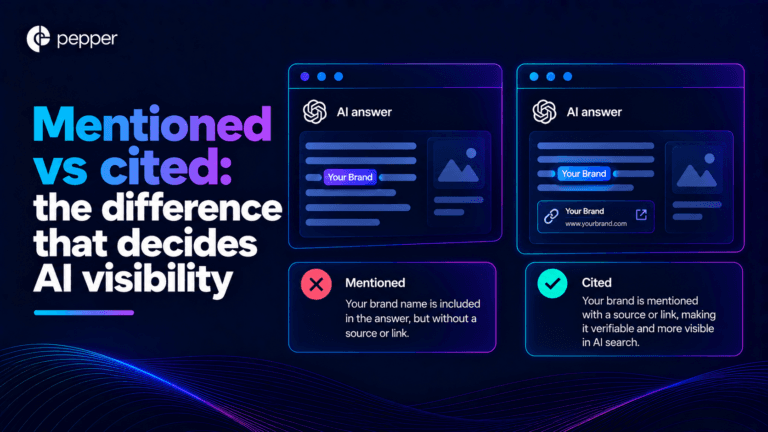
Being mentioned means the engine names your brand. Being cited means it links a page from your domain as the source. You can have plenty of the first and almost none of the second, and that gap has its own fix.
How often should I re-run this check?
Quarterly is enough for most teams, or straight after you ship something significant. Re-running an unchanged site more often than that will mostly measure engine variance rather than any real change in your own brand visibility.
Do I need a paid tool to track this?
Not to start, no. Tools earn their cost when you need the same prompt set run on a schedule and reported over time. That only matters once somebody is accountable for the number rather than simply curious about it.
What if I appear on some engines but not others?
That is entirely normal, because engines retrieve from different sources and weight them differently. Prioritise the engines your buyers actually use, and treat any single-engine result as a partial picture rather than as a final verdict.
Where to go next
Once you know which of the three results you have, the fix is different for each. If you were absent, start with how to get cited in LLMs and the LLM trust hierarchy. If you were named but not cited, how to structure content for AI citation is the one to read. Where your facts came back wrong, start with crawlability for AI.
To go deeper on the method, our client-grade 7-point checklist is the full version, and the ChatGPT brand visibility audit goes deep on that engine alone. To understand why a competitor appears and you do not, we have written that up separately. For the terminology, what GEO is is the short version.
If you would rather we ran it, see where you show up across six engines.
And the honest exit. If you come back named and cited on most of your ten questions, you do not need an audit, a platform, or us this quarter. Put a reminder in for three months. Spend the budget on something that is actually broken.
Sources and further reading
Research sources, published in 2026 and checked at the original on 11 September 2026:
- Pew Research Center, “Americans and AI 2026”, published 17 June 2026. American Trends Panel survey of 5,119 US adults, fielded 17 to 23 February 2026. Used for the 60%, 49% and 42% figures. US adults only.
- Google Search Central, “Optimizing your website for generative AI features on Google Search”, announced 15 May 2026 and last updated 10 July 2026. The quoted phrase appears verbatim, and the page also carries the warning about third-party tools promising ranking success.
Removed from the previous version of this page, and why:
- The entire 2022 article, “15 Best SEO Analyzer Tools in 2022”. It ranked Ahrefs, SEMrush, Moz, SpyFu, Majestic, Ubersuggest and nine others as classic SEO analysis tools, and predates AI search entirely.
- The “Team Pepper” byline, replaced with a named author and reviewer.
- Two vendor scale claims quoted from those tools’ own marketing, neither of which was dated or independently verifiable.
Latest Blogs
Most advice on this is inference dressed as fact. OpenAI documents exactly one thing clearly, which is access. Here is what is documented, what is inferred, and how to verify the rest for yourself.
Being named in an AI answer and having your page used as its source are different outcomes with different causes and different fixes. The gap between them is the most useful diagnostic in AI search, and most reporting collapses it into one number.
Every platform reports share of voice and almost none of them define it the same way. Here is the definition worth using, the three choices that change the number, and how to measure it yourself without buying anything.
Get your hands on the latest news!

Similar Posts
GEO / AI Search
10 mins read
How to get cited by ChatGPT
GEO / AI Search
10 mins read
Mentioned vs cited: the difference that decides AI visibility
GEO / AI Search
13 mins read