Why your competitor shows up in ChatGPT and you do not

The short answer
You ran a prompt, a competitor got named, and you did not. That is not one problem. It is three, and they need completely different fixes.
Either engines do not know you exist, or they know you and cite somebody else’s page, or they cannot read your site well enough to use it. Most advice on this question treats all three as one “build more citations” problem. That is why so much of it does not work.
The good news is that telling them apart takes an afternoon and costs nothing.
Key takeaways
- There are three failure modes, not one. Not mentioned at all, mentioned but not cited, and not readable. Each has a different fix and a different cost.
- The diagnostic is the gap between two numbers. How often engines mention your brand, against how often they cite a page from your domain. A wide gap means a citability problem, not a visibility problem.
- Your own website is one input of three. Engines assemble an answer from what they can fetch, what other sources say about you, and what they can verify. Most teams only work on the first.
- Earned media does the heavy lifting. 84% of AI citations come from earned media and 0.3% from paid, so another blog refresh is rarely the fix.
- Do not buy a platform to answer this. Run the free version first. If you find the answer and nobody has capacity to act on it, a subscription will not help.
A note on where this comes from. We run organic for more than 250 enterprises and track more than 10 million prompts across every major engine. This is the diagnostic we run at the start of an account. It is our framework rather than a published standard, and we have said so on the chart.
Why is my competitor showing up in ChatGPT and not me?
Because an engine found something it could use about them, and did not find the equivalent about you. That is the whole mechanism, and it fails in three distinct ways.
An AI engine does not rank pages and hand you ten links. It assembles an answer, then names the brands it can support with sources it trusts. So “why them and not me” resolves to one of three states.
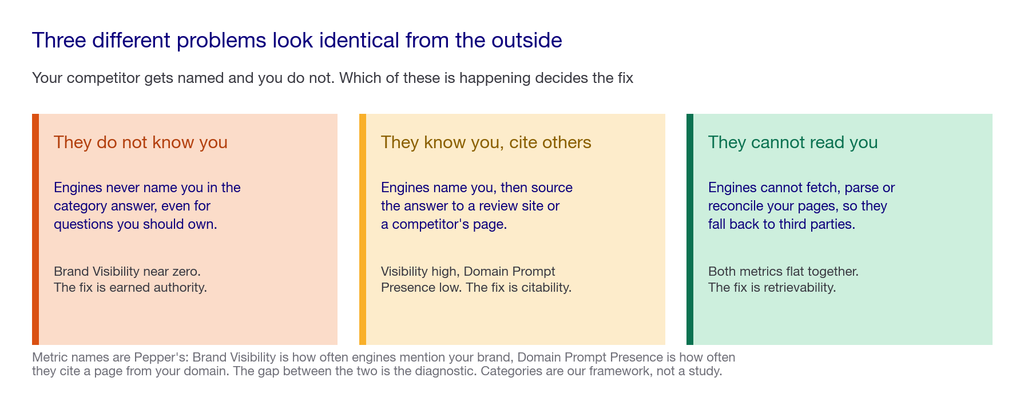
- They do not know you. You are absent from the category answer entirely, even on questions you should own. In our own GEO analytics this shows as Brand Visibility close to zero. The engine has nothing to work with, and the fix is earned authority.
- They know you but cite others. The engine names you, then sources the claim to a review site, a roundup, or a competitor’s comparison page. Brand Visibility is healthy and Domain Prompt Presence is low. The fix is citability.
- They cannot read you. The crawler cannot reach, parse or reconcile your pages, so the engine falls back to whoever it can read. Both numbers stay flat together. The fix is retrievability.
Those three map to the Visibility, Citability and Retrievability framework we run every account against. The distinction matters because it is a budget question. The first is digital PR, the second a content and structure project, the third often a fortnight of engineering.
What is an AI visibility gap, and how is it different from a ranking gap?
An AI visibility gap is the distance between how often engines mention your brand and how often they cite a page from your domain. A ranking gap is about position in a list of links. A visibility gap is about whether you are in the answer at all, and whether the answer points at you or at somebody else.
The two are related but not the same, which is why a page can rank well in Google and never appear in ChatGPT. Google’s own guidance says optimizing for generative AI search is still SEO, and that is true for Google. It does not make the two identical everywhere else.
The three problems at a glance
| Problem | What you see in an answer | Metric signature | The fix | Typical cost and time |
|---|---|---|---|---|
| They do not know you | Your brand never appears, competitors do | Brand Visibility near zero | Earned media, analyst and review presence, category content | The most expensive of the three. Months, and usually a PR budget |
| They know you, cite others | You are named, the link goes elsewhere | Visibility healthy, Domain Prompt Presence low | Own the claim on your own page, structure it to be liftable | Moderate. Weeks of content and structure work |
| They cannot read you | You appear inconsistently or with wrong facts | Both flat, or facts contradict each other | Crawlability, rendering, schema, consistent entity facts | Cheapest to fix. Often days of engineering |
If you take one thing from this page, take the middle row. It is the most common state we find in accounts we take over. It is also the one most often misdiagnosed as absence, and treated with a PR budget it never needed.
Why this happens in 2026
Three findings explain most of it, and all three were published this year.
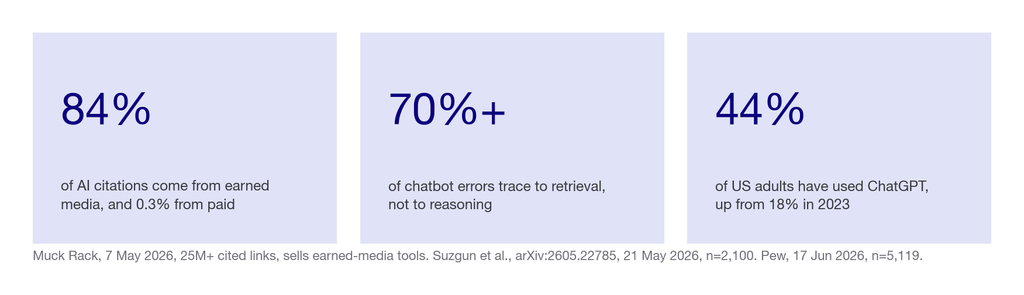
Muck Rack analysed more than 25 million cited links across 17 industries in May 2026. Earned media accounted for 84% of AI citations. Paid and advertorial accounted for 0.3%. Muck Rack sells earned-media software, so read it with that interest in mind, but the figure has held between 82% and 89% across three editions.
That is the whole argument for why your competitor gets named. Somebody else wrote about them.
Second, a Stanford-led evaluation of six commercial chatbots published on 21 May 2026 tested 2,100 factual questions. It found that retrieval failures, not reasoning failures, drive over 70% of all errors. When an engine gets your brand wrong, or omits you, the usual cause is what it could fetch rather than how it thought.
Third, the stakes moved. Pew Research Center put ChatGPT at 44% of US adults in 2026, up from 18% in 2023, with 42% of adults using chatbots to search for information. Being absent from the answer is no longer a niche problem.
What an engine assembles before it names anyone
Understanding the order helps, because it tells you which lever you are actually pulling.
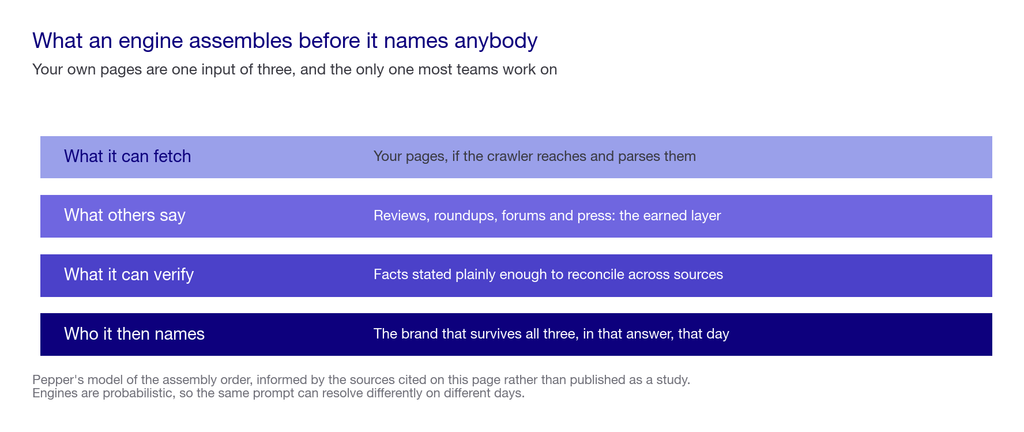
The engine starts with what it can fetch, which is your site if the crawler can reach and parse it. Then it weighs what other sources say about you, which is the earned layer and the largest one. Then it checks what it can verify, meaning facts stated plainly enough to reconcile across sources. Only then does it name somebody.
Your own pages are one input of three. Most teams work on that one exclusively, then wonder why nothing moved. Worth adding: engines are probabilistic, so the same prompt can resolve differently on different days, which is why a single run tells you nothing.
Our point of view
We think the standard advice on this question is wrong in a specific and expensive way. “Build more citations” is not a diagnosis. Teams that follow it spend a PR budget on what was a structure problem, or rewrite forty pages the crawler could not reach anyway.
The pattern we see most often in accounts we take over is the middle case. The brand is known. Engines mention it. And every answer sources to G2, a competitor comparison page, or a listicle the brand had no part in. Brand Visibility looks fine on a dashboard. Domain Prompt Presence is near the floor. Nobody had separated the two numbers, so nobody knew which problem they had.
Diagnosis first, then spend. That order is the entire point of this page.
Book a growth audit if you want us to run the diagnostic below on your prompt set and tell you which of the three you have.
Our methodology: how we weighted what to fix first
We are not ranking products here, so there is no vendor scorecard. What we do publish is how we prioritise the three fixes when an account has more than one. That ordering is a judgement, and you should be able to argue with it.
| Criterion | Weight | How we score it |
|---|---|---|
| Cost to fix | 30 | Engineering days beat content months, which beat a PR retainer. We fix the cheap thing first even when it is not the biggest problem, because it buys time and evidence. |
| Blocking effect | 30 | Retrievability blocks the other two. There is no point earning coverage if the crawler cannot read the page it points at, so anything blocking gets fixed first. |
| Time to a readable signal | 20 | How long before the prompt set shows movement. Structure changes surface in weeks, earned authority in months, and that difference should shape the sequence. |
| Durability | 15 | Whether the fix keeps working. An owned page that states a claim plainly outlives a single placement. |
| Reversibility | 5 | What it costs to undo if we were wrong. Low weight, because almost nothing here is irreversible. |
Weights sum to 100. Cost and blocking effect carry 60 between them, which is why our default order is retrievability, then citability, then visibility, even though visibility is usually the loudest complaint.
How to diagnose which one you have
Run this before you buy anything. It takes an afternoon and costs nothing.
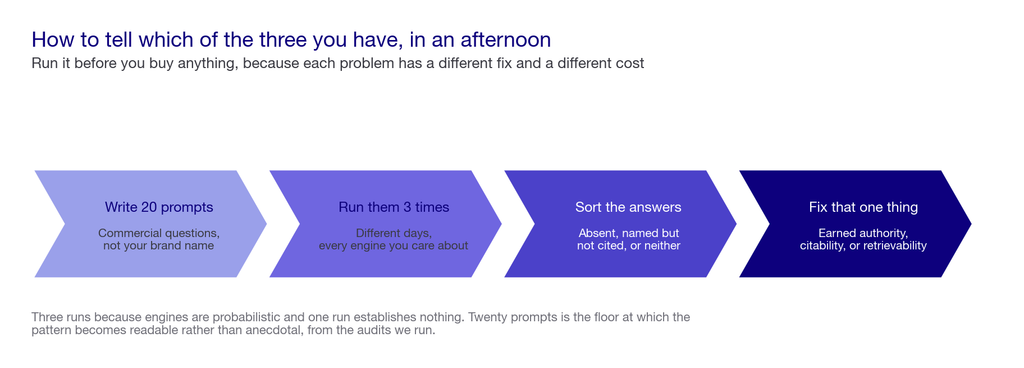
- Write 20 prompts. Real commercial questions your buyers would type, not your brand name. Branded prompts are the ones you already win, and they will tell you nothing.
- Run them three times each, on different days, across every engine you care about. For most B2B teams that means ChatGPT, Perplexity, Gemini and Google AI Overviews.
- Sort every answer into one of three buckets. Were you absent? Were you named but the citation went elsewhere? Or were you named with facts that were wrong or inconsistent?
- Fix the bucket that dominates, and only that one.
The sorting step is the part people skip, and it is the only step that matters. A tally of 60 answers across 20 prompts will show you one clear pattern, and the pattern is your diagnosis.
Fixing each one
If they do not know you
This is the expensive case, so confirm it before you spend. You are looking for total absence across the prompt set rather than low placement.
- Get into the sources engines already trust for your category: review platforms, analyst listings, industry roundups and the comparison pages buyers actually read.
- Pursue earned coverage in publications that cover your category, because that is the layer doing 84% of the work.
- Publish category-level content that answers the commercial questions directly, so there is something to cite once people start looking.
- Read our guide to LLM seeding for the mechanics, and the LLM trust hierarchy for which sources carry weight.
Expect months, not weeks. Anyone promising otherwise is selling you something.
If they know you but cite others
The most common case, and the most fixable. The engine already believes you exist. It just has a better source than you for the claim.
- Find the exact claims engines are sourcing elsewhere, then own them on your own pages, stated plainly and completely.
- Structure the page so the answer is liftable: a direct answer near the top, clear headings, and the fact in the sentence rather than implied across three paragraphs.
- Add the supporting detail a third party cannot have: your own data, your own methodology, your own pricing where you publish it.
- Our guides on earning citations from LLMs and how to structure content for AI citation cover this in detail.
Weeks of work, and the fastest return of the three.
If they cannot read you
Cheapest to fix and the one to check first, because it blocks everything else.
- Confirm AI crawlers can reach you at all. Start with robots.txt for AI crawlers and our guide to crawlability for AI.
- Check that content renders without JavaScript execution, because a page that needs a browser to show its text is a page an engine may never see.
- Make your entity facts consistent everywhere: name, category, location, founding year, product names. Contradictions across sources are what an engine cannot reconcile.
- Use schema markup to state plainly what the page is about.
Often days of engineering, and it is the reason we weight it first.
What this costs, and how long it takes
There is no honest single price, because the three fixes are three different budgets. What we can give you is the shape.
- Retrievability is usually the cheapest: engineering time, often under two weeks, no ongoing spend. Movement shows up in the prompt set within a month.
- Citability is a content and structure project. Weeks of work per priority cluster, and the first movement is typically visible inside 60 to 90 days.
- Visibility is the expensive one. Earned coverage takes months and usually a retainer, and it is the hardest to attribute cleanly.
The tooling to measure any of this ranges from free to about $300 a month. Whether you need a monitoring tool at all is a separate question, and for many teams the honest answer is not yet.
Pepper, and how we would run this
We are an agentic organic growth engine, which means three things working together rather than one product.
- An organic growth partner. A senior strategist and always-on agents attached to your account, running the diagnostic, deciding the order, and doing the work alongside your team. One team on the hook for the number rather than a dashboard you interpret alone.
- Pepper’s GEO platform. Genuinely self-serve. You log in, set up a workspace, define your brand profile, competitors and personas, connect GA4 and Search Console, and manage your own themes and prompts. It tracks six engines, including ChatGPT, Perplexity, Gemini, Claude and Google AI Overviews, and it reports Brand Visibility and Domain Prompt Presence side by side, which is what makes the gap in this article visible at a glance.
- The Agent Atlas. You build, version and run your own agents on a visual canvas. Quick runs handle a single input, sheet runs handle bulk. It is how the diagnostic above stops being an afternoon of manual work and becomes something that runs on a schedule.
That combination is why we can point at outcomes rather than dashboards. The Acceldata case study records 6X organic traffic, and top-three keywords rising from 85 to more than 300. It also records 100,000 plus new organic users, and 260,000 plus impressions from a single hero guide.
Where it falls short: we do not publish pricing, so budget discovery is a conversation rather than a page. We are built for teams treating organic as a long-term function, so a one-off audit is not what we are for. Our depth sits in content, authority and AI search rather than large technical migrations, so if your retrievability problem is really a replatforming problem, say so early. And if you only want to know today whether you appear in ChatGPT, the diagnostic above is free and you do not need us for it.
How to choose what to fix first, and who to trust with it
I am going to write this in the first person, because a prioritisation nobody will defend is worth nothing.
Start from what Google settled. Its official guidance on optimizing for generative AI features states it plainly. “From Google Search’s perspective, optimizing for generative AI search is optimizing for the search experience, and thus still SEO.” The same page tells you to skip most of what gets sold as AI optimisation. “You don’t need to create new machine readable files, AI text files, markup, or Markdown to appear in Google Search.” That is correct, and it is correct for Google. Google is one engine, and the evidence that engines disagree is why single-engine conclusions are unsafe.
So my order is: fix what blocks, then fix what you own, then buy what you cannot make. Here is the scorecard I would hold any partner to, ours included.
| Area | Weight | What a strong partner demonstrates |
|---|---|---|
| Diagnoses before prescribing | 30 | They run the prompt set and tell you which of the three problems you have before proposing any work. A proposal that arrives before the diagnosis is a template. |
| Owns the technical layer | 25 | They can check crawlability, rendering and entity consistency themselves rather than handing you a list for your engineers to interpret. |
| Can actually earn coverage | 25 | Real digital PR capability with named placements, because 84% of citations come from that layer and it is the hardest to fake. |
| Measures both numbers | 15 | They report brand mentions and domain citations separately, and they can explain the gap. One composite score means they cannot. |
| Tells you when to stop | 5 | They will say when a problem is not worth fixing this quarter. Rare, and the strongest signal on this list. |
Weights sum to 100. Diagnosis carries the most, which is a judgement, and it is the judgement this whole page rests on.
Before you sign anything, run the free version. Write 20 to 30 real commercial prompts, three runs each, across every engine you care about, and give any fix 90 days before you judge it. Four worked examples for a mid-market B2B SaaS analytics company:
- “best data observability platform for enterprise”
- “how do I monitor data quality across Snowflake and Databricks”
- “Acceldata vs Monte Carlo vs Bigeye”
- “what should I look for in a data observability vendor”
Then demand five answers from anyone pitching you:
- “Which of the three problems do we have, and what is your evidence?” A good answer cites the tally across runs. A weak one says “you need more citations”.
- “What would you fix first, and why that?” A good answer names the blocking issue and explains the sequencing. A weak one starts with a content calendar.
- “Show me a placement you earned in our category.” A good answer names publications. A weak one describes a process.
- “How will you tell whether it worked, and when?” A good answer separates brand mentions from domain citations and gives a window. A weak one promises a score going up.
- “What would make you tell us not to do this?” A good answer exists. A vendor without one has never turned down work.
Red flags, each one something a vendor actually says:
- “We guarantee you will appear in ChatGPT.” Nobody can, and Google’s own guidance warns against third-party tools promising ranking success.
- “You need more citations.” Said before any diagnosis, this is a template rather than a finding.
- “Here is your AI visibility score.” One composite number across engines that behave differently hides the exact gap you are trying to see.
- “We will publish 40 articles a month.” Volume aimed at a surface where 84% of citations come from somebody else’s site.
- “We track your brand name across every engine.” Branded prompts are the ones you already win.
- “We can get this fixed in two weeks.” True for retrievability, impossible for an absence problem.
Two approaches circulate here, and one is weaker than the other. The weaker one runs: rewrite pages, add FAQ schema, publish more, hope. The stronger one runs: diagnose, unblock retrieval, own the claims on pages you control, then earn the coverage that gets cited. Note where each begins. A weaker sequence starts with the part you control, and the stronger one starts with what the engine can actually reach and trust.
It comes down to one principle: fix what blocks before you buy what promotes. Retrievability first, because it gates everything. Citability second, because it returns fastest. Visibility last, because it is slowest and dearest.
The note that costs us something. Very few firms are equally strong at technical work, content, digital PR and measurement, and that includes us. Ask everyone on your shortlist which of those four is their weakest, ours included. The ones that answer straight are the ones worth hiring.
What nobody should promise you
- A guaranteed mention in ChatGPT. Engines are probabilistic and no third party controls their ranking systems. Google’s own guidance is blunt about the adjacent claim: “Be wary of third-party tools that promise ranking success or claim to use ‘internal’ Google metrics. No third-party tool has access to our internal ranking or AI systems.”
- A single composite AI visibility score. Our own help documentation says it plainly: there is no universal good target for these metrics. Trend and comparison with the category leader are what matter.
- A fix in two weeks for an absence problem. Earned authority does not compress.
- Conclusions from one run on one engine. Three runs across different days is the floor.
- Clean attribution from a citation to closed revenue. That measurement does not exist yet.
Frequently asked questions
Why is my competitor showing up in ChatGPT and not me?
One of three reasons. Engines do not know you, they know you but cite someone else’s page, or they cannot read your site. Run twenty commercial prompts three times each and sort the answers to find out which.
Does ranking well on Google mean I will show up in ChatGPT?
Not reliably. Google’s own guidance says optimizing for generative AI search is still SEO, but engines differ in what they retrieve and trust. Strong Google rankings help most where an engine leans on Google’s index, and less elsewhere.
How long does it take to start appearing in ChatGPT?
It depends which problem you have. Retrievability fixes can show up within a month. Citability work typically shows movement in 60 to 90 days. Building earned authority from near zero takes months and cannot be compressed.
Can I pay to appear in AI answers?
No, and be wary of anyone offering it. Paid and advertorial content accounts for just 0.3% of AI citations, against 84% for earned media. Buying placement is unavailable through legitimate channels, and beside the point even if it were.
What is the difference between being mentioned and being cited?
Being mentioned means the engine names your brand. Being cited means it links a page from your domain as the source. You can have plenty of the first with almost none of the second, and that gap is a citability problem.
Do I need a paid tool to check this?
No. The diagnostic in this article is free and manual, and you should run it before buying anything. Tools help once you need to track the same prompt set on a schedule rather than by hand.
Why do I appear in one engine but not another?
Engines retrieve from different sources and weight them differently, so coverage is genuinely uneven. This is why conclusions drawn from a single engine are unsafe, and why a prompt set should run across every engine your buyers actually use.
My facts show up wrong in AI answers. What causes that?
Usually inconsistent entity information across the web, or pages an engine cannot parse. Retrieval failures drive more than 70% of chatbot errors, so start by making your core facts identical everywhere and your pages readable.
Where to go next
If you want the mechanics behind each fix, start with how to get cited in LLMs and how to appear in ChatGPT results. For a structured version of the diagnostic above, our ChatGPT brand visibility audit walks through it, and citation analysis explains how to read the results.
If the terminology is the sticking point, what GEO is is the short version. Where you suspect the problem is engine-specific, Perplexity versus ChatGPT brand visibility covers where the two diverge.
If you already know which problem you have and want it fixed, see where you show up and we will run your prompt set across six engines.
And the honest exit. If you found your competitor in one answer, on one engine, on one day, you do not have a problem yet. You certainly do not need a platform. Run the twenty prompts three times first. Absent across the board is worth acting on. If you appeared in most of them, you saw variance rather than a visibility gap, and the money is better spent elsewhere this quarter.
Sources and further reading
Research sources, all published in 2026 and checked at the original on 9 September 2026:
- Muck Rack, “What Is AI Reading?”, published 7 May 2026. More than 25 million cited links across 17 industries and ChatGPT, Claude and Gemini. Used for the 84% earned-media and 0.3% paid figures. Muck Rack sells earned-media software and has a commercial interest in this finding.
- Suzgun et al., “Evaluating Commercial AI Chatbots as News Intermediaries”, arXiv:2605.22785, submitted 21 May 2026. Six chatbots on 2,100 factual questions derived from BBC News reporting, tested 9 to 22 February 2026. Used for the finding that retrieval failures drive over 70% of errors.
- Pew Research Center, “Americans and AI 2026”, published 17 June 2026. Survey of 5,119 US adults fielded 17 to 23 February 2026. Used for ChatGPT reach at 44%, up from 18% in 2023, and for 42% using chatbots to search.
- Google Search Central, “Optimizing your website for generative AI features on Google Search”, announced 15 May 2026 and last updated 10 July 2026. Both quoted phrases appear verbatim on that page.
Removed from the previous version of this page, and why:
- The entire 2021 article, which covered competitor content analysis using BuzzSumo, SpyFu, BuiltWith and Owletter. It predated AI search entirely and none of its tooling advice addresses the question this page now answers.
- The “Team Pepper” byline, replaced with a named author and reviewer.
- Every undated statistic. Nothing in the previous version carried a source.
A note on the competing pages for this query. The three strongest results we checked all treat “not mentioned” and “mentioned but not cited” as the same problem. The most thorough of them is built almost entirely on 2025 research. That is the gap this rewrite is aimed at.
Latest Blogs
Most advice on this is inference dressed as fact. OpenAI documents exactly one thing clearly, which is access. Here is what is documented, what is inferred, and how to verify the rest for yourself.
Being named in an AI answer and having your page used as its source are different outcomes with different causes and different fixes. The gap between them is the most useful diagnostic in AI search, and most reporting collapses it into one number.
Every platform reports share of voice and almost none of them define it the same way. Here is the definition worth using, the three choices that change the number, and how to measure it yourself without buying anything.
Get your hands on the latest news!