Why use AI search monitoring tools, and when you do not need one
The short answer
AI search monitoring tools track whether engines mention your brand, cite your domain and describe you accurately, across prompts your buyers actually use. Search Console cannot see any of that. You need one when two things are true: you have enough distinct commercial prompts to read a trend, and somebody can act on it. Below that, you are buying a report.
Key takeaways
- These platforms catch three things Search Console structurally cannot: whether an engine mentions you at all, which competitor it names instead, and which third-party sources shape the answer.
- The entry tiers meter far less than buyers assume. Otterly’s cheapest plan tracks 15 prompts. Profound’s Starter tracks 50 prompts against 1,500 responses a month. That number decides whether a tool can answer your question, not the price.
- Engine count is the least comparable spec in the category. One vendor sells three engines as paid add-ons. Another bundles both Google surfaces into one line, a third publishes “7+”, a fourth “up to 9”. Every listicle ranks on this number anyway.
- Skip the purchase if your category has fewer distinct commercial prompts than an entry tier already meters. Skip it too if nobody can act on findings within a fortnight. Spend the money on earned media instead.
- A single composite visibility score is not measurement. Ask what prompts produced it and which URLs it cited, or ignore it.
A note on where this comes from. I look at this through pipeline rather than traffic. That is the argument I have to win internally at Pepper, and the one our customers have to win with their own boards. Pepper runs organic for more than 250 enterprises and tracks over 10 million prompts across every major engine. That shapes what follows, along with the client reviews I sit in each week and the buyers who tell us on calls what they wish they had known before signing. We sell in this category, so read this knowing we have a commercial interest in the answer.
Disclosure: we include Pepper in the comparison below and we published this guide. So we have placed ourselves in a separate category rather than ranking ourselves against tools we do not directly compete with. We apply the same scrutiny to ourselves as to everyone else, including a “where it falls short” line. Every tool description and every price comes from that company’s own website as read on 8 September 2026, rather than another roundup. Where a company does not publish pricing, we say so rather than estimating it. We also keep Pepper out of both ranked figures, because we sell with a growth team attached and are not a like-for-like tool.
What is an AI search monitoring tool, and what does it actually watch?
An AI search monitoring tool runs a fixed set of prompts against answer engines on a schedule and records what comes back. It turns that into a trend: whether an engine mentioned your brand, whether it cited a page from your domain, which competitors appeared, and which sources it leaned on.
The mechanism matters, because it explains both the value and the limits. These platforms are not reading a search index. They are sampling answers, repeatedly, and inferring a pattern from the sample.
That makes them a survey instrument rather than an analytics platform. Everything good and everything frustrating about the category follows from that one fact. Definitions for the surrounding vocabulary sit in our glossary of core AEO terms.
Why use AI search monitoring tools instead of Search Console?
This is the honest case for buying one, and it is a strong case.
Whether an engine mentions you at all. It can recommend three vendors in your category and never name you. No analytics platform reports an absence. Only sampling the answer finds it.
Which competitor gets named instead. The useful unit is not your score, it is the substitution. Learning that an engine recommends a rival for the question you thought you owned is the finding that changes a roadmap.
Which sources shaped the answer. Engines synthesise from third parties, so the citation list tells you which publications, comparison pages and communities do the persuading. That is a media plan, not a keyword report. It is why citation analysis is a different exercise from rank tracking.
How they describe you. An inaccurate mention is its own problem, and no traffic-based report will show it.
Search Console cannot show any of it. A zero-click answer generates no query, no impression and no click. That is the whole argument in zero-click versus AI citation, and the reason this category exists at all.
The number that actually decides this, and it is not the price
Here is what no listicle tells you.
Every platform in this category bills by prompts or by responses, and the entry tiers meter far less than buyers expect.
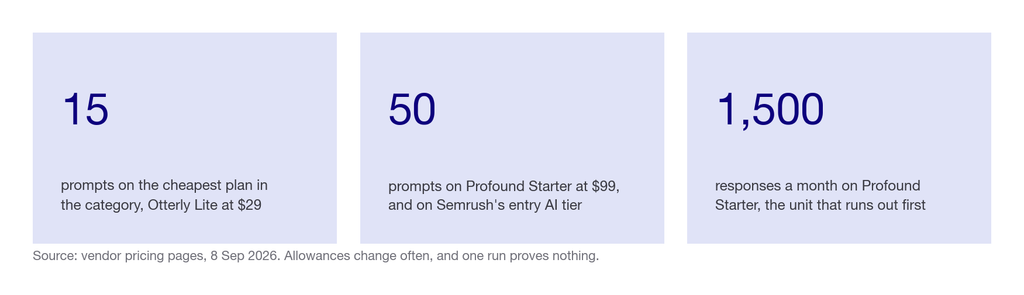
Otterly’s Lite plan tracks 15 prompts. Profound’s Starter tracks 50 prompts against 1,500 responses a month. Semrush’s entry AI tier tracks 50 prompts daily.
Now put that next to how these systems behave. Engines are probabilistic, so the same prompt returns different answers on different runs. A reading needs repetition before it means anything. Fifteen prompts sampled a few times is not a trend. It is anecdote with a dashboard.
So the first question is not which tool. It is how many distinct commercial questions in your category you would genuinely act on. If that number is smaller than what an entry tier already meters, the tool is not your constraint, and buying it will not tell you anything you can use.
Our view: this is a measurement purchase, so judge it like one
Most of this category is sold as visibility, which is a feeling. It should be bought as measurement, which has rules.
A measurement instrument has to tell you what it sampled, how often, and with what uncertainty. That means three demands here. You can see and edit the prompt set, the tool shows the cited URLs rather than summarising them, and it reports the same prompt run twice honestly rather than smoothing it.
Where the category falls short: most tools fail the third demand. They show you a number that moved without saying whether the movement exceeded run-to-run variation. That is how a dashboard manufactures a quarterly narrative out of noise.
This is also why we refuse to sell a single composite score. You cannot act on a number that blends mentions, citations and sentiment, because you cannot tell which input moved. We wrote about that trap in the limits of an AI visibility score.
So Pepper’s GEO platform reports three separable things instead. Brand Visibility for how often engines mention you, Domain Prompt Presence for how often they cite a page from your domain, and Share of Voice for your slice of all brand mentions in the category. The gap between the first two is the diagnosis. Healthy mentions with flat citations is an authority problem, not a tracking problem. Book a growth audit and we will run that split before you buy anything.
How we scored these tools
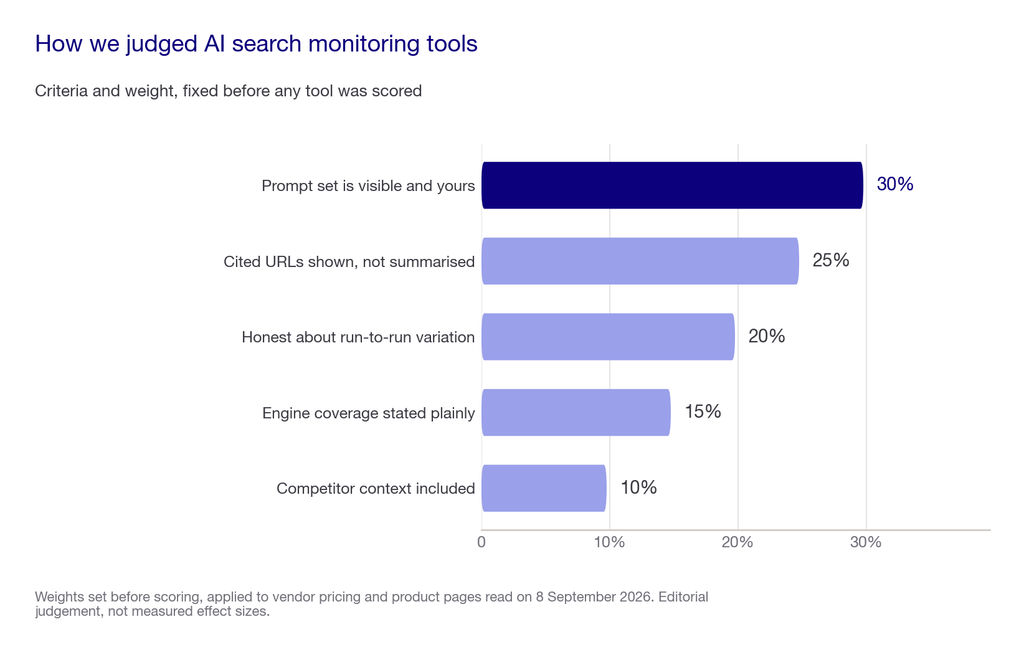
Five criteria. We fixed the weights before scoring anything, and this is also the scorecard I would hand a vendor and ask them to fill in.<figure class=”wp-block-table”> <div style=”overflow-x:auto;-webkit-overflow-scrolling:touch;”> <table style=”width:100%;table-layout:fixed;border-collapse:collapse;font-size:15px;line-height:1.5;”> <thead><tr> <th style=”padding:10px 12px;border:1px solid #e3e3e0;overflow-wrap:break-word;word-break:normal;vertical-align:top;background:#f6f6f4;font-weight:600;text-align:left;width:18.8%;”>Criterion</th> <th style=”padding:10px 12px;border:1px solid #e3e3e0;overflow-wrap:break-word;word-break:normal;vertical-align:top;background:#f6f6f4;font-weight:600;text-align:left;width:9.2%;”>Weight</th> <th style=”padding:10px 12px;border:1px solid #e3e3e0;overflow-wrap:break-word;word-break:normal;vertical-align:top;background:#f6f6f4;font-weight:600;text-align:left;width:72.0%;”>What a strong tool has to demonstrate</th> </tr></thead><tbody> <tr> <td style=”padding:10px 12px;border:1px solid #e3e3e0;overflow-wrap:break-word;word-break:normal;vertical-align:top;”>Prompt set is visible and yours</td> <td style=”padding:10px 12px;border:1px solid #e3e3e0;overflow-wrap:break-word;word-break:normal;vertical-align:top;”>30</td> <td style=”padding:10px 12px;border:1px solid #e3e3e0;overflow-wrap:break-word;word-break:normal;vertical-align:top;”>You can see every prompt being run, edit it, and add your own, rather than trusting a generated set you cannot inspect or change</td> </tr> <tr> <td style=”padding:10px 12px;border:1px solid #e3e3e0;overflow-wrap:break-word;word-break:normal;vertical-align:top;”>Cited URLs are shown, not summarised</td> <td style=”padding:10px 12px;border:1px solid #e3e3e0;overflow-wrap:break-word;word-break:normal;vertical-align:top;”>25</td> <td style=”padding:10px 12px;border:1px solid #e3e3e0;overflow-wrap:break-word;word-break:normal;vertical-align:top;”>The tool names the exact pages an engine used, because that list is the only part of the output that tells you what to do next</td> </tr> <tr> <td style=”padding:10px 12px;border:1px solid #e3e3e0;overflow-wrap:break-word;word-break:normal;vertical-align:top;”>Honest about run-to-run variation</td> <td style=”padding:10px 12px;border:1px solid #e3e3e0;overflow-wrap:break-word;word-break:normal;vertical-align:top;”>20</td> <td style=”padding:10px 12px;border:1px solid #e3e3e0;overflow-wrap:break-word;word-break:normal;vertical-align:top;”>The tool reports repeated runs as a range or a confidence signal, rather than smoothing them into one moving line that implies precision the method does not have</td> </tr> <tr> <td style=”padding:10px 12px;border:1px solid #e3e3e0;overflow-wrap:break-word;word-break:normal;vertical-align:top;”>Engine coverage stated plainly</td> <td style=”padding:10px 12px;border:1px solid #e3e3e0;overflow-wrap:break-word;word-break:normal;vertical-align:top;”>15</td> <td style=”padding:10px 12px;border:1px solid #e3e3e0;overflow-wrap:break-word;word-break:normal;vertical-align:top;”>The vendor spells out what your tier includes, what costs extra, and how it counts each surface, with no bundling that inflates the headline number</td> </tr> <tr> <td style=”padding:10px 12px;border:1px solid #e3e3e0;overflow-wrap:break-word;word-break:normal;vertical-align:top;”>Competitor context, not just your own score</td> <td style=”padding:10px 12px;border:1px solid #e3e3e0;overflow-wrap:break-word;word-break:normal;vertical-align:top;”>10</td> <td style=”padding:10px 12px;border:1px solid #e3e3e0;overflow-wrap:break-word;word-break:normal;vertical-align:top;”>You can see who appeared instead of you on a given prompt, which is the finding that changes a plan</td> </tr> </tbody></table></div></figure>
AI search monitoring tools at a glance
Named, never linked. Every figure read off the vendor’s own pricing page on 8 September 2026, because this category reprices constantly.
| Tool | What it monitors | Published price | Engines at that price | Where it falls short |
|---|---|---|---|---|
| Profound | Prompt tracking with per-response detail and agent analytics | Starter $99, Growth $399, Enterprise custom | ChatGPT only on Starter, 3 on Growth, “up to 9” on Enterprise | Single-engine entry tier means the cheapest plan cannot answer a cross-engine question, which is usually the question |
| AthenaHQ | Prompt and response analysis, sources and competitor insight | Essential free with $25 credit, Starter $295, Enterprise custom | 5 models free, 10 on Starter | The jump from free to $295 is steep with nothing between, so mid-sized teams have no natural tier |
| Scrunch | Brand monitoring across engines, plus GA4 for AI referral traffic | Starter $250 annual or $300 monthly, Growth $417 or $500, Enterprise custom | Same set at every tier: ChatGPT, Claude, Gemini, Perplexity, both Google AI surfaces, Meta | Highest entry price of the published ladders, so it is a poor fit for a first, exploratory purchase |
| Otterly | Prompt tracking and link monitoring across AI search | Lite $29, Standard $189, Premium $489, Enterprise from $1,000 | 4 included. Google AI Mode, Gemini and Claude are paid add-ons | The advertised entry price is not the price of useful coverage. See the figure below |
| AirOps | AI search insights plus agent execution | No price published at any paid tier. Solo is free | ChatGPT insights only on Solo, “7+” on Pro | Publishes no paid pricing, and repriced inside the last week, so any comparison of it ages in days |
| Semrush | AI Visibility inside the wider SEO suite | Starter $165.17 to Advanced $455.67 monthly, billed annually | AI Overviews, AI Mode, ChatGPT, Perplexity, Gemini | Meters prompts at 50 to 200 by tier, thin for a real category, and you buy a whole suite to get it |
| Pepper, separate category | Brand Visibility, Domain Prompt Presence and Share of Voice, with agents that act on what they find | Not published | Six engines, including ChatGPT, Perplexity, Gemini and Google AI Overviews | We are built for teams running organic as a long-term function, so a self-serve tracker with nobody attached is not what we are |
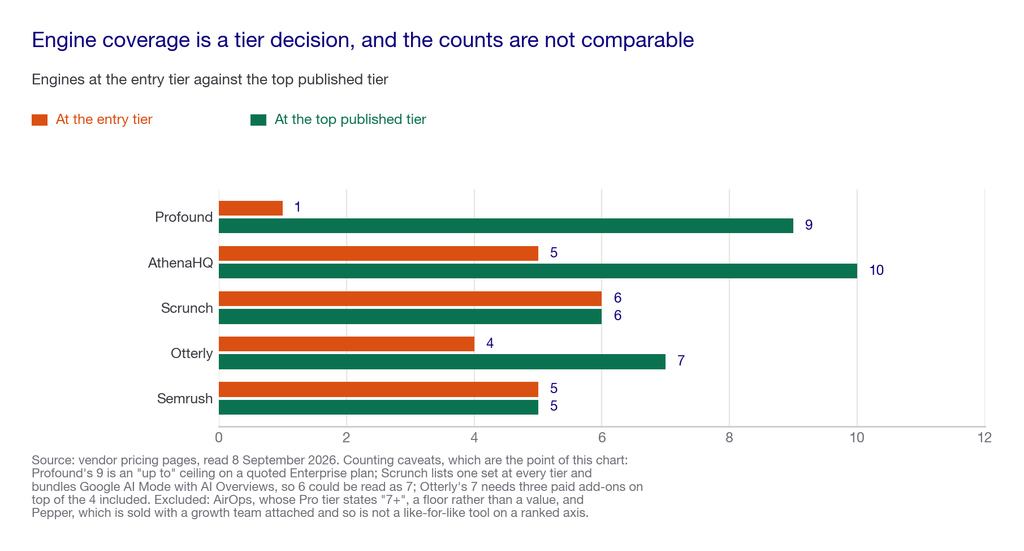
Read that figure with the counting caveat in mind. It is the point of the figure, not a footnote to it. Scrunch’s total depends on whether you treat Google AI Mode and AI Overviews as one surface or two. Profound’s “up to 9” is a ceiling, not a guarantee. Otterly’s higher number needs paid add-ons.
What these tools actually cost, because the sticker price is not the price
Otterly deserves a worked example, because it is the clearest case in the category and the arithmetic is verifiable.
Lite is $29 a month and includes four engines: ChatGPT, Google AI Overviews, Perplexity and Microsoft Copilot. Google AI Mode, Gemini and Claude are add-ons at $9, $9 and $29 on that tier.<
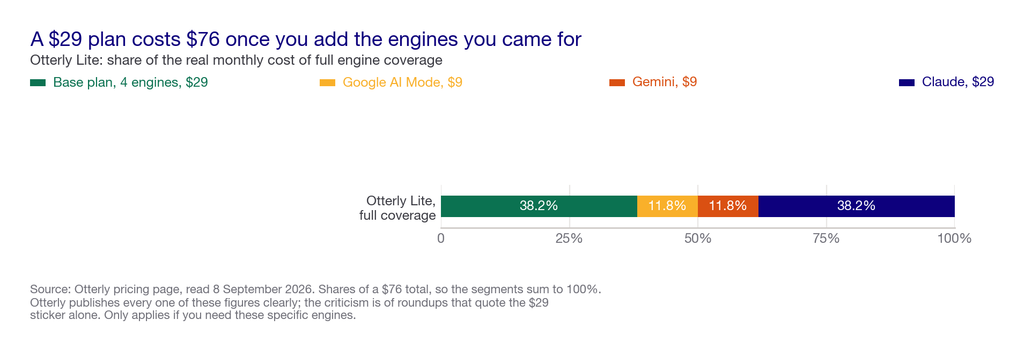
Full coverage on the cheapest plan in the category is therefore $76 a month, not $29. That is still inexpensive, and it is no criticism of Otterly, which publishes every one of those numbers clearly. The criticism is of every roundup that puts “$29” in a comparison table and calls the job done.
Where it falls short: this arithmetic only applies if you need those specific engines. If your buyers live in ChatGPT and Google, the $29 tier is honestly priced for what you need.
When you do not need one
The section every other page on this topic skips. Four honest cases, and I would say all four out loud on a sales call.
Your category has too few prompts to measure. If you cannot list roughly thirty distinct commercial questions a buyer would ask, sampling will not produce a trend. Track a handful by hand each month in a spreadsheet, and spend the licence fee on earned media.
Nobody can act within a fortnight. Prompt-level data goes stale fast. Our own guidance is to add three to five prompts at a time and give them two weeks before reading anything into the result. If nothing can ship inside that window, the tool becomes a subscription to being told you have a problem.
You already know the answer. Plenty of teams buy monitoring to confirm they are invisible in AI search. If you are confident that is true, you have your finding for free. Skip to fixing it, because what actually matters in AI search measurement is whether the work changes.
Your problem is authority, not visibility measurement. If engines mention you constantly and cite you rarely, more tracking tells you the same thing every week. Earned coverage and original material become the constraint, and no dashboard produces either.
The uncomfortable version, since I would rather you trusted the rest of this page. A monitoring subscription is the easiest thing to buy here, and the least likely thing to change your numbers on its own.
How to choose an AI search monitoring tool
I would not start from a feature grid. I would start by writing down the decision the tool should inform. In most evaluations I see, nobody can name one, and a tool bought without a decision attached becomes a report nobody reads by the second quarter.
The framing judgement first, anchored outside our own opinion. Google’s guidance states that optimising for generative AI search “is optimizing for the search experience, and thus still SEO”. Google also advises against providers guaranteeing rankings. I think that framing is right for Google and incomplete as a buying rule, because the other engines publish nothing comparable. Hold both. Do not buy a separate AI methodology, and do not assume one engine’s behaviour generalises.
Here is the 100-point scorecard I would run over any vendor, ours included.
| Area | Weight | What a strong vendor should demonstrate |
|---|---|---|
| Prompt transparency and control | 30 | You can see, edit and export every running prompt, and someone can explain how they chose the starting set rather than pointing at a generated list |
| Evidence in the output | 25 | The tool names cited URLs per prompt per engine, so the report tells you which third-party page to go and influence rather than only that your number moved |
| Honesty about variance | 20 | The vendor will state, unprompted, that engines are probabilistic, and will show what a repeated run looks like rather than a single smoothed line |
| True cost at the coverage you need | 15 | A written quote covering the engines, prompts and seats you actually require, with add-ons itemised, not a headline tier price |
| Competitor and source context | 10 | You can see who appeared instead of you and which sources influenced that answer, at prompt level rather than in aggregate |
Then run the live test, on us as readily as on anyone else. Give each vendor 25 questions from your own category and ask them to run them live in front of you, not in a prepared deck. For example: “best AI visibility platform for enterprise”, “who are the leading vendors in our category”, “what is the difference between AEO and GEO”, “alternatives to our biggest competitor”.
Ask them to come back with five things. Where does my brand appear today. Which competitors appear instead. Which sources are influencing those answers. Why are those sources winning. What exactly would you change in the next 90 days. Then ask them to run the same set again the following day. Treat any vendor whose numbers come back identical with suspicion, because that is not how these systems behave.
The weaker evaluation, and it is what most teams run: shortlist from a listicle, compare engine counts and prices in a spreadsheet, take the demo, buy the middle tier. Every step feels rigorous. None of it tests whether the tool can answer a question you actually have.
The stronger sequence: name the decision the data will inform, write the prompt set yourself, then price the coverage you genuinely need with add-ons included. Test two vendors on the same prompts on two different days, compare their cited URLs, and only then compare price. It matters because the cited URL list is the only output that tells you what to do, and the one least likely to appear in a demo.
Red flags, each one something I have heard in a real vendor call. “Here is your AI visibility score” as the headline, with no prompts or URLs behind it. A prompt set you cannot see or edit, usually described as proprietary. Tracking only branded prompts, which makes every report look good. Coverage claims like “7+ engines” or “up to 9” that nobody will pin to your tier in writing. No mention of run-to-run variation anywhere in the pitch. Citation counts with no competitor share of voice, so you cannot tell whether you are winning. A guarantee of citations or rankings, which Google itself advises against, because no third party has access to the ranking systems. And a comparison table on the vendor’s own site where they happen to come first.
Five questions I would ask, and what a good answer sounds like.
- “Show me the exact prompts you are running for my brand.” A good vendor exports the list in the call. Hesitation here is the strongest negative signal available.
- “Run this prompt twice and show me both answers.” The right answer is a shrug and two different outputs, with an explanation of how they aggregate. A vendor surprised by the request has not thought about their own method.
- “Which cited URL would you go and influence first, and why?” This separates a measurement product from a dashboard. A good answer names a specific page and a reason.
- “What does this cost at the engines and prompt volume I actually need?” Ask for it in writing with add-ons itemised. Otterly’s $29 becoming $76 is the general case, not an exception.
- “Tell me about a customer you would not sell this to.” Anyone who cannot answer will sell it to you regardless of fit.
If I reduce this to one principle: buy the evidence, not the score. A tool that shows you which prompts ran and which URLs it cited earns its price. A tool that shows you a number does not, at any price.
The honest closing note, and it costs us something. Very few vendors here are equally strong at measurement, execution, earned authority and attribution, ourselves included, and the good ones will tell you which is their weakest. We are a growth engine with measurement attached, not a pure measurement product. So if all you want is the cleanest tracker with nobody attached, one of the named tools above will serve you better than we will.
What nobody should promise you
Nobody should promise a single number that captures your AI visibility. The inputs move independently and blending them destroys the only signal you could act on.
Nobody should promise a universal benchmark for a good citation rate. There is no such figure, and our own product guidance says so plainly: your own trend and the category leader are the only useful comparisons. That is the argument in what to track and what to ignore.
Nobody should promise a guaranteed citation, results from a single run on a single engine, or clean attribution from a citation to closed revenue. We will not, and I would rather lose the deal than pretend we have solved attribution.
Where this stops working, including for us
If your category is genuinely small, or if organic is not a real commitment for the next several quarters, none of this pays back. Track a few prompts by hand and revisit when the work outgrows the spreadsheet.
If you have monitoring already and nothing has changed as a result, buying a better tool will not fix it. The problem is downstream of measurement, and it is usually capacity or authority. Citation rate is worth watching, but only if someone owns moving it.
Where Pepper falls short: we do not publish pricing, so budget discovery is a conversation rather than a page. We are built for teams running organic as a long-term function, with an internal team to work alongside, so a pure self-serve tracker is not what we are for. Our engine coverage is also deliberately narrower than the widest claim here: six engines, including ChatGPT, Perplexity, Gemini and Google AI Overviews, run at the response volume needed to trust a reading.
Where to go next
Write your prompt list first. Thirty distinct commercial questions, in a spreadsheet, before you look at a single vendor. That exercise alone tells most teams whether they need to buy anything.
Then compare two vendors on that list, on two different days, and look at the cited URLs rather than the scores. If you want the split between your mentions and your citations run against your own category first, see where you show up, or read our current view of citation monitoring tools and LLM monitoring tools.
Frequently asked questions
Why use AI search monitoring tools at all? Because Search Console cannot see a zero-click answer. These tools sample what engines actually say, so they reveal whether an engine mentions you, which competitor it names instead, which sources shaped the answer, and how accurately it describes you.
Can I not just use Google Search Console? No. Search Console reports queries, impressions and clicks on your own property. An AI answer that names a competitor and never sends a click generates none of those, so the absence is invisible in every traffic-based report.
How many prompts do I need before monitoring is worth buying? Roughly thirty distinct commercial questions you would genuinely act on. Below that, sampling produces anecdote rather than trend, and entry tiers already meter 15 to 50 prompts, so you would be paying for capacity you cannot fill.
How much do AI search monitoring tools cost? Published entry tiers run from free to $300 a month. Mid tiers sit between roughly $189 and $500, and enterprise plans are quoted. Check add-ons: full coverage on the category’s cheapest plan costs $76, not its $29 sticker price.
Which AI engines should a monitoring tool cover? The ones your buyers use, usually fewer than the longest list on offer. Treat engine counts sceptically. Vendors bundle Google’s two AI surfaces differently, sell some engines as add-ons, and publish floors like “7+” rather than firm numbers.
Is an AI visibility score a real metric? Not on its own. A composite blends mentions, citations and sentiment, so when it moves you cannot tell which input changed. Ask which prompts produced it and which URLs it cited, then use those instead.
How often should I check AI search visibility? Monthly for reporting, with a stable prompt set. Our own guidance is to add three to five prompts at a time and give them two weeks before drawing conclusions, because engines are probabilistic and short-run movement is usually noise.
What should I do if monitoring shows I am invisible? Work out whether it is a mention problem or a citation problem first. Healthy mentions with no citations means authority, so invest in earned coverage and original material. Low mentions everywhere means the category does not know you yet.
Sources and further reading
- Vendor pricing and coverage read off each company’s own website on 8 September 2026: Profound, AthenaHQ, Scrunch, Otterly, AirOps and Semrush. Not linked, per our policy of naming competitors without passing them authority. Every price, prompt allowance and engine list in this article comes from those pages rather than from any roundup.
- Google Search Central, guide to optimizing for generative AI features, and the announcement post, 15 May 2026. Source of the “still SEO” framing and of Google’s advice against guaranteed rankings. Applies to Google Search only.
- Microsoft, AI Performance in Bing Webmaster Tools, public preview announced 10 February 2026. The one piece of first-party citation reporting a publisher can get free, covering Copilot, Bing AI summaries and select partner integrations. Worth setting up before buying anything.
- Suzgun, Shen, Bianchi, Spangher, Icard, Ho, Jurafsky and Zou, “Evaluating Commercial AI Chatbots as News Intermediaries”, arXiv:2605.22785, submitted 21 May 2026. Cited here for the finding that these systems vary in what they retrieve, which is why a single run proves nothing.
- Pepper, Acceldata case study. Referenced for what acting on measurement produced on one account: 6X organic growth and 85 to more than 300 top-three keywords. One account, not a benchmark.
Latest Blogs
Most advice on this is inference dressed as fact. OpenAI documents exactly one thing clearly, which is access. Here is what is documented, what is inferred, and how to verify the rest for yourself.
Being named in an AI answer and having your page used as its source are different outcomes with different causes and different fixes. The gap between them is the most useful diagnostic in AI search, and most reporting collapses it into one number.
Every platform reports share of voice and almost none of them define it the same way. Here is the definition worth using, the three choices that change the number, and how to measure it yourself without buying anything.
Get your hands on the latest news!

Similar Posts
GEO / AI Search
10 mins read
How to get cited by ChatGPT
GEO / AI Search
10 mins read
Mentioned vs cited: the difference that decides AI visibility
GEO / AI Search
13 mins read