Best LLM monitoring tools for brand visibility in 2026
The short answer
If you are shortlisting LLM monitoring tools for brand visibility, the first thing to check is whether the tools on your list do the same job. Most lists mix two unrelated categories, so half the products solve a problem you probably do not have.
One category watches what AI engines say about your brand. The other watches what your own AI application is doing internally: traces, latency, token cost, evaluation scores. Both get called LLM monitoring. Only the first has anything to do with brand visibility.
The tools that matter for visibility are separated by two things, and price is not really one of them. What separates them is how many engines you get at the price you can actually see, and whether anyone is on the hook for acting on what the dashboard says.
Key takeaways
- “LLM monitoring” describes two different products. Datadog LLM Observability and LangSmith monitor your own applications. They do not track brand mentions in ChatGPT, and they should not be on a brand visibility shortlist.
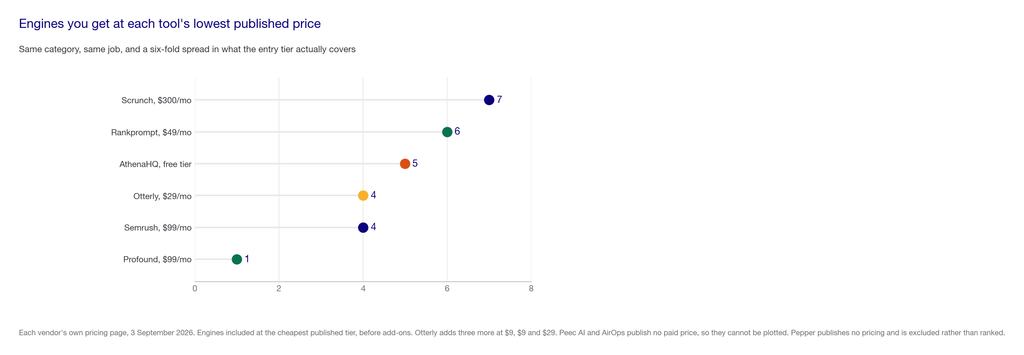
- Engine coverage per dollar varies wildly. At its cheapest published tier, Profound covers one engine for $99 a month. Rankprompt covers six for $49. That is not a small difference.
- Cheap headline prices hide add-ons. Otterly starts at $29 a month, but Google AI Mode, Gemini and Claude are paid extras, so full coverage on the entry plan lands nearer $76.
- Some tools publish nothing. Peec AI names four tiers and no figures at any of them. AirOps gates its paid pricing. You cannot budget against a page that does not exist.
- A tracker is not a plan. Every product here tells you where you stand. None of them does the work that changes it, which is the gap Pepper’s GEO platform is built to close.
A note on where this comes from. We run organic for more than 250 enterprises and track over 10 million prompts across every major engine. That shapes this read, along with the client reviews we sit in every week. So do the conversations we have with operators at our events. It is our opinion about the category, not a neutral directory.
What are LLM monitoring tools, and why do two different products share the name?
An LLM monitoring tool for brand visibility runs a set of prompts against AI engines on a schedule, then records whether your brand was named, which sources the engine cited, and how you compare with competitors. That is the whole mechanism.
An LLM observability tool does something else entirely. It instruments an AI application you built yourself, and reports execution traces, token spend, latency and evaluation scores.
The naming collision is not academic, because it puts the wrong products on real shortlists. LangSmith describes itself as an “Agent and LLM Observability Platform”, and its own positioning line is “know what your agents are really doing”. Datadog’s equivalent product is pitched at teams shipping their own AI agents, and it tracks traces, cost, latency, quality and security across those agents.
Neither one can tell you whether ChatGPT recommends you. They are excellent at their actual job. That job is not marketing.
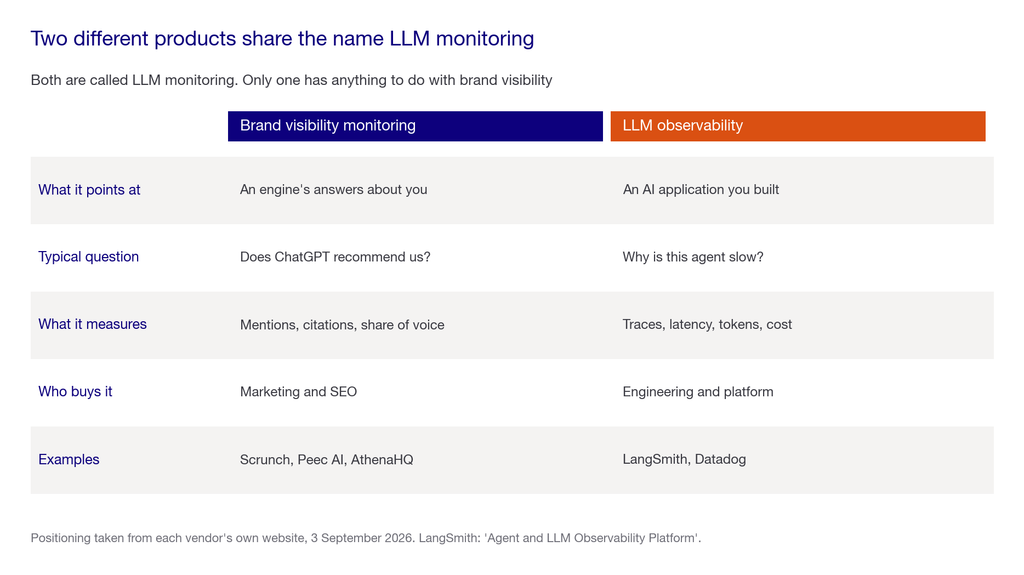
This is the single most common error we see when a team arrives with a shortlist already built. Somebody searched the category name, and the results mixed engineering tooling with marketing tooling, because both groups took the same words.
The practical filter: ask what the tool points at. If it points at your own application, it is observability. If it points at an engine’s answers about you, it is visibility monitoring. Only the second belongs in this comparison.
Why does brand visibility in AI search matter in 2026?
Because the surface is now large enough to matter, and small enough that most teams misjudge it in both directions.
Conductor’s 2026 AEO and GEO Benchmarks Report, which analysed 21.9 million unique Google searches, found AI Overviews triggering on 25.11% of them. The spread by industry is wide: healthcare sits at 48.75%, financials at 25.79%.
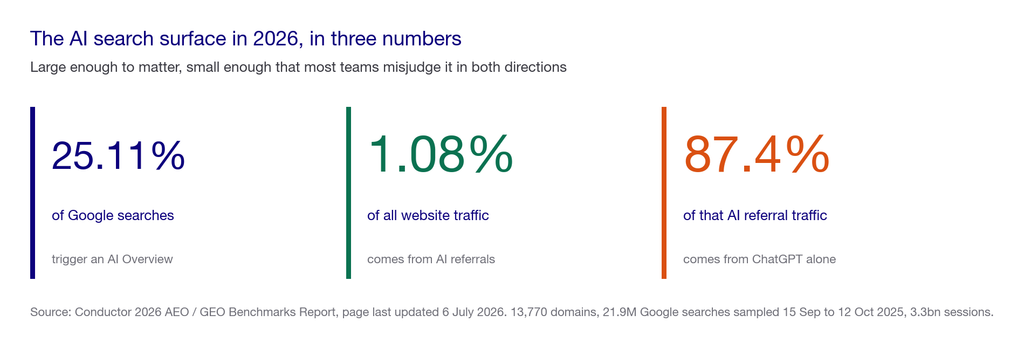
Now the number that reframes it. Across 3.3 billion sessions, the same report puts AI referral traffic at 1.08% of all website traffic. So the answer surface is everywhere, but the click-through from it is still small.
That combination is the actual 2026 situation, and it argues against both of the popular positions. AI search is not yet a traffic channel worth reorganising around. It is already a discovery surface where buyers form a shortlist before they ever visit you.
There is a second detail in that report worth your attention. ChatGPT accounts for 87.4% of all AI referral traffic. Read carelessly, that says monitor ChatGPT and ignore the rest. Read properly, it says referral traffic concentrates in one engine while shortlist formation does not, so single-engine tracking measures the cheapest thing rather than the important one.
The commercial case is stronger than the traffic case. Adobe Analytics found AI-referred traffic to US retail sites grew 393% year over year in Q1 2026, and that by March 2026 it converted 42% better than other channels, having converted 38% worse a year earlier. Small channel, unusually good visitors.
Our point of view on this category
We think most teams buy a tracker when they needed a plan, and then blame the tracker.
Here is the pattern we see repeatedly in accounts we take over. A team buys a monitoring product, watches Brand Visibility for a quarter, and learns that they are mentioned less than two competitors. That is genuinely useful for about a week. Then it repeats every week, unchanged, because nobody has the capacity to act on it.
The dashboard was never the constraint. Execution was.
That is why we would rather talk about the gap between two numbers than about any single score. When your Brand Visibility is healthy but your Domain Prompt Presence is flat, engines are willing to say your name and unwilling to cite your pages. That is a citability problem, and it is fixed with content and earned authority, not with more tracking. The three levers we work from are Visibility, Citability and Retrievability, and monitoring only ever addresses the first.
So here is the answer that loses us the sale. If your category generates fewer than roughly 30 meaningful commercial prompts, or nobody on your team has capacity to act on findings in the next quarter, do not buy a platform yet. Run a free checker once a month and spend the money on earned media instead. You will get more visibility from being cited in one industry publication than from watching a number you cannot move. Our own guide to what to track and what to ignore is deliberately free for that reason.
If you are past that point, book a growth audit and we will run your prompt set before you buy anything.
Our methodology: how we scored these LLM monitoring tools
Our full GEO ranking methodology applies here, weighted for tooling rather than services. Every score comes from the vendor’s own website, checked on 3 September 2026.
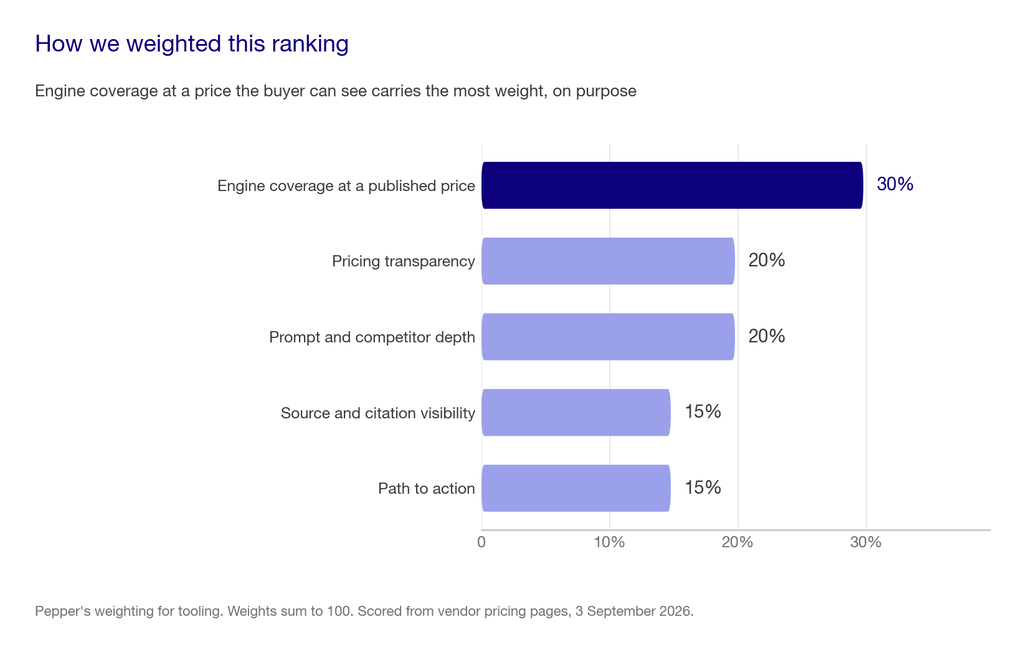
| Area | Weight | What a strong tool demonstrates |
|---|---|---|
| Engine coverage at a published price | 30 | The buyer can see, without a sales call, exactly which engines are included at the tier they can afford, and the list covers more than one engine family |
| Pricing transparency | 20 | Real figures on a public page, with add-ons disclosed in the same place rather than discovered at checkout |
| Prompt and competitor depth | 20 | Enough tracked prompts to cover a real category, plus competitor share of voice rather than mentions counted in isolation |
| Source and citation visibility | 15 | The product names the URLs an engine cited, so the team can see which pages are winning and why |
| Path to action | 15 | Something happens after the finding, whether that is content execution, technical fixes or an attached team |
Weights sum to 100. We deliberately did not score user interface quality, because it does not survive contact with a procurement decision.
LLM monitoring tools at a glance
| Tool | Lowest published price | Engines at that price | Best for |
|---|---|---|---|
| AthenaHQ | Free (Essential, includes $25 credit) | 5 | Trying real multi-engine tracking before committing budget |
| Rankprompt | $49 per month | 6 | Agencies and multi-brand tracking on a small budget |
| Otterly | $29 per month | 4, with three more as paid add-ons | Single-brand monitoring where Copilot matters |
| Semrush AI Visibility Toolkit | $99 per month per domain, billed annually | 4 | Teams already standardised on Semrush |
| Profound | $99 per month | 1 | Enterprises that will land on the $399 tier or above |
| Scrunch | $300 per month ($250 annual) | 7 | Buyers who want every engine included at every tier |
| Peec AI | Not published at any tier | 5 | Teams who will accept a sales call to get a number |
| AirOps | Solo free, paid tiers gated | 1 on the free tier | Existing AirOps workflow users |
| Pepper | Not published | Six engines, plus an attached growth team | Teams who need someone to act on the finding |
The tools, in detail
AthenaHQ publishes the most generous entry point in the category. Its Essential tier is free and arrives with a $25 credit, and it tracks five models: ChatGPT, Perplexity, AI Overviews, Gemini and Copilot. Starter at $295 a month lifts that to ten, adding AI Mode, Claude, Grok, DeepSeek and Meta AI, with more available on request. That is the highest published engine count at a published price anywhere on this list. Where it falls short: the jump from free to $295 is steep with nothing in between, so a small team that outgrows Essential has no gentle next step.
Rankprompt is the best engine-per-dollar deal we found. Starter is $49 a month, or $39.17 on annual billing at 20% off, and it covers six engines: ChatGPT, Perplexity, Google AI Mode, Gemini, Claude and Grok. The ladder runs up through Pro, Agency and Agency Plus at $71.25, $119.17 and $239.17 annually, scaling prompts and brands rather than engines, which is the right way round. A free first report is available without a card. Where it falls short: it is a younger product than most here, and the content generation and outreach modules it bundles are broad rather than deep.
Otterly looks like the cheapest option and is not quite. Lite is $29 a month for 15 prompts, and it includes four engines: ChatGPT, Google AI Overviews, Perplexity and Microsoft Copilot. Google AI Mode and Gemini are $9 each on that tier, and Claude is $29, so seven-engine coverage on Lite costs about $76. Standard is $189 and Premium $489, with a 15% annual discount. Unlimited team members on every plan is a genuine advantage. Where it falls short: the add-on model means the headline price is not the price, and the gap between Lite and Standard is six times the money for around seven times the prompts.
Semrush AI Visibility Toolkit is the safe institutional choice. It is $99 a month per domain on annual billing, covers mentions from ChatGPT, Google AI, Gemini and Perplexity, and tracks 25 custom prompts against one domain for brand performance. There is a seven-day free trial, and a free AI visibility checker for three lookups a day. Where it falls short: 25 prompts is thin for a real category, it is measurement only with no execution attached, and per-domain pricing gets expensive for anyone running several brands.
Profound publishes the clearest enterprise ladder in the category, which is exactly why its entry tier deserves scrutiny. Starter is $99 a month and covers ChatGPT only, with 50 prompts and 1,500 monthly responses. Growth at $399 adds Perplexity and Google AI Overviews for three engines total and 100 prompts. Enterprise is quoted, reaches up to nine answer engines, and brings SSO, SAML and SOC 2. Agent Analytics runs unlimited domains at every tier. Where it falls short: single-engine coverage at $99 is the weakest value on this list, and the product is genuinely built for the tier most readers here will not buy.
Scrunch takes the opposite approach to engine gating, and we think it is the better one. Starter is $300 a month, or $250 annually, and every tier includes all seven engines: ChatGPT, Claude, Gemini, Perplexity, Google AI Mode, AI Overviews and Meta. Growth is $500, or $417 annually, with a 17% discount for paying yearly. GA4 integration attributes AI referral traffic properly. Note that its domain moved, and scrunchai.com now redirects to scrunch.com. Where it falls short: $300 is a hard floor with no small-team entry point, and the Agent Experience Platform remains limited availability rather than generally released.
Peec AI positions itself as AI search analytics for marketing teams, and it shares Scrunch’s good instinct on engines. Five engines at every tier, ChatGPT, Perplexity, Gemini, AI Mode and Copilot, with no gating by plan. The four tiers differ by project count and support rather than coverage. Where it falls short: no published figures at any of the four tiers. Its buyer is a marketing manager with a budget line. Making them book a call to learn the price is a real cost. That is why it sits below tools with weaker features but visible numbers.
AirOps has repositioned to AI Search for Enterprise, and it is a platform rather than a tracker. Insights is free, and the Solo tier is free with 100 tracked prompts and pages but ChatGPT insights only. Pro lifts that to 250 prompts across Google, Perplexity, OpenAI and Google AI Studio, with unlimited seats, and its price is gated. Where it falls short: the free tier’s single-engine limit makes it a poor evaluation of multi-engine reality, and the paid pricing is not public.
Pepper, in its own category
We are not a monitoring tool, so ranking ourselves against these products would flatter us on a comparison we are not in. Pepper is an agentic organic growth engine, and monitoring is one surface of it rather than the product.
Practically, that means two things at once. Customers log in and run it themselves. They set up a workspace, define brand profile, competitors and personas, and connect GA4 and Search Console. They also manage themes and prompts, read GEO analytics, and run their own agents in the Agent Atlas. And a growth team is attached to the account and does the work alongside them. Agents for scale, experts for judgement, one team on the hook for the number.
The platform tracks six engines, including ChatGPT, Perplexity, Gemini, Claude and Google AI Overviews, and reports Brand Visibility, Domain Prompt Presence and Share of Voice. The gap between the first two is the diagnostic we care most about, because it separates “engines will not say our name” from “engines will not cite our pages”. Those need different fixes. Acceldata, working with us, took organic traffic to 6X and top-three keywords from 85 to more than 300.
Where it falls short: we do not publish pricing, so budget discovery is a conversation rather than a page, and if you want a number today then several tools above will give you one. We are built for teams running organic as a long-term function, so a one-off audit or a pure dashboard purchase is not what we are for. If you want software and nothing else, buy software. Our own comparison of when to buy a tool and when to buy a team is honest about which cases go the other way.
What these tools actually cost
Published entry prices in this category run from free to $300 a month, and the spread tells you less than it appears to.
The number that matters is cost per engine at the tier you will actually buy. Profound’s $99 buys one engine. Semrush’s $99 buys four. Rankprompt’s $49 buys six. Scrunch’s $300 buys seven at every tier, which is expensive per month and cheap per engine.
Then add the things that are not on the pricing page. Prompt overages, per-domain multipliers if you run more than one brand, and the add-on engines that turn Otterly’s $29 into roughly $76. Budget for the tier above the one you are looking at, because prompt allowances are the first thing teams outgrow.
How to choose an LLM monitoring tool
I run technical GEO at Pepper, so this is the evaluation I would actually do, in the order I would do it.
Start by narrowing the question. Google’s May 2026 AI search guidance sits under SEO fundamentals in Search Central. It states plainly that AEO and GEO are part of SEO. It also confirms that AI Overviews and AI Mode run on core Search ranking. There is no separate AI index. Google also mythbusts llms.txt, content chunking, AI-specific rewrites and structured-data over-optimisation.
That guidance is correct, and it is correct for Google. Google is one engine among several, and the research on generative engines consistently finds substantial variation and low source overlap between them. So hold both ideas: your Google visibility is an SEO problem with a new surface, and your ChatGPT and Perplexity visibility is not fully governed by Google’s rules. A tool that only reflects Google’s world will mislead you about the rest.
Then score against a scorecard rather than a demo. Mine is the same 100-point split I used to rank this list, turned around so you can apply it to your own shortlist.
| Area | Weight | What to demand in the demo |
|---|---|---|
| Engine coverage at a published price | 30 | Ask them to name the engines included at the tier you would actually buy, then check that list against their own pricing page while you are on the call |
| Pricing transparency | 20 | A public page with real figures and every add-on disclosed in the same place, so your budget survives the second invoice |
| Prompt and competitor depth | 20 | Enough tracked prompts to cover your real category, plus competitor share of voice rather than your mentions counted on their own |
| Source and citation visibility | 15 | The product should name the URLs an engine cited, so your team can see which pages are winning and go and read them |
| Path to action | 15 | Something has to happen after the finding, whether that is content execution, technical fixes or a team attached to the account |
Weights sum to 100. Weight them differently if your situation differs, but write them down before the first demo. Weight them differently if your situation differs, but write the weights down before the first demo. Vendors are good at making whatever they do well feel like the most important criterion.
Run the live test before you pay anyone. Write 20 to 30 real commercial questions your buyers ask, not branded ones. Branded prompts flatter every tool, because engines name you when asked about you.
Four worked examples, for a B2B data company:
- “What is the best data observability platform for enterprise?”
- “Compare data quality tools for a company running Snowflake and dbt.”
- “Which data observability vendors have SOC 2 and support on-prem?”
- “What should I ask a data observability vendor in a procurement review?”
Run each on at least three engines, twice, on different days. Then answer five questions: where do I appear, which competitors appear instead, which sources influenced those answers, why are those sources winning, and what would change in the next 90 days. Engines are probabilistic, so one run on one engine establishes nothing. Two runs across three engines starts to be evidence.
Know the difference between the weaker playbook and the stronger one. The weaker sequence is familiar: find some prompts, rewrite a few blogs, add FAQ schema, sprinkle statistics, hope for a citation. It produces activity and a flat chart.
The stronger sequence runs in a different order: demand intelligence first, then technical discoverability, then entity and brand authority, then content, then earned-media authority, then distribution, then visibility measurement, and revenue attribution last. Measurement sits near the end deliberately. Buying the measurement layer first is buying the scoreboard before the team.
Red flags, each one something a vendor actually says. “We guarantee citations in ChatGPT” is the worst, and Google’s own guidance advises against providers who guarantee rankings. “Here is your AI visibility score” as a single composite number, which hides the Brand Visibility and Domain Prompt Presence gap that tells you what to fix. “We track your branded prompts” as the headline, which measures the easiest possible case. “We optimise for ChatGPT” as a complete offer, when it is 87.4% of referral traffic and nothing like 87.4% of shortlist formation. And mass AI-generated articles as the execution plan, which is the practice Google’s guidance explicitly warns about.
Two more that sound reasonable. Any vendor with no stated prompt-selection methodology is picking prompts that make the chart look good. Any vendor reporting citation counts without competitor share of voice is reporting a number with no denominator.
Five questions I would ask, and what a good answer sounds like.
- “Which engines are included at the tier I would buy, not the tier above?” A good answer names them without checking, and volunteers the add-ons. A bad one moves to the enterprise tier.
- “How did you choose the prompts in this demo?” A good answer describes a method: category demand data, real buyer questions, competitor overlap. A bad one is “we picked some relevant ones.”
- “Show me a page my competitor is cited on that I am not.” A good answer produces a URL in the product. A bad one talks about mentions.
- “What happens after the dashboard tells me I am losing?” A good answer is honest that the tool reports and someone else acts. A bad one implies the tool fixes it.
- “What does your product not do well?” Every good vendor has a ready answer. A vendor with no weaknesses has not thought about the buyer.
The reducing principle. It comes down to one principle: buy the narrowest thing that closes your actual gap. If you cannot see your position, buy monitoring. If you can see it and cannot move it, monitoring is the wrong purchase and more of it will not help.
And the honest closing note. Very few companies are equally strong across measurement, content execution, technical SEO, digital PR and attribution, ours included. We are stronger on execution and earned authority than on being the cheapest way to look at a number. If a visible price today is your binding constraint, a tool on this list is the better buy. The good vendors will tell you which of those five is their weakest. Ask.
What nobody should promise you
No tool can guarantee a citation or a position in an AI answer. Engines are probabilistic, they re-rank constantly, and no vendor controls them.
No single composite AI visibility score is trustworthy on its own, and we would not ship one. A score that blends mentions and citations hides the exact gap you need to see, which is why we report Brand Visibility and Domain Prompt Presence separately.
There is no universal benchmark for what a good number looks like. Compare against your own trend and against the category leader. Anyone selling you an industry benchmark is selling you a number with no methodology behind it.
Results from one engine or one run establish nothing. Neither does clean attribution from a citation to closed revenue, which nobody in this category can currently deliver end to end, whatever the demo suggests.
Frequently asked questions
What are LLM monitoring tools?
They run a fixed set of prompts against AI engines on a schedule and record whether your brand is named, which sources were cited, and how you compare with competitors. They measure visibility inside AI answers rather than website traffic.
Are LLM monitoring and LLM observability the same thing?
No. Observability tools like LangSmith and Datadog monitor AI applications you build yourself, reporting traces, latency and token cost. Brand visibility tools monitor what external engines say about you. Different buyers, different budgets, different products entirely.
How much do LLM monitoring tools cost in 2026?
Published entry prices run from free to about $300 a month. AthenaHQ has a free tier, Otterly starts at $29, Rankprompt at $49, Semrush and Profound at $99, and Scrunch at $300. Several vendors publish nothing.
Which tool tracks the most AI engines?
At a published price, AthenaHQ’s $295 Starter tier tracks ten models. Scrunch includes seven at every tier from $300. Rankprompt covers six from $49, which is the strongest engine-per-dollar ratio we found in September 2026.
Do I need to track more than ChatGPT?
Usually yes. ChatGPT drives 87.4% of AI referral traffic according to Conductor’s 2026 benchmarks, but buyers form shortlists across several engines before clicking anything. Single-engine tracking measures the cheapest signal rather than the most useful one.
How many prompts should I track?
Enough to cover your real commercial category, which for most B2B businesses means 30 to 100 unbranded questions. Add three to five at a time and give them two weeks before judging. Branded prompts inflate every number and teach you nothing.
Can these tools improve my AI visibility?
Monitoring tools report position, they do not change it. Improvement comes from technical discoverability, content that answers real questions, and earned media citations. Choose a tool for measurement, then resource the execution separately or buy them together.
What is the difference between Brand Visibility and Domain Prompt Presence?
Brand Visibility counts how often engines mention your brand by name. Domain Prompt Presence counts how often they cite a page from your domain. A wide gap between them means engines know you but will not cite you, which is a citability problem.
Where to go next
If you want to know where you stand before you spend anything, our guide to what actually matters in AI search measurement walks through the free version. For engine-specific behaviour, Perplexity and ChatGPT differ more than most teams expect, and that difference should shape which tool you buy.
If you have the measurement and need the movement, that is what Pepper’s GEO platform and the growth team attached to it are for. See where you show up, and we will run your prompt set across every engine we track before you commit to anything. Our customer results are the fairest way to judge whether that is worth your time.
Sources and further reading
All vendor pricing, tier and engine claims were verified on each company’s own website on 3 September 2026. Vendor pages are cited by name rather than linked, as a matter of editorial policy.
- Conductor, 2026 AEO / GEO Benchmarks Report, page last updated 6 July 2026. 13,770 domains across ten industries, 21.9 million unique Google searches sampled 15 September to 12 October 2025, 3.3 billion sessions. Source of the 25.11% AI Overview trigger rate, healthcare 48.75%, financials 25.79%, AI referral traffic at 1.08% of all traffic, and ChatGPT at 87.4% of AI referral traffic. Read the report
- Adobe Analytics, 2026 AI traffic reporting, based on more than one trillion visits to US retail sites. Source of the 393% year-over-year growth in AI-referred retail traffic in Q1 2026 and the 42% conversion advantage recorded in March 2026, reversed from 38% worse in March 2025. Adobe Digital Insights
- Google Search Central, first official AI search optimisation guidance, published 15 May 2026 under SEO fundamentals. Source of the position that AEO and GEO are part of SEO. Also the confirmation that AI Overviews run on core Search ranking, with no separate AI index. And the advice against providers who guarantee rankings. Google Search Central
- Vendor pricing pages for AthenaHQ, Rankprompt, Otterly, Semrush, Profound, Scrunch, Peec AI and AirOps, each checked at source on 3 September 2026.
- Pepper case study, Acceldata: 6X organic traffic, top-three keywords from 85 to more than 300, 100,000+ new organic users. Acceldata case study
Removed from the previous version of this article, and why. The McKinsey figure on 16% of brands tracking AI search comes from a CMO survey fielded in September 2025. It was published that October, so it is a 2025 study and falls outside our 2026-only rule. The Insightland claim of 527% growth in AI-sourced traffic measured January to May 2025 was removed for the same reason, and replaced with Adobe’s 2026 measurement. Three further claims carried no source at all, so we cut them rather than re-source them. One had LLM visitors converting at 4.4 times organic traffic. Another had 40% to 60% of cited domains changing every month. The third put tool accuracy at 85% to 95% on direct brand mentions. LangSmith and Datadog LLM Observability were removed from the tool list because both are application observability products rather than brand visibility trackers.
Latest Blogs
The research pulls in two directions. Fan-out rewards covering many adjacent questions; absorption research finds longer pages get used. The resolution is that the passage competes, not the page.
Seven documented changes, not seven predictions. Google switched two rich results off, shipped two new AI reports, and added a channel to Analytics. Here is what actually moved and what it means.
Content chunking is the process of splitting a page into smaller pieces so a machine can retrieve one of them. Here is the part most articles get wrong: chunking is something engines do to your page, not something you do to it. You do not choose the chunk size.
Get your hands on the latest news!

Similar Posts
Artificial Intelligence
9 mins read
What is the Share of Answer? Definition, Benchmarks, and How to Improve It
Generative AI
8 mins read