Most answers to this question are forecasts. This one is a list of things that have already happened, each with the documentation behind it.
The short answer
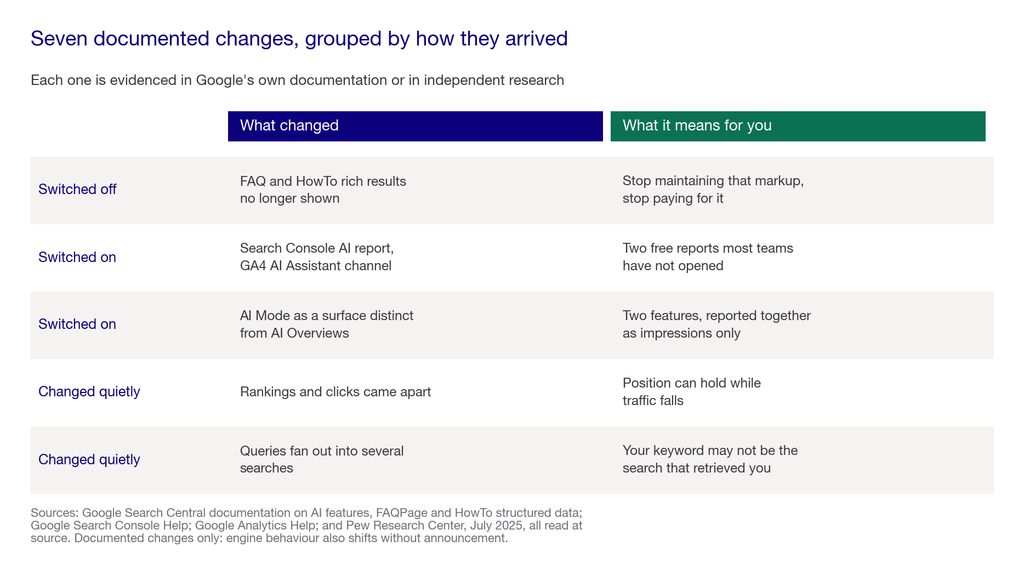
Seven changes are documented rather than predicted, and they fall into three groups.
Things Google switched off.
- FAQ rich results. Google’s documentation now states the feature “is no longer shown in Google Search results.”
- HowTo rich results. Google states this one “is no longer shown in search results, on both desktop and mobile devices.”
Things Google switched on.
- A generative AI performance report in Search Console, covering AI Overviews and AI Mode.
- An AI Assistant channel in Google Analytics, for traffic arriving from assistants like ChatGPT and Copilot.
- AI Mode as a surface distinct from AI Overviews, for queries needing exploration or comparison.
Things that changed underneath without an announcement.
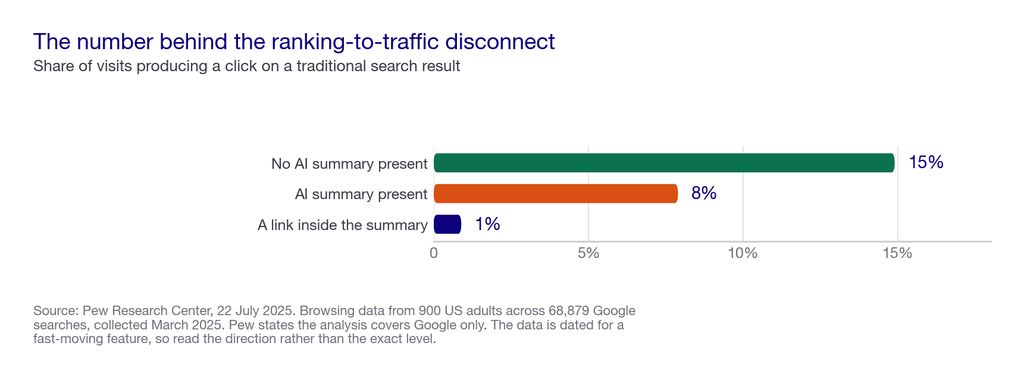
- The relationship between a ranking and the traffic it earns. Independent research found users clicked a result 8% of the time when an AI summary appeared, against 15% when none did.
- What a query actually is. Both AI features use query fan-out, issuing several related searches behind the one you typed.
What has not changed is what Google tells you to do about it: “There are no additional requirements to appear in AI Overviews or AI Mode, nor other special optimizations necessary. That said, it’s always good to review the fundamental SEO best practices.”
We run this work daily. Pepper is an agentic organic growth engine, not an SEO agency. This page comes out of what we run: organic for more than 250 enterprises across eight years, more than 10 million tracked prompts, and the questions buyers put to us in client reviews. Customers log in and run the platform themselves, with a Pepper growth team attached. Book a growth audit and we will show you which of these already affect you.
Key takeaways
Key takeaways from Google’s own documentation and one independent study.
- Two rich results are gone. FAQ and HowTo markup no longer produce a result in Google Search.
- Two new reports exist. Search Console now reports AI feature impressions, and Analytics has an AI Assistant channel.
- Clicks and rankings came apart. A feature can take the click without changing your position.
- Queries fan out. One question becomes several searches behind the scenes.
- Google’s advice did not change. No special optimisation is required for AI features, by Google’s own statement.
- Your reporting probably has not caught up. That is the real work for most teams this year.
What is actually different about SEO in 2026?
Less than the headlines suggest about the work, and more than most teams have absorbed about the measurement.
The fundamentals are intact. Crawlability still gates everything. Clear content still wins. Earned authority is still the slowest and most valuable part. Google says as much itself.
What changed is the layer above: where you appear, what that appearance is worth, and whether you can see any of it. Those three are the subject of this page.
Where it falls short as a framing. Documented changes are not the only changes. Engine behaviour shifts without announcement, and Google’s documentation lags its products. This list is what can be evidenced, not everything that is true.
What Google switched off
Two structured data types stopped producing results, and both are still sold as deliverables.
FAQ rich results. Google narrowed these in September 2023 so the feature showed only for “well-known, authoritative government and health websites.” The documentation now states plainly that “The FAQ rich result feature is no longer shown in Google Search results.”
HowTo rich results. Same outcome. Google’s page states “this rich result is no longer shown in search results, on both desktop and mobile devices,” and it removed the documentation in September 2023.
What to do about it. Leave existing markup in place, since it is harmless, but stop maintaining it and stop paying for it. If a proposal lists FAQ schema as a visibility deliverable, that specific promise is no longer available. Entity markup like Article and Organisation is a different matter and still worth having, as the technical checklist sets out.
What Google switched on
Three additions, and two of them are free reporting you may not have opened yet.
A generative AI performance report in Search Console. It covers AI Overviews and AI Mode, and reports impressions only, defined as “how many times links to your site were shown to a user in a generative AI feature.” Dimensions are pages, countries, dates and devices. There is no click metric and no query-level filtering, and the two features are not separated from each other.
An AI Assistant channel in Google Analytics. Google defines it as “the channel by which users arrive at your site from sources like ChatGPT, Gemini, Deepseek, Copilot, or Grok,” and sets the medium to ai-assistant when the referrer matches its internal list. That list is not published, so the channel cannot be fully audited.
AI Mode as a distinct surface. Separate from AI Overviews, and described by Google as “particularly helpful for queries where further exploration, reasoning, or complex comparisons are needed.” We compare the two surfaces in AI Overviews vs AI Mode.
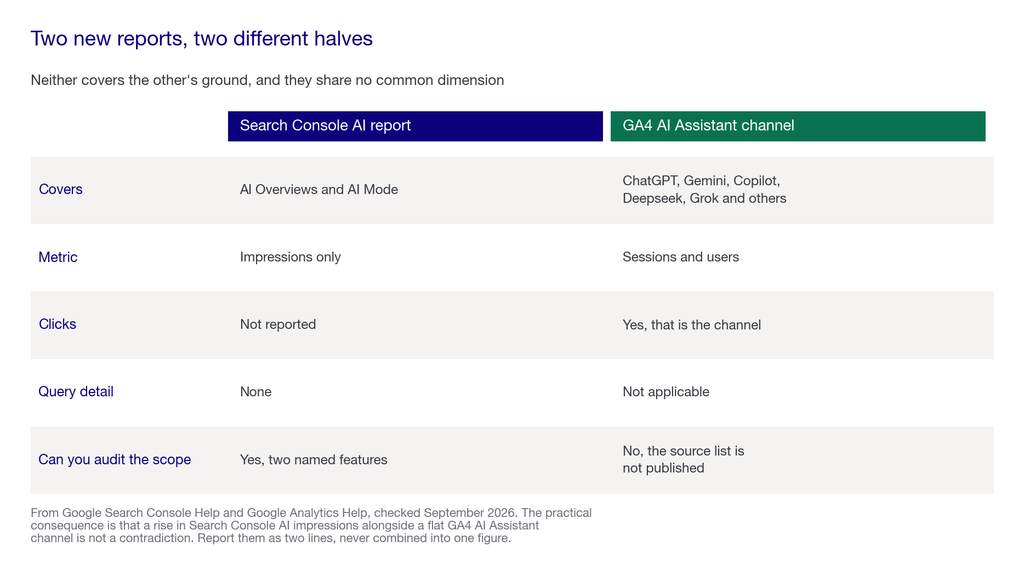
The catch worth knowing. The two reports do not meet. Search Console covers Google’s own surfaces without clicks; Analytics covers third-party assistants without impressions. Reporting them as one “AI traffic” number produces a figure you cannot explain. We work through the setup in how to know if AI search is sending you traffic.
What changed without an announcement
These are the two that actually alter how you work, and neither came with a release note.
Rankings and traffic came apart
The Pew Research Center tracked real browsing from 900 US adults across 68,879 Google searches. Users who encountered an AI summary clicked a traditional result in 8% of visits. Users who did not clicked in 15% of visits, which Pew describes as “nearly twice as often.” Clicks on a link inside the summary occurred in just 1% of visits.
What that does to your reporting. Position can hold while clicks fall, because a feature above your result answered the question. Ranking reports and traffic reports stopped agreeing, and neither is wrong. How to present that is in how to read an SEO report.
The honest caveat. Pew’s browsing data is from March 2025, which is dated for a fast-moving feature, and it covers Google only. We go through the evidence and its limits in are AI Overviews taking your clicks.
A query stopped being a query
Both AI features use what Google calls query fan-out: the feature issues multiple related searches behind the scenes and builds its answer from what those return. Google says this surfaces “a wider and more diverse set of helpful links” than a standard results page.
What that does to your targeting. The keyword you optimised for is not necessarily the search that retrieved you. A page can be pulled into an answer by a fan-out search you never considered, which is why prompt sets are becoming a more useful unit than keyword lists. The measurement set is in AI search visibility metrics and KPIs.
What did not change
Worth stating plainly, because a lot of budget is being moved on the assumption that everything did.
- Google’s advice. “There are no additional requirements to appear in AI Overviews or AI Mode, nor other special optimizations necessary.”
- The fundamentals. Crawlability, clear content, page experience, earned authority. All still the levers.
- Guarantees are still worthless. Google’s separate guidance states “No one can guarantee a #1 ranking on Google.”
- Earned authority is still the expensive part. Independent research across 11,000 queries found third-party and reference sources cited far more often than their share of the web would suggest, which is the argument of our GEO best practices playbook.
So the discipline did not fork. There is no separate practice your team is locked out of, and a proposal that doubles your cost by separating AI work from SEO should explain what the second half buys.
What to actually do this year
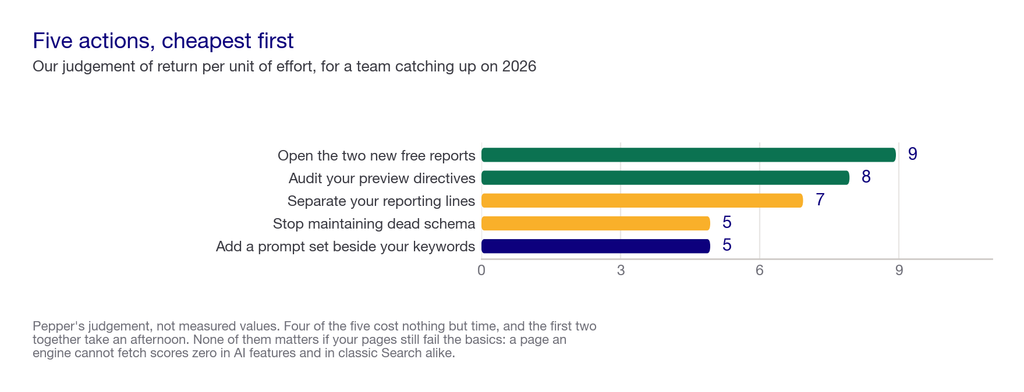
Five things, in order of how cheap they are.
- Open the two new reports. Search Console’s generative AI report and the GA4 AI Assistant channel. Free, and most teams have not looked.
- Audit your preview directives.
nosnippet,data-nosnippetandmax-snippetlimit how you appear in AI features. A tight setting from years ago may be working against you. The full checklist is in how to audit your site for AI search. - Stop maintaining dead schema. FAQ and HowTo markup earn nothing now.
- Separate your reporting lines. Impressions in AI features, sessions from assistants, and ordinary organic clicks are three numbers, not one.
- Add a prompt set alongside your keyword list. Fan-out means the question people ask and the search that retrieves you are no longer the same string.
The answer that loses us the sale. If your site still fails the basics, none of this is your priority. A page engines cannot fetch or render scores zero in AI features and in classic Search alike, and no amount of new reporting changes that. Fix access first, and come back to this list afterwards.
What nobody should promise you
- A ranking guarantee. Google’s own words: “No one can guarantee a #1 ranking on Google.”
- Placement in an AI Overview. Google states there are no additional requirements or special optimisations for appearing, which also means there is no lever to sell.
- Click data for AI features. Search Console’s generative AI report is impressions only.
- An audited AI Assistant channel. Google does not publish which referrers it counts.
- That 2026 broke SEO. The measurement changed more than the method did, and the method Google still recommends is the one you already know.
Frequently asked questions
What is changing in SEO in 2026?
Seven documented shifts: FAQ and HowTo rich results switched off, a generative AI report and an AI Assistant channel switched on, AI Mode established as its own surface, rankings decoupling from clicks, and queries fanning out into several searches.
Is SEO dead in 2026?
No, and Google’s own position is that AI features need no special optimisation beyond standard SEO practice. What changed is where you appear and whether you can measure it, not the work that gets you there.
What Google changed
Does FAQ schema still work?
Not for visibility. Google’s documentation states the FAQ rich result “is no longer shown in Google Search results,” after narrowing it in 2023 to well-known government and health sites. Existing markup is harmless but earns nothing.
What is the generative AI performance report?
A Search Console report covering AI Overviews and AI Mode. It shows impressions only, defined as how many times links to your site were shown in a generative AI feature, with no clicks and no query filtering.
What is the AI Assistant channel in GA4?
A default channel for visits arriving from assistants like ChatGPT, Gemini, Copilot and Grok. Google sets the medium to ai-assistant when the referrer matches its internal list, which it does not publish.
What it means for your work
Why did my rankings hold while traffic fell?
Because an AI feature can occupy the space above your result without changing your position. Independent research found click rates of 8% with an AI summary present against 15% without.
Should I still target keywords?
Yes, and add a prompt set alongside them. Both AI features use query fan-out, issuing several related searches behind one question, so the term you target may not be the search that retrieves your page.
What is the single most useful thing to do this year?
Open the two free reports and audit your preview directives. Together they take an afternoon, cost nothing, and most teams have done neither.
Sources
Google’s documentation was read directly, including raw page source where the wording mattered. Research is independent and named.
Google documentation
- Google Search Central, AI features and your website, checked 29 September 2026. Source of the AI Overviews and AI Mode definitions, the query fan-out description, the preview controls, and the statement that there are “no additional requirements to appear in AI Overviews or AI Mode, nor other special optimizations necessary. That said, it’s always good to review the fundamental SEO best practices.” The page does not use the terms AEO or GEO.
- Google Search Console Help, Generative AI performance report (Search), checked 29 September 2026. Covers AI Overviews and AI Mode, reporting impressions defined as “how many times links to your site were shown to a user in a generative AI feature.”
- Google Analytics Help, Default channel group, checked 23 September 2026. Defines AI Assistant as “the channel by which users arrive at your site from sources like ChatGPT, Gemini, Deepseek, Copilot, or Grok,” with the medium set to
ai-assistantwhen the referrer matches a list Google does not publish. - Google Search Central, FAQ (FAQPage) structured data, checked 29 September 2026. States “The FAQ rich result feature is no longer shown in Google Search results.”
- Google Search Central, HowTo structured data, checked 29 September 2026. States “this rich result is no longer shown in search results, on both desktop and mobile devices.”
- Google Search Central, Do you need an SEO?, checked 29 September 2026. States “No one can guarantee a #1 ranking on Google.”
Independent research
- Pew Research Center, Google users are less likely to click on links when an AI summary appears in the results, 22 July 2025. Browsing data from 900 US adults, 68,879 Google searches, March 2025. Finds click rates of 8% with an AI summary present against 15% without, and 1% on links inside the summary. Pew states the analysis covers Google only. Non-commercial research organisation.
- Huang, Goyal, Saha and Chandrasekharan, Answer Bubbles: Information Exposure in AI-Mediated Search, arXiv, 17 March 2026. 11,000 real search queries across five systems. Finds Wikipedia and longer third-party sources cited far more often than their share of the web would suggest.
On what this list is not
This is a list of documented changes, not a forecast. Engine behaviour shifts without announcement and Google’s documentation lags its products, so the absence of something from this list is not evidence it did not change. Where we have included a number it comes from a named source we read directly, and where we could not verify a widely repeated claim we have left it out rather than repeating it.
Latest Blogs
The research pulls in two directions. Fan-out rewards covering many adjacent questions; absorption research finds longer pages get used. The resolution is that the passage competes, not the page.
Seven documented changes, not seven predictions. Google switched two rich results off, shipped two new AI reports, and added a channel to Analytics. Here is what actually moved and what it means.
Content chunking is the process of splitting a page into smaller pieces so a machine can retrieve one of them. Here is the part most articles get wrong: chunking is something engines do to your page, not something you do to it. You do not choose the chunk size.
Get your hands on the latest news!