18 generative engine optimization best practices that actually move citations
Most lists like this are assembled from what sounds sensible. This one starts from measurement, because a genuinely useful thing happened in 2026: independent researchers took the question apart with real data.
Zhang, He and Yao measured 21,143 search-layer citations across ChatGPT, Google AI Overview and Perplexity in April 2026, from 602 controlled prompts and 18,151 fetched pages, extracting 72 features per page. They found the pages engines actually absorb into answers are longer, more structured, semantically aligned, and richer in extractable evidence: definitions, numerical facts, comparisons and procedural steps.
That single finding produces most of the list below. Where a practice has evidence behind it, the evidence is named. Where a widely recommended practice has none, we say so rather than padding the count.
Pepper tracks over 10 million prompts across every major engine, and this is what we actually do on client accounts.
The short answer
Make one passage per page liftable, put real numbers in it, and get cited somewhere you do not own. Almost everything else is detail.
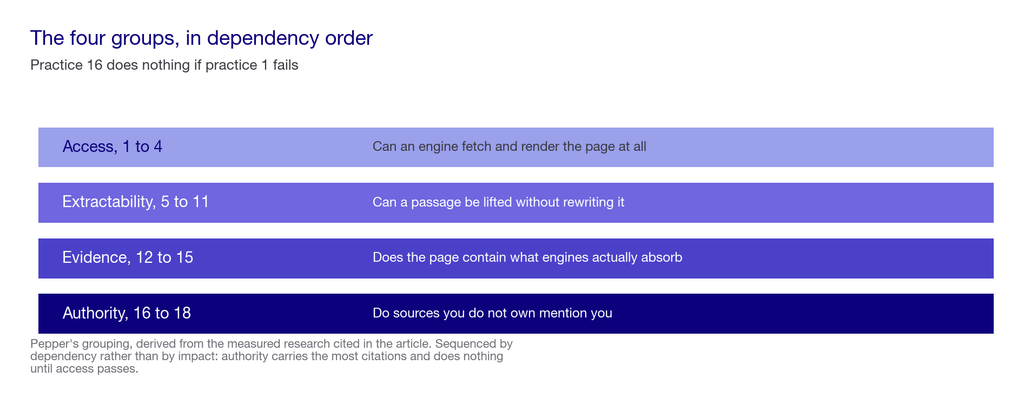
The eighteen practices split into four groups, and they are sequenced by dependency rather than by impact, because the later ones do nothing until the earlier ones pass.
Key takeaways
- Structure beats length, but length helps. Measured across 21,143 citations, absorbed pages were longer and more structured. Not one or the other.
- Four content types get absorbed most: definitions, numerical facts, comparisons and procedural steps. Build pages around those.
- Access gates everything. A page an engine cannot fetch scores zero on all seventeen other practices.
- Most of the citation pool is off your site. No amount of on-page work reaches it.
- Four popular practices have no evidence. They are listed at the end so you can stop doing them.
A note on where this comes from. We run organic for more than 250 enterprises and track over 10 million prompts across every major engine. What follows is shaped by that, by the client reviews we sit in weekly, and by two independent academic studies published this year.
What is generative engine optimization?
Generative engine optimization, or GEO, is the practice of getting your brand named and your pages cited inside AI-generated answers rather than only ranked in a list of links. AEO, answer engine optimization, describes the same work.
Google’s May 2026 guidance states that AEO and GEO are part of SEO, and that AI Overviews and AI Mode run on core Search ranking systems with no separate AI index. So most of the fundamentals carry over from search work your team already does. What is genuinely new is narrower: measuring answers rather than positions, and earning citations from sources you do not own.
Two numbers are worth separating throughout. Brand Visibility is how often engines mention you by name. Domain Prompt Presence is how often they cite a page from your domain. A wide gap between them means engines know you and trust somebody else to describe you.
The eighteen at a glance
| Group | Practices | What it governs | Cost to implement |
|---|---|---|---|
| Access | 1 to 4 | Whether an engine can fetch and render you at all | Free to low, one robots.txt edit plus engineering time |
| Extractability | 5 to 11 | Whether a passage can be lifted without rewriting | Editorial time, cheap per page |
| Evidence | 12 to 15 | Whether the page contains what engines absorb | Research time, the slowest to fake |
| Authority | 16 to 18 | Whether sources you do not own mention you | The largest budget line |
Sequenced by dependency. Practice 16 does nothing if practice 1 fails.
If you want these scored against your own pages rather than applied blind, book a growth audit and we will show you which group is actually your constraint.
How we weighted the four groups
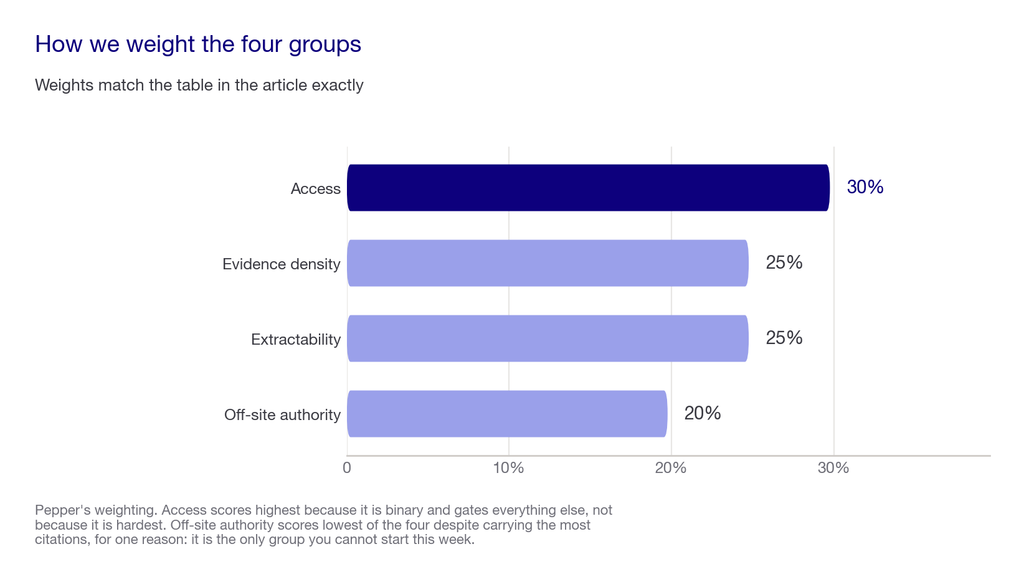
| Area | Weight | What decides the score |
|---|---|---|
| Access | 30 | Whether each engine’s search crawler can fetch and render your key templates. Binary, and it gates everything below |
| Evidence density | 25 | Whether pages contain the four content types the research found engines absorb most |
| Extractability | 25 | Whether a single passage answers its question cleanly enough to lift without rewriting |
| Off-site authority | 20 | Whether the sources engines favour in your category mention you at all |
Access carries the most weight because it is binary rather than because it is the hardest. Off-site authority scores lowest of the four despite being the largest share of citations, for one reason: it is the only group you cannot start this week. Our [GEO agency ranking methodology](https://www.pepper.inc/blog/geo-agency-ranking-methodology/) explains how we build weightings like this.
Group one · Access, practices 1 to 4
1. Allow the search crawler, not just any crawler. Every AI company runs two: one controlling whether you appear in answers, one collecting training data. Allow OAI-SearchBot for ChatGPT, PerplexityBot for Perplexity, and Googlebot for AI Overviews. Blocking GPTBot or Google-Extended costs nothing in visibility, and Google states plainly that Google-Extended “does not impact a site’s inclusion in Google Search.”
2. Serve the content that matters server-side. Retrieval failures caused more than 70% of chatbot errors in a Stanford-led evaluation of six commercial chatbots across 2,100 questions in May 2026. Content that only exists after JavaScript executes is the most common cause we find on new accounts.
3. Compare rendered against raw HTML on every key template. Not once on the homepage. Per template, because pages are generated from patterns and one flawed pattern is tens of thousands of flawed URLs.
4. Keep server responses healthy. Google ties crawl capacity to latency stability and the absence of 5xx errors. Slow or erroring templates get crawled less, which reduces everything downstream.
Where this group falls short: it makes you reachable, not worth reaching. A perfectly accessible thin page stays uncited.
Group two · Extractability, practices 5 to 11
This group follows directly from the measured finding that absorbed pages are more structured.
5. Put a standalone definition in the first fifty words. One sentence that answers the page’s question without needing the paragraph before it. This is the single most liftable structure there is.
6. Answer the heading in the first two sentences under it. Engines extract from the top of a section, not the middle. A section that builds to its point over four paragraphs gets skipped.
7. Write at least one heading as a genuine question. So a model can match a heading to a query directly.
8. Keep a claim and its evidence in the same block. A statistic two paragraphs from its source cannot be lifted cleanly, so it gets left behind.
9. Use tables for genuine comparisons. Comparison was one of the four content types the research found most absorbed. Prose describing a comparison is measurably worse than a table containing one.
10. Use numbered steps where the question implies a process. Procedural steps were another of the four.
11. Make paragraphs short enough to lift. Two to three sentences. A 150-word paragraph containing one useful claim forces an engine to either quote all of it or none.
Where this group falls short: structure makes a good page liftable. It does not make a page with nothing to say worth lifting, and it is the group most often mistaken for the whole discipline.
Group three · Evidence, practices 12 to 15
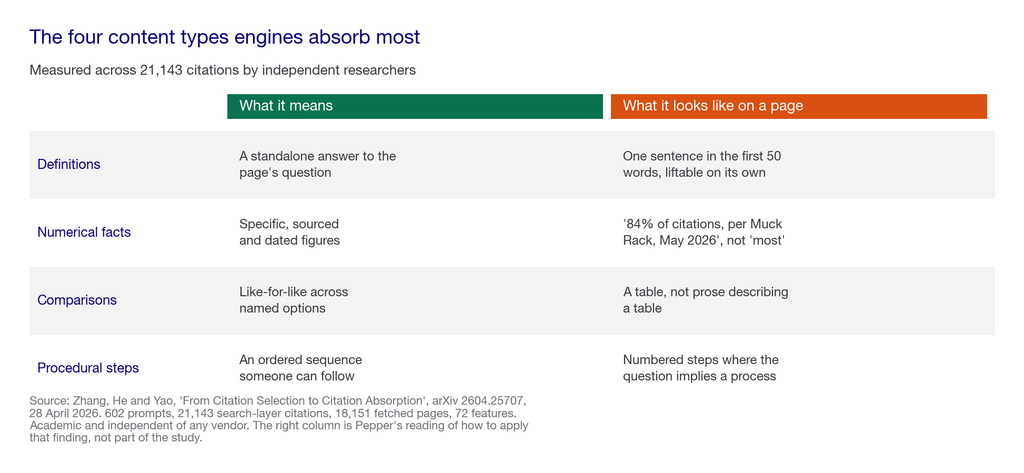
12. Include specific numbers, sourced and dated. Numerical facts were one of the four absorbed types. A page saying “most teams struggle with this” is unciteable. A page saying “84% of AI citations come from earned media, per Muck Rack’s analysis of 25 million cited links in May 2026” is a quotable unit.
13. State your method when you publish a figure. Sample size, date, what was measured. A number without a method is one an engine cannot safely repeat, and increasingly does not.
14. Publish something only you can publish. Original data, a documented framework, a definition of a term. This is the difference between a page that summarises the category and one the category cites.
15. Show visible, accurate dates. Freshness affects selection on time-sensitive questions, and an undated page on a fast-moving subject is a risk an engine can avoid by citing someone else.
Where this group falls short: it is the slowest to fake and the slowest to build. You cannot write original data into existence this quarter, which is exactly why it works.
Group four · Authority, practices 16 to 18
16. Get cited on sources you do not own. Muck Rack analysed more than 25 million cited links across ChatGPT, Claude and Gemini in May 2026 and found earned media accounted for 84% of AI citations against 0.3% for paid and advertorial. Muck Rack sells PR software, so read it as an interested party with a large dataset. Independent work points the same way: Huang and colleagues, across 11,000 queries, found Wikipedia and longer third-party sources disproportionately overrepresented in AI answers.
17. Build your target list from actual citation data, not from a media list. Run thirty commercial prompts, record every cited domain, sort by frequency. That list is your real target list, and it will not match the publications you assumed mattered.
Our guide to tracking brand mentions in AI search covers how to build that list.
18. Keep your brand described consistently everywhere it appears. Same category, same descriptors, same claims across your site, your profiles and third-party listings. Engines assembling an answer about you are reconciling sources, and contradictions cost you the mention.
Where this group falls short: it is the most expensive, the slowest, and the hardest to do in house. It is also where most of the citation pool sits, which is an uncomfortable combination and the honest reason so many programmes stall here.
Four practices with no evidence behind them
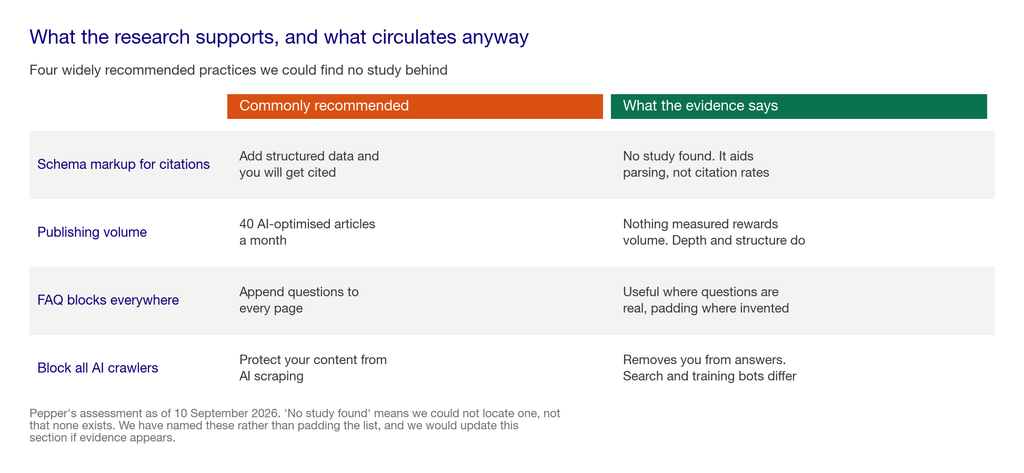
Worth naming, because you will be sold all four.
Schema markup as a citation lever. Structured data makes meaning machine-readable, which is genuinely useful. We could find no study showing it increases AI citation rates, and it is the most consistently oversold tactic in this category. Do it because it helps machines parse you, not because it will get you cited.
Publishing volume. “Forty AI-optimised articles a month” is a production commitment, not a strategy. Nothing in the measured research rewards volume; the findings reward depth, structure and evidence density.
Adding FAQ blocks to everything. Useful where the questions are real and match what people ask. Decorative where they are not, and a page padded with invented questions is thinner, not richer.
Blanket-blocking every crawler with AI in the name. This actively removes you from answers. The search crawler and the training crawler are separate tokens, and the difference is the whole game.
What this work costs
Access is free: a robots.txt edit and the ten minutes to check. Rendering fixes cost engineering time and usually sit longest in a backlog. Extractability costs editorial time, cheap per page and slow across a library. Evidence costs research time. Authority is the largest recurring line and cannot be done from your own site at all.
Measurement now starts at nothing, since several AI visibility platforms have genuine free tiers, covered in the best answer engine optimization tools. Our cost breakdown of platforms against hiring models the execution side, which is where the real spend sits.
What nobody should promise you
Guaranteed citations. Google advises against providers guaranteeing rankings, because third parties cannot access internal ranking systems. The same holds for AI answers.
That schema will get you cited. No study we could find supports it.
That on-page work is enough. Most of the citation pool sits on sources you do not own, so a programme that never leaves your domain is optimising the smaller half.
A single AI visibility score. It hides the gap between Brand Visibility and Domain Prompt Presence, which is the finding you could act on.
How to choose which practices to apply first
I would refuse to apply them in list order, because the list is sequenced by dependency and your constraint is probably not at the top.
Google’s May 2026 guidance sets the scope. AEO and GEO are part of SEO, and AI Overviews and AI Mode run on core Search ranking systems with no separate AI index. That is correct for Google, and Google is one engine, since ChatGPT and Perplexity retrieve differently. Hold both: most of this is search work your team already knows, and the measurement and earned media layers are genuinely new.
Score your own pages before applying anything.
| Area | Weight | What a strong position demonstrates |
|---|---|---|
| Access | 30 | Every engine’s search crawler allowed and verified in the live robots.txt, with key templates rendering server-side |
| Evidence density | 25 | Pages carry sourced numbers, stated methods, and at least one thing only you could publish |
| Extractability | 25 | A single passage per page answers its question cleanly enough to lift without rewriting |
| Off-site authority | 20 | You appear on the domains that actually feed answers in your category, drawn from citation data rather than assumption |
Those weights sum to 100. Score honestly, then apply the practices from your lowest-scoring group rather than from the top of the list.
The live test, and it costs nothing. Take 30 real commercial questions from your category, in your buyers’ words. Four worked examples: “what are the best generative engine optimization practices”, “how do we get cited by ChatGPT in our category”, “best tool for tracking brand mentions in AI answers”, “does schema markup help with AI search”. Run each across ChatGPT, Perplexity and Google AI Mode, more than once, because engines are probabilistic and one run establishes nothing.
Then answer five questions. Where do we appear and where do we not. Which competitors appear instead, consistently. Which sources influence those answers, sorted by frequency. Why are those sources winning, checked against the four absorbed content types. What would change in the next 90 days, and who does it.
The weak playbook against the strong one. The weaker sequence adds schema, appends FAQ blocks, publishes more articles, and reports a visibility score. Entirely on-site, entirely owned media, aimed at the smallest share of the citation pool, and it can be executed perfectly on a site no engine can reach.
The stronger sequence checks access first, fixes rendering, restructures key pages so a passage lifts cleanly, adds sourced evidence, and then builds presence on the domains the citation data actually names. Fewer actions, in dependency order.
Red flags, each one something you will genuinely hear. “Add schema and you will start getting cited.” “We publish 40 AI-optimised articles a month.” “We blocked the AI crawlers to protect our content”, usually meaning the training bot, usually without knowing the search bot is separate. “We guarantee citations in ChatGPT.” “Here is your AI visibility score”, with no prompt set disclosed. “AI search is a completely new discipline”, contradicted by Google’s own position. And the quiet one: a proposal with no earned media line, which given the evidence is structurally incomplete.
Five questions for your own team.
- Which crawlers does our robots.txt allow today? A good answer names the tokens. A weak one assumes.
- Can a crawler see our main template without JavaScript? A good answer is a rendered-versus-raw comparison.
- Which of the four absorbed content types does our key page contain? A good answer counts them. A weak one is that the page is comprehensive.
- Which domains feed answers in our category? A good answer is a frequency-sorted list. A weak one is a guess.
- Who owns earned media, and from which budget? A good answer names both. A weak one calls it content amplification.
It all comes down to one principle: make one passage liftable, put a real number in it, and get cited somewhere you do not own. The other fifteen practices are how those three get done.
One closing note that costs us something. Very few providers are equally strong across measurement, execution, earned authority and attribution, ours included, and the good ones will tell you which of the four is their weakest. If your access is clean and your pages already carry sourced evidence, skip straight to group four and spend nothing on the rest.
Where Pepper fits
Pepper is an agentic organic growth engine, built this way because groups one to three are work your team can do and group four usually is not.
- What you log into: workspace setup, brand profile, competitors and personas. GA4 and Search Console connected. Themes and prompts managed, GEO analytics read directly, and your own agents built and run in the Agent Atlas
- Engines tracked: 6, including ChatGPT, Perplexity, Gemini and Google AI Overviews, reported separately
- And a growth team is attached to the account, doing the work alongside your people, including the earned media in group four that no software performs
- Metrics reported: Brand Visibility, Domain Prompt Presence and Share of Voice, with the gap between the first two as the citability diagnostic
- Best for: teams who need groups one to four covered rather than only the first three
- Where it falls short: we do not publish pricing, so you cannot size it before a call. A one-off audit is not what we are for, and our depth sits in content, authority and AI search rather than large technical migrations
Frequently asked questions
What are the most important generative engine optimization best practices?
Three carry most of the weight: allow the correct search crawler, make one passage per page liftable without rewriting, and get cited on sources you do not own. The other fifteen are how those three actually get done.
Does schema markup help with AI citations?
It makes meaning machine-readable, which is useful. We could find no study showing it increases citation rates, and it is the most oversold tactic in this category. Do it for parsing, not for citations.
What content do AI engines actually cite?
Independent research across 21,143 citations found absorbed pages are longer, more structured and richer in extractable evidence, specifically definitions, numerical facts, comparisons and procedural steps. Build pages around those four.
Does publishing more articles improve AI visibility?
Nothing in the measured research rewards volume. The findings reward depth, structure and evidence density, so forty thin articles perform worse than four substantial ones.
How long is a page supposed to be for GEO?
There is no target length. The research found absorbed pages were longer and more structured, so length correlates with depth rather than causing citations. Write until the question is answered properly, then stop.
Should I block AI crawlers?
Block the training crawlers if you want to; it costs nothing in visibility. Never block the search crawlers, since that removes you from answers entirely. They are separate tokens and confusing them is the most common fault we find.
Why does earned media matter so much?
Muck Rack found 84% of AI citations came from earned media across 25 million cited links, and independent academic work found third-party and reference sources disproportionately overrepresented. A programme confined to your own site addresses the smaller share.
How do I know which practices to apply first?
Score the four groups and start with your lowest. Applying the list top to bottom wastes effort if your constraint is authority, and applying authority work first wastes it entirely if your crawler access is blocked.
Where to go next
Check access today. Open your robots.txt and look for OAI-SearchBot, PerplexityBot and Googlebot. Ten minutes, and it decides whether the other seventeen practices can do anything.
Then take one important page and count how many of the four absorbed content types it contains: a standalone definition, sourced numbers, a genuine comparison, procedural steps. Most pages contain one. The ones getting cited contain three or four.
Our engine-by-engine optimisation guide covers access in full, how to run a GEO audit covers the five-stage framework, and the Visibility, Citability and Retrievability framework explains which lever is stuck.
For tooling, the best answer engine optimization tools covers which have free tiers. For the technical half at scale, our enterprise SEO audit framework sets out 47 checks. Our SalesHood case study documents AI Overview keywords moving from 14 to 97 across five months.
The honest exit. If your access is clean, your pages already carry sourced evidence, and you have an existing PR function, you may need none of this as a project. Run the thirty-prompt diagnostic quarterly and spend the budget on earned media.
Sources
Every study cited was published in 2026 and checked at the original source. Crawler tokens were checked at each company’s own documentation on 10 September 2026.
- Zhang Kai, He Xinyue and Yao Jingang, From Citation Selection to Citation Absorption, arXiv, 28 April 2026. 602 controlled prompts, 21,143 search-layer citations, 18,151 fetched pages, 72 extracted features, across ChatGPT, Google AI Overview and Perplexity. Finds absorbed pages are longer, more structured and richer in extractable evidence. Academic and independent.
- Huang, Goyal, Saha and Chandrasekharan, Answer Bubbles: Information Exposure in AI-Mediated Search, arXiv, 17 March 2026. 11,000 real search queries across five systems. Finds Wikipedia and longer sources disproportionately overrepresented. Academic and independent.
- Suzgun et al., Evaluating Commercial AI Chatbots as News Intermediaries, arXiv, 21 May 2026. 2,100 questions across six chatbots, on retrieval failure as a cause of answer errors. Tested on news rather than commercial queries.
- Muck Rack, Earned media still drives 84% of AI citations, 7 May 2026. More than 25 million cited links, 17 industries. Muck Rack sells PR software, so read it as an interested party with a large dataset.
- Google Search Central, AI features and your website, 15 May 2026. States AEO and GEO are part of SEO, and advises against providers guaranteeing rankings.
- Google Search Central, Google common crawlers, checked 10 September 2026, for the Google-Extended statement.
- OpenAI, Bots documentation and Perplexity, Crawler documentation, both checked 10 September 2026, for the search-versus-training crawler distinction.
The four groups and the weightings are Pepper’s own framework, derived from the research above and from the accounts we run. Where we could find no study supporting a practice, we have said so rather than implying evidence exists.
Latest Blogs
Most advice on this is inference dressed as fact. OpenAI documents exactly one thing clearly, which is access. Here is what is documented, what is inferred, and how to verify the rest for yourself.
Being named in an AI answer and having your page used as its source are different outcomes with different causes and different fixes. The gap between them is the most useful diagnostic in AI search, and most reporting collapses it into one number.
Every platform reports share of voice and almost none of them define it the same way. Here is the definition worth using, the three choices that change the number, and how to measure it yourself without buying anything.
Get your hands on the latest news!

Similar Posts
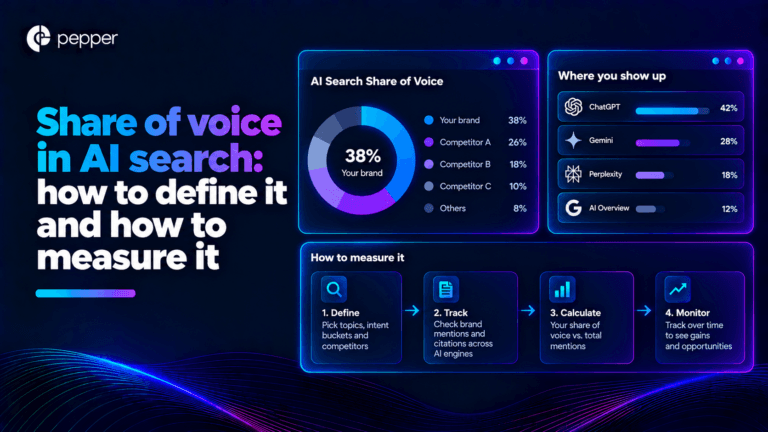
Share of voice in AI search: how to define it and how to measure it
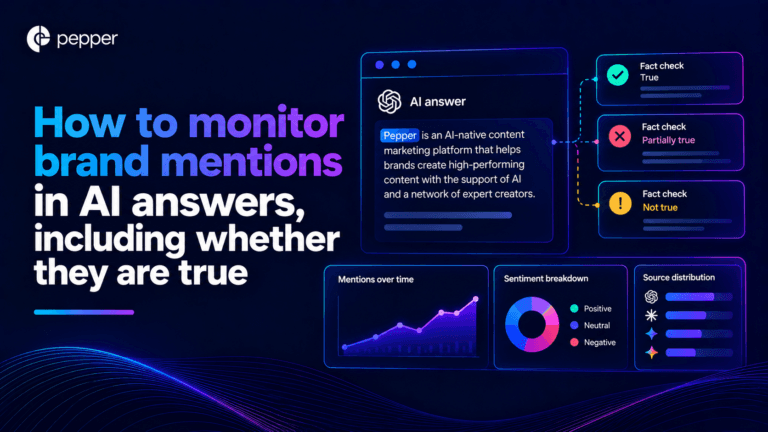
How to monitor brand mentions in AI answers, including whether they are true
Content Creation
11 mins read