Best answer engine optimization tools in 2026
The short answer
Start with AirOps or AthenaHQ, both of which have free tiers, or HubSpot’s AI Search Grader for a one-off check with no account. If you need published pricing and clear specs, Profound. For the widest engine coverage at a published price, AthenaHQ. If you run multiple brands, Trakkr. If your stack already includes Semrush or Ahrefs, check what you are entitled to before buying anything new.
But there is an important distinction: all of these tools help you see the problem. Pepper is for teams that need someone to solve it. Pepper is an organic growth partner, not another AEO dashboard. We diagnose where your organic growth is breaking down, build the strategy, create and optimize the content, and do the work required to improve your visibility across search and AI.
So if you have the time and team to turn reports into action, start with a tool. If you know what needs to happen but nobody has the capacity to make it happen, that is where Pepper sits.
Key takeaways
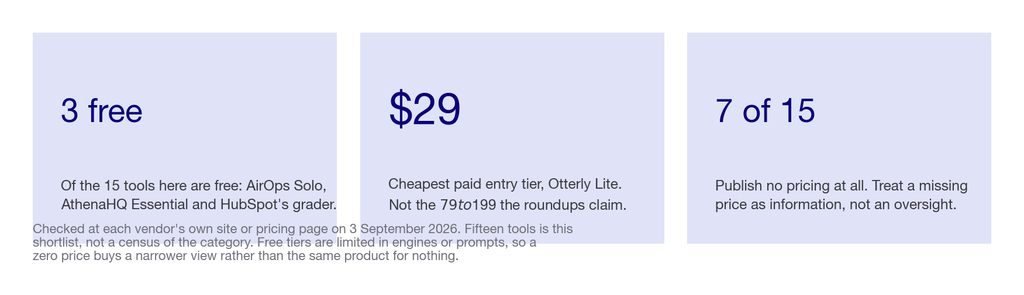
- Three of these are free. AirOps Solo tracks 100 prompts, AthenaHQ Essential covers five models, and HubSpot’s grader needs no account at all.
- Prompt limits are not comparable. Semrush counts prompts daily. Profound counts them monthly. The same “50 prompts” differs by roughly thirty times.
- Engine counts are not comparable either. Some are tier-gated, some are paid add-ons, and several count two Google surfaces as two engines.
- Seven of the fifteen publish no pricing at all. Treat a missing price as information rather than an oversight.
- The bigger distinction is measurement versus execution. Every tool here helps you measure visibility. None of them replaces the organic growth work required to improve it. Muck Rack found 84% of AI citations come from earned media, which no dashboard can create on its own.
- Pepper sits on the execution side of that line. It is an organic growth partner for teams that want the strategy, content and ongoing work done, not simply another report to interpret.
A note on where this comes from. We run organic for more than 250 enterprises and track over 10 million prompts across every major engine. What follows is shaped by that, by the client reviews we sit in weekly, and by conversations with buyers and operators at the events we run. It is our read on the category, informed by competing in it. more than 250 enterprises and track over 10 million prompts across every major engine. What follows is shaped by that, by the client reviews we sit in weekly, and by conversations with buyers at the events we run. It is our read on the category, informed by working in it.
What is an answer engine optimization tool?
An answer engine optimization tool runs a defined set of prompts across AI engines on a schedule. It reports whether your brand was mentioned, whether a page from your domain was cited, which competitors appeared instead, which URLs and domains fed the answer, and how the sentiment reads.
AEO means answer engine optimization. GEO, generative engine optimization, describes the same work, as do “LLM SEO” and “AI search optimisation”. Google’s May 2026 guidance states that AEO and GEO are part of SEO, and that AI Overviews and AI Mode run on core Search ranking systems with no separate AI index. Our answer engine optimization guide covers the mechanics and GEO vs SEO vs AEO covers where the distinctions carry meaning.
Three metric names are worth fixing, because vendors use different words for the same things. Brand Visibility is how often engines mention your brand by name. Domain Prompt Presence is how often they cite a page from your domain. Share of Voice is your slice of all brand mentions in the category. The gap between the first two is the diagnostic worth reporting. Engines that know you but cite somebody else to describe you have a citability problem, not an awareness one.
The claims on this topic that do not hold up
Worth naming, because you will meet them in a sales call and in the roundups above this one.
“No fully free AEO platform exists in 2026.” AirOps publishes a free Solo tier tracking 100 prompts and pages. AthenaHQ publishes a free Essential tier covering five models with $25 of credit. HubSpot publishes a free one-time grader that needs no account. Ahrefs includes Brand Radar custom prompts free with limited daily checks in its paid plans.
“Self-serve pricing starts around $79 to $199 a month.” Otterly’s Lite tier is $29.
“We track 10 AI platforms.” Writesonic’s headline says so, and its three published paid tiers, up to $399, cover three: ChatGPT, Gemini and Google AI Overviews. The other seven arrive at the quoted Enterprise tier.
Nearly every page ranking for this query is published by a vendor that appears on its own list, usually first. That is not disqualifying, and we are doing it too, which is why the disclosure above exists. It does mean the pricing claims on those pages need checking rather than quoting.
Answer engine optimization tools at a glance
| Tool | Entry pricing | Engines | Prompt allowance | Notable for |
|---|---|---|---|---|
| Pepper | Not published | 6 | Managed with the account | Platform plus a growth team |
| AirOps | Free Solo | 1 free, 4 on Pro | 100 prompts free | Most generous free tier |
| AthenaHQ | Free Essential, $295 Starter | 5 free, 10 on Starter | Credit-based | Widest coverage at a published price |
| HubSpot AI Search Grader | Free | 3 | One-time check | No account required |
| Otterly | $29 Lite | 4 included, 3 add-ons | 15 on Lite | Cheapest paid entry, unlimited seats |
| Profound | $99 Starter, $399 Growth | 1, then 3, up to 9 | 50 monthly, then 100 | Clearest published specs |
| Semrush AI Visibility | $165 Starter (annual) | ChatGPT, Perplexity, Gemini, Google | 50 daily | Bundled with SEO tooling |
| Trakkr | $100 Growth | 8, all tiers | 50 per brand | Multi-brand, no per-model fees |
| Ahrefs Brand Radar | From €47, free tier limited | 7 | 83 daily on Index plan | Bundled with Ahrefs |
| Scrunch | $300 Starter | 7, all tiers | Not published | No tier-gating, GA4 attribution |
| Peec AI | Not published | 5, all tiers | Not published | No tier-gating |
| Evertune | Not published | 7 | Samples each prompt up to 100 times | Response volume methodology |
| Conductor | Not published | 6 | Not published | Enterprise AEO suite |
| seoClarity | Not published | Not specified | Not published | Unified SEO and AEO |
| BrightEdge | Not published | Not specified | Not published | Enterprise SEO incumbent |
Checked at each vendor’s own site or pricing page on 3 September 2026.
How we weighted this ranking
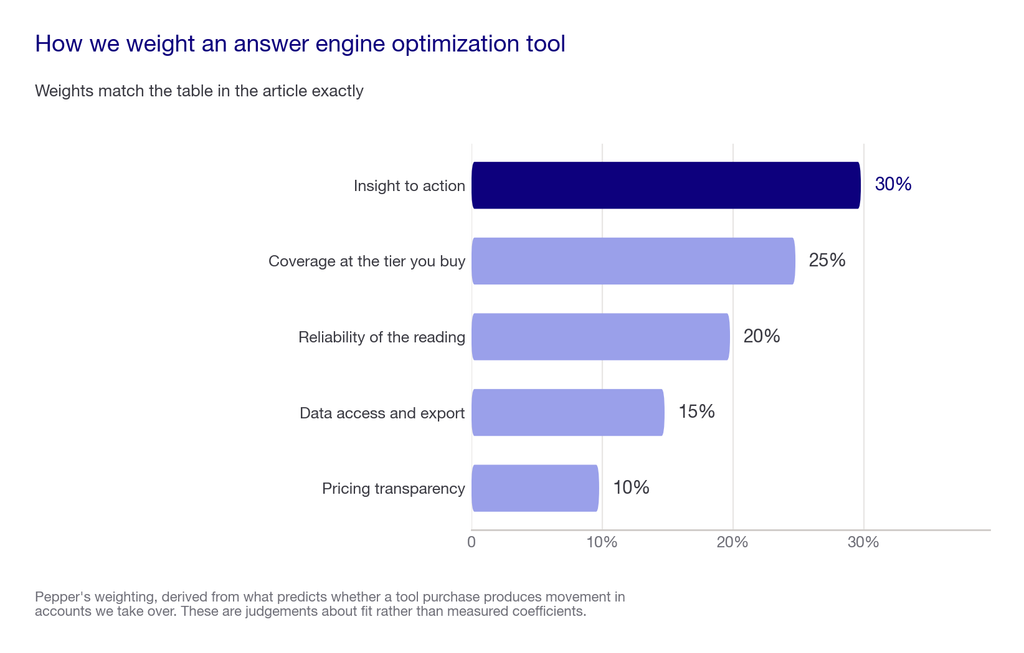
| Area | Weight | What decides the score |
|---|---|---|
| Insight to action | 30 | Whether findings arrive as prioritised work with an owner, or as a dashboard somebody must interpret and then staff |
| Coverage at the tier you buy | 25 | Which engines and how many prompts the purchasable tier actually returns, not the product ceiling |
| Reliability of the reading | 20 | Stated response or sampling volume, because engines are probabilistic and one run establishes nothing |
| Data access and export | 15 | Raw answer text and cited URLs, exportable, so a year of history is not stranded |
| Pricing transparency | 10 | Whether a buyer can build a business case before booking a call |
Insight to action carries the most weight because it decides outcomes. The most common state we inherit is accurate dashboards and nothing moving, and that is a capacity problem no tool fixes.
Our GEO agency ranking methodology explains how we build weightings like this one.
Why “50 prompts” means four different things
This is the trap that costs the most money, and no comparison page we found mentions it.
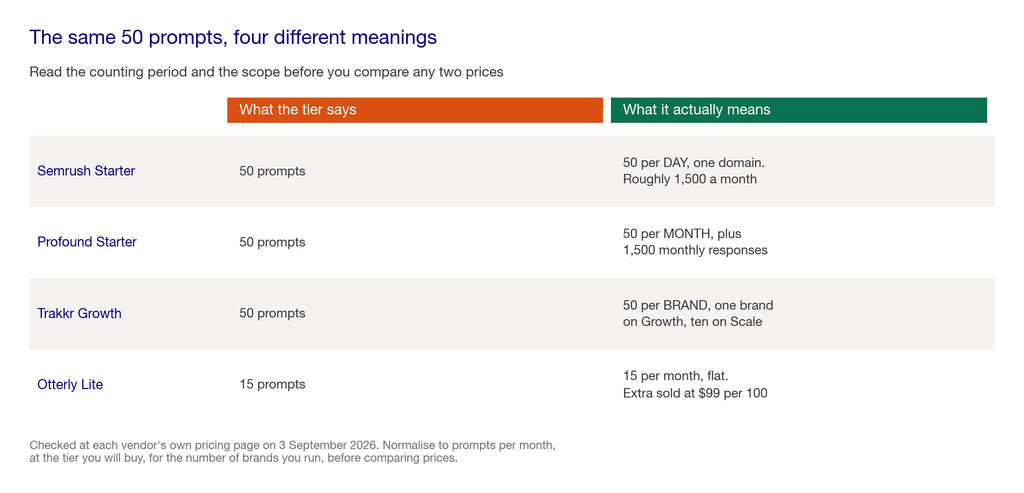
Semrush’s Starter tier tracks 50 prompts daily. Profound’s Starter tracks 50 prompts monthly. Those are the same headline number describing roughly a thirtyfold difference in what gets watched.
Trakkr’s 50 prompts are per brand, with one brand on Growth and ten on Scale, so the number multiplies with your portfolio. Otterly’s 15 prompts on Lite are a flat monthly cap, with extra prompts sold in hundreds at $99.
Before comparing prices, normalise the unit. Prompts per month, at the tier you will actually buy, for the number of brands you actually run. The ranking changes once you do.
The tools, ranked
1. Pepper, in its own category per the disclosure, is an agentic organic growth engine rather than a measurement tool. Customers log into the platform themselves: they set up a workspace, define brand profile, competitors and personas, connect GA4 and Search Console, manage themes and prompts, read GEO analytics, and build and run their own agents in the Agent Atlas.
And a growth team is attached to the account and does the work alongside them, which covers the execution and earned media that no tool on this list performs at any price. We track six engines, including ChatGPT, Perplexity, Gemini and Google AI Overviews.
Where it falls short: we do not publish pricing, so budget discovery is a conversation rather than a page. We are built for teams running organic as a long-term function, so a one-off audit is not what we are for. Our depth sits in content, authority and AI search rather than large technical migrations.
If you want the diagnostic run against your category before you shortlist anyone, book a growth audit and we will show you which sources decide your answers today.
2. AirOps repositioned to “AI Search for Enterprise” and has the most generous free tier here: Solo covers 100 tracked prompts and pages with ChatGPT insights and monthly opportunity reports. Pro adds multi-engine coverage across Google, Perplexity, OpenAI and Google AI Studio, with unlimited seats. Where it falls short: the free tier is single-engine, so a quiet result may be a coverage limit rather than a finding, and paid pricing is quoted.
3. AthenaHQ publishes the most engines at a published price. Free Essential covers five models with $25 of credit. Starter at $295 covers ten, adding AI Mode, Claude, Grok, DeepSeek and Meta AI. Where it falls short: the step from free to $295 is steep with nothing between.
4. HubSpot AI Search Grader is free, needs no account, and scores brand perception out of 100 across sentiment, presence quality, brand recognition, share of voice and market competition, using ChatGPT, Perplexity and Gemini. Where it falls short: it is a one-time check rather than monitoring, so it establishes a baseline and nothing after it.
5. Otterly has the cheapest paid entry at $29 for 15 prompts and includes unlimited team members on every plan. Four engines are included. Where it falls short: Google AI Mode, Gemini and Claude are paid add-ons at $9, $9 and $29 on Lite, so full coverage costs about $76 rather than $29.
6. Profound publishes the clearest specifications in the category, naming prompts and monthly responses at every tier: $99 Starter for ChatGPT only, 50 prompts, 1,500 responses; $399 Growth for three engines, 100 prompts, 9,000 responses; Enterprise quoted up to nine engines with SSO, SAML and SOC 2. Where it falls short: coverage is the most heavily tier-gated here, so the entry tier measures one engine.
7. Semrush AI Visibility Toolkit tracks 50 prompts daily on Starter at $165.17 monthly billed annually, rising to 100 on Pro+ at $248.17 and 200 on Advanced at $455.67, covering Google Search, ChatGPT, Perplexity and Gemini. The daily counting makes it far better value than the headline suggests. Where it falls short: one domain per plan, with additional domains charged separately.
8. Trakkr covers all eight models on every tier and positions explicitly against per-engine pricing: “no add-ons, no per-model fees, every model included.” Growth is $100 for one brand, Scale $500 for ten, Enterprise from $790. Where it falls short: 50 prompts per brand is a low ceiling for a broad category, and there is no free tier, only a 14-day trial.
9. Ahrefs Brand Radar covers seven engines and is included with limited daily checks in Ahrefs paid plans, with custom prompts from €47 monthly and an AI Visibility Index from €179 for 83 daily prompts. Where it falls short: it is an add-on to a broader SEO product, so it suits existing Ahrefs customers far better than new buyers.
10 Scrunch publishes $300 Starter and $500 Growth and covers the same seven engines at both, removing tier-gating entirely. Its GA4 integration for AI referral traffic helps attribution conversations. Where it falls short: the highest entry price here with no free or low tier to test with.
11. Peec AI covers five engines on every tier with no gating, and reports 3,000+ brands and agencies as customers. Where it falls short: no figures published at any tier, so you cannot build a business case without a sales call.
12. Evertune describes itself as “the marketing platform for brand discovery in AI search” and samples each prompt up to 100 times per model across seven engines. That sampling depth is the most explicit answer to probabilistic engines we found. Where it falls short: no published pricing, and the depth suits brand-perception work more than day-to-day monitoring.
13. Conductor calls itself “the only all-in-one enterprise AEO platform” and tracks six engines, connecting presence to traffic, conversions and revenue. Where it falls short: no published pricing, and it is priced and scoped for enterprise, so a small team will find it heavy.
14. seoClarity positions as a “Unified SEO and AEO Platform” serving 3,500+ brands, with an AI suite covering visibility tracking, prompt research, sentiment, bot activity and hallucination monitoring. Where it falls short: it does not specify which AI engines it tracks, and publishes no pricing.
15. BrightEdge is the incumbent enterprise SEO platform, with Copilot, Autopilot and AI Catalyst layered on. Where it falls short: it names fewer specifics about AI engine coverage than the specialists, and publishes no pricing, so verify engine coverage directly rather than assuming parity.
What these tools cost

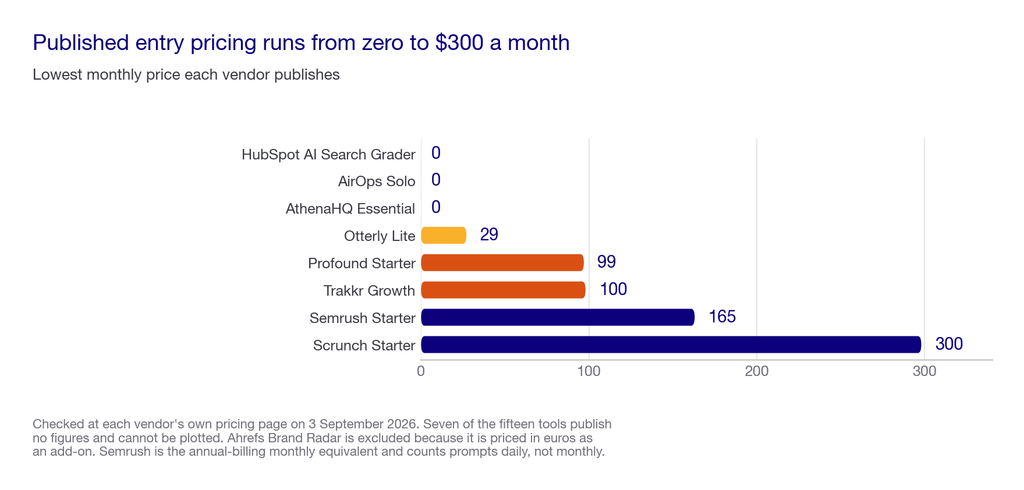
The spread runs from free to $300 at entry, and price does not predict quality. It predicts what the tier includes.
Normalise before you compare. Prompts per month at the tier you will buy, engines actually returned at that tier, and stated response volume. Our engine coverage comparison works through the coverage side, and which gives better value works through the unit-cost arithmetic.
The largest cost is on none of these pages. A tool surfacing two hundred opportunities a quarter creates two hundred pieces of work. Priced at a loaded hourly rate, that lands several times above the subscription. Our cost breakdown of platforms against hiring models it.
What nobody should promise you
Guaranteed citations. Google advises against providers guaranteeing rankings, because third parties cannot access internal ranking systems. The same holds for AI answers.
That a tool will improve your visibility. Every product here measures. Improvement takes technical fixes, content and earned media, and Muck Rack found 84% of AI citations come from earned media.
A comparable prompt allowance or engine count. Daily versus monthly counting, per-brand multipliers, tier-gating and paid add-ons make headline numbers non-comparable until you read the tier row.
A single composite AEO score worth reporting. It hides the gap between Brand Visibility and Domain Prompt Presence, which is the finding you could act on.
How to choose the right answer engine optimization tool
I would establish what your constraint actually is before comparing a feature, because the answer decides whether you should buy anything at all.
Google’s May 2026 guidance is the anchor. Google states that AEO and GEO are part of SEO, and that AI Overviews and AI Mode run on core Search ranking systems with no separate AI index. That is correct for Google, and Google is one engine. ChatGPT and Perplexity retrieve and cite differently. Hold both: the fundamentals carry over from work your SEO team already does, so a tool sold as a wholly separate discipline overstates its novelty, and the measurement layer is genuinely new, because rank tracking cannot see an answer.
Score the decision before a demo.
| Area | Weight | What a strong vendor demonstrates |
|---|---|---|
| Insight to action | 30 | Findings arrive prioritised with a named owner and an estimate of hours, rather than a dashboard your team must interpret and then staff |
| Coverage at the tier you buy | 25 | The tier row lists your buyers’ engines and a prompt allowance stated per month, and the vendor volunteers which engines are add-ons |
| Reliability of the reading | 20 | A stated response or sampling volume, because engines are probabilistic and a single run proves nothing |
| Data access and export | 15 | Raw answer text and cited URLs, exportable, so a year of history is not stranded if you switch |
| Pricing transparency | 10 | Enough published for you to build a business case before a sales conversation |
Those weights sum to 100. Score your own constraint first. If the honest answer is that nobody has hours to act, no tool on this page fixes it.
The live test, and it now costs nothing. Take 30 real commercial prompts from your category, written the way a buyer would type them. Four worked examples: “what are the best answer engine optimization tools”, “how do we find out if ChatGPT recommends our product”, “which platform tracks brand mentions across AI assistants”, “is answer engine optimization worth doing in house”. Load them into a free tier from AirOps or AthenaHQ, let it run for a month, then hand the identical list to every vendor on your shortlist.
Ask for five things back. Where do we appear and where do we not. Which competitors appear instead, consistently. Which sources influence those answers, sorted by frequency. Why are those sources winning. What would you change in the next 90 days, and who does it. Compare their output against your own run, because the discrepancies tell you more than the demo. Engines are probabilistic, so require more than one run on more than one engine.
The weak playbook against the strong one. The weaker sequence is cheap to deliver and widely sold: buy a tool, find some prompts, rewrite a few pages into question-and-answer format, add FAQ schema, sprinkle statistics, and hope for a citation. It is entirely on-site and entirely owned media, aimed at the smallest share of the citation pool.
The stronger sequence runs eight steps: demand intelligence, technical discoverability, entity and brand authority, content, earned-media authority, distribution, visibility measurement, revenue attribution. Measurement is one of the eight, which is the correct way to size a tool purchase.
Red flags, each one something you will genuinely hear. “We track 10 AI platforms”, when the published paid tiers cover three. “No free option exists”, which is now simply untrue. “50 prompts included”, without saying daily or monthly. “We guarantee citations in ChatGPT”, which Google’s own guidance advises against. “Here is your AEO score”, a composite with no competitor share of voice and no audit path. “We track your branded prompts”, which always looks healthy. “Unlimited prompts”, which caps somewhere the contract mentions and the page does not. And the quiet one: a proposal listing engines that never states response volume.
Five questions for the first call.
- Is that prompt allowance daily or monthly, and per brand or per account? A good answer is immediate and specific. A weak one has to check.
- Which engines does this specific tier return, and which cost extra? A good answer reads the tier row aloud and names add-on prices. A weak one points at the feature list.
- How many responses per prompt per month? A good answer is a number. A weak one calls it sufficient.
- Can we export raw answers and cited URLs? A good answer is yes, with a format and a sample. A weak one explains why the dashboard is enough.
- When this shows us we are invisible, what happens next and who does it? A good answer names roles and hours. A weak one describes a recommendation engine.
It all comes down to one principle: normalise the units, buy the narrowest tool that covers your buyers’ engines at a volume you can trust, and budget separately for the hours it creates. The tool is the cheap half of this purchase.
One closing note that costs us something. Very few providers are equally strong across measurement, execution, earned authority and attribution, ours included, and the good ones will tell you which of the four is their weakest. If you have capacity in house and an existing PR function to borrow, a free tier may be all you need.
Frequently asked questions
What are the best answer engine optimization tools in 2026?
AthenaHQ leads on published engine coverage with ten models at $295. Profound publishes the clearest specifications. AirOps and AthenaHQ both offer free tiers, which makes starting free the sensible first step for most teams rather than any paid purchase.
Are there free answer engine optimization tools?
Yes, three. AirOps Solo tracks 100 prompts on ChatGPT, AthenaHQ Essential covers five models with $25 of credit, and HubSpot’s AI Search Grader is a free one-time check needing no account. Ahrefs also includes limited daily checks in paid plans.
How much do AEO tools cost?
From free to $300 monthly at entry, with higher tiers between $165 and $500 and enterprise pricing quoted. Seven of the fifteen tools here publish no pricing at all, so budget for quoted pricing across roughly half a shortlist.
Why are prompt limits hard to compare?
Because vendors count differently. Semrush tracks 50 prompts daily, Profound tracks 50 monthly, and Trakkr counts 50 per brand. Normalise to prompts per month at the tier you will buy, for the number of brands you run, before comparing prices.
Which AEO tool covers the most engines?
AthenaHQ, with ten models on its $295 Starter tier. Trakkr covers eight on every tier with no add-ons. Counts are not directly comparable, because vendors gate engines by tier, sell some separately, and count two Google surfaces as two engines.
Can an AEO tool improve my AI visibility?
No. Tools measure mentions, citations and competitor share of voice. Improving visibility takes technical retrievability work, content and earned media, and Muck Rack found earned media drives 84% of AI citations across its dataset.
Do I need a separate AEO tool if I use Semrush or Ahrefs?
Check your entitlement first. Ahrefs includes Brand Radar with limited daily checks in paid plans, and Semrush sells an AI Visibility Toolkit alongside its SEO tiers. Many teams already have partial coverage they have not activated.
How many prompts should I track?
Around 30 real commercial questions establishes whether AI answers matter in your category. Running a category properly usually needs several hundred across brands, regions and personas, which is what higher tiers actually sell.
Where to go next
Start free and spend a day rather than a budget cycle. Load 30 real commercial prompts into a free tier, let it run, and sort the cited domains by frequency. That single list tells you whether your gap is measurement, execution or authority.
Then normalise the units before you compare prices. Prompts per month, engines at your tier, response volume. Most shortlists reorder once you do.
Our guide to tracking brand mentions in AI search covers the five methods and what each misses, and best AI visibility platforms for enterprise applies procurement criteria to the same market.
If you are deciding between buying software and buying help, do you need an AEO agency or an AEO tool covers it directly, and is a GEO platform worth it without an agency covers the four conditions that decide whether you can act on findings. Our SalesHood case study documents AI Overview keywords moving from 14 to 97 across five months.
The honest exit. If nobody has protected hours to act on what a tool reports, you do not need to buy one this quarter. Fix the ownership question, run the free diagnostic, and revisit with data.
Latest Blogs
Most advice on this is inference dressed as fact. OpenAI documents exactly one thing clearly, which is access. Here is what is documented, what is inferred, and how to verify the rest for yourself.
Being named in an AI answer and having your page used as its source are different outcomes with different causes and different fixes. The gap between them is the most useful diagnostic in AI search, and most reporting collapses it into one number.
Every platform reports share of voice and almost none of them define it the same way. Here is the definition worth using, the three choices that change the number, and how to measure it yourself without buying anything.
Get your hands on the latest news!
