On the raw number, AthenaHQ: ten models on a $295 Starter tier, which is the highest engine count anyone publishes at a published price.
That answer is close to useless on its own, and this page is mostly about why. An engine count is a ceiling specification. It tells you what a vendor can reach at some tier, not what you will buy, not what your buyers use, and not whether the readings are stable enough to act on. Read the wrong way, it sends you shopping for a number rather than for coverage.
Engine counts are the easiest number to put on a comparison page and the hardest to compare honestly. Three practices inflate them. All three are legitimate, and none is disclosed next to the headline. Pepper sells in this category and appears in the table below, so the disclosure sets out how we handled that.
The short answer
AthenaHQ publishes the highest count: ten models for $295 a month. Profound reaches up to nine, but only at a quoted Enterprise tier, with one engine at its $99 entry. Scrunch covers seven at $300. Peec AI is the only platform that does not gate engines by tier, covering five at every tier.
Now the number that actually decides a purchase. Coverage is a threshold, not a scoreboard: once a platform returns the engines your buyers open, with enough response volume to trust the reading, further engines add cost and noise rather than insight. Most categories clear that threshold at four to six engines, which is why the widest count and the right choice are rarely the same vendor.
Key takeaways
- AthenaHQ leads on published coverage, with ten models at $295 monthly, ahead of Profound’s nine at a quoted Enterprise price.
- Tier-gating is the biggest distortion. Profound advertises up to nine engines and returns one at its $99 entry tier.
- Some engines are paid add-ons. Otterly includes four and sells Google AI Mode, Gemini and Claude separately.
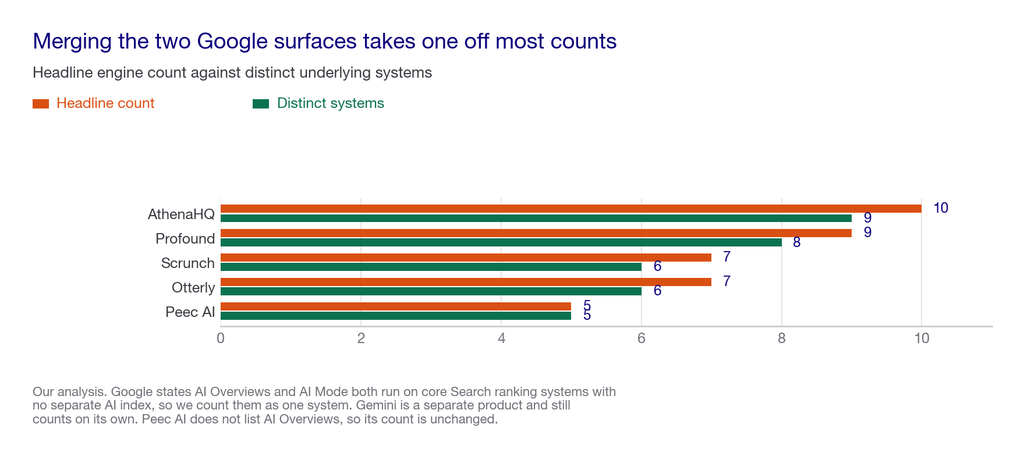
- Google surfaces get counted twice. AI Overviews and AI Mode both run on core Search ranking systems, so counting them as two engines inflates a headline by one.
- Coverage is a threshold, not a scoreboard. Once a platform covers the engines your buyers actually use, more engines add cost rather than insight.
A note on where this comes from. We run organic for more than 250 enterprises and track over 10 million prompts across every major engine. What follows is shaped by that, by client reviews we sit in weekly, and by conversations with buyers at the events we run. It is our read on the specs, informed by running them.
What is an AI engine, and what counts as one?
Less settled than the comparison tables suggest, which is the root of the problem.
An AI engine, in this category, means any surface that generates an answer and may name or cite your brand. That covers standalone assistants like ChatGPT, Claude, Perplexity, Copilot, Grok, DeepSeek and Meta AI. It also covers AI features inside a traditional search engine, which is where counting gets loose.
Google alone presents three things vendors count separately: AI Overviews, the summary block above the results; AI Mode, the conversational tab inside Search; and Gemini, the standalone assistant. The first two are surfaces of Google Search. Google’s May 2026 guidance states that AI Overviews and AI Mode use core Search ranking systems, with no separate AI index. It also states that AEO and GEO are part of SEO.
So a vendor listing AI Overviews and AI Mode as two engines is describing two placements fed by one ranking system. Gemini is a genuinely separate product and counts on its own.
That is not a scandal. It is a real distinction, since the two surfaces behave differently and are worth reporting separately. It just means a “ten engine” headline and a “seven engine” headline may describe a smaller gap than they look.
Our breakdown of GEO, SEO and AEO covers the vocabulary, and the Visibility, Citability and Retrievability framework covers what to do once you can see the data.
How we weighted this comparison
We are comparing a specification rather than ranking vendors, so the weighting is about how we counted rather than how we scored.
| Area | Weight | What decides the score |
|---|---|---|
| Engines at the tier you would buy | 40 | Coverage at a real purchasable tier, not the product ceiling quoted on a marketing page |
| Honesty of the count | 25 | Whether add-ons and tier-gating are disclosed next to the number, and whether Google surfaces are counted once or twice |
| Response volume behind the count | 20 | Whether the vendor states monthly responses, since coverage without volume produces confident noise |
| Price transparency | 15 | Whether cost per engine can be calculated at all without a sales call |
Coverage at a purchasable tier dominates because a ceiling you cannot afford is not coverage. If you want the buyer-facing scorecard rather than our counting method, it is in the decision section further down.
Our GEO agency ranking methodology explains how we build weightings like this one. If you would rather skip the spec comparison entirely and see which engines actually surface your category, book a growth audit and we will run your prompt set across them.
Engine coverage at a glance
| Platform | Engines at top tier | Price of that tier | Engines at entry tier | Entry price |
|---|---|---|---|---|
| AthenaHQ | 10 | $295 Starter | 5 | Free Essential |
| Profound | Up to 9 | Enterprise, quoted | 1 | $99 Starter |
| Scrunch | 7 | $300 Starter | 7 | $300 Starter |
| Otterly | 7 with add-ons | $489 Premium plus add-ons | 4 | $29 Lite |
| Peec AI | 5 | Not published | 5 | Not published |
| AirOps | 4 | Pro, quoted | 1 | Free Solo |
Checked at each vendor’s own pricing page on 31 August 2026.
Pepper sits outside that table by design, because it is not sold as a measurement tool. Pepper tracks six engines, including ChatGPT, Perplexity, Gemini and Google AI Overviews, and attaches a growth team to the account. The comparison that matters for Pepper is not how many engines get reported but what happens to the findings, which is a different purchase and a different table.
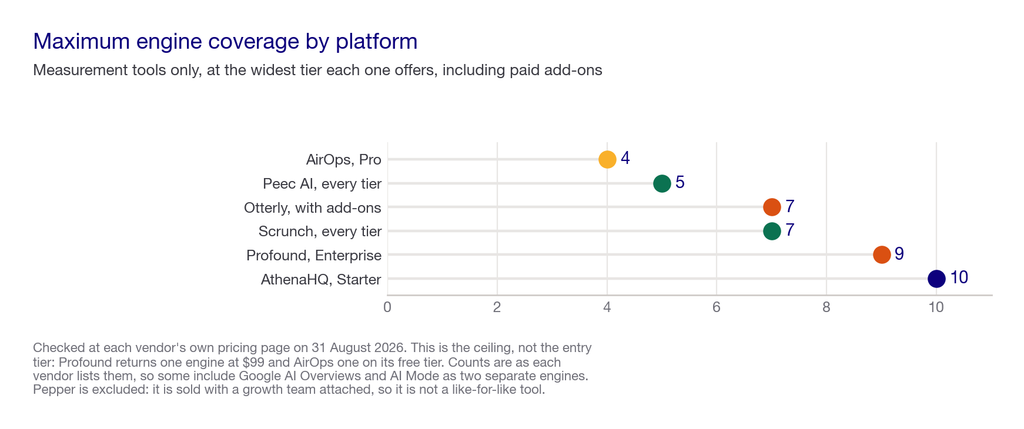
Scrunch is worth pausing on. It is the only platform here whose entry tier and top tier cover the same seven engines. What you see at $300 is what you get. That is a genuinely different pricing philosophy from Profound’s, and neither is wrong.
The three practices that inflate an engine count
Tier-gating. The advertised number is the ceiling, not the product. Profound is the clearest example, and the most transparent about it. Its pricing page reaches up to nine answer engines at Enterprise, three at $399 Growth, and ChatGPT only at $99 Starter. A buyer comparing marketing pages would record “nine” and buy “one”.
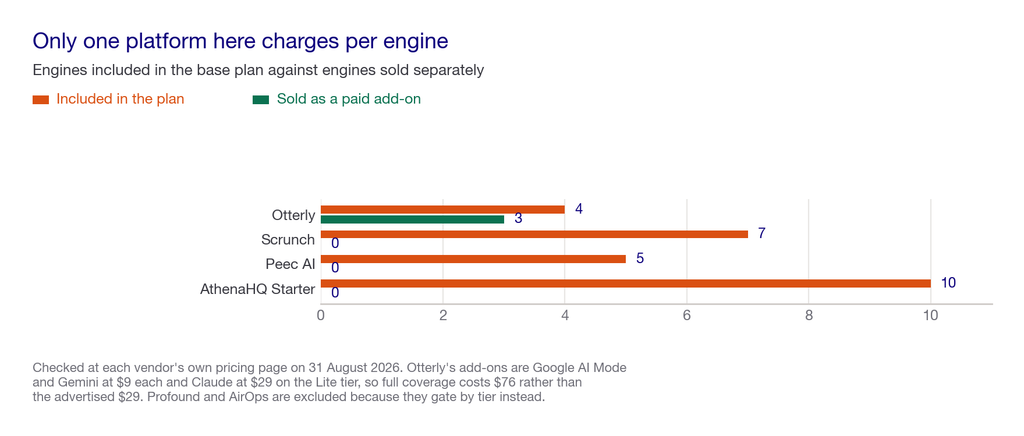
Paid add-ons. Otterly includes four engines on every plan: ChatGPT, Google AI Overviews, Perplexity and Microsoft Copilot. Google AI Mode, Gemini and Claude are sold separately, at $9, $9 and $29 monthly on the Lite tier. Full seven-engine coverage on Lite therefore costs $76 a month rather than the advertised $29.
Counting Google surfaces separately. Discussed above. It adds one to most headline counts.
None of the three is dishonest, and every vendor documents them somewhere on the page. The problem is that the headline number travels and the footnote does not. That is how a comparison spreadsheet ends up wrong.

What engine coverage costs
Divide the tier price by the engines that tier includes and the ranking reorders.
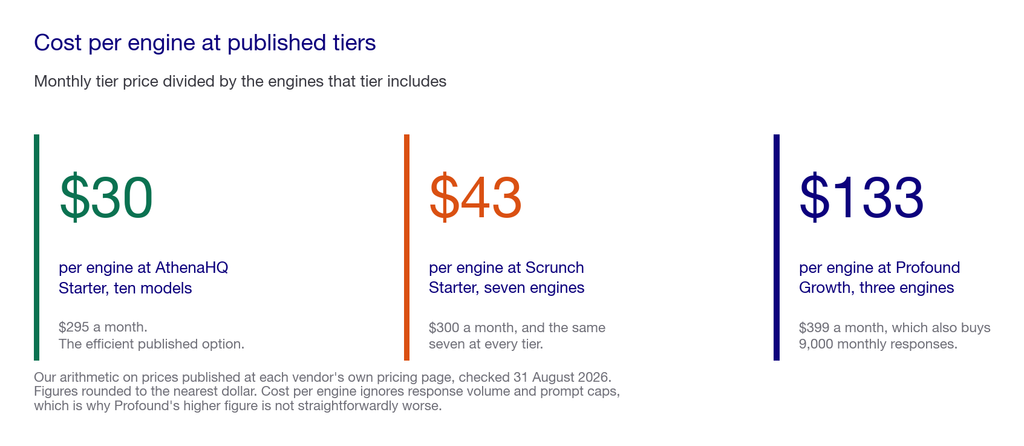
AthenaHQ is the most efficient published option on this measure at roughly $30 per engine per month. Scrunch is about $43. Profound Growth is about $133. That reflects the 9,000 monthly responses you are also buying, rather than engine access alone.
That last point matters and it is why cost per engine should not decide this either. Response volume is what separates a real change from noise, because engines are probabilistic and a single run establishes nothing. Profound publishes 1,500 monthly responses at Starter and 9,000 at Growth, which is unusually transparent and worth more than an extra engine to most teams.
Our roundup of the best LLM SEO tools records which vendors publish and which gate, and GEO agency vs GEO tool: which gives better value works through the unit-cost arithmetic in full.
The platforms, and where each falls short on coverage
1. AthenaHQ covers ten models on Starter at $295: ChatGPT, Perplexity, Google AI Overviews, AI Mode, Gemini, Claude, Copilot, Grok, DeepSeek and Meta AI, with more available on request. Its free Essential tier covers five with $25 of credit. Where it falls short: the gap between free and $295 is steep with nothing in between, so a team that outgrows the free tier faces a large single step.
2. Profound reaches the second-highest ceiling and publishes the clearest specs behind it, naming prompts and monthly responses at every tier. Where it falls short: coverage is the most heavily tier-gated in this set, so the headline nine is an Enterprise number and the entry tier returns ChatGPT alone.
3. Scrunch covers ChatGPT, Claude, Gemini, Perplexity, Google AI Mode, AI Overviews and Meta at every published tier, which removes the tier-gating problem entirely. Where it falls short: $300 is the highest entry price here, with no free or low tier to test with first.
4. Otterly offers the widest reach for the lowest headline price and includes unlimited team members on every plan. Where it falls short: three of its seven engines are paid add-ons. Full coverage therefore costs roughly two and a half times the advertised entry price.
5. Peec AI is the only platform that does not gate engines by tier at all, covering ChatGPT, Perplexity, Gemini, AI Mode and Copilot on Starter through Enterprise. Where it falls short: no figures are published at any tier, so cost per engine cannot be calculated before a sales call.
6. AirOps positions as “AI Search for Enterprise” with the most generous free tier here, covering 100 tracked prompts on ChatGPT. Pro adds Google, Perplexity, OpenAI and Google AI Studio. Where it falls short: the narrowest coverage in this set, and paid pricing is quoted rather than published.
7. Pepper tracks six engines, including ChatGPT, Perplexity, Gemini and Google AI Overviews, and it is the one entry here that is not sold as a measurement tool.
That scope is a design decision rather than a ceiling. Six engines is where the commercial questions in our clients’ categories actually get asked, and running fewer engines at higher response volume produces readings you can take to a board, which is the harder half of this problem. Reporting eleven engines thinly is easy. Reporting six with enough runs behind each to separate a real movement from engine noise is the part that changes decisions.
Customers log into the platform themselves: workspace setup, brand profile, competitors and personas, GA4 and Search Console connected, themes and prompts managed, GEO analytics read directly, and their own agents built and run in the Agent Atlas. And a growth team is attached to the account doing the work alongside them, which covers the execution that no engine count addresses.
Where it falls short: we do not publish pricing, so cost per engine is a conversation rather than a page. We are built for teams running organic as a long-term function, which means a one-off breadth audit is not what the engagement is shaped for.
If you want your own prompt set run across the engines your buyers actually use, book a growth audit and we will show you where the answers come from today.
What nobody should promise you
That more engines means better visibility. Coverage is a threshold. Past the engines your buyers use, extra engines add cost and noise rather than insight.
A comparable engine count. Tier-gating, add-ons and Google surface counting make headline numbers non-comparable until you read the tier row.
Guaranteed citations on any engine. Google advises against providers guaranteeing rankings, because third parties cannot access internal ranking systems. The same holds for AI answers.
That one run on one engine tells you anything. Engines are probabilistic. Response volume, not engine count, is what makes a reading trustworthy.
How to evaluate engine coverage for your shortlist
I would start by working out which engines you actually need, because that number is almost always smaller than the one on the comparison page and it changes the whole shortlist.
Google’s May 2026 guidance anchors the technical half. Google states that AEO and GEO are part of SEO, and that AI Overviews and AI Mode run on core Search ranking systems with no separate AI index. That is correct for Google, and Google is one engine. ChatGPT and Perplexity retrieve and cite differently, so hold both: the fundamentals carry over from work your team already does, and the distribution genuinely differs by engine. It also tells you why counting two Google surfaces as two engines overstates the difference between vendors.
Score coverage rather than counting it.
| Area | Weight | What a strong vendor demonstrates |
|---|---|---|
| Coverage of your buyers’ engines | 40 | The tier you will buy returns the specific engines your customers use, evidenced by your own prompt run rather than a feature list |
| Response volume at that tier | 25 | Enough monthly responses to separate a real change from noise, stated as a number rather than described as sufficient |
| Honesty about gating and add-ons | 20 | The vendor volunteers which engines are tier-gated and which cost extra, before you ask |
| Cost per engine at your tier | 10 | Price divided by included engines, computed on the call rather than deflected |
| Engine roadmap | 5 | A stated process for adding engines as new assistants gain share, not a promise about a specific one |
Those weights sum to 100. Coverage of your buyers’ engines dominates because an engine your customers never open is worth nothing regardless of price.
The live test, and it costs nothing. Take 30 real commercial prompts from your category, written the way a buyer would type them. Four worked examples: “which GEO platform tracks the most AI engines”, “how do we find out if ChatGPT recommends our product”, “best tool for tracking brand mentions across AI assistants”, “does Perplexity cite our competitors more than us”. Run them across ChatGPT, Perplexity, Gemini and Google AI Mode, using a free tier from AthenaHQ or AirOps. Record which engines surface your category at all.
Then ask five things of every vendor. Where do we appear and where do we not. Which competitors appear instead, consistently. Which sources influence those answers. Why are those sources winning. What would you change in the next 90 days, and who does it. Hand them the identical prompt list and compare against your own run, because the discrepancies tell you more than the demo.
The weak evaluation against the strong one. The weaker sequence builds a spreadsheet of headline engine counts, sorts descending, and shortlists the top three. It records ceilings rather than products. It misses add-on pricing, and treats two Google surfaces as two systems.
The stronger sequence establishes which engines your buyers use, reads the tier row for the tier you will actually buy, adds add-on costs into the comparison, and only then looks at price. It usually ends in a cheaper purchase, because most teams need four or five engines rather than ten.
Red flags, each one something you will genuinely hear. “We track all major AI engines”, quoted from a marketing page when the tier row says one. “Nine engines”, said without mentioning that it is the Enterprise tier. “Full Google coverage”, counting AI Overviews and AI Mode as two products. “Unlimited prompts”, which caps somewhere the contract mentions and the page does not. “We add engines as they launch”, offered instead of naming the ones you get today. “Our coverage is the widest in the market”, with no tier named. And the quiet one: a proposal that lists engines but never states monthly response volume.
Five questions for the first call.
- Which engines does this specific tier return, today? A good answer reads the tier row aloud. A weak one describes the product’s ceiling.
- Which engines cost extra, and how much? A good answer names the add-ons and prices. A weak one says it depends on the plan.
- How many responses per month at this tier? A good answer is a number. A weak one calls it sufficient for most customers.
- Do you count AI Overviews and AI Mode separately, and why? A good answer explains the behavioural difference. A weak one has not thought about it.
- Can we see raw answer text and cited URLs per engine? A good answer shows you on the call. A weak one shows a composite score.
It all comes down to one principle: buy coverage of the engines your buyers use, with enough response volume to trust the reading, and stop. Engine count past that threshold is a specification you are paying for and will not use.
One closing note that costs us something. Very few providers are equally strong across measurement, execution, earned authority and attribution, ours included, and the good ones will tell you which of the four is their weakest. If raw engine breadth for a one-off audit is genuinely what you need, a free tier from AthenaHQ will do it, and we would point you there rather than sell you a programme.
Frequently asked questions
Which GEO platform covers the most AI engines?
AthenaHQ publishes the highest count at a published price, covering ten models on its $295 Starter tier. Profound reaches up to nine at a quoted Enterprise tier. Counts are not directly comparable, because vendors gate and bundle engines differently.
How many AI engines do I actually need to track?
Usually four or five: the engines your buyers open. Running your own prompt set across ChatGPT, Perplexity, Gemini and Google AI Mode will show which ones surface your category at all, and any engine beyond that adds cost rather than insight.
Are Google AI Overviews and AI Mode separate engines?
They are separate surfaces of Google Search. Google states both run on core Search ranking systems with no separate AI index. Vendors often count them as two engines, which inflates a headline count by one without adding a distinct system.
Which platform does not restrict engines by tier?
Peec AI covers the same five engines on every tier: ChatGPT, Perplexity, Gemini, AI Mode and Copilot. Scrunch also covers its full seven at its entry tier. Both remove the tier-gating problem, though Peec AI publishes no pricing.
Do any GEO platforms charge extra per engine?
Otterly does. Four engines are included on every plan, while Google AI Mode, Gemini and Claude are add-ons costing $9, $9 and $29 monthly on Lite. Full coverage on the entry plan therefore costs about $76 rather than $29.
What does engine coverage cost per engine?
At published tiers, AthenaHQ works out at roughly $30 per engine monthly, Scrunch about $43, and Profound Growth about $133. The higher figure reflects response volume rather than engine access alone, so treat unit cost as one input.
Which engines does Pepper track?
Six engines, including ChatGPT, Perplexity, Gemini and Google AI Overviews. The scope is chosen around where commercial questions in our clients’ categories are actually asked, and run at the response volume needed to trust a reading.
Does more engine coverage improve AI visibility?
No. Coverage is measurement, not execution. Improving visibility takes technical retrievability work, content and earned media, and no platform performs those regardless of how many engines it reports on.
Where to go next
Work out which engines your buyers use before comparing any vendor. Take 30 commercial prompts, run them across ChatGPT, Perplexity, Gemini and Google AI Mode using a free tier, and record which engines surface your category at all. Most teams find the answer is four or five, which removes half the shortlist immediately.
Then read the tier row rather than the marketing page, and add any add-on pricing into the comparison before you sort by price.
Our guide to tracking brand mentions in AI search covers the five methods and what each misses. Best AI visibility platforms for enterprise applies procurement criteria to the same vendor set, and is a GEO platform worth it without an agency covers whether your team can act on what any of them reports.
For the wider stack, best enterprise SEO tools and the best AEO platforms cover adjacent shortlists. Our SalesHood case study documents AI Overview keywords moving from 14 to 97 across five months.
The honest exit. If your category only surfaces on ChatGPT and Google today, you do not need a ten-engine platform. Buy the cheapest tier covering those two with enough response volume, and revisit when your prompt set says otherwise.
Sources
Every engine count and price was checked at that company’s own pricing page on 31 August 2026, not taken from another roundup. Deduplicated counts are our own analysis and the method is stated in the article.
- AthenaHQ pricing: free Essential covering five models with $25 credit; $295 Starter covering ten, including ChatGPT, Perplexity, Google AI Overviews, AI Mode, Gemini, Claude, Copilot, Grok, DeepSeek and Meta AI.
- Profound pricing: $99 Starter, ChatGPT only, 50 prompts, 1,500 monthly responses; $399 Growth, three engines, 100 prompts, 9,000 responses; Enterprise up to nine engines, quoted.
- Scrunch pricing: $300 Starter, $500 Growth, Enterprise quoted. Tracks ChatGPT, Claude, Gemini, Perplexity, Google AI Mode, AI Overviews and Meta.
- Otterly pricing: $29 Lite, $189 Standard, $489 Premium. Four engines included; Google AI Mode, Gemini and Claude are add-ons at $9, $9 and $29 monthly on Lite.
- Peec AI pricing: four tiers, no published figures, five engines at every tier.
- AirOps pricing: free Solo tier with 100 tracked prompts, ChatGPT only; Pro adds Google, Perplexity, OpenAI and Google AI Studio, quoted.
- Google Search Central, AI features and your website, 15 May 2026. States that AEO and GEO are part of SEO, that AI Overviews and AI Mode use core Search ranking systems with no separate index, and advises against providers guaranteeing rankings.
Latest Blogs
Most advice on this is inference dressed as fact. OpenAI documents exactly one thing clearly, which is access. Here is what is documented, what is inferred, and how to verify the rest for yourself.
Being named in an AI answer and having your page used as its source are different outcomes with different causes and different fixes. The gap between them is the most useful diagnostic in AI search, and most reporting collapses it into one number.
Every platform reports share of voice and almost none of them define it the same way. Here is the definition worth using, the three choices that change the number, and how to measure it yourself without buying anything.
Get your hands on the latest news!